

Note (September 2026): An earlier version of this article advised against steel-braided washing machine supply hoses; insurers such as State Farm recommend replacing rubber hoses with steel-braided ones. Claim statistics have also been updated to the latest Triple-I/ISO figures (2019-2023).
Water damage insurance is the part of a standard homeowners policy that pays for sudden and accidental water damage, such as a burst pipe, a ruptured water heater or an appliance that overflows. It does not cover flood water, gradual seepage, damage caused by poor maintenance or, in most policies, sewer backup and mold unless you add separate coverage.
Key Takeaways
- Standard homeowners policies cover water damage that is sudden and accidental, such as a burst pipe or an overflowing appliance, according to the NAIC and Triple-I.
- Flood damage is excluded from homeowners and renters policies; flood cover is a separate policy from the National Flood Insurance Program (NFIP) or a private insurer, and NFIP policies usually have a 30-day waiting period.
- Sewer and drain backup usually needs an endorsement, and mold is generally excluded unless it results directly from a covered peril.
- Water damage and freezing made up 22.6% of homeowners claims in 2023, and the average claim cost $15,400 over 2019-2023 (Triple-I, citing ISO).
- Gradual leaks and neglected maintenance are the most common reasons water claims are denied, so fix small leaks quickly.
Many homeowners insurance policies include multiple protections. One of them is water damage insurance. You might be wondering what that even is.
Water damage insurance gives you protection in the event of accidental and sudden water damage. Typically, this coverage won’t deal with a homeowner failing to maintain their home or being otherwise negligent. Given that, it might not automatically cover every case of flooded basement cleanup that you might be facing.
Also, flooding is a specific situation that isn’t automatically covered by the water damage insurance. Flood cover is normally bought as a separate policy, either from the National Flood Insurance Program (NFIP) or from a private flood insurer. FEMA notes that there is typically a 30-day waiting period before a new NFIP policy takes effect.
If you face a flooded basement cleanup, you’re probably asking yourself three questions. First, how did this happen? Second, how do you get it fixed up? Third, can insurance cover it?
Your homeowner’s policy might have water damage insurance. That coverage will help you with some forms of water damage, but not all of them. You’ll have to consult your policy and your insurance agent to find out if it applies to any flooded basement cleanup you might be facing.
There are two categories of exclusions that are common to many water damage insurance policies. The first category is anything resulting from negligence on your part to keep up your home. The second category is commonly floodwaters.
What are eligible hazards for water damage coverage? Plumbing failures are usually covered. These can range from burst pipes to problems with your toilets.
Proper maintenance of your home is essential. Doing this will often prevent issues that can cost you time and money. For that matter, regular maintenance maintains a good quality of life.
You should also do it just because water damage insurance won’t cover negligence. However, taking simple steps goes a long way. If you have a leaky pipe underneath a kitchen or bathroom sink, fix it before you wind up with mold. During rainstorms, keep an eye on your ceiling for drippage.
Water damage plays a heavy hand in homeowners insurance claims. Water damage and freezing is the second most common cause of homeowners insurance claims. According to the Insurance Information Institute (Triple-I), citing ISO data, it accounted for 22.6% of homeowners claims in 2023, and the average water damage and freezing claim cost $15,400 over 2019-2023.
The statistics can be a bit frightening. Water damage and freezing claims came in just behind wind and hail damage. According to Triple-I, about one in 60 insured homes (roughly 1.7%) has property damage claims because of freezing or water damage on an annual basis. Based on ISO claim-frequency figures for 2019-2023 published by Triple-I, water damage and freezing claims (1.50 per 100 insured house-years) were about 12 times as frequent as theft claims (0.12) and about 6.5 times as frequent as fire and lightning claims (0.23).
When it comes to failures in plumbing supply systems, there are two frequent kinds of incidents that might happen. The first is frozen pipes. The second is a material failure.
In the case of frozen pipes, water pressure builds up when water freezes. Water expands by about 9% in volume when it freezes, which is also why ice floats on liquid water. Inside a pipe, they have nowhere to go, and the pipe eventually bursts.
Supply system material failures can result in several different sets of circumstances. In some cases, you’ll just get a leak, but in others, the pipes might burst.
Failures in plumbing supply systems result in many water damage claims. Even after a deductible, you might face bills in the thousands of dollars. These issues outnumber frozen pipe issues by nearly three to one.
Drain system failures can also cost thousands of dollars per incident. Finished basements might also suffer from sewer backups that are far less likely to happen on higher floors within a home. Standard homeowners policies generally do not cover sewer or drain backup; Triple-I notes that this coverage must be bought as a separate product or as an endorsement, usually at a nominal cost. Toilet failures can result in water damage because the toilet might back up into your home, or the water supply line get clogged. Water heaters and supply lines for washing machines can also be sources of damage to your home.
You can prevent water damage to avoid triggering your insurance and paying the high costs and deductibles. Older homes should be inspected using a licensed plumber at five-year intervals. Older water heaters are good things to replace. Replace rubber washing machine supply hoses with steel-braided hoses, as State Farm recommends, change supply hoses every three to five years, and consider shutting off the supply valves when the machine isn’t being used. Never run a washing machine or dishwasher when there’s no one home.
In cases involving water damage, there are three professional contacts you should have ready. One is your insurance agent about coverage and steps you might take to lower your premiums, the second is a plumber who can prevent and fix things, and the third is a restoration specialist if the worst happens.
What Water Damage Does Homeowners Insurance Cover?
Homeowners insurance covers water damage when the cause is sudden and accidental. The NAIC (National Association of Insurance Commissioners) states that homeowners policies cover damage from a sudden and accidental discharge from a plumbing system. Triple-I describes the covered peril as accidental discharge or overflow of water or steam from a plumbing, heating, air conditioning or automatic fire sprinkler system, or from a household appliance.
The key test is timing and cause. A pipe that bursts overnight is usually covered; a slow drip that rots a subfloor over months is usually treated as a maintenance issue. Triple-I notes that water seepage is excluded under the common HO-3 homeowners policy.
| Water damage situation | Standard homeowners policy | How to get cover |
|---|---|---|
| Burst or frozen pipe (sudden) | Usually covered | Included, subject to your deductible |
| Water heater or appliance rupture or overflow | Usually covered | Included, subject to your deductible |
| Slow leak or seepage over time | Not covered | Prevent it through maintenance |
| Damage from neglect (e.g. no heat in a vacant home) | May be denied | Keep the home heated or shut off the water |
| Flood, storm surge, rising surface water | Not covered | Separate NFIP or private flood policy |
| Sewer or drain backup | Usually not covered | Sewer/drain backup endorsement |
| Mold | Generally excluded | May be paid if caused by a covered peril; endorsements exist |
Policy wording differs by insurer and state, so the declarations page and the exclusions section of your own policy are the final word. For help comparing policies, see our guide on what to consider when choosing insurance.
Does Homeowners Insurance Cover Burst Pipes?
Homeowners insurance usually covers burst pipes when the failure is sudden and accidental. The NAIC warns that if an insurer decides you neglected your plumbing by not taking steps to prevent freezing, the burst-pipe damage may not be covered. Insurers typically require you to keep the home at a minimum temperature or shut off the water supply if the home is vacant.
The Insurance Institute for Business and Home Safety (IBHS) advises insulating pipes in attics, crawl spaces and exterior walls, and setting the thermostat to at least 55°F when you are away in cold weather. Our guide to reducing the risk of burst pipes covers more steps.
Is Flood Damage Covered by Water Damage Insurance?
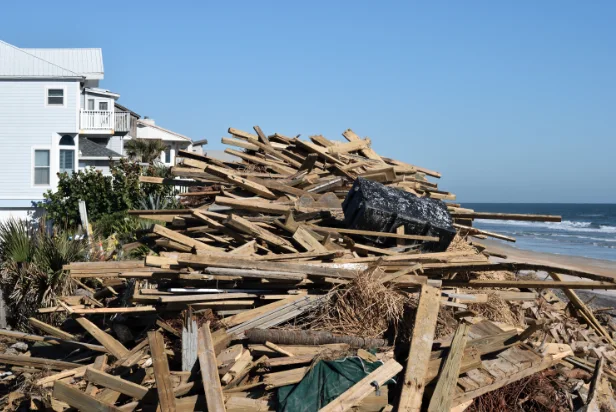
Flood damage is not covered by standard homeowners or renters insurance. Triple-I states that flood damage is excluded under standard homeowners and renters policies, and FEMA says most homeowners insurance does not cover flood damage.
Flood insurance is sold separately through the National Flood Insurance Program, which Congress created in 1968, and by a few private insurers. According to FEMA, NFIP coverage for single-to-four family homes goes up to $250,000 for the building and up to $100,000 for contents, and there is a 30-day waiting period before new policies take effect. NFIP cover is available to anyone living in one of the roughly 22,600 participating NFIP communities.
If your home has already flooded, read what to do after your house floods. If you are buying a home, our guide on how to tell if a house has been flooded before can help.
Does Homeowners Insurance Cover Mold From Water Damage?
Mold is generally not covered by standard homeowners insurance. Triple-I describes mold, like rot and insect infestation, as a home maintenance issue. The exception is mold that results directly from a covered peril: if a burst pipe causes mold, the cost of removing it may be covered.
Speed matters. The US Environmental Protection Agency (EPA) says water-damaged areas and items should be dried within 24-48 hours to prevent mold growth, and recommends keeping indoor relative humidity below 60%, ideally between 30% and 50%. The EPA considers a moldy area of less than about 10 square feet (roughly 3 ft by 3 ft) generally manageable as a do-it-yourself cleanup.
Water Damage Claim Statistics
Water damage is one of the most frequent homeowners insurance claims. The figures below are ISO data for 2019-2023, published by Triple-I. Claim frequency is the number of claims per 100 insured house-years; severity is the average claim cost.
| Cause of loss | Claim frequency (per 100 house-years) | Average claim cost |
|---|---|---|
| Wind and hail | 2.80 | $14,747 |
| Water damage and freezing | 1.50 | $15,400 |
| Fire and lightning | 0.23 | $88,170 |
| Theft | 0.12 | $5,524 |
| All property damage | 5.53 | $16,857 |
By share of claims in 2023, Triple-I reports wind and hail at 42.5%, water damage and freezing at 22.6%, and fire and lightning at 21.6%.
How to File a Water Damage Claim: Step by Step
- Stop the water. Shut off the main water valve or the valve for the failing fixture so the damage does not keep spreading.
- Call your insurer or agent promptly. Triple-I advises contacting your insurance professional immediately and asking about coverage, filing deadlines, deductibles and whether repair estimates are needed.
- Document the damage. Photograph or video the damage before cleanup, and list damaged items.
- Prevent further damage. Triple-I advises taking reasonable steps to protect your property from further damage, such as temporary repairs, while you wait for the adjuster.
- Dry out quickly. Start drying within 24-48 hours, per EPA guidance, to limit mold.
- Keep every receipt. Save receipts for emergency repairs, and for additional living expenses if you must move out during repairs; Triple-I notes most policies cover these costs with proper records.
If a pipe is still leaking or a drain is backing up, see the signs you should call an emergency plumber immediately.
How to Prevent Water Damage
- Washing machine hoses: State Farm reports that a washing machine hose holds about 70 pounds of pressure and a failed hose can release an average of 650 gallons of water per hour. State Farm paid nearly $30 million in 2020 on homeowners claims caused by washing machine hose failures.
- Replace aging hoses: State Farm suggests replacing supply hoses every three to five years; IBHS advises changing washing machine and dishwasher supply hoses that are more than 10 years old.
- Gutters and grading: State Farm recommends clean gutters, downspouts that extend 10 feet from the home, and landscaping that slopes away from the foundation.
- Sump pump: Install a sump pump with battery backup and test it twice a year, per State Farm.
- Annual check-up: Triple-I suggests checking plumbing and heating systems once a year.
For basements that already take on water, our guide to wet basement repair and waterproofing explains the common fixes.
Frequently Asked Questions
Does homeowners insurance cover mold after a burst pipe?
Mold removal may be covered when the mold results directly from a covered peril such as a burst pipe, according to Triple-I. Mold from ongoing humidity or unrepaired leaks is generally excluded as a maintenance issue.
Is a slow leak under a sink covered?
A slow leak under a sink is usually not covered. Triple-I states that seepage is excluded under the HO-3 homeowners policy because it is viewed as a maintenance issue, so small leaks should be repaired as soon as they appear.
Do I need separate flood insurance?
Yes, if you want flood cover. Standard homeowners and renters policies exclude flood damage. Flood insurance is sold through the National Flood Insurance Program and some private insurers, and FEMA says new NFIP policies typically have a 30-day waiting period.
Does homeowners insurance cover sewer backup?
Sewer backup is usually not covered by a standard homeowners policy. According to Triple-I, it must be bought as a separate product or as an endorsement to a homeowners policy, usually at a nominal cost.
How much does the average water damage claim cost?
The average water damage and freezing claim cost $15,400 over 2019-2023, according to ISO data published by Triple-I. Your out-of-pocket cost depends on your deductible and your policy limits.

Justwebworld has published guides since 2012. How we write and update articles Report an error
