The Pomodoro Technique is a simple way to focus: you work on one task for 25 minutes, take a short 5-minute break, and after four rounds you take a longer break. Each 25-minute work block is called a “pomodoro”, which is Italian for tomato.
Francesco Cirillo created it in the 1980s with a tomato-shaped kitchen timer, because he couldn’t focus on his university studies. It is popular with students and remote workers because it turns a big, scary task into small, timed chunks. This guide shows the steps, a sample study schedule, what the research actually says, and how to adjust it if 25 minutes doesn’t suit you.

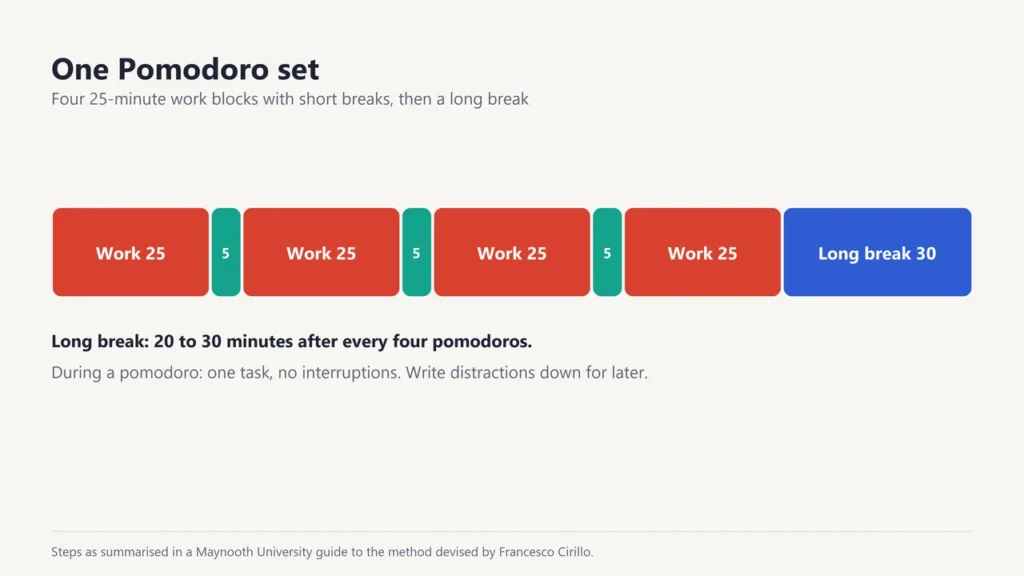
- Work: 25 minutes on one task
- Short break: 5 minutes
- Long break: 20 to 30 minutes after four pomodoros
- One full set: about 2 hours before the long break
- The rule: no interruptions during a pomodoro; write distractions down for later
How the Pomodoro Technique works, step by step
These steps follow the method devised by Francesco Cirillo, as summarised in a Maynooth University study guide.
- Choose one task. Big or small, pick something that deserves your full attention.
- Set a timer for 25 minutes. Promise yourself you won’t interrupt the task until it rings.
- Work until the timer rings. If you remember something else you need to do, write it on paper and carry on.
- Mark a tick on paper. You have finished one pomodoro.
- Take a 5-minute break. Stretch, walk, drink water: do something that isn’t work.
- After four pomodoros, take a longer break of 20 to 30 minutes.
A sample Pomodoro schedule
Here is what one full set looks like if you start studying at 4:00 p.m.
| Time | What you do |
|---|---|
| 4:00 to 4:25 | Pomodoro 1: focused work |
| 4:25 to 4:30 | Short break |
| 4:30 to 4:55 | Pomodoro 2 |
| 4:55 to 5:00 | Short break |
| 5:00 to 5:25 | Pomodoro 3 |
| 5:25 to 5:30 | Short break |
| 5:30 to 5:55 | Pomodoro 4 |
| 5:55 to 6:25 | Long break (30 minutes) |
It is more than a timer
Most apps reduce the method to “work 25 minutes, then rest”. Cirillo himself has pointed out that newspapers, bloggers and apps compressed “a complete system for managing time, focus, and complexity” into that single instruction. The fuller method, taught on the official Pomodoro® site, also includes planning your day’s pomodoros, dealing with interruptions and estimating how many pomodoros a task will take.
Three habits from the fuller method are easy to add:
- Plan in pomodoros. Each morning, list today’s tasks and guess how many pomodoros each needs.
- Protect the pomodoro. If someone interrupts, note it and get back to them after the timer rings.
- Learn from your estimates. If a “2-pomodoro” task took 5, you will plan better next time.

Does the Pomodoro Technique really work?
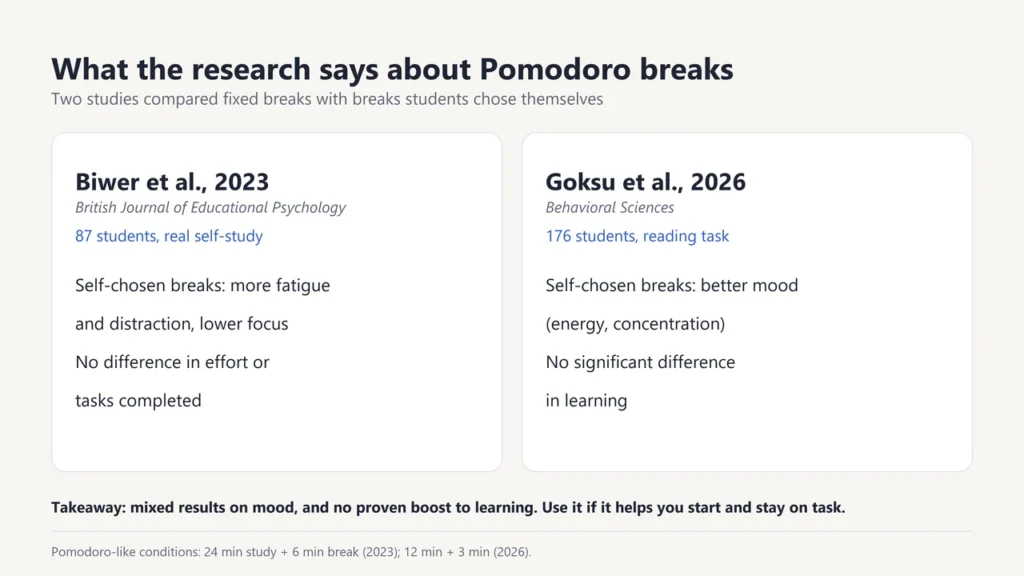
The honest answer is that research is limited and mixed. Two recent studies compared fixed, Pomodoro-style breaks with breaks that students chose for themselves:
- Biwer and colleagues (2023), in the British Journal of Educational Psychology, followed 87 university students during real self-study. Students who chose their own breaks reported more fatigue and distraction and less concentration and motivation than students on fixed schedules, including a Pomodoro-like 24-minute study and 6-minute break plan. There was no difference in mental effort or tasks completed.
- Göksu and colleagues (2026), in Behavioral Sciences, tested 176 students on a reading task. This time, students who chose their own breaks reported better moods, and there was no significant difference in learning between the two approaches.
So the evidence doesn’t show that Pomodoro makes you learn more. Its likely benefit is practical: a fixed schedule means you don’t have to keep deciding when to stop, and the next break is never far away. If it helps you start and keep going, it is working for you.
How to adjust the Pomodoro Technique
Twenty-five minutes isn’t magic. The research above used 24-minute and 12-minute study blocks. Try these changes if the standard timing doesn’t suit you:
| If you… | Try |
|---|---|
| Struggle to start at all | Shorter blocks of 10 to 15 minutes |
| Lose focus just as you get going | Longer blocks of 40 to 50 minutes with a 10-minute break |
| Feel tired after four rounds | A longer long break, or stop after three |
| Get pulled out of deep work by the timer | Finish your current sentence or step before you stop |
Common Pomodoro mistakes
- Checking your phone during a pomodoro. Keep it in another room, or turn on do-not-disturb.
- Working through the breaks. Breaks are part of the method, and skipping them defeats its purpose.
- Spending breaks on social media. Scrolling can easily turn 5 minutes into 20. Stand up and move instead.
- Choosing a vague task. “Study history” is hard to start. “Read chapter 4 and make notes” is easy.
- Giving up after one bad day. Change the timing before you drop the method.

Want more ideas for staying focused? Read is social media killing your focus, our study motivation tips and these time management mistakes to avoid. For a timer, any phone clock works. You can also use the 24-hour clock to plan your study blocks.
Frequently asked questions
What is the Pomodoro Technique in simple words?
Work on one task for 25 minutes without interruption, take a 5-minute break, and after four rounds take a longer break.
Why is it called Pomodoro?
“Pomodoro” means tomato in Italian. Francesco Cirillo used a tomato-shaped kitchen timer when he created the method.
Is the Pomodoro Technique good for studying?
Many students find it helps them start and stay on task. Research hasn’t shown that it improves learning compared with choosing your own breaks, so treat it as a focus tool and adjust it to suit you.
How long is a long break in Pomodoro?
About 20 to 30 minutes, taken after every four pomodoros.
Can I change the 25 minutes?
Yes. Many people use longer or shorter blocks. The key ideas are a fixed work block, no interruptions and a real break afterwards.
How many pomodoros should I do in a day?
There is no fixed number. Start with one set of four, about two hours, and add more sets if you have the energy. Plan your day’s tasks in pomodoros to see how much you can realistically do.