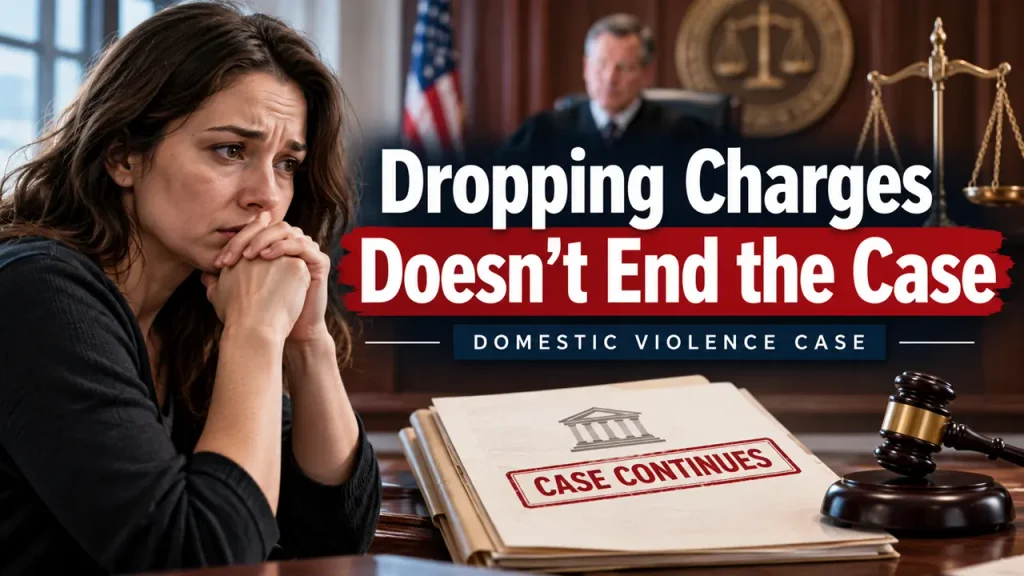
One of the most common and most mistaken beliefs about domestic violence cases is that the accuser controls them. People assume that if the person who called the police has second thoughts — decides it was a misunderstanding, or simply doesn’t want to pursue it — they can “drop the charges” and the matter disappears. In reality, it almost never works that way, and that misunderstanding causes enormous confusion and distress.
Understanding how domestic violence cases actually function, and why the alleged victim can’t unilaterally end them, is essential for anyone involved in or affected by one. The mechanics are counterintuitive, but they’re consistent, and they explain why these cases take on a life of their own.
The state, not the accuser, brings the case
The foundational point is a feature of how criminal law works that surprises almost everyone: criminal charges are brought by the state, not by the individual who called the police.
Once an arrest is made in a domestic violence situation, the case belongs to the prosecutor — representing the state — not to the alleged victim. The accuser is, legally, a witness, not the party in control. That means the decision to continue or dismiss the case rests with the prosecutor’s office, which can choose to proceed even if the accuser has changed their mind. A domestic violence attorney spends a great deal of time explaining this reality to families stunned to learn that wanting to “drop it” isn’t enough.
This single fact reshapes everything about how these cases unfold.
The “no-drop” approach
Many jurisdictions have adopted what are often called “no-drop” policies in domestic violence cases, which formalize the state’s control.
Under this approach, prosecutors are encouraged or expected to pursue domestic violence cases even when the alleged victim recants or wants to withdraw. Florida law reflects this philosophy. Under Florida Statute section 741.2901, domestic violence cases are treated as a serious matter of public policy, and prosecutors handle them with that gravity — not as private disputes to be dropped at the parties’ discretion.
The reasoning behind no-drop policies is rooted in a recognition that accusers sometimes recant under pressure, fear, or financial dependence. Whatever one thinks of the policy, its practical effect is clear: the accuser’s wishes don’t control the outcome.
Why the accuser recants — and why it doesn’t end things
Accusers change their minds for many reasons: reconciliation, financial interdependence, family pressure, fear, or a genuine belief that the situation was overblown. The no-drop approach exists precisely because the system doesn’t want these pressures to automatically defeat prosecution.
So when an accuser tells the prosecutor they don’t want to proceed, the prosecutor doesn’t simply close the file. They may evaluate the other available evidence and decide whether they can proceed without the accuser’s cooperation — which they often can.
How cases proceed without a cooperating accuser
This is the part that most surprises people: a domestic violence case can move forward even if the alleged victim won’t testify or actively wants it dropped.
Prosecutors can build cases on other evidence — police observations, photographs, 911 recordings, medical records, statements made at the scene, and other witnesses. This “evidence-based prosecution” is designed specifically to allow cases to proceed without relying solely on the accuser’s testimony. The result is that recanting doesn’t guarantee dismissal; the case may continue on the strength of everything else.
Understanding this is crucial, because it dispels the dangerous assumption that an accuser’s change of heart makes the whole thing go away for the accused.
What this means for the accused
For someone facing a domestic violence charge, the implications are significant and often misunderstood.
The most important realization is that you cannot rely on the accuser “dropping it” to resolve your case. Even with a sympathetic or recanting accuser, the state may press forward, and the charge carries serious potential consequences — criminal penalties, a permanent record, and collateral effects on employment, housing, firearm rights, and family-law matters like custody. Treating the situation as something that will resolve itself because the other person doesn’t want to pursue it is a serious miscalculation.
This is why experienced legal representation matters from the start, regardless of what the accuser says they want.
The protective order is separate, too
Adding to the complexity, domestic violence situations often involve a protective order (sometimes called a restraining order or injunction), which operates separately from the criminal case.
A protective order can impose conditions — like prohibiting contact or requiring someone to stay away from a residence — independent of whether the criminal charge proceeds or resolves. These orders have their own process and their own consequences for violations. Someone involved in a domestic violence matter may be dealing with both the criminal case and a protective order simultaneously, each on its own track.
Navigating both at once is one more reason these situations call for knowledgeable guidance.
Why the system treats these cases this way
It helps to understand the reasoning, even for those caught up in a case that feels unfair to them. Domestic violence policies reflect a serious societal effort to protect people who may be vulnerable to pressure to recant, and to treat these incidents as matters of public concern rather than purely private disputes.
That policy framework is why the accuser doesn’t control the case and why prosecutors can proceed despite recantation. Whether or not it feels fair in an individual situation, it’s the consistent logic that governs how these cases are handled.
The bottom line
The widespread belief that an accuser can simply “drop the charges” and end a domestic violence case is one of the most consequential misunderstandings in criminal law. In reality, the state controls the prosecution, no-drop policies encourage proceeding despite recantation, and evidence-based prosecution allows cases to continue even without the accuser’s cooperation.
For anyone involved — accused or accuser — the practical lesson is the same: don’t assume the case will disappear because someone wants it to. These matters are serious, they’re controlled by the state, and they warrant prompt, experienced legal guidance precisely because they don’t follow the intuitive logic most people expect.