FIR stands for First Information Report. It is the written record the police make when someone reports a cognizable offence, a serious crime for which the police can arrest without a warrant. In India, FIRs are now registered under Section 173 of the Bharatiya Nagarik Suraksha Sanhita (BNSS), 2023, which replaced the old Code of Criminal Procedure.
The new law, in force from 1 July 2024, also lets you report a crime at any police station, even if it happened somewhere else. This is popularly called a Zero FIR. This guide explains what an FIR is, how to file one, your rights, and what to do if the police refuse. It is general information, not legal advice.
- FIR full form: First Information Report
- Law: Section 173, BNSS 2023 (earlier Section 154 of the CrPC)
- Where: any police station, wherever the crime happened (Zero FIR)
- How: in person, in writing, or by electronic communication
- Your right: a free copy of the FIR
- If refused: write to the Superintendent of Police, then the Magistrate
What is an FIR?
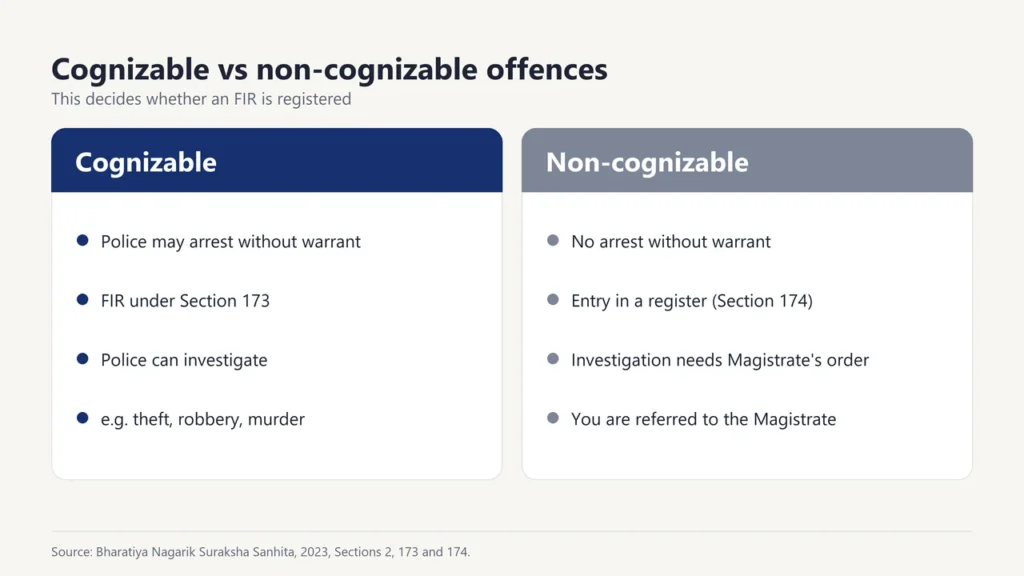
An FIR is the first official step in a criminal case. Once the police record it, they can start investigating. The BNSS defines a cognizable offence as one for which a police officer may arrest without a warrant, such as theft, robbery or murder. For a non-cognizable offence, the police have no authority to arrest without a warrant.
| Cognizable offence | Non-cognizable offence | |
|---|---|---|
| Arrest without warrant? | Yes | No |
| What the police record | An FIR (Section 173) | An entry in a register (Section 174) |
| Investigation | Police can start investigating | Only with a Magistrate’s order |
| Next step for you | Police investigate | Police refer you to the Magistrate |
What is a Zero FIR?
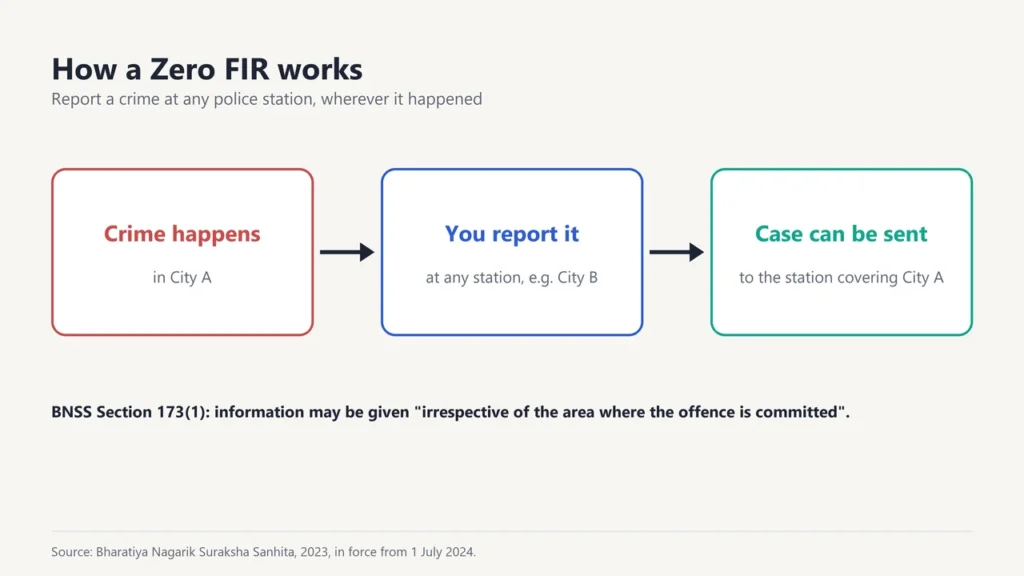
Section 173(1) of the BNSS lets you report a cognizable offence to any police station, “irrespective of the area where the offence is committed”. So you do not have to find the “right” police station first. If you are robbed while travelling, you can report it at the nearest station.
It is called a Zero FIR because the receiving station usually records it as “zero” instead of giving it one of its own case numbers. The case can then be sent to the police station that covers the place of the crime. Zero FIRs existed earlier as a practice, but the BNSS now writes the “any station” rule into the law itself.
How to file an FIR, step by step
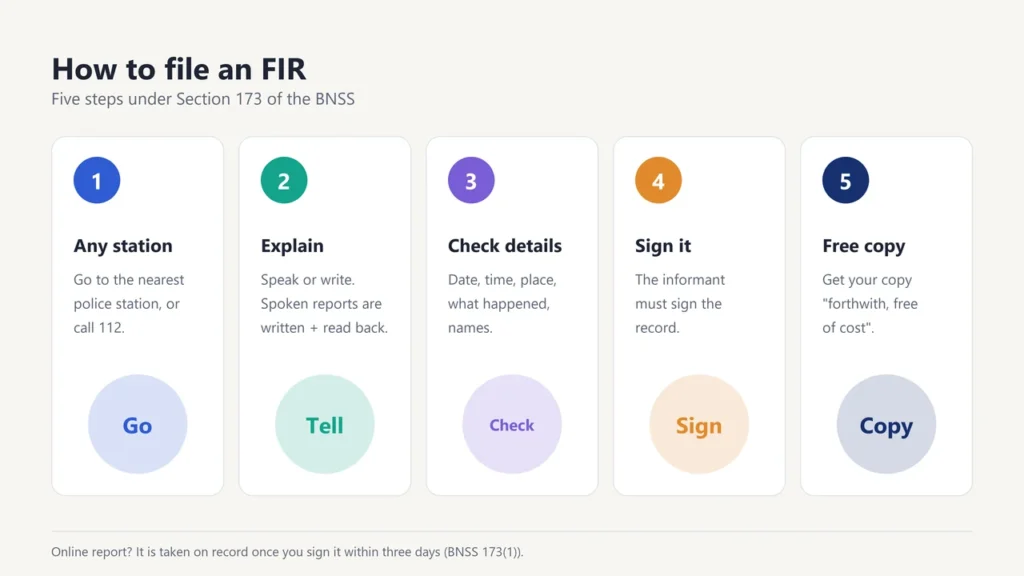
- Go to any police station, or call 112 in an emergency.
- Tell the officer what happened, by speaking or by giving a written complaint. If you speak, the officer must write it down and read it back to you.
- Check the details. Make sure the date, time, place, what happened and any names or descriptions are correct.
- Sign the FIR. The law requires the person giving the information to sign it.
- Take your free copy. Section 173(2) says a copy must be given “forthwith, free of cost” to the informant or the victim.
- Note the FIR number and the police station’s name, so you can follow up.
Can you file an FIR online?
Yes, the BNSS allows information to be given “by electronic communication”. But there is a condition: it is taken on record once the person giving it signs it within three days. Many states run online police portals for this. For online financial fraud, the Ministry of Home Affairs runs the national helpline 1930 and the National Cyber Crime Reporting Portal, cybercrime.gov.in.
Your rights when filing an FIR
- Report anywhere: any police station must take information about a cognizable offence.
- Free copy: you get a copy at no cost.
- Read back: a spoken complaint must be written down and read over to you.
- Women officers for some offences: some crimes against women, such as sexual offences, must be recorded by a woman police officer or woman officer.
- Help for people with disabilities: for these offences, if the victim has a disability, the police must record the information at the victim’s home or a place they choose. An interpreter or special educator must be present, and it must be video-recorded.
What if the police refuse to register your FIR?
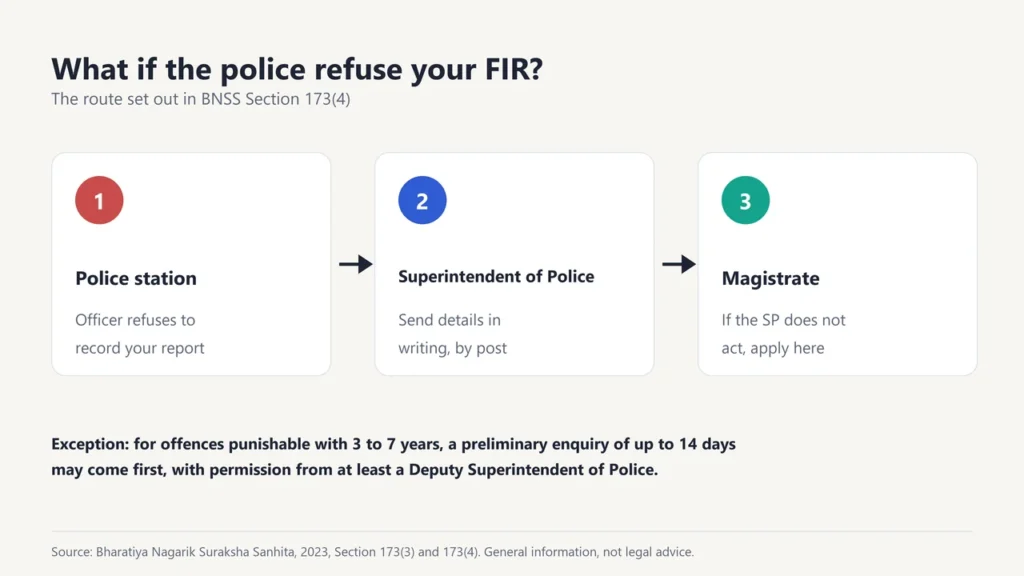
Section 173(4) gives you a way forward. If the officer refuses to record your report, write down what happened and post it to the Superintendent of Police (SP). If the SP is satisfied that it shows a cognizable offence, the SP must investigate or order an investigation. If that also fails, you can apply to the Magistrate.
There is one exception to know about. Some offences carry a punishment of three to seven years. For these, the police may first hold a preliminary enquiry of up to 14 days to check if there is a real case. They need permission from a senior officer, at least a Deputy Superintendent of Police, to do this.
FIR vs complaint: what’s the difference?
In everyday speech, people use “complaint” for any report to the police. In law, the BNSS uses “complaint” for an allegation made to a Magistrate, orally or in writing, asking them to take action. An FIR is recorded by the police. For a non-cognizable offence, the police note it in a register and refer you to the Magistrate.
FIR full form in Hindi
FIR का फुल फॉर्म First Information Report है। हिंदी में इसे प्रथम सूचना रिपोर्ट कहते हैं। यह वह लिखित रिपोर्ट है जो पुलिस किसी संज्ञेय अपराध की जानकारी मिलने पर दर्ज करती है। In English: an FIR is the written report the police record when they learn about a cognizable offence.
Worried about online fraud? Read our guide to two-factor authentication to protect your accounts, and how safe your data is online.
Frequently asked questions
What is the full form of FIR?
First Information Report. In Hindi, it is प्रथम सूचना रिपोर्ट.
Under which section is an FIR registered now?
Section 173 of the Bharatiya Nagarik Suraksha Sanhita, 2023, in force from 1 July 2024. Before that, it was Section 154 of the Code of Criminal Procedure.
Can I file an FIR at any police station?
Yes, for a cognizable offence. Section 173 allows information to be given “irrespective of the area where the offence is committed”. This is known as a Zero FIR.
Is there a fee to file an FIR?
No. Filing an FIR is free, and the law says you must get a copy free of cost.
How long do I have to sign an online FIR?
Under the BNSS, an online report counts once you sign it within three days.
What can I do if the police refuse to write my FIR?
Send the details in writing, by post, to the Superintendent of Police. If that doesn’t work, you can apply to the Magistrate. A lawyer can help you with the next steps.