

Valves are any devices that control passages of fluid through a pipe. Some valves differ in structures but to compare globe valve vs ball valve, they mainly differ in the way they close.
The main difference between a globe valve and a ball valve is how they control flow. A ball valve turns a ball with a hole 90 degrees for tight on-off shutoff with little pressure drop. A globe valve moves a plug or disc up and down, so it regulates flow better but causes a higher pressure drop.
Key takeaways
- Ball valves are rotational valves: a stem turns a ball 90 degrees to open or close the flow.
- Globe valves are stroke valves: a stem moves a plug or disc in a linear motion.
- Ball valves are best for on-off service, while globe valves are best for regulating flow.
- Ball valves close without much pressure drop, while globe valves have a high pressure drop.
- A ball valve’s handle lines up with the flow when open and sits across it when closed.
Ball valves have so-called “rotational” valves. It’s a stem and ball that turns horizontally. They suit best on applications that require on and off control without pressure drop.
Globe valves, on the other hand, have a stem and plug which strokes linearly. It’s otherwise known as stroke valves. They’re best used for regulating flow.
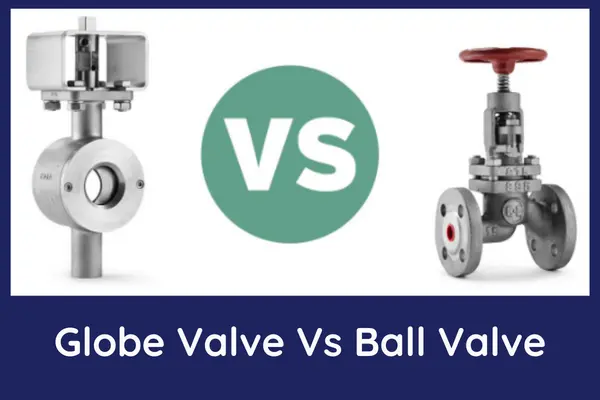
Different types of valves have different applications. Since we need them for different applications, it’s best for us to learn about the difference between ball valves and globe valves.
Ball Valve’s Work
A ball valve works by rotating a ball with a hole through it to open or block the flow. These valves’ design is durable. They have a ball inside the valve (a.k.a floating ball) that serves as a pivoting ball. It controls any liquid flowing through its hole.
The ball valve opens when the ball’s hole is in line. It closes when the valve handles pivot to 90 degrees. When open, the handle is flat and aligned with the flow and perpendicular to it when closed. This is how you visually confirm the valve’s status.
It has an excellent shutoff that lasts for years. It’s very cost-effective. They are generally preferred over globe valves in terms of shutoff applications. Unfortunately, the ball allows a large amount of flow, giving a limitation in proportional control.
For a medical plastics manufacturer who ensures the quality of production, it’s best to include planning about the kind of valves in the warehouse. When you upgrade equipment every 3 to 5 years, make sure you won’t skip a part.
Globe Valve’s Work
A globe valve works by moving a plug or disc up and down inside the valve body to control the flow. These valves are considered the industry standard in control valves for many years. They got such a name because of their spherical shape.
An internal baffle separates two halves of the body. The opening part is where a movable plug can be screwed.
Automated globe valves don’t usually use threaded stems. Instead, they use smooth stems. They are opened and closed by an actuator assembly.
Globe valves are designed with a stem. It moves up and down inside the valve to control the flow of liquid.
Usually, globe valves are used on hot and chill water coils. They are also used on larger models to control the flow of chillers. Its close-off rating can be lower than other valves which serve as its main limitation.
Speaking of control, it’s competitive enough for engine parts manufacturers to be able to control the quality of their products. This is the job of globe valves in a manufacturing scenario. It serves as the controller of what goes through the pipe.
More Significant Differences
Ball valves perform well. They are durable and reliable. After how many cycles, they still perform well and close securely even if you don’t use them for long periods. On the other side, ball valves lack control over the amount of liquid or gas flow that globe valves offer.
When we talk about the durability of a ball valve, it’s best compared to the sustainability of a glass soda bottle. It’s reusable and lasts for a long time too.
In choosing a valve, it’s best to understand the requirements first. Ball valves and globe valves have different purposes. Understanding both will let you decide easily which to choose.
Both valves are commonly used in plumbing systems. They have their own strengths and weaknesses which will further help you in choosing the right one. Let’s take a closer look at their differences:
- A ball valve has a ball and stem. The stem is rotated to open or close the valve inside. The globe valve has a stem and disc. Turning the handwheel moves the disc up or down to open or close the valve in a linear motion.
- Ball valves are also called rotational valves. Globe valves are also known as stroke valves.
- Globe valves are the ones considered the industry standard. Ball valves are considered to be an improved version of globe valves.
- Ball valves are used because of their on and off services while globe valves are used for flow regulation.
- Ball valves close without any pressure drop while globe valves have a high-pressure drop.
- There are instances when the flow should be closed for a long time. Ball valves are best suited for this kind of purpose. For systems where flow is strictly regulated, globe valves are highly recommended.
- If talking about temperature applications, you better use ball valves in high pressure and temperature. Then, use a globe valve in low to moderate pressure and temperature.
- Ball valves have lesser weight than globe valves.
- Ball valves are known to be more durable and long-lasting than globe valves.
- Ball valves obstruct small portions of fluid while globe valves can obstruct a large part of it.
- Ball valves make less noise while globe valves become noisy when used for a longer period.
- Globe valves have greater control over throttling compared to ball valves.
Conclusion
Ball valves are durable and reliable. They are the kind of valves that last for a long time. Globe valves are still the same but they’re made to serve greater purposes such as being constantly used for a regular flow of liquid or gas.
Both are useful, as are other designs such as double-check valves. It’s just that they serve better in specific applications. It’s up to your final decision which best suits your need.
Frequently Asked Questions
What is the main difference between a globe valve and a ball valve?
A ball valve turns a ball a quarter turn for on-off control, while a globe valve moves a plug up and down to regulate flow.
Can a ball valve be used to control flow?
Only roughly. A ball valve lets a large amount of flow through, which limits proportional control, so a globe valve is the better choice for throttling.
Which valve has a lower pressure drop?
A ball valve does. It opens and closes with little pressure drop, while a globe valve has a high pressure drop because of its internal design.
How can you tell if a ball valve is open?
Look at the handle. When the valve is open, the handle lines up with the flow; when it is closed, the handle sits at 90 degrees across it.
What valve is best for shutoff?
Ball valves are generally preferred for shutoff because they seal well, last for years and still close securely after long periods without use.

Justwebworld has published guides since 2012. How we write and update articles Report an error
