

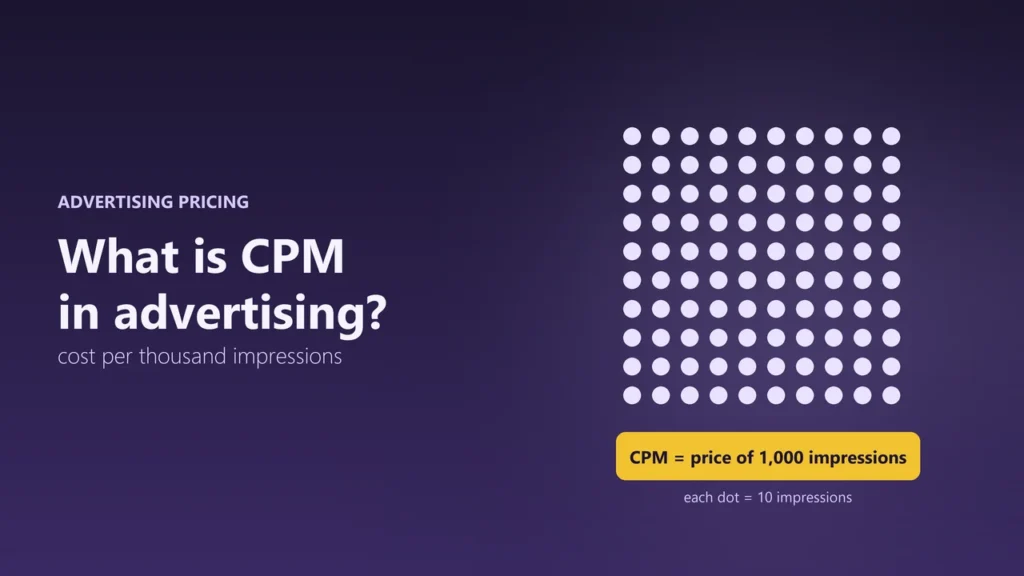
CPM in advertising means “cost per mille”, or cost per thousand impressions. It is the price an advertiser pays for an ad to be shown 1,000 times. “Mille” is Latin for thousand. The formula is simple: CPM = (total cost ÷ impressions) × 1,000.
For example (made-up numbers), if a campaign costs 300 in any currency and the ad is shown 100,000 times, the CPM is 300 ÷ 100,000 × 1,000 = 3. This guide explains how CPM works, how it compares with CPC, CPA and CPV, what “viewable CPM” means, how publishers see the same number as RPM, and how to use CPM to plan a budget.
What does CPM mean?
CPM is a way to price ads by how often they are shown, not by what people do after they see them. Each time an ad loads on a screen, that is one impression. CPM is the price of 1,000 of those impressions.
Google Ads describes CPM bidding as “a way to bid where you pay per one thousand views (impressions)” on the Google Display Network. Social media platforms, news sites, podcasts, TV and even billboards use the same idea. The difference is how each one counts an “impression”.
- Websites and apps: an impression is counted when the ad is served or shown on a page or screen.
- Video: each platform sets its own rule for when a video ad impression or view counts, so check the platform’s help pages.
- Programmatic ads: these are bought automatically by software through ad auctions, such as the Google Display Network ad auction. Display bids there can be set per 1,000 viewable impressions (vCPM).
- TV, radio, podcasts and billboards: the CPM idea is the same, but the way “impressions” are counted varies, so ask the seller how they were measured.
Because of this, a CPM on one channel is not always comparable with a CPM on another. Always ask how impressions are counted.
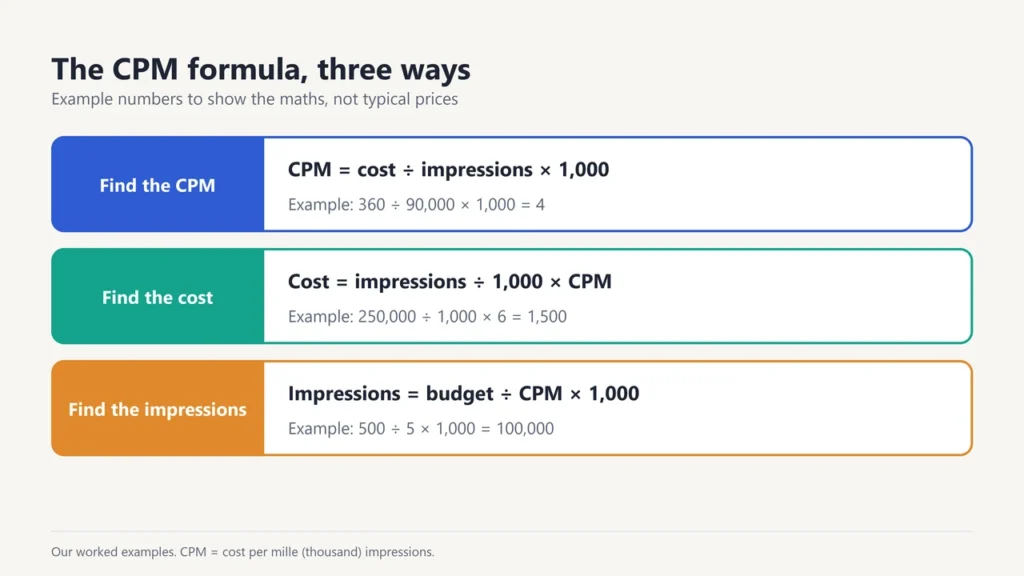
The CPM formula, with examples
There are three versions of the same formula. You only need the one that answers your question.
| What you want to know | Formula |
|---|---|
| The CPM | CPM = (cost ÷ impressions) × 1,000 |
| The total cost | Cost = (impressions ÷ 1,000) × CPM |
| How many impressions a budget buys | Impressions = (budget ÷ CPM) × 1,000 |
Example 1: find the CPM. A banner costs 360 for a month and is shown 90,000 times. CPM = 360 ÷ 90,000 × 1,000 = 4.
Example 2: find the cost. You want 250,000 impressions at a CPM of 6. Cost = 250,000 ÷ 1,000 × 6 = 1,500.
Example 3: find the impressions. You have a budget of 500 and a CPM of 5. Impressions = 500 ÷ 5 × 1,000 = 100,000.
These are made-up numbers to show the maths, not typical prices. Real CPMs change a lot with the country, the audience, the ad format, the season and the site.
CPM vs CPC vs CPA vs CPV
CPM is one of several ways to pay for ads. The main difference is what you pay for.
| Model | You pay for | Best when you want |
|---|---|---|
| CPM (cost per mille) | Every 1,000 impressions | People to see your brand or message |
| CPC (cost per click) | Each click on the ad | Visits to your website |
| CPA (cost per action) | Each sale, sign-up or other action | Results you can count as sales or leads |
| CPV (cost per view) | Each video view, by the platform’s rules | People to watch a video |
A few details from Google’s own help pages:
- CPC. With CPC bidding you pay for each click. You set a maximum CPC, and “you’ll often be charged less”.
- CPV. On YouTube, a view is counted by format. For in-stream ads it is when someone watches 30 seconds (or the whole ad if it is shorter) or interacts with it, whichever comes first.
Which one is cheaper?
None of them is always cheaper. A low CPM can still be expensive if almost nobody clicks or buys. A high CPC can be cheap if the clicks turn into sales. Compare models by what you actually get for your money, such as the cost per sale or sign-up.
How to compare CPM with CPC (effective CPM)
To compare a CPC deal with a CPM deal, turn the CPC into an “effective CPM” (eCPM). You need the click-through rate (CTR), which is the share of impressions that get a click.
eCPM = CPC × CTR × 1,000
For example, if you pay 0.50 per click and 0.4% of people click (CTR = 0.004), the eCPM is 0.50 × 0.004 × 1,000 = 2. So that CPC deal costs the same as paying a CPM of 2. Again, these are example numbers.
You can turn it round the other way too. If you pay a CPM of 4 and your CTR is 0.5%, each click costs you 4 ÷ (0.005 × 1,000) = 0.80.
What is viewable CPM (vCPM)?
Not every impression is seen. An ad can load at the bottom of a page that the reader never scrolls to. Viewable CPM fixes this by charging only for impressions that could be seen.
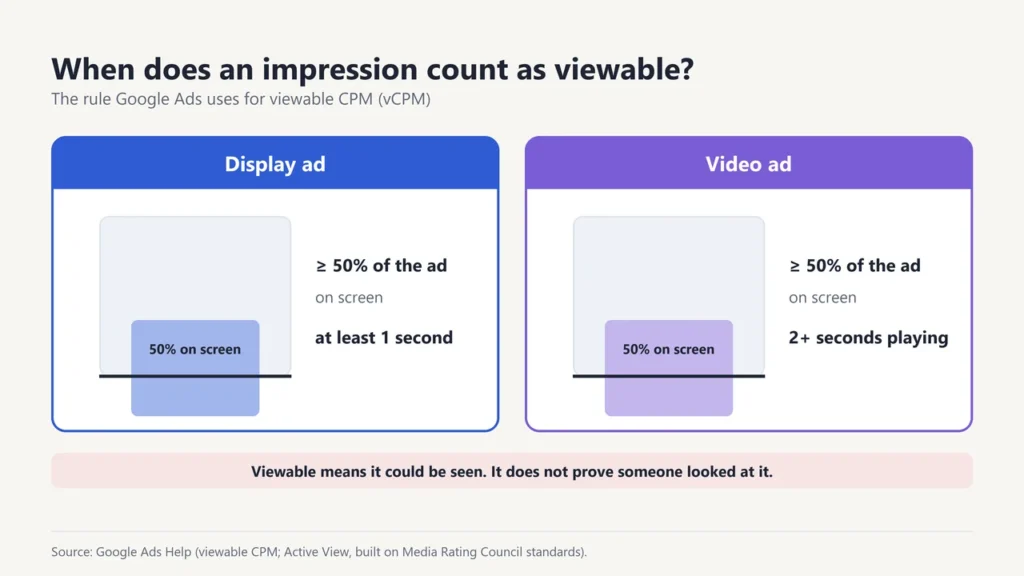
Google Ads says an ad is counted as “viewable” when 50 percent of it shows on screen for 1 second or longer for display ads, or plays continuously for 2 seconds or longer for video ads. Google says its Active View metrics follow standards developed by the Media Rating Council (MRC), a US industry body.
Two things follow from this:
- A vCPM bid may need to be higher than a plain CPM bid, because you only pay for the impressions that count as viewable. Google notes that your vCPM bid “might need to be higher” than a standard CPM bid to keep the same costs and reach.
- Google Ads says “Max. CPM is no longer available as a bid strategy”. Google also says existing CPM bids are converted to viewable CPM automatically.
Even viewable does not mean “looked at”. Google itself says Active View can tell you when ads are viewable, but it can’t guarantee that a person looked at the ad.
CPM vs RPM: the publisher’s side
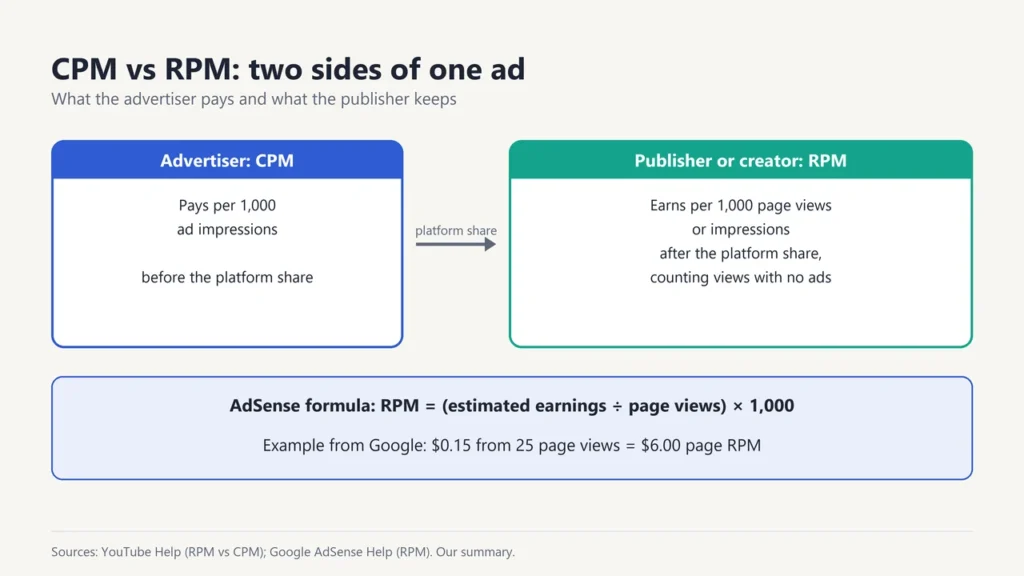
Advertisers talk about CPM. Publishers and creators often look at RPM, “revenue per mille”, which is how much they earn per 1,000 page views or impressions.
Google AdSense gives this formula: RPM = (estimated earnings ÷ number of page views) × 1,000. Its example: estimated earnings of $0.15 from 25 page views give a page RPM of $6.00.
YouTube explains why RPM is lower than CPM for creators:
- CPM is the cost per 1,000 ad impressions before YouTube’s revenue share.
- RPM is the creator’s total revenue, after YouTube’s share, per 1,000 views. It also counts views that showed no ads.
So the same campaign has two numbers: what the advertiser pays (CPM) and what the publisher keeps per 1,000 views (RPM). Some publishers and ad networks also use “eCPM” for what they earn per 1,000 impressions, so always check which side a number comes from. If you run a blog and want to learn about networks that pay by impressions, see our guide to CPM ad networks for blogs.
When does CPM make sense?
CPM pricing suits some goals better than others.
- Good fit: launching a brand, a new product or an event, where you want many people in the right audience to see the name.
- Good fit: retargeting people who already know you, where seeing the ad again matters more than a click.
- Weaker fit: direct sales from a cold audience. Here, CPC or CPA often makes it easier to see what you get.
How to use CPM to plan a budget
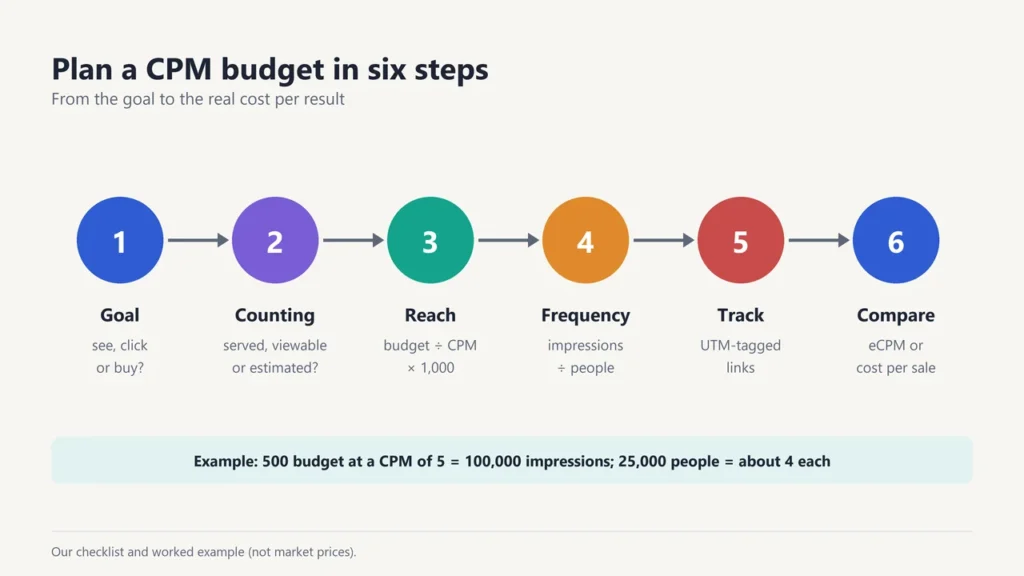
- Pick the goal. Seeing, clicking or buying? This tells you whether CPM is the right model at all.
- Ask how impressions are counted. Served, viewable, or estimated? Ask for a report you can check.
- Work out reach. Use Impressions = (budget ÷ CPM) × 1,000.
- Check frequency. Impressions are not people. If 100,000 impressions reach 25,000 people, each person saw the ad about 4 times on average.
- Track what happens next. Add UTM tags to your links and watch visits, sign-ups and sales, so you can work out the real cost per result.
- Compare fairly. Turn every offer into the same unit (eCPM, or cost per sale) before you choose.
On blogs and news sites, CPM is common for banners. Many direct deals use a flat fee instead. Our guide on how to advertise on blogs shows how to turn a flat fee into a CPM so you can compare offers. If you are paying for an article rather than a banner, read what is sponsored content for the labelling rules. For coverage you do not pay for, see how to get media coverage.
Common CPM mistakes
- Comparing CPMs from different channels as if they were the same. A podcast or TV CPM may count impressions in a different way from a viewable display CPM, so ask the seller.
- Judging a campaign by CPM alone. A cheap CPM with no results is not a good deal.
- Forgetting frequency. Showing the same ad 20 times to the same person can waste money.
- Not asking about viewability and invalid traffic. Ask what share of impressions were viewable, and how bots and fake traffic are filtered out.
- Treating example rates as real prices. Ask each seller for their real rate and terms in writing.
Frequently asked questions
What does CPM stand for?
CPM stands for “cost per mille”, which means cost per thousand impressions. “Mille” is Latin for thousand. It is sometimes written as “cost per thousand”.
Is a lower CPM always better?
No. A lower CPM means each impression costs less, but it does not tell you whether the right people saw the ad or did anything. Compare offers by cost per result, such as cost per sign-up or sale.
What is a good CPM?
There is no single good CPM. It changes with the country, the audience, the ad format, the platform and the time of year. Compare a CPM with offers for the same audience and format, and judge it by the results it brings.
What is the difference between CPM and RPM?
CPM is what an advertiser pays per 1,000 impressions. RPM is what a publisher or creator earns per 1,000 page views or impressions. On YouTube, RPM is lower than CPM because it is counted after YouTube’s revenue share and includes views that showed no ads.
What is CPM on YouTube?
On YouTube, CPM is the cost per 1,000 ad impressions before YouTube’s revenue share, as YouTube explains in its help pages. YouTube Analytics also shows a “playback-based CPM”: the cost per 1,000 video playbacks that showed at least one ad. It is often higher than CPM, because one video can show more than one ad.
Does CPM include clicks?
No. With CPM you pay for impressions whether people click or not. If you only want to pay for clicks, use CPC pricing.
How do I calculate CPM in Excel or Google Sheets?
If the cost is in cell A2 and the impressions are in B2, type =A2/B2*1000. To find impressions from a budget, use =A2/C2*1000, where C2 holds the CPM.
Can I buy ads on Justwebworld?
Yes. See the box below or the Advertise page; pricing is on request, and we never promise backlinks, rankings or traffic.
Want to reach Justwebworld readers?
Justwebworld is a digital magazine that has published since December 2012, with 8,000+ articles across 20 topics and a public editorial policy. We offer sponsored articles, product reviews, banner placements and newsletter sponsorship. Pricing is on request, and the team usually replies within 24-48 hours. We never promise backlinks, rankings or traffic. See Advertise with Justwebworld for the details. Expert writers can see Write for Us; free guest posting is closed.

Justwebworld has published guides since 2012. How we write and update articles Report an error
