

To get media coverage, give a journalist a real story that their readers care about, send it to the right person at the right time, and make their job easy. That means a clear news angle, a short pitch email to a reporter who covers your topic, facts they can check, and someone ready to talk. You cannot buy news coverage. If you pay for a placement, it is advertising, and readers must be able to tell that it is paid.
This guide is for founders, small businesses, marketers, PR teams and event organisers. It shows how to find a story, who to pitch, what to write, how interviews work, what to avoid, and how to measure the result honestly.
What counts as media coverage?
Media coverage is when a news site, magazine, TV or radio show, podcast or newsletter talks about you because its editors chose to. Nobody paid for that choice. This is often called “earned media”. It is different from content you pay for or content you own.
| Type | Who decides what runs | Example |
|---|---|---|
| Earned media (coverage) | The journalist and editor | A local paper writes about your new clinic |
| Paid media (advertising) | You, because you paid | A sponsored article or a banner on a news site |
| Owned media | You | Your blog, newsletter or social account |
All three can work together. But only earned media carries the trust that comes from an outside editor choosing your story. That trust is also why you cannot pay for it.
What makes a story newsworthy?
A story is newsworthy when it is new, true and matters to a specific group of readers. “We launched a website” is rarely news. “The first repair shop in the city that fixes e-bike batteries” might be, for a local outlet.
Before you pitch, check your idea against these questions:
- Is it new? A first, a change, a launch, a result or a decision.
- Is it timely? It links to something happening now: a season, a law change, an event or a trend in the news.
- Who cares? Name the readers: parents in one city, nurses, gamers, small shop owners.
- Is there proof? Your own data, a customer story, a photo or a demo that a reporter can check.
- Is there a person? Journalists need someone to quote: a founder, an expert, a customer.
- Can you say it in one sentence? If you can’t, the reporter can’t either.
If the answer to most of these is “no”, work on the story before you write the pitch. Sometimes the best move is to wait until you have a real result to share.
Step 1: Find the right outlet and the right reporter
Coverage starts with the right match. A great pitch sent to the wrong person goes nowhere.
- Start with outlets your customers read. A small trade magazine or local news site can matter more than a big national name.
- Find the reporter, not just the outlet. Read their last few articles. Note the topics they cover (their “beat”).
- Look for a gap. If a reporter wrote about a problem last month, you may have a useful update, data or a new angle.
- Keep a short list. Ten well-matched reporters beat 500 random email addresses.
Many outlets list a news desk or tips email on their contact page. Use it for local news and events. For features, a named reporter who covers your topic is usually better.
Step 2: Shape the angle
The angle is the reason this story matters to this outlet’s readers today. The same company can have different angles for different outlets.
For example, a small bakery that switched to compostable packaging could pitch:
- a local paper: “Neighbourhood bakery cuts its plastic waste and shares what it cost”;
- a food trade magazine: “What switching packaging did to a small bakery’s costs and sales”;
- a business podcast: “How a five-person bakery runs a supplier change”.
Each angle needs facts behind it. Only share numbers you can show if asked.
Step 3: Prepare a simple press kit
A press kit (or media kit) is a page or folder with everything a reporter needs. It saves them time, and it shows you are ready.
- A short fact sheet: who you are, what you do, where, since when, and the key facts of this story.
- Two or three good photos that you own or have the right to share, with captions and a photo credit.
- A short bio of the person who will speak, and how to reach them.
- Any data you mention, with how you collected it.
- Your logo, if a reporter needs it.
Step 4: Write a short pitch
A pitch is a short, personal email that offers a story. Keep it under about 200 words. Put the story first and your company second.
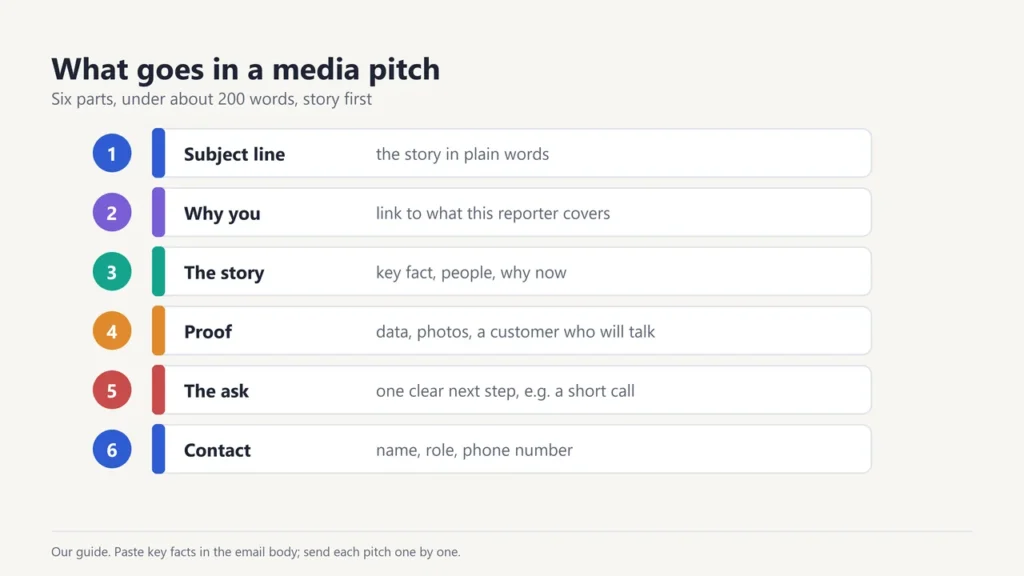
- Subject line: the story in plain words, not “Press release” or “Partnership opportunity”.
- Opening line: why this is relevant to the reporter, for example a link to what they covered recently.
- The story: two or three sentences with the key fact, the people and why it matters now.
- Proof: what you can share, such as data, photos, a demo or a customer who will talk.
- The ask: “Would you like the full data or a 15-minute call with our founder this week?”
- Contact: your name, role and phone number.
Paste the key facts into the email body. Some people do not open attachments from strangers. Send each pitch one by one, with the reporter’s name and a reason it suits them. A mass email that starts “Dear Sir/Madam” is easy to ignore.
Example pitch
Subject: Local bakery cut plastic waste by switching packaging: owner will share costs
Hi Priya, I read your piece last week on plastic bans for small shops. Our bakery in Riverside switched all takeaway packaging to compostable boxes in June. The owner, Sam Lee, can share what it cost, what customers said and what she would do differently. We have before-and-after photos and our supplier invoices to back the numbers. Would a short call on Thursday or Friday help? Alex Kim, Manager, Riverside Bakery, 555-0134.
(The names, place and phone number in this example are made up to show the format.)
Step 5: Time it well and follow up once
- Give enough notice. For an event, send a media advisory several days ahead, then a short reminder the day before.
- Avoid busy moments. A big breaking story can bury your pitch. If that happens, wait and try again.
- Embargoes. An embargo means “please don’t publish before this date and time”. Ask first (“Would you accept this under embargo until Tuesday 9:00 GMT?”) and only share it if the reporter agrees.
- Exclusives. Offering one outlet the story first can help. If you promise an exclusive, keep the promise.
- Follow up once. If there is no reply after a few working days, send one short, polite follow-up. Then move on.
How do media interviews work?
When a reporter says yes, you will usually do an interview by phone, video or email. Agree the ground rules before you start, not after you have said something.
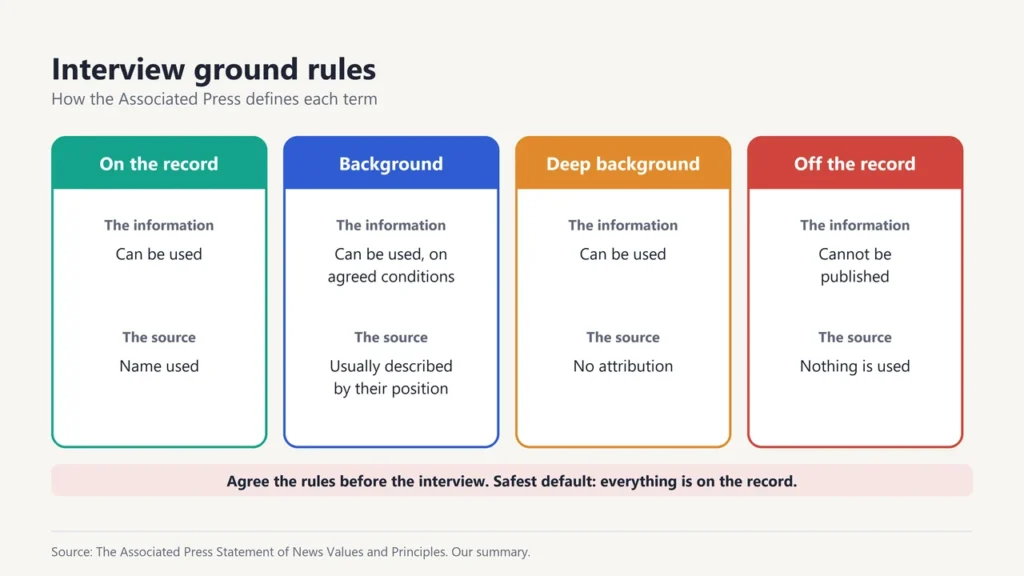
The Associated Press (AP), the global news agency, uses these definitions in its Statement of News Values and Principles. AP also notes that people do not all use these terms the same way, so before any interview where a source wants to stay unnamed in any way, it asks reporters to agree the ground rules clearly first:
| Term | What AP says it means |
|---|---|
| On the record | The information can be used, quoting the source by name. |
| Off the record | The information cannot be used for publication. |
| Background | It can be published under conditions agreed with the source. Sources usually do not want their name used but will agree to a description of their position. |
| Deep background | It can be used, but without attribution. The source is not identified in any way. |
Other outlets may use slightly different wording, so ask the reporter what they mean. AP itself tells its reporters to assume interviews are on the record. That is a safe rule for most businesses too.
Tips for the interview:
- Prepare three key points and one example for each.
- Answer the question asked, in short sentences.
- If you don’t know, say so and offer to send the answer later.
- Send any promised data or photos quickly.
- Do not ask to approve the article before it runs. Many outlets will not agree to this. You can offer to check facts or numbers.
What to avoid
Some common habits make coverage less likely, or put your name at risk.
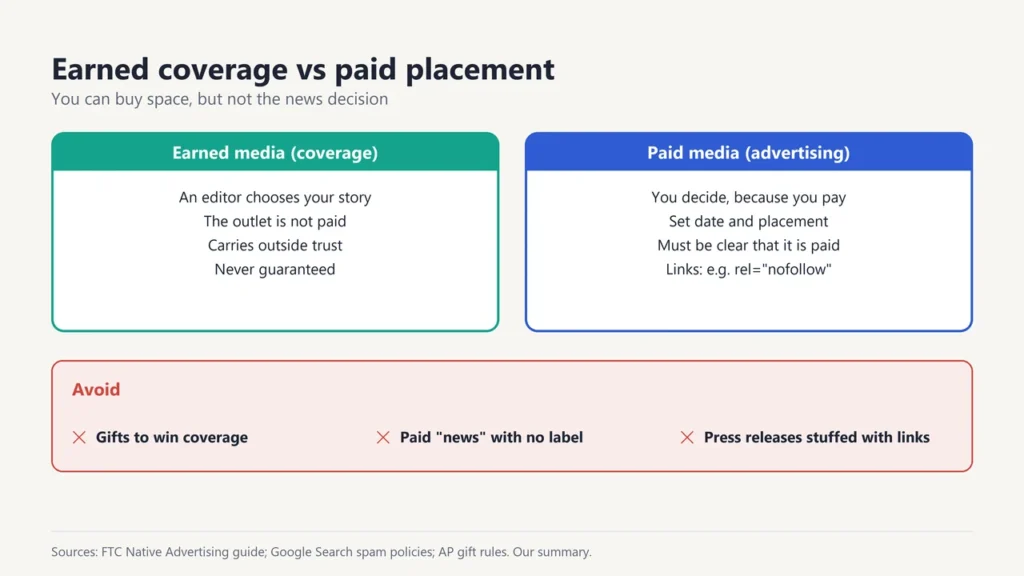
- Gifts to win coverage. Many newsrooms have strict rules. The AP statement says its staff cannot accept gifts from sources or PR agencies, except small items like caps or mugs worth about $25 or less. A gift can look like a bribe, even when you mean it as thanks.
- Paying for “news”. If you pay to appear, it is an ad. In the US, the Federal Trade Commission’s guide on native advertising says it is deceptive to mislead people about the commercial nature of content. Its watchword is “transparency”. In the UK, the CAP Code says marketing must be obviously identifiable as marketing. Our guide to what sponsored content is explains how paid articles should be labelled.
- Press releases stuffed with links. Google’s spam policies list “links with optimized anchor text in articles, guest posts, or press releases distributed on other sites” as link spam. Google says paid links are fine when they are qualified, for example with rel=”nofollow”, so they do not pass ranking credit. Write releases for people. If you want to learn more about how links work, see our guide to anchor text.
- Claims you cannot prove. “Award-winning” or “the best in the country” need evidence. Reporters check, and a false claim can end the story and the relationship.
- Pitching everyone at once. Untargeted lists waste your time and theirs.
How to get media coverage for a startup or small business
A new company has one big advantage: it can be the first to do something. Use it, but only with facts you can show.
- Lead with real news: a launch, funding you can name on the record, a first customer in a new market, or a result you measured.
- Tell the founder story briefly. Why you started, and the problem you saw. Reporters still need the news first.
- Share your own data. A short survey of your customers or numbers from your product can give a reporter something new. Explain how you collected it.
- Start with trade, local and niche outlets. They are more likely to cover a small company, and their readers are often your customers.
- Try newsletters and podcasts in your field. Many look for founders and experts to interview.
How to get media coverage for an event
For an event, the main tool is a media advisory. It is a short note, sent before the event, that answers who, what, when, where and why. It also says what reporters can film or photograph.
- Put the date, time, full address and a contact phone number at the top.
- Say what is visual: a demo, a performance, a big crowd, a famous guest.
- Say whether reporters need to register, and where to park or check in.
- Have someone ready on the day to greet media and set up interviews.
- After the event, send good photos and a short summary to outlets that could not come.
Paid options when coverage is not enough
Earned coverage is never guaranteed. Some brands add paid placements, such as a sponsored article, a product review or a newsletter slot, so they can reach readers on a set date. That is fine if readers can tell it is paid and the publisher keeps its editorial standards.
Two of our guides explain how this works: how to advertise on blogs and how to get your product reviewed. If you are thinking about writing for other sites, see is guest posting worth it?
How to measure media coverage honestly
Measure what the coverage did, not just how many articles appeared.
- Count the coverage. Outlet, date, headline, reporter, and whether your key message was in it.
- Check quality. Was the outlet read by your customers? Were you quoted correctly?
- Track action. Use links with UTM tags in your own posts about the coverage, and watch referral visits, sign-ups, sales or calls in your analytics. A tracking tool from our list of content marketing tools can help.
- Note what changed. New partners, investors, job applicants or customer questions that mention the article.
Some people quote an “advertising value equivalent” (AVE): what the same space would cost as an ad. AMEC, the international association for the measurement and evaluation of communication, runs a campaign called “Say No to AVEs”. AMEC also promotes the Barcelona Principles (version 4.0 when we checked), a set of industry principles for measuring communication. Use outcomes you can show instead.
Quick checklist
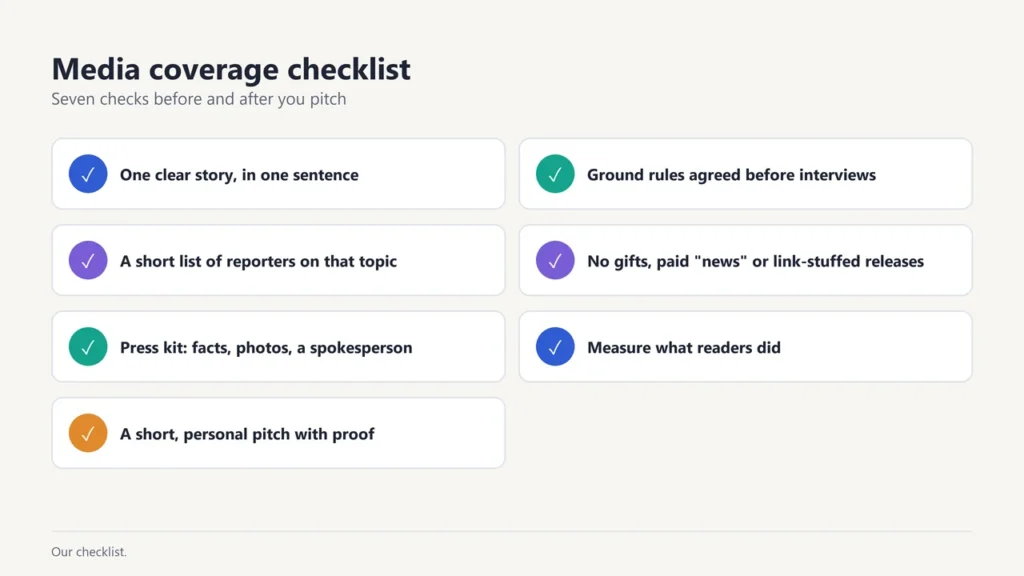
- One clear story, in one sentence.
- A short list of reporters who cover that topic.
- A press kit with facts, photos and a spokesperson.
- A short, personal pitch with proof and a clear ask.
- Ground rules agreed before any interview.
- No gifts, no paid “news”, no link-stuffed releases.
- Results measured by what readers did.
Frequently asked questions
How long does it take to get media coverage?
It can take one email or several months. A strong local story can be covered within days. Coverage in big national outlets usually takes longer and often needs a stronger story, data or a relationship with a reporter.
Can you get media coverage for free?
Yes. Earned coverage is free in the sense that you do not pay the outlet. It still costs time to build the story, the press kit and the pitch. Some people hire a PR agency or freelancer to help, which costs money, but the outlet itself is not paid.
Does a press release get you coverage?
A press release on its own rarely gets coverage. It works best as a reference document behind a personal pitch, or for formal news such as results, a merger or a public notice. A short pitch to the right reporter usually matters more.
How do I get media coverage for EB-1A?
For the US EB-1A visa, the USCIS Policy Manual lists published material about you and your work, in professional or major trade publications or other major media, as one of ten criteria. Applicants need evidence of at least three of the ten, or of a one-time major achievement such as a major international award. The evidence must include the title, date and author. USCIS also says marketing material, including content you or your employer paid for, is not generally treated as published material about the person. Speak to an immigration lawyer about your own case.
How do you calculate the value of media coverage?
There is no single official formula. Track outcomes you can show, such as referral visits, sign-ups, sales, enquiries and how often your key message appeared. AMEC, the international measurement body, campaigns against using advertising value equivalents (AVEs) as a measure of value.
What should I do if a journalist gets a fact wrong?
Email the reporter or the outlet’s corrections contact. Keep it polite, say exactly what is wrong and attach proof. Ask for a correction, not a rewrite. Many outlets publish a correction policy.
Should I hire a PR agency?
An agency can help if you have regular news, need contacts in a new market or lack the time to pitch. Ask what they will do each month and how they report results. Be wary of anyone who guarantees coverage in named outlets. Editors decide what runs.
Can I advertise on Justwebworld?
Yes. Brands can ask about sponsored articles, product reviews, banners and newsletter sponsorship on the Advertise page. Pricing is on request, and we never promise backlinks, rankings or traffic.
Want to reach Justwebworld readers?
Justwebworld is a digital magazine that has published since December 2012, with 8,000+ articles across 20 topics and a public editorial policy. We offer sponsored articles, product reviews, banner placements and newsletter sponsorship. Pricing is on request, and the team usually replies within 24-48 hours. We never promise backlinks, rankings or traffic. See Advertise with Justwebworld for the details. Expert writers can see Write for Us; free guest posting is closed.

Justwebworld has published guides since 2012. How we write and update articles Report an error
