

In Chutes and Ladders, players race from square 1 to square 100. On your turn, spin the spinner and move forward that many squares. Land at the bottom of a ladder and you climb up. Land at the top of a chute and you slide down. The first player to reach square 100 wins, either by exact count or by climbing the ladder from square 80.
This guide follows Hasbro’s official rules for the current Chutes and Ladders game (A4756), with simple answers to the questions families argue about, like whether you need an exact spin to win.
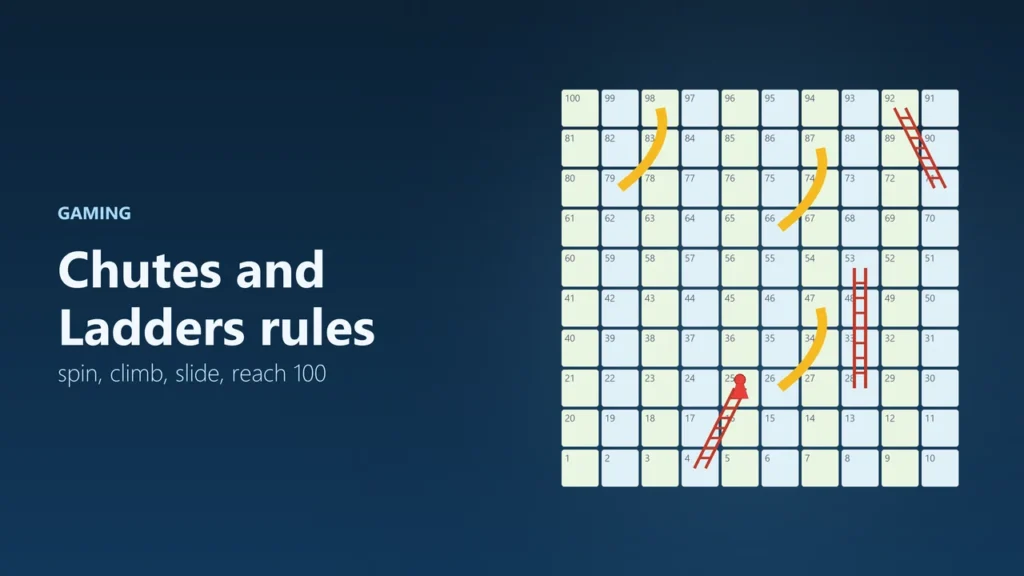
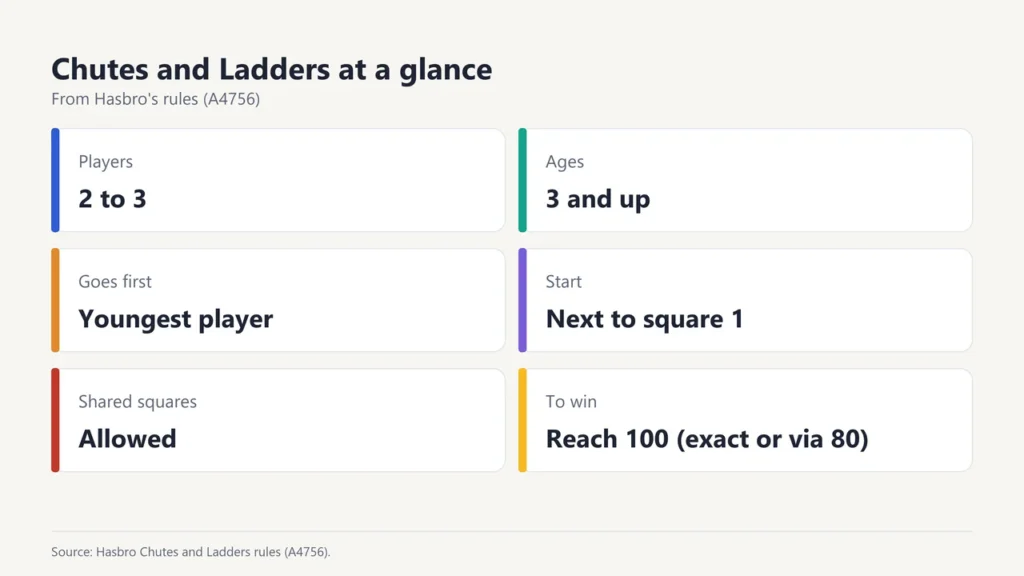
- Players: 2 to 3 in the current edition, ages 3 and up
- In the box: gameboard, spinner with arrow and base, 3 character pawns and 3 stands
- Who goes first: the youngest player, then play passes to the left
- To win: be first to reach square 100
How to set up Chutes and Ladders
- The first time you play, punch out the pawns and the spinner board, put each pawn in a stand, and have an adult attach the arrow and base to the spinner.
- Each player picks a pawn. The youngest chooses first, then the choice moves to the left.
- Put every pawn next to square 1, not on it.
How to play Chutes and Ladders
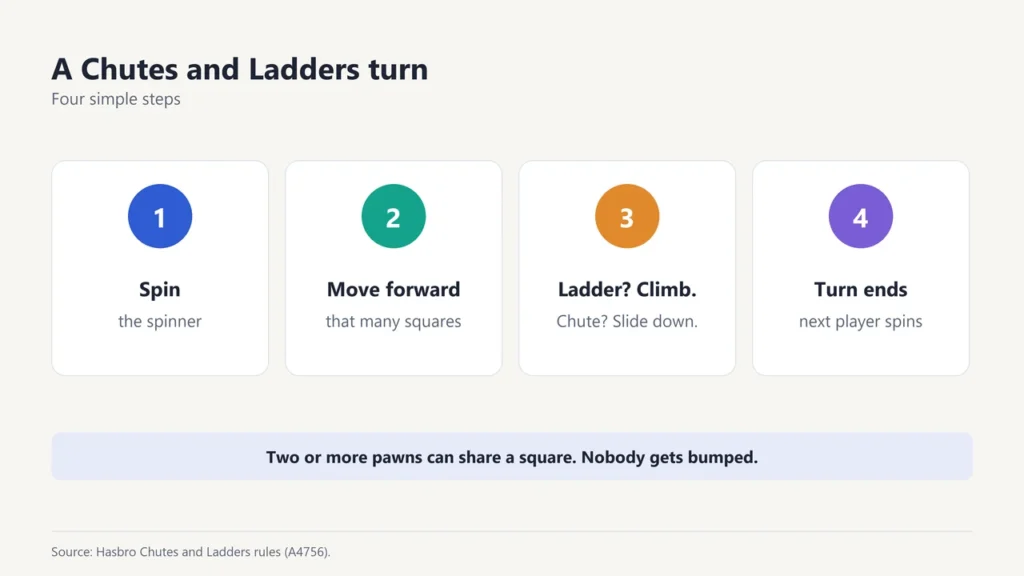
The youngest player goes first. On your turn:
- Spin the spinner.
- Move your pawn forward that number of squares.
- If you land at the bottom of a ladder, climb it. If you land at the top of a chute, slide down it.
- Your turn ends, and the next player spins.
Two or more pawns can share a square at the same time. Nobody gets bumped.
How do ladders and chutes work?
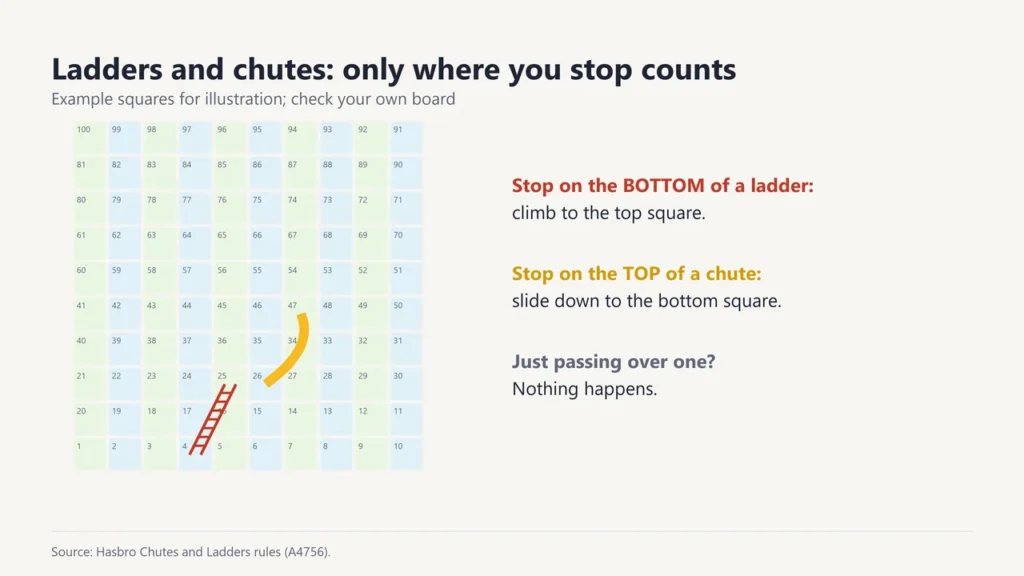
- Ladders go up. You only climb if you land exactly on the square at the bottom of a ladder. Move your pawn to the square at the top.
- Chutes go down. You only slide if you land exactly on the square at the top of a chute. Move your pawn all the way to the square at the bottom.
Passing over a ladder or chute does nothing. Only the square you stop on counts.
Do you need an exact spin to win Chutes and Ladders?
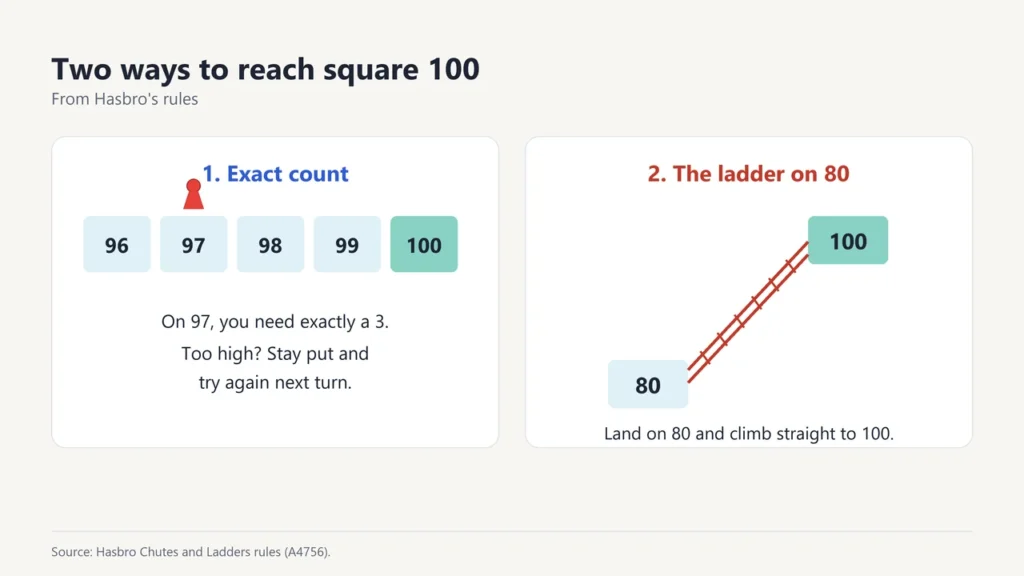
Yes, unless you take the ladder. Hasbro’s rules give two ways to reach square 100:
- Land on it by exact count. If your spin would take you past square 100, don’t move. Try again on your next turn.
- Land on square 80 and climb the ladder straight to square 100.
So a player on square 97 needs a 3 exactly. Any bigger number means waiting a turn.
Chutes and Ladders vs Snakes and Ladders
They are the same kind of race game. Snakes and Ladders uses snakes where Chutes and Ladders uses slides, and some sets use a die instead of a spinner. Board layouts and end rules vary between sets, so follow the sheet that came with yours.
Tips for playing with young children
- Count out loud. Saying each square number as you move is good counting practice up to 100.
- Practise taking turns. The game is short and simple, so it is a gentle way to learn waiting for your go.
- Expect ups and downs. There is no strategy, just luck, so everyone has a fair chance to win.
More family game rules: Candy Land rules, Trouble game rules, Sorry! game rules and Yahtzee rules.
Frequently asked questions
Do you need an exact number to win Chutes and Ladders?
Yes. If your spin would take you past square 100, you don’t move that turn. The other way to win is to land on square 80 and climb its ladder to 100.
Can two players be on the same square?
Yes. Hasbro’s rules say two or more pawns can be on the same square at the same time.
Where do you start in Chutes and Ladders?
Next to square 1, off the board. Your first spin moves you onto the board.
Who goes first in Chutes and Ladders?
The youngest player. Play then passes to the left.
Do you go up a ladder if you pass it?
No. You only climb if you stop exactly on the square at the bottom of the ladder.
How many players can play Chutes and Ladders?
The current Hasbro edition is for 2 to 3 players and comes with 3 pawns.

Justwebworld has published guides since 2012. How we write and update articles Report an error
