

UNO is a card game where you try to be the first to get rid of all your cards. Each player gets 7 cards. On your turn, you play one card that matches the top card of the discard pile by color, number or symbol, or you play a Wild card. If you can’t play, you draw one card. When you have one card left, you must shout “UNO!”. If someone catches you first, you draw 2 cards.
This guide explains the official UNO rules in simple words. It is based on the instruction sheets that Mattel, the company that makes UNO, publishes on its customer service website. We compared three of those sheets, from 2001, 2009 and 2025. Most of the rules have stayed the same, but a few have changed. Those changes are why people argue about UNO rules so much.
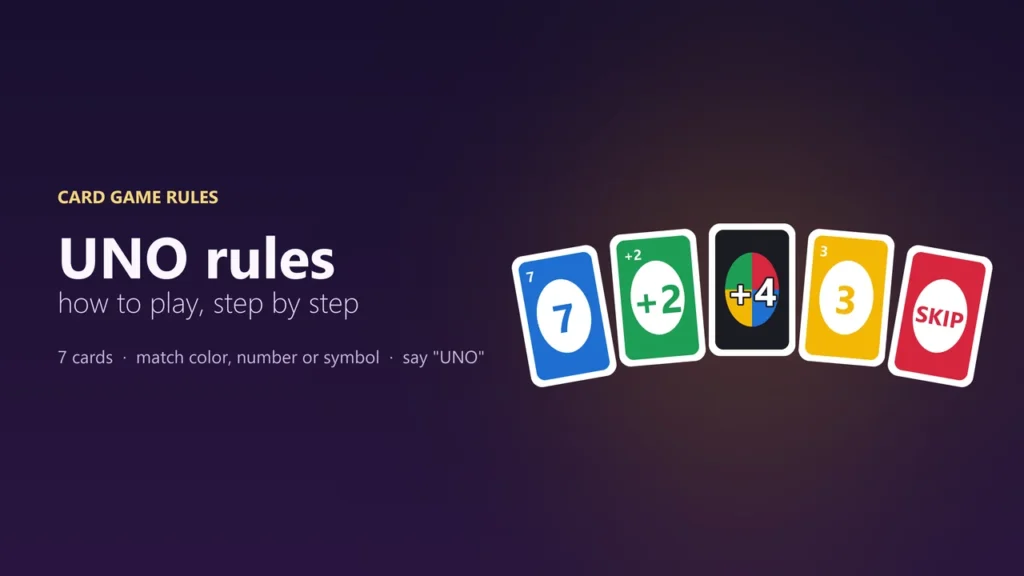
- Players: 2 to 10, ages 7 and up
- Cards dealt: 7 each
- Goal of each round: play all your cards first
- Goal of the game: first to 500 points (optional)
- Forget to say UNO: draw 2 cards if caught before the next player starts their turn
- Stacking +2 and +4 cards: not in the official rules
What’s in an UNO deck?
A classic UNO deck has 108 cards. Mattel’s 2009 instruction sheet lists them like this:
| Card | How many | What it does |
|---|---|---|
| Number cards (0 to 9) | 76 (19 in each of red, blue, green and yellow) | Match by color or number |
| Draw Two (+2) | 8 (2 per color) | Next player draws 2 and misses their turn |
| Reverse | 8 (2 per color) | Changes the direction of play |
| Skip | 8 (2 per color) | Next player misses their turn |
| Wild | 4 | Play on anything and choose the color |
| Wild Draw Four (+4) | 4 | Choose the color, and the next player draws 4 and misses their turn |
| Total | 108 |
Each color has one 0 and two of every number from 1 to 9. That is why there are 19 number cards per color.
Many newer decks have 112 cards. The extra cards change from edition to edition. Mattel’s 2001 sheet added 4 blank cards for house rules or for replacing lost cards. Mattel’s own product page for the classic game says it now comes with customizable Wild cards. Themed decks often add one special Wild card with its own rule. If your deck has a card you don’t recognize, check the instruction sheet in your box.
How to set up a game of UNO
- Pick a dealer. In the 2009 rules, each player draws a card and the highest number deals. Action cards count as zero. Newer sheets simply say “choose a dealer”.
- Shuffle and deal 7 cards to each player.
- Make the draw pile. Put the rest of the deck face down in the middle.
- Start the discard pile. Turn over the top card of the draw pile and place it face up next to it.
- Start playing. The player to the left of the dealer goes first, and play moves clockwise.
What if the first card is an action card? Mattel’s 2025 sheet keeps it simple: ignore it and turn over the next card. The older 2009 sheet gives each card its own effect. A Draw Two makes the first player draw 2. A Skip skips the first player. A Reverse means the dealer goes first and play moves to the right. A Wild lets the first player choose the color. A Wild Draw Four goes back into the deck and a new card is turned over. Agree on one version before you start.
How to play UNO: your turn, step by step
On your turn, you either play one card or draw one card. You can play a card if it matches the top card of the discard pile in at least one way:
- Same color. A red 3 can go on a red 8.
- Same number. A blue 7 can go on a green 7.
- Same symbol. A yellow Skip can go on a red Skip.
- Any Wild card. A Wild can go on anything. A Wild Draw Four has one extra condition (see below).
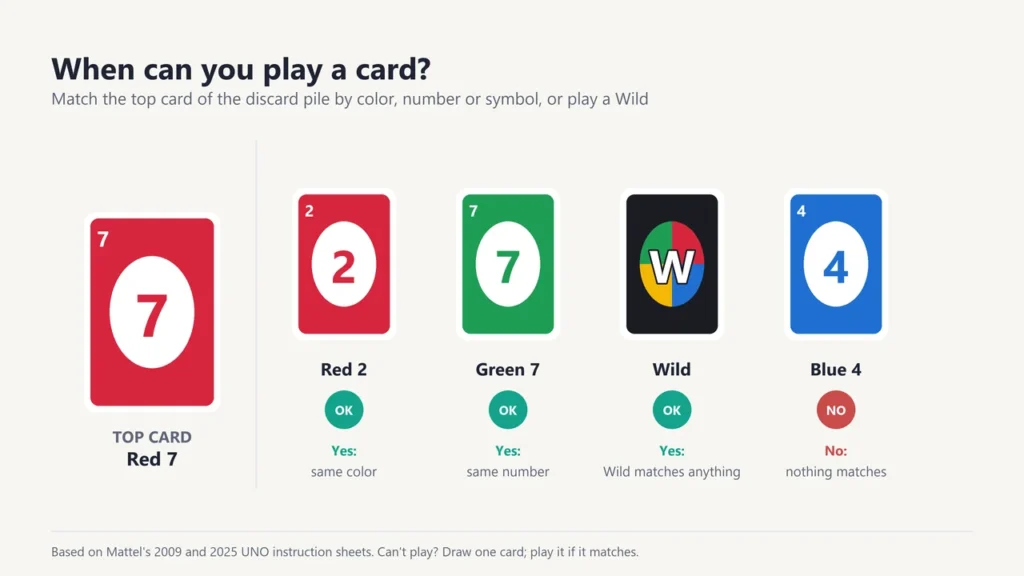
If you can’t play: draw one card from the draw pile. If that card can be played, you may play it straight away. If not, your turn ends.
If you can play but don’t want to: you may draw a card instead. Mattel’s sheets allow this. The 2009 sheet adds one limit: after drawing, the only card you may play is the one you just drew.
If the draw pile runs out: shuffle the discard pile to make a new draw pile, and keep playing.
UNO action cards explained
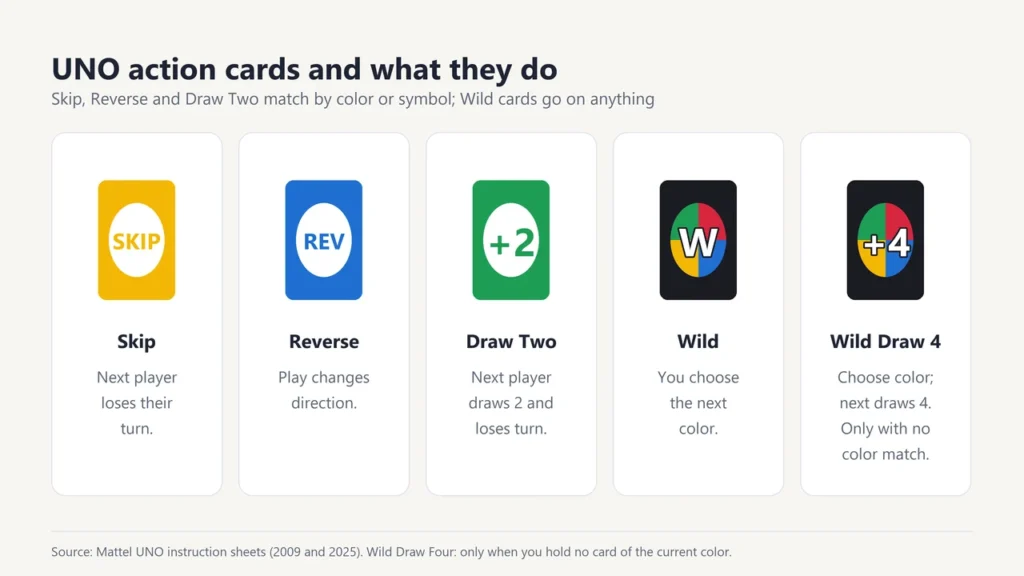
| Card | Can be played on | Effect |
|---|---|---|
| Skip | Same color or another Skip | The next player loses their turn. |
| Reverse | Same color or another Reverse | Play changes direction, clockwise to counterclockwise or back. |
| Draw Two (+2) | Same color or another Draw Two | The next player draws 2 cards and loses their turn. |
| Wild | Anything | You choose the next color. You may play it even if you have another card you could play. |
| Wild Draw Four (+4) | Anything, but only if you have no card matching the current color | You choose the next color, and the next player draws 4 cards and loses their turn (unless they challenge). |
The Wild Draw Four rule and how to challenge it
You can only play a Wild Draw Four when you have no card in your hand that matches the color of the discard pile. Holding a card with the same number or symbol in a different color is fine. Only the color counts.
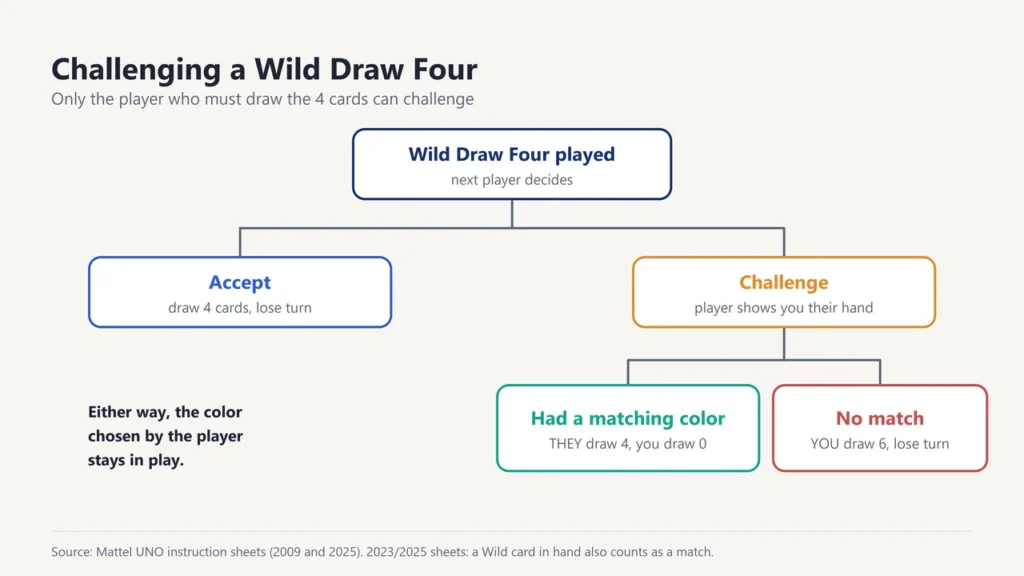
If you think someone broke this rule against you, you can challenge them. Only the player who would have to draw the 4 cards can challenge. Here is what happens:
- They show their hand to you. They don’t show it to everyone.
- If they had a matching color (they were “guilty”), they draw the 4 cards and you draw none.
- If they did not (they were “innocent”), you draw 6 cards: the 4, plus 2 extra as a penalty.
- The color they chose stays either way. Mattel’s 2025 sheet says the player still chooses the color “regardless of the outcome of any challenge”.
One small change shows up in newer sheets. Mattel’s 2023 and 2025 sheets say that during a challenge, “Wild cards are considered a match, too”. So if you hold a plain Wild card, playing a Wild Draw Four is against the rules under those sheets. The 2009 sheet does not mention this.
Saying “UNO”: the rule and the penalty
When you are down to one card, you must say “UNO” so everyone knows. If another player catches you before the next player begins their turn, you must draw 2 cards. That is the penalty in Mattel’s 2009, 2023 and 2025 sheets.
If someone tells you the penalty is 4 cards, they aren’t making it up. Mattel’s 2001 sheet did say four. It also gave a few fine details that are still useful for settling arguments:
- You can’t be caught until your second-to-last card touches the discard pile.
- If you forget but say “UNO” before anyone catches you, you’re safe.
- Once the next player begins their turn, it is too late to catch you.
Can you stack Draw Two and Draw Four cards?
Not under the official rules. None of the Mattel instruction sheets we checked has a stacking rule. When a Draw Two is played, the next player “must draw 2 cards and lose their turn”. Because they lose their turn, they can’t play a +2 of their own to pass the draw along. The same goes for a Wild Draw Four.
Stacking (also called “progressive UNO”) is a very common house rule. Many families play it, and it makes rounds faster and meaner. If you want to use it, agree before the first card is dealt, including whether a +4 can go on a +2. Some decks even come with blank or customizable cards for writing down your own rules like this.
How a round ends and how to score UNO
A round ends the moment a player plays their last card. You can go out on an action card. If your last card is a Draw Two or Wild Draw Four, the next player still draws those cards, and they count in the score.
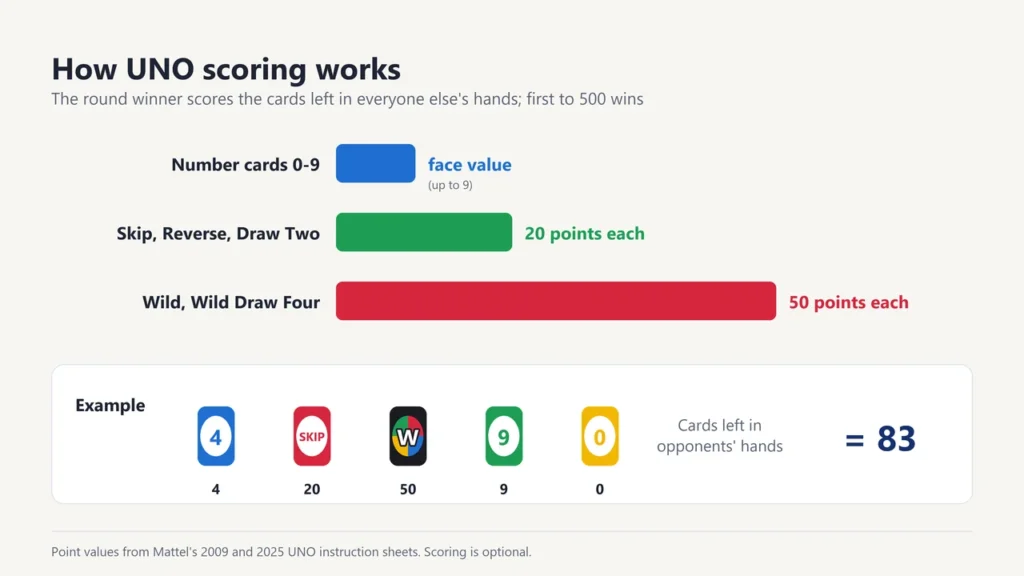
Scoring is optional. If you keep score, the winner of the round gets points for the cards left in everyone else’s hands:
| Card left in a hand | Points |
|---|---|
| Number cards (0 to 9) | Face value (a 7 is worth 7) |
| Skip, Reverse, Draw Two | 20 each |
| Wild, Wild Draw Four (and special Wild cards) | 50 each |
The first player to reach 500 points wins the game. Mattel also gives another way to score. Each player keeps a running total of the points left in their own hand at the end of each round. When someone reaches 500, the player with the lowest total wins.
Example: Priya goes out. Sam holds a blue 4, a red Skip and a Wild. Lee holds a green 9 and a yellow 0. Priya scores 4 + 20 + 50 + 9 + 0 = 83 points.
UNO rules for 2 players
The normal rules work with two players, but some cards act differently. Mattel’s 2001 sheet gave these special two-player rules:
- Reverse works like Skip. You play it and then play another card right away.
- Skip lets you go again. Play another card straight away.
- Draw Two and Wild Draw Four: your opponent draws the cards, and then it’s your turn again.
The same sheet also has a partner game for four players. Partners sit across from each other, and when either partner goes out, the team scores all the points left in the two opponents’ hands.
Common UNO rule mistakes
| What people often do | What the official rules say |
|---|---|
| Stack +2 on +2 to pass the draw | No stacking. The next player draws and loses their turn. |
| Keep drawing until you get a playable card | Draw one card only. Play it if you can, or your turn ends. |
| Play a +4 whenever you like | Only when you have no card of the current color. |
| Can’t finish on an action or Wild card | You can. Playing your final card wins the round. |
| Say “UNO” after your last card | Say it when you have one card left. Being caught means drawing 2 cards. |
Looking for more games to play at the same table? Our board games guide sorts games by type and group size. UNO also appears in our list of board games that start with U. If you play alone, try our solitaire card game guide. And if you like games with written rules you can check, see how chess notation records every move.
Frequently asked questions
How many cards do you get in UNO?
Each player is dealt 7 cards. The rest of the deck becomes the draw pile, and its top card is turned over to start the discard pile.
Can you put a Draw Two on a Draw Two in UNO?
You can play a Draw Two on another Draw Two as a normal match. But you can’t use it to stack the penalty. Under the official rules, the player hit by the first Draw Two draws 2 cards and loses their turn, so they never get the chance to answer it. Stacking is a house rule.
What happens if you forget to say UNO?
If another player catches you before the next player begins their turn, you draw 2 cards. If nobody catches you in time, there is no penalty. Mattel’s 2001 rules used a 4-card penalty, so older players may remember that.
Can you win UNO with an action card or a Wild card?
Yes. A round ends as soon as a player plays their final card, whatever it is. If it is a Draw Two or Wild Draw Four, the next player still draws the cards, and they count toward the winner’s points.
Can you play a card after drawing in UNO?
Yes, but only the card you just drew, and only if it matches. If it doesn’t match, your turn ends. You draw just one card, not until you find one that plays.
Can you play a Wild Draw Four if you have a Wild card?
Under Mattel’s 2023 and 2025 instruction sheets, no. Those sheets say Wild cards count as a match when a Wild Draw Four is challenged. The older 2009 sheet only talks about cards that match the color, so groups using it may allow it.
How many points do you need to win UNO?
The official target is 500 points. Number cards score their face value, Skip, Reverse and Draw Two score 20, and Wild cards score 50. Keeping score is optional, so many people just play single rounds.
How many people can play UNO?
UNO is made for 2 to 10 players, ages 7 and up. With two players, Reverse acts like Skip, and Skip and draw cards let you play again.
Note: these rules come from Mattel’s official instruction sheets for UNO (2001, 2009 and 2025 editions). Special editions such as UNO Flip, UNO No Mercy and themed decks have extra cards and rules, so check the sheet in your box for those.

Justwebworld has published guides since 2012. How we write and update articles Report an error
