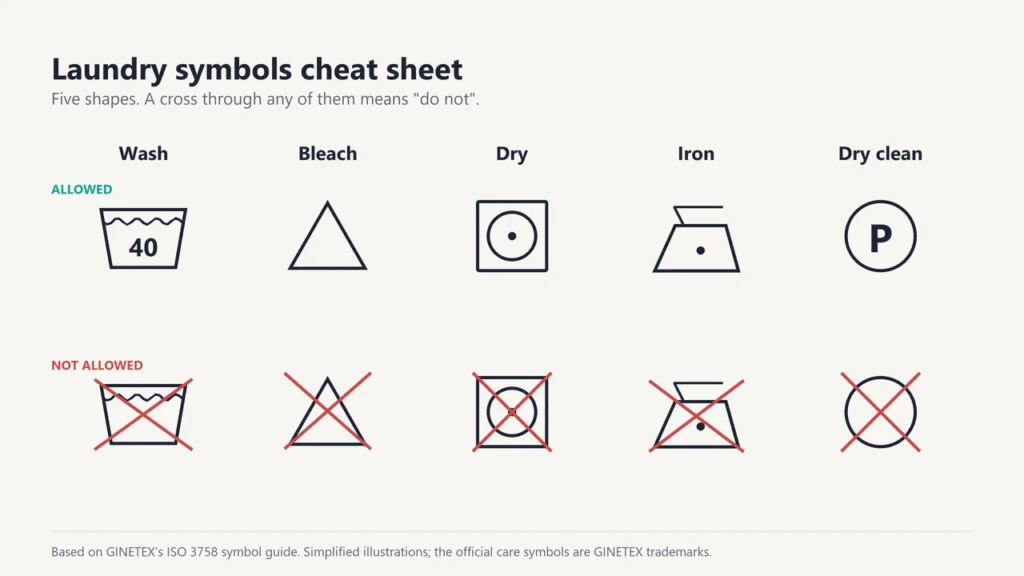
Laundry symbols use five basic shapes: a tub for washing, a triangle for bleaching, a square for drying, an iron for ironing and a circle for professional cleaning. A cross through any symbol means “do not”. Numbers, dots and bars add the detail: how hot, and how gentle.
Once you know the five shapes, you can read almost any care label. This guide explains every common symbol, what the numbers and dots mean, how labels in the US differ from those in Europe and most of the world, and the mistakes that shrink or fade clothes.
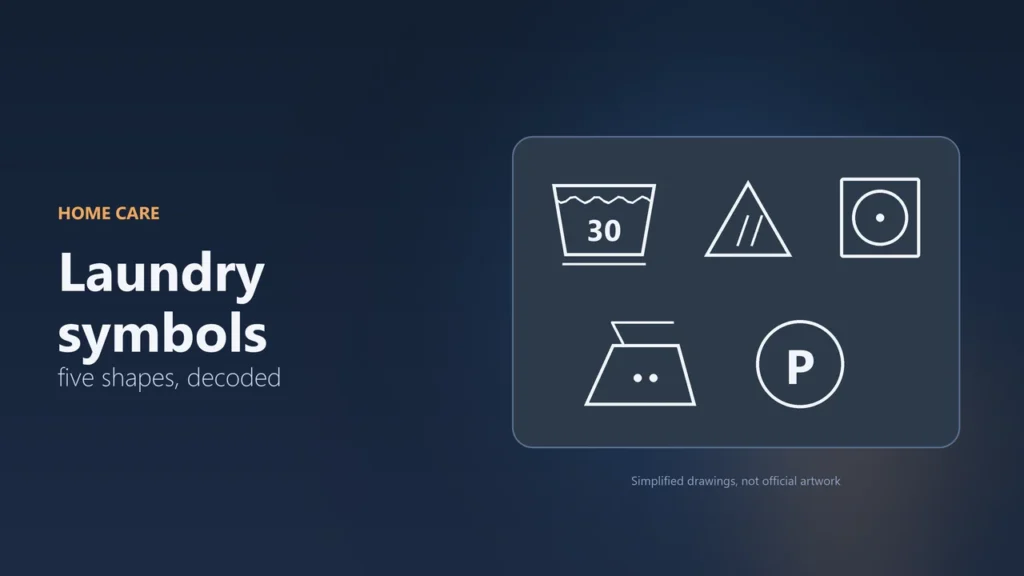
- Tub: washing. A number inside is the highest water temperature in °C
- Triangle: bleaching
- Square: drying. A circle inside means tumble dryer
- Iron: ironing. More dots means a hotter iron is safe
- Circle: professional dry cleaning or wet cleaning
- Bars underneath: use a gentler cycle. A cross: don’t do it
The symbols explained here are the international system set out in the standard ISO 3758, as described by GINETEX, the international association for textile care labelling. GINETEX owns the symbols as trademarks in most countries, so the images in this guide are simplified drawings, not the official artwork.
Washing symbols (the tub)
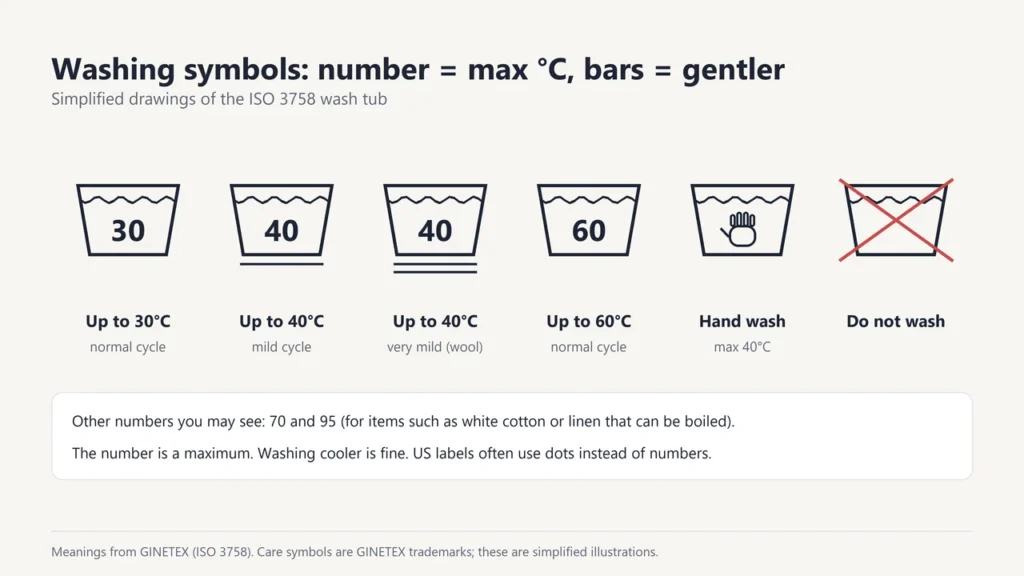
The tub tells you whether the item can be washed at home, by hand or in a machine. GINETEX explains that the number in the tub is the maximum washing temperature in degrees Celsius, which must not be exceeded. Lower is always fine.
| Symbol | Meaning |
|---|---|
| Tub with 30 | Wash at up to 30°C |
| Tub with 40 | Wash at up to 40°C |
| Tub with 60 | Wash at up to 60°C |
| Tub with 70 | Wash at up to 70°C |
| Tub with 95 | Wash at up to 95°C (for example, white cotton or linen that can be boiled) |
| Tub with a hand | Hand wash only, at no more than 40°C |
| Tub with a cross | Do not wash |
What the bars under the tub mean
- No bar: a normal wash cycle.
- One bar: a milder cycle with less spinning and movement. GINETEX says this suits “easy-care” and delicate items, such as synthetics.
- Two bars: a very mild cycle, for example for machine-washable wool.
For gentle cycles, GINETEX also advises putting less in the drum. For a “very mild” 40°C wash, it says the drum should be no more than one-third full.
Bleaching symbols (the triangle)
| Symbol | Meaning |
|---|---|
| Empty triangle | Any bleach is allowed, chlorine or oxygen |
| Triangle with two slanted lines | Only oxygen (non-chlorine) bleach. No chlorine bleach |
| Triangle with a cross | Do not bleach. Use a bleach-free detergent |
GINETEX notes that oxygen bleach is already contained in many universal detergents. So if a label shows the crossed triangle, check your detergent too.
Drying symbols (the square)
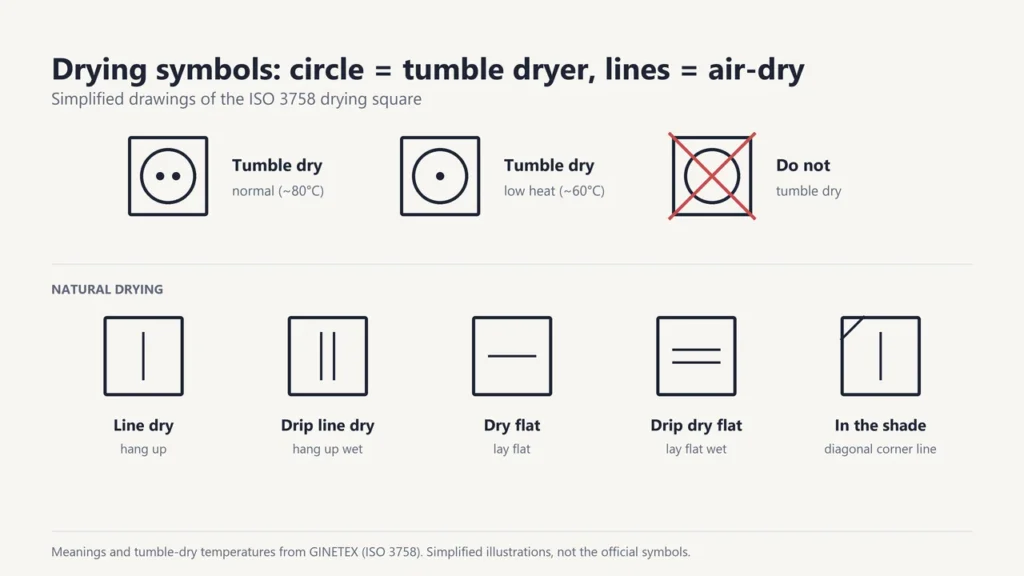
Every drying symbol is built on a square. A circle inside the square means tumble drying. Lines inside the square mean natural drying.
Tumble dry symbols
| Symbol | Meaning |
|---|---|
| Square with a circle and two dots | Tumble dry normally (GINETEX gives about 80°C) |
| Square with a circle and one dot | Tumble dry on a mild, lower-heat setting (about 60°C) |
| Square with a circle and a cross | Do not tumble dry |
Natural drying symbols
Lines in the square show how to air-dry. Upright (vertical) lines are for hanging. Flat (horizontal) lines are for laying the item flat.
- Line drying: hang it up to dry. GINETEX gives “all colourfast textiles” as an example.
- Drip line drying: hang it up dripping wet. GINETEX says this helps large items dry without wrinkles.
- Flat drying: lay it flat, which suits heavy items that could stretch.
- Drip flat drying: lay it flat while still wet.
- A slanted line in the corner: dry in the shade, out of direct sun. GINETEX gives woollen jackets and silk as examples.
Ironing symbols (the iron)
The dots on the iron show the highest soleplate temperature that is safe. GINETEX says to choose the temperature from the label, not from what you think the fabric is.
| Symbol | Max temperature | Matching iron setting |
|---|---|---|
| Iron with 1 dot | 120°C | Low: acrylic, nylon, acetate |
| Iron with 2 dots | 160°C | Medium: wool, silk, polyester, viscose |
| Iron with 3 dots | 210°C | High: cotton, linen |
| Iron with a cross | – | Do not iron |
| Iron with 1 dot and a crossed-out steam mark | 120°C | Low heat, no steam |
For shiny or delicate pieces, GINETEX suggests ironing inside out or under a pressing cloth.
Dry cleaning symbols (the circle)
The circle is for professional cleaning only. It tells the cleaner what process is safe. You don’t need to understand every detail, but these are useful to know:
- Circle with a letter: the item can be dry cleaned. The letter tells the cleaner which solvents are allowed.
- Wet-cleaning symbol: the item can be cleaned in water by a professional wet-cleaning process. GINETEX notes that home washing machines can’t match this process.
- A bar under the circle: a milder process is needed. Two bars means very mild.
- Circle with a cross: do not dry clean. GINETEX adds: don’t use solvent-based stain removers either.
US care labels vs the international symbols
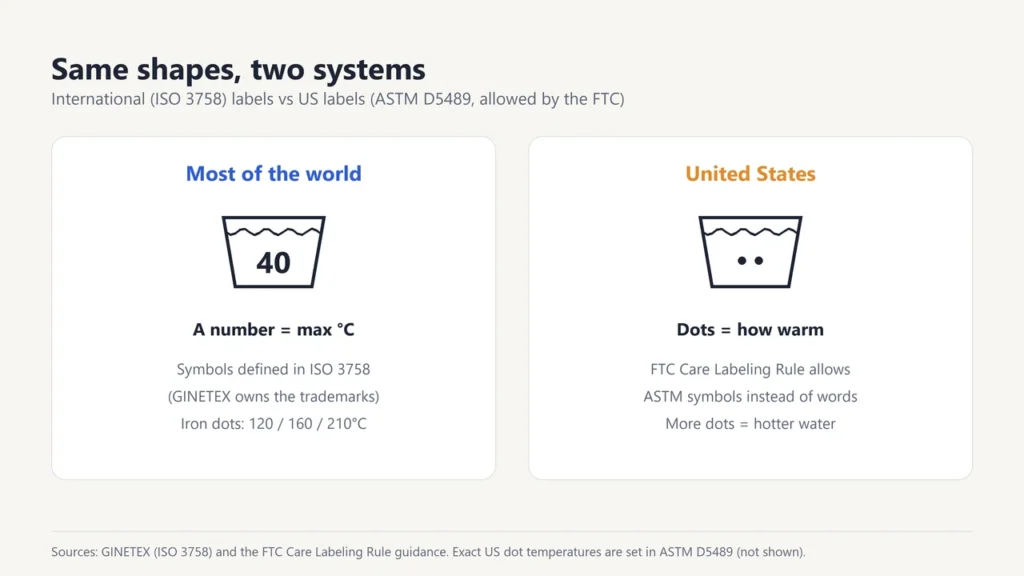
In the US, the Federal Trade Commission’s Care Labeling Rule requires most clothing to carry care instructions. The FTC says makers may use symbols from the ASTM standard D5489 instead of words. It proposed allowing the ISO symbols in 2012, but in its business guidance that is still listed as a proposal.
The two systems use the same basic shapes. The main difference you will notice is in the wash tub: US labels often show dots instead of a number, and more dots means hotter water. Many US labels also print the instructions in words, which is the clearest guide when you see both.
Common care label mistakes
- Reading the number as the “right” temperature. It is the maximum. Washing cooler is fine.
- Ignoring the bars. A 40°C tub with two bars needs a wool or very gentle cycle, not a normal 40°C wash.
- Using the tumble dryer by default. If the square has a crossed circle, air-dry instead.
- Using chlorine bleach on a “two lines” triangle. Only oxygen bleach is allowed.
- Cutting the label off. Take a photo first, so you can still check it later.
Some fabrics need extra care beyond the label. See our tips on how to care for white wash denim.
Frequently asked questions
What does the triangle mean on clothes?
It is the bleach symbol. An empty triangle allows any bleach. Two slanted lines inside mean oxygen bleach only. A crossed triangle means do not bleach.
What does a square with a circle mean?
You can tumble dry the item. Two dots inside mean normal heat, one dot means low heat, and a cross means do not tumble dry.
What does 30 in a wash tub mean?
Wash at no more than 30°C. Bars under the tub mean a gentle (one bar) or very gentle (two bars) cycle.
What does the hand in the tub mean?
Hand wash only, in water no hotter than 40°C. GINETEX advises a mild detergent, no rubbing or wringing, and gently pressing the water out.
What do the dots on the iron symbol mean?
They show the maximum iron heat: one dot is 120°C, two dots is 160°C and three dots is 210°C.
What does an empty circle mean on a label?
It refers to professional cleaning. A letter inside tells the dry cleaner which solvents are safe. A crossed circle means do not dry clean.
Why don’t US labels show temperatures in numbers?
The US Care Labeling Rule allows the ASTM symbol system, which commonly uses dots in the tub instead of numbers. More dots means warmer water. Check for written instructions on the label too.