A manufacturing line does not need to be fully automated for production to depend on IT. The schedule may live in an ERP system. Work instructions may be pulled from SharePoint. Quality records may be entered through a web application. Shipping labels may require a cloud service. Supervisors may authenticate through Microsoft 365 before reaching the systems they use every shift.
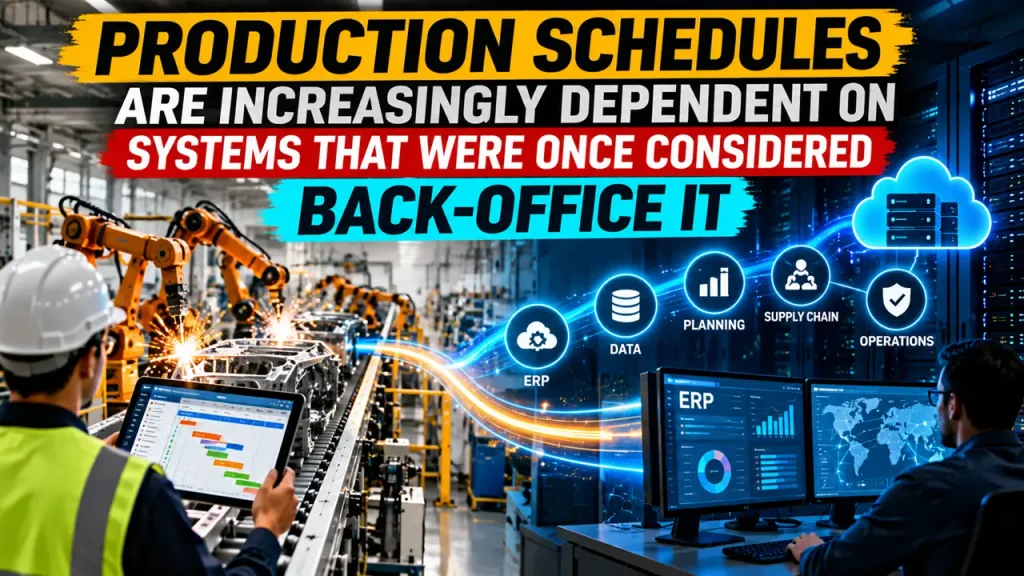
As those dependencies grow, the old distinction between “production technology” and “office IT” becomes less useful. A failure in an identity platform, network switch, cloud application, or vendor connection can now stop physical work even when the machinery itself is functioning normally.
Production dependencies often sit outside the production line
Consider what happens before a job reaches a machine. Sales enters an order. Planning schedules capacity. Engineering releases drawings. Purchasing confirms materials. Quality provides specifications. Employees retrieve instructions and record results. Shipping closes the loop.
Each step can depend on a different system. That means a manufacturer can have excellent machine maintenance and still lose production time because a database is unavailable or employees cannot authenticate.
The risk is easy to underestimate because many of these systems were originally introduced as administrative tools. Their operational importance increased gradually as paper processes disappeared and integrations improved.
A dependency map is more useful than a list of servers
Traditional IT inventories answer “What technology do we own?” Manufacturers also need to ask “Which business process stops if this technology fails?”
Start with a critical production workflow and trace backward. Which applications are required? Which network segments connect them? Which identity system controls access? Are there local servers, cloud services, vendor-hosted platforms, or remote support connections in the path?
NIST’s Cybersecurity Framework Manufacturing Profile treats manufacturing cybersecurity as a risk-management problem spanning industrial control systems, networks, information systems, and operational technology. That broad view reflects how interconnected modern production environments have become.
Support priorities should follow operational impact
An email problem and a production-scheduling failure should not enter the support queue with the same urgency merely because both are “IT issues.” Manufacturers need escalation rules that reflect what is happening to the business.
A system that affects a production cell, shipping deadline, inspection process, or customer commitment may require a different response than a normal workstation issue. The support team needs enough operational context to recognize that difference.
Companies considering managed IT services in Everett should therefore look beyond help desk coverage and ask how a provider learns the production environment, documents critical dependencies, and handles incidents where technology problems affect operations.
Vendor access deserves special attention
Manufacturing environments often include equipment that is maintained by the machine builder, software vendor, automation integrator, or another specialist. Remote access can be essential because those vendors may be the only people capable of diagnosing a fault quickly.
It also creates another dependency. The manufacturer should know how the vendor connects, which systems it can reach, whose account is used, whether multifactor authentication is required, and how access is disabled when it is no longer needed.
CISA’s Cross-Sector Cybersecurity Performance Goals include practices for both information technology and operational technology owners. That is a useful model for manufacturers because risks often cross the boundary between the two rather than staying neatly inside one team.
Recovery planning needs production input
IT staff can restore systems, but operations leaders are better positioned to determine the order that matters.
If the ERP is unavailable, can the plant continue from printed schedules for two hours? Can quality inspections be recorded manually and entered later? Can shipping operate if the label service is down? Does the production team know which processes have a safe manual fallback and which ones must stop?
Those answers determine recovery priorities. They also reveal where a relatively small technology dependency has become a single point of operational failure.
Testing those workarounds matters too. A manual procedure that exists only in a binder may fail when a shift supervisor tries to use it under time pressure. Short exercises can show whether the fallback actually keeps production moving.
Manufacturing IT needs a shared vocabulary
Operations people do not need to become network engineers, and IT staff do not need to become production planners. Both groups do need a common way to describe impact.
Instead of saying a server is “critical,” document which production process depends on it, how long that process can operate without it, what workaround exists, and who should be notified if it fails. Instead of saying a vendor needs “remote access,” document what access is required and when.
That level of specificity makes support, cybersecurity, recovery, and investment decisions easier to prioritize.
Manufacturers have always managed dependencies such as suppliers, tooling, labor, and equipment. Software, identity, networks, and cloud services now belong on the same operational map. Once the business sees them that way, back-office IT stops being back-office and becomes part of production planning.