

Eleven-day approval cycles for two-hour tasks. Untagged infrastructure running for quarters before anyone notices. IAM roles with permissions no one can explain. These are not edge cases in enterprise cloud programs. They are what the cloud control gap looks like when it has been left unaddressed long enough to become normal.
What the Cloud Control Gap Actually Means?
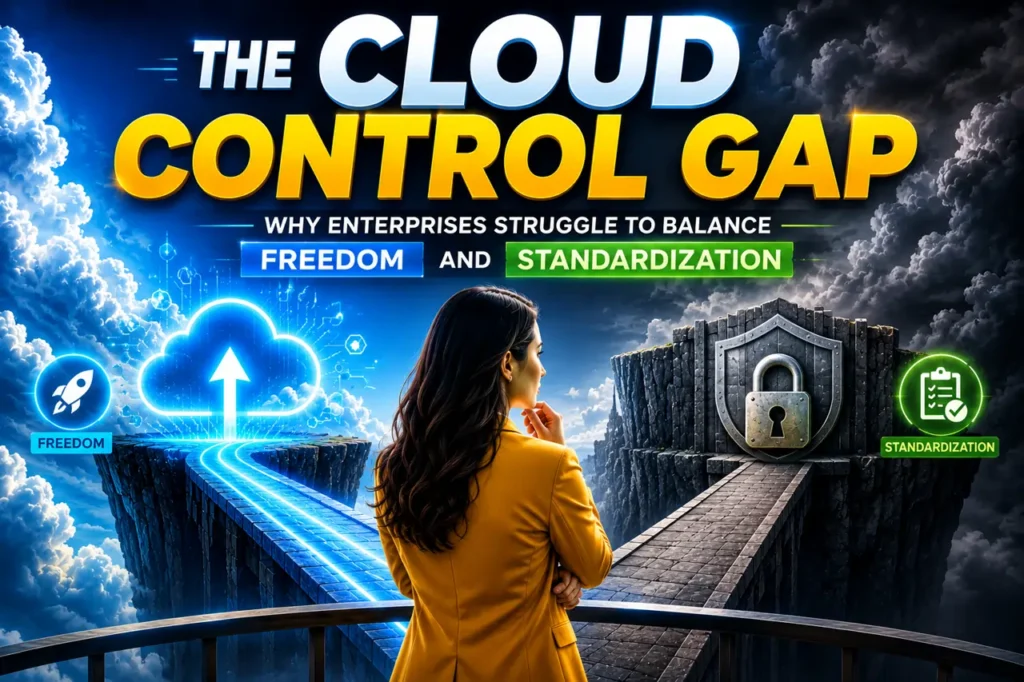
The cloud control gap is not a technology problem; it requires structured cloud engineering services to balance governance and developer autonomy. It is an organizational one.
It describes the space between what your governance policies say should happen and what developers actually do when those policies create friction. When approval workflows take three days for a two-hour task, engineers find workarounds. When your internal developer platform does not provision what a team needs, they provision it themselves, outside the platform. The gap widens every time governance is enforced without an understanding of what it costs the people it governs.
Understanding cloud governance vs autonomy requires accepting that both extremes fail. Full centralized control slows delivery to the point where cloud stops being an advantage. Full autonomy generates sprawl, security debt, and compliance exposure that compounds faster than any team can clean it up.
The gap sits in between, and most enterprises have never drawn its borders deliberately.
Why is the Tension Between Autonomy and Standardization Getting Worse?
Engineering autonomy in cloud environments has never been a fringe demand. Developers need to move fast. Product timelines are short. The expectation that infrastructure will be available on-demand is baked into how modern software teams plan work.
But the same conditions that make cloud agile also make it risky to leave ungoverned. Every new service spun up outside a standard module is a configuration that compliance has not reviewed. Every team that builds its own networking stack is a team that will need to be migrated later when the company decides to standardize. The downstream cost of early autonomy is high, and it is often paid by a completely different team than the one that made the original decision.
This tension plays out differently depending on where a team sits:
| Perspective | What They Want | What They Fear |
| Product engineering | Autonomy to build and ship fast | Being blocked by platform approvals |
| Platform / infra teams | Consistent, auditable environments | Shadow IT and ungoverned sprawl |
| Security teams | Full visibility and least-privilege defaults | Engineers with overly broad IAM permissions |
| Finance / FinOps | Predictable, tagged, budgeted spend | Untagged resources and orphaned workloads |
No single stakeholder is wrong here. The problem is that this exact collision point, where all four sets of priorities meet without a clear arbiter, is where the cloud control gap takes hold.
The Cost of Getting the Balance Wrong
There are two failure modes. Both are expensive, and both are common enough that you have probably seen one of them firsthand.
Over-control looks like this: a central platform team owns every deployment decision. Engineers raise tickets to provision infrastructure. Reviews take days. The golden path covers only the use cases the platform team anticipated, so any novel workload requires an exception process that can take weeks. The developers who tolerate this environment are the ones with no other option. The ones who can work around it, will.
The result is predictable. Teams start managing their own AWS accounts outside the platform. Shadow infrastructure accumulates. The central platform team eventually loses visibility into what is actually running in production, which is precisely the visibility it was trying to maintain.
Under-control looks different but lands in a similar place. Engineers provision freely. There are no enforced tagging standards, so cost attribution becomes a guessing game. IAM roles accumulate permissions over time, a pattern known as permission creep or identity drift. Non-production environments never get cleaned up. When a security review eventually happens, the findings are so numerous that remediating them requires pausing feature work entirely.
Cloud standardization challenges in the under-control model often come to light during a compliance audit, a cost spike, or a breach, not during normal operations.
The harder truth is that most enterprises sit somewhere between these two states, oscillating based on whoever has more internal influence at a given moment. That oscillation is the gap playing out in real time.
What Guardrails Actually Mean, and What Are They Not?
The word “guardrail” gets used so loosely in cloud conversations that it has nearly stopped meaning anything.
A guardrail, precisely defined, is a hard stop. It is a non-negotiable prevention mechanism that blocks configurations which would compromise security or platform stability, things like public storage buckets or unenforced binary authorization. That definition matters because a lot of what gets called a guardrail in practice is actually a speed bump: a soft control that slows work down without categorically preventing harm.
Effective cloud platform guardrails are not approval gates. They are not compliance checklists reviewed quarterly. They are not architecture review boards that engineers schedule months in advance. They are automated, enforced at provisioning time, and ideally invisible to anyone who is following the intended path.
The distinction between a guardrail and an obstacle comes down to one question: does it stop something genuinely dangerous, or does it stop something that someone in the organization once decided was preferable? The first category belongs in automated enforcement. The second category belongs in documentation and enablement, not in blocking pipelines.
A platform with too many cloud platform guardrails can feel like a maze of restrictions, and that erodes trust in the very platform teams trying to build a governance framework that enables both fast and safe delivery. Platform teams that conflate these two categories end up building platforms that developers actively route around.
The Platform Team’s Role in Closing the Gap
Platform teams are not in the business of controlling engineers. They are in the business of making the right path easier than the wrong one.
That reframing matters more than it sounds. When a platform team’s primary output is policies and restrictions, it positions itself adversarially against the product teams it is supposed to serve. When its primary output is paved roads, meaning pre-built modules, approved service templates, internal developer portals with self-service provisioning, it positions itself as an accelerator.
Risk and compliance embedded into platform defaults and workflows from the beginning, rather than enforced through external governance layers, allows teams to move quickly while operating within acceptable boundaries. When compliance is added later as a control mechanism, it increases operational toil, slows delivery, and encourages workarounds instead of responsible behavior.
The practical difference between these two approaches:
- Reactive governance model- A team provisions a resource. Compliance discovers it is misconfigured two weeks later during a scheduled review. A ticket is raised. The team fixes it under deadline pressure. The root cause, that the default provisioning path allowed the misconfiguration, is never addressed.
- Embedded governance model- The provisioning template enforces the correct configuration by default. The engineer never had to make a compliance decision because the platform already made it for them. The review still happens, but it finds nothing to fix.
Balancing innovation and governance at the platform level is not about compromise. It is about moving the enforcement point upstream, to where code is written and infrastructure is defined, not downstream, where problems are already in production.
Building a Cloud Control Model That Actually Holds
A sound cloud control model should answer three questions clearly:
- What can any engineer do without any approval?
- What requires a platform-provided module or template?
- What requires explicit human review?
Most enterprises have implied answers to these questions but have never written them down. The gap that results is not accidental. It is the product of a governance strategy that was never made explicit, so every team interprets it differently.
Here is a framework that works in practice:
| Control Layer | What It Covers | Who Enforces It | Friction Level |
| Hard guardrails | Security baselines, compliance mandates, network boundaries | Automated policy engine (OPA, SCPs, Azure Policy) | Zero: blocks at provisioning |
| Golden paths | Approved service modules, vetted templates, default configurations | Platform team tooling and IDP | Low: self-service with guardrails built in |
| Soft guidance | Architecture patterns, cost optimization, non-mandatory best practices | Documentation, internal wikis, office hours | None: advisory only |
| Human review | Major architectural changes, new cloud regions, net-new service categories | Architecture review board | Scheduled, not ad hoc |
The key insight here is that cloud governance vs autonomy is a false binary. The actual choice is about which decisions require human judgment and which ones should never reach a human at all because the platform has already made them correctly by default.
Engineering autonomy in cloud is preserved when engineers can move freely within a well-defined boundary. The goal of a cloud control model is not to restrict that boundary but to make it explicit, so engineers know exactly where it sits.
Cloud standardization challenges typically emerge when organizations try to standardize outputs, the actual resources and configurations, rather than standardizing inputs: the modules, templates, and defaults engineers use to create those resources. Standardizing the path is more durable than auditing the destination.
The Organizational Side That Most Frameworks Ignore
Technical controls are only part of the answer. The other part is organizational, and it is the part that most cloud governance frameworks skip entirely.
The cloud control gap persists in organizations where the platform team and the product teams operate under different incentive structures. Product teams are measured on delivery speed. Platform teams are measured on stability and compliance. Neither metric rewards the other team’s priorities.
Closing the gap requires a shared accountability model. That means platform teams need to have a stated service level for how fast engineers can self-provision standard workloads. It means product teams need to have an expectation that working outside the platform comes with a cost, whether that is an architecture review, a delayed compliance clearance, or a budget line that shows up untagged.
The accountability model changes when you shift toward more automated governance. Explainability and predictability become requirements. Human judgment belongs in three specific areas: policy definition, exception handling, and blast radius decisions. The system can rightsize a workload, but a human should define what guardrails are appropriate for the environment.
Balancing innovation and governance at the organizational level means defining where human judgment is genuinely needed and removing it from everywhere else. Not because human judgment is not valuable, but because applying it to low-stakes, repeatable decisions is a waste of the people who should be making the high-stakes ones.
What the Gap Looks Like When It Is Managed Well?
There will always be a degree of distance between policy and practice. The organizations that handle this well are not the ones who have eliminated it entirely. They are the ones who have decided consciously where to let it sit.
They have hard stops on the things that create irreversible risk: public data exposure, unenforced encryption, overly permissive IAM. They have paved roads for everything engineers do routinely: compute provisioning, database templates, networking modules, monitoring configuration. They have a genuine feedback loop between platform teams and the engineers using the platform, so the golden paths stay current with what teams actually need.
And they have accepted that some cloud standardization challenges will not be solved by more policy. They will be solved by making the standard option the easiest option, every time.
Governance as enforcement will always lose to governance as design. The cloud control gap does not close because someone writes a better policy document. It closes because the platform makes doing the right thing cheaper than doing the wrong thing. That shift is where most enterprises still have ground to cover.
Getting there is its own programme — migration pathways from legacy ECC to a future-ready core covers it.

Justwebworld has published guides since 2012. How we write and update articles Report an error
