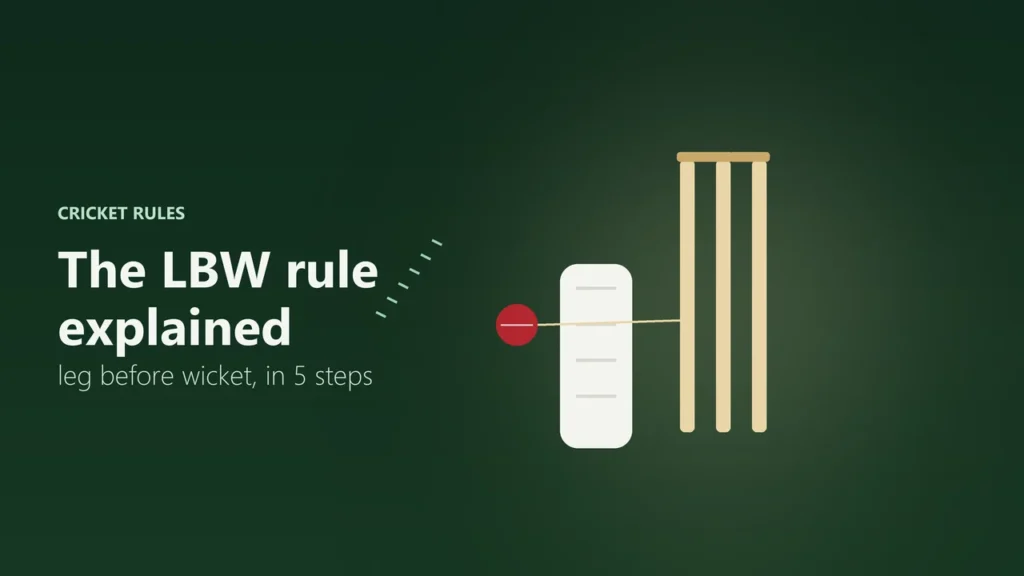
LBW stands for leg before wicket. A batter is out LBW when the ball hits their body or pads instead of the bat, and the umpire decides it would have gone on to hit the stumps. But there are conditions: the ball must not pitch outside leg stump, and it must hit the batter in line with the stumps, unless they made no attempt to play it.
It is the most argued-about way of getting out in cricket. This guide explains the LBW rule in simple words, using the five conditions in Law 36 of the Laws of Cricket, written by the Marylebone Cricket Club (MCC). The International Cricket Council (ICC) uses the same wording in its match playing conditions. You’ll also find a quick table of common situations and answers to the most-asked questions.
- LBW full form: leg before wicket
- Rule: Law 36 of the Laws of Cricket
- Three key questions: Where did it pitch? Where did it hit? Would it have hit the stumps?
- Never out: if the ball pitches outside leg stump, or hits the bat first
- Off-stump catch: hit outside off stump is out only if the batter didn’t try to play a shot
The 5 conditions for LBW
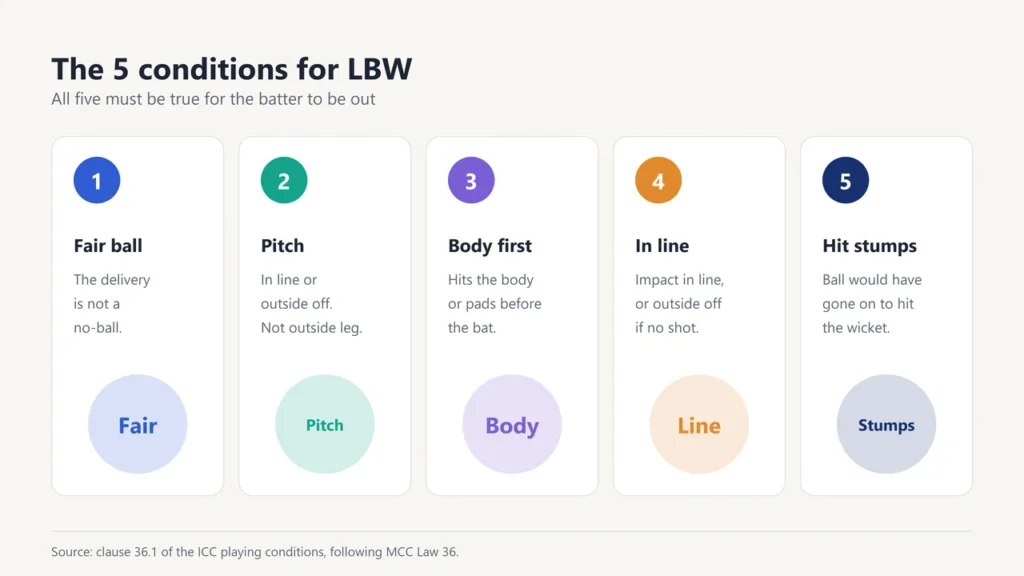
Under clause 36.1 of the ICC playing conditions, which follows MCC Law 36, a batter is out LBW only if all five of these are true:
- It is a fair ball. The bowler delivers a ball that is not a no-ball.
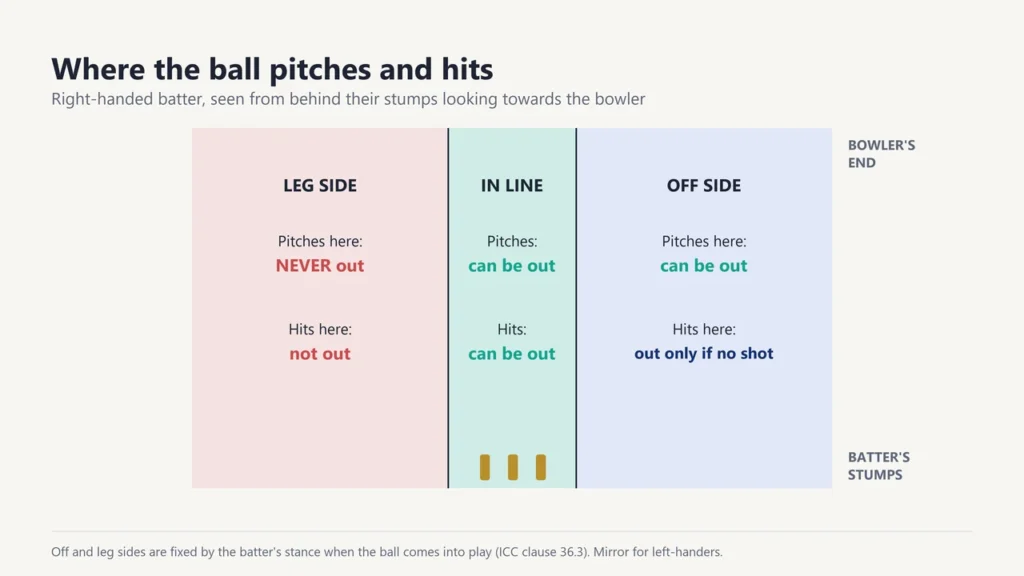
- It pitches in the right place. If the ball bounces before reaching the batter, it must pitch in line between wicket and wicket, or on the off side. It must not pitch outside leg stump.
- It hits the body, not the bat. The ball has not touched the bat first, and it hits any part of the batter’s body, including the pads.
- It hits in line. The point of impact is between wicket and wicket, even if it is above the bails. It can also be outside off stump, but only if the batter made no genuine attempt to play the ball with the bat.
- It would have hit the wicket. But for the body getting in the way, the ball would have hit the stumps.
If any one of the five fails, the batter is not out LBW.
The three questions the umpire asks
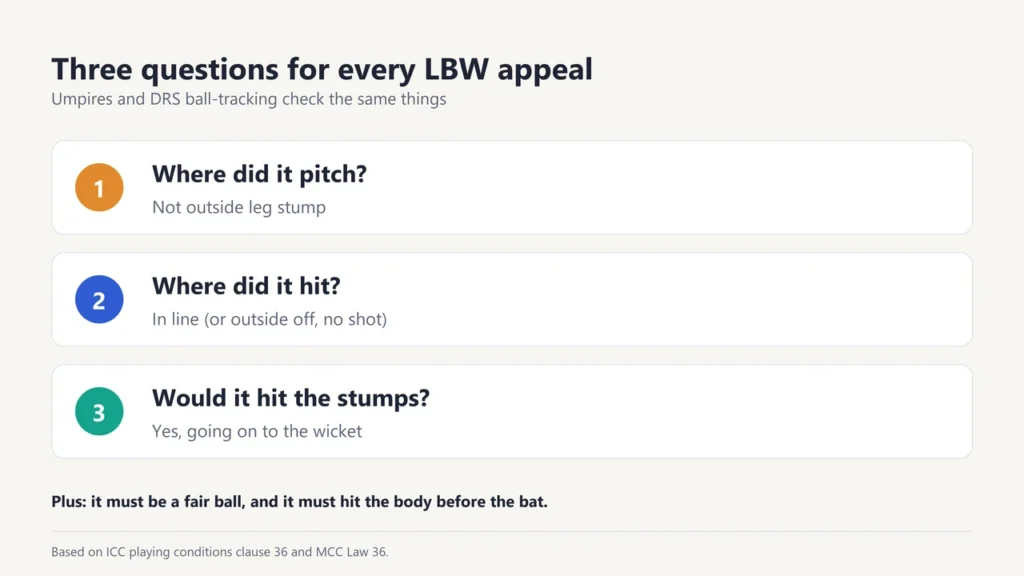
In practice, after a fair ball hits the pad, umpires work through three questions:
| Question | Out possible? | Not out |
|---|---|---|
| 1. Where did it pitch? | In line, outside off, or a full toss | Outside leg stump |
| 2. Where did it hit? | In line, or outside off with no shot played | Outside leg, or outside off while playing a shot |
| 3. Would it hit the stumps? | Yes | Missing, or going over the top |
LBW rules explained with examples
| Situation | Out or not out? |
|---|---|
| Pitches in line, hits pad in line, going on to hit middle stump | Out |
| Pitches outside leg stump, would hit the stumps | Not out |
| Hits the bat, then the pad | Not out (it hit the bat first) |
| Hits pad outside off stump, batter playing a shot | Not out |
| Hits pad outside off stump, batter leaves the ball with no shot | Can be out |
| A full toss hits the pad in line, going on to hit the stumps | Out |
| A no-ball hits the pad in line | Not out |
| The umpire isn’t sure if it hit pad or bat first | Not out |
Tricky points in the LBW rule
- Above the bails still counts. The rule says the point of impact can be “even if above the level of the bails”. What matters is whether the ball would have gone on to hit the stumps.
- Full tosses can be LBW. If the ball hits the batter without bouncing, the umpire imagines its path carrying on, “whether or not it would have pitched subsequently”.
- Only the first contact counts. If the ball hits the pad and then the bat, only the first interception, the pad, is considered.
- The benefit of doubt goes to the batter. If the umpire is not satisfied that the ball hit the body before the bat, the batter is not out.
- Off and leg are set by the stance. The off side is “determined by the striker’s stance at the moment the ball comes into play”. This matters for switch hits and reverse sweeps: a batter who changes stance during the delivery keeps the off and leg sides they had when the ball came into play.
Why the off side and leg side are treated differently
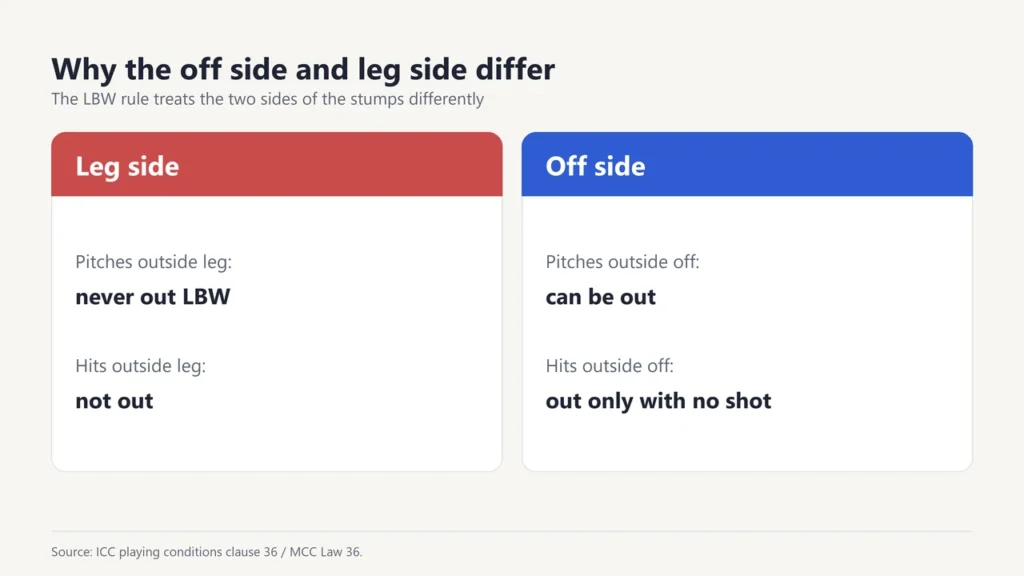
The rule treats the two sides differently. A ball pitching outside leg stump can never give an LBW. But if a batter simply pads the ball away outside off stump without trying to hit it, they can still be given out. In effect, batters can’t rely on their pads instead of their bat outside off stump.
LBW and DRS
In international cricket, teams can ask for a TV review of an LBW decision using the Decision Review System (DRS). Ball-tracking technology shows where the ball pitched, where it hit, and whether it would have hit the stumps, the same three questions as above. In very close cases, the on-field umpire’s decision may stand.
Other meanings of LBW
Outside cricket, LBW is also a medical term: low birth weight, which the World Health Organization defines as a weight at birth of less than 2,500 grams (about 5.5 pounds). In a cricket context, though, LBW always means leg before wicket.
Love cricket? Browse our Cricket World Cup winners list, the T20 World Cup winners and every IPL winner. New to other sports? See how tennis scoring works.
Frequently asked questions
What is the full form of LBW in cricket?
Leg before wicket. A batter is out when the ball would have hit the stumps but hit their body first, as long as the other conditions of Law 36 are met.
Can you be out LBW if the ball pitches outside leg stump?
No. A ball that pitches outside leg stump can never give an LBW, even if it would have hit the stumps.
Can you be LBW if the ball hits you outside off stump?
Only if you made no genuine attempt to play the ball with your bat. If you were playing a shot, you are not out.
Is it LBW if the ball hits the bat first?
No. If the ball touches the bat before the body, you cannot be out LBW. If the umpire isn’t sure which it hit first, the batter is not out.
Can you be out LBW off a no-ball?
No. The first condition of the LBW rule is that the delivery is not a no-ball.
Can a full toss be LBW?
Yes. If a full toss hits the batter in line and would have gone on to hit the stumps, it can be out LBW.