Tennis is scored in three layers: points win games, games win sets, and sets win the match. Inside a game, the points are called love (0), 15, 30, 40 and then “game”. You must win a game by two points. A set goes to the first player to win six games by two, with a tie-break at 6-6. A match is best of three or best of five sets.
Those rules come from the official Rules of Tennis, published each year by the International Tennis Federation (ITF). This guide walks you through each layer with examples: deuce and advantage, how a tie-break works and who serves, how the Grand Slams decide a final set, and the shorter formats you may see in club and doubles play.
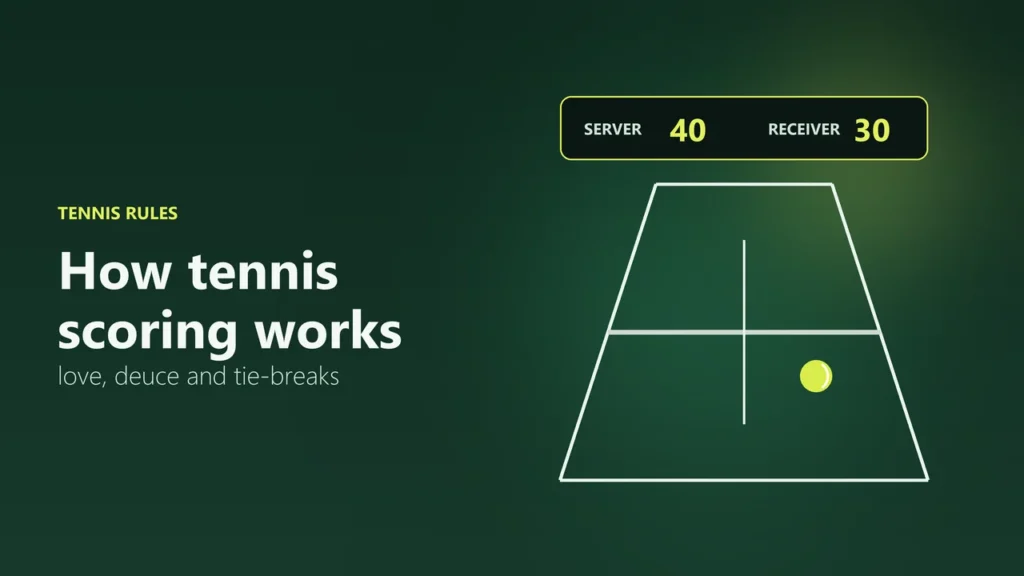
- Points in a game: love, 15, 30, 40, game
- 40-40: called “deuce”. You then need two points in a row to win the game
- A set: first to 6 games, at least 2 ahead. At 6-6, play a tie-break (first to 7 points, 2 ahead)
- A match: best of 3 sets (win 2) or best of 5 sets (win 3)
- Grand Slam final set: a 10-point tie-break at 6-6
How points are scored in a tennis game
A standard game is scored like this, according to Rule 5 of the ITF rules:
| Points won | What the umpire calls |
|---|---|
| 0 | Love |
| 1 | 15 |
| 2 | 30 |
| 3 | 40 |
| 4 | Game (if the other player has 2 points or fewer) |
The server’s score is always called first. So “30-15” means the server has won two points and the receiver has won one. “15-30” means the receiver is ahead. “Love-40” means the server has not won a point yet and the receiver needs one more point to win the game.
Why 15, 30 and 40 instead of 1, 2 and 3? Nobody knows for sure. There are several popular stories, but none has been proven. The ITF rules simply set the calls.
What deuce and advantage mean
When both players have won three points (40-40), the score is called “deuce”. From here, a player must win two points in a row to win the game:
- The player who wins the next point has “advantage”. Umpires often say “advantage” followed by the player’s name.
- If that player wins the next point too, they win the game.
- If the other player wins it instead, the score goes back to deuce.
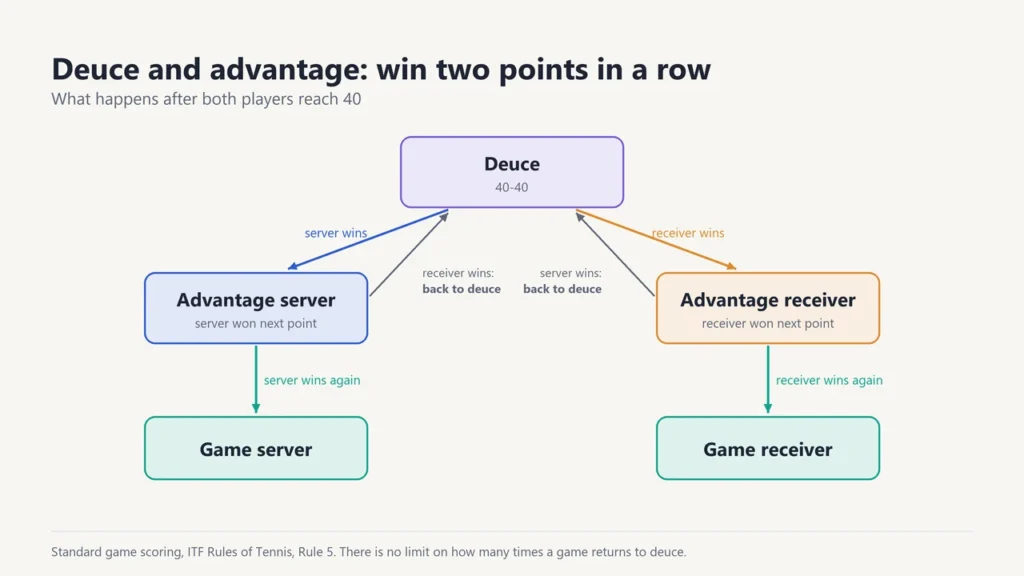
There is no limit on how many times a game can go back to deuce. That is why a single game can sometimes last many minutes.
How a set is scored
A set is won by the first player to win six games with a lead of at least two. So 6-4 ends a set, but 6-5 does not. At 6-5 the set goes on, and the leader can win it 7-5.
Rule 6 allows two ways to finish a close set. The event must announce which one it uses before it starts:
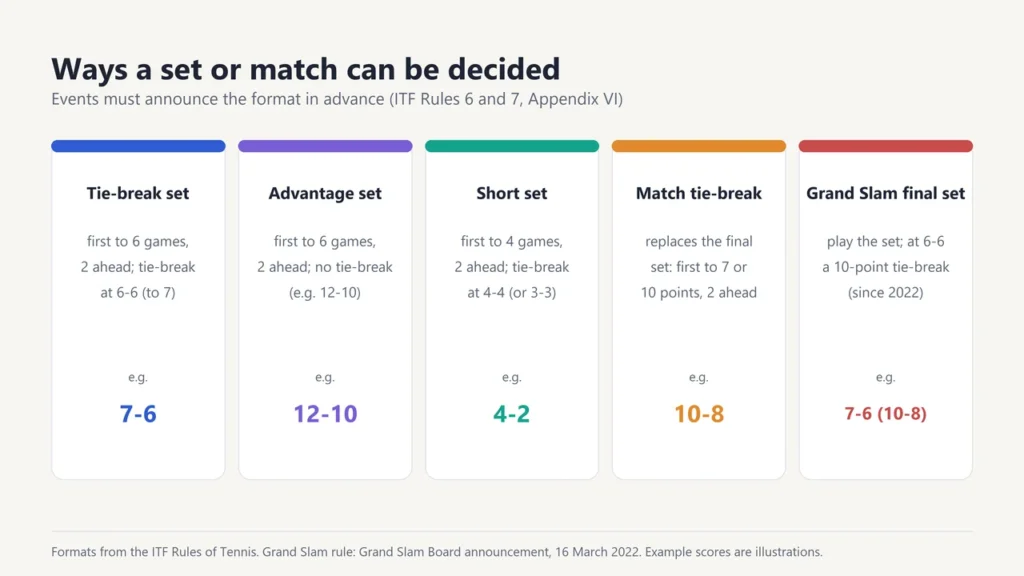
- Tie-break set: at 6-6, the players play one tie-break game to decide the set. The set score is then written 7-6. This is the usual method.
- Advantage set: no tie-break. Play continues until one player is two games ahead, such as 8-6 or 12-10.
Players change ends after the first, third and every following odd-numbered game of each set (Rule 10). That is why you see players switch sides at 1-0, 2-1, 3-2 and so on.
How a tie-break works
In a tie-break, points are counted in plain numbers: zero, 1, 2, 3 and so on. The first player to win seven points, with a two-point lead, wins the tie-break and the set. If it reaches 6-6, it continues until someone leads by two, such as 9-7.
The serving order is the part that confuses most people. Under Rule 5:
- The player whose turn it is to serve serves the first point only.
- The opponent then serves the next two points.
- After that, the players take turns serving two points each until the tie-break ends.
- Players change ends after every six points.
- The player who served first in the tie-break receives in the first game of the next set.
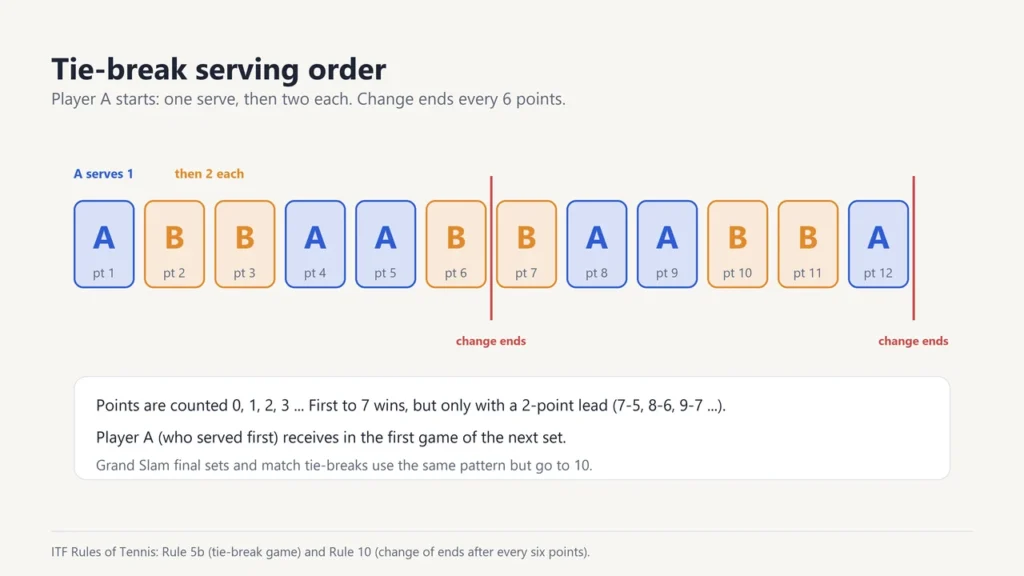
In results, a tie-break set is usually written with the loser’s tie-break points in brackets. So 7-6(5) means the winner took the set 7 games to 6 and won the tie-break 7-5.
How a tennis match is won
Rule 7 allows two match lengths:
- Best of three sets: the first player to win two sets wins the match. Most professional and club matches use this.
- Best of five sets: the first to win three sets wins. The men’s singles at the four Grand Slams use this format.
Here is how to read a full match score: 6-4, 3-6, 7-6(5). The winner took the first set 6-4, lost the second 3-6, and won the third set in a tie-break, 7 points to 5. That is two sets to one, so the match is over.
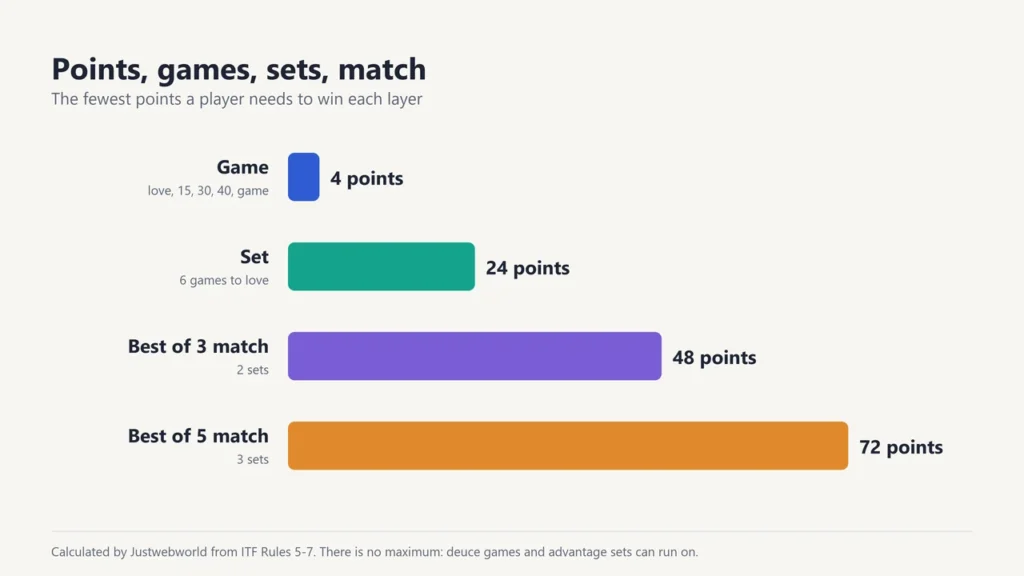
The shortest possible game, set and match
Because every layer needs a minimum number of wins, you can work out the fewest points needed:
| To win | Fewest points | How |
|---|---|---|
| A game | 4 | Win four points in a row (game to love) |
| A set | 24 | 6 games to love × 4 points |
| A best-of-three match | 48 | 2 sets × 24 points |
| A best-of-five match | 72 | 3 sets × 24 points |
How the final set works at the Grand Slams
On 16 March 2022, the Grand Slam Board announced one rule for all four majors: the Australian Open, Roland-Garros, Wimbledon and the US Open. If the final set reaches six games all, the players play a tie-break to 10 points, with a two-point lead. The Australian Open’s announcement said the change started at Roland-Garros that year.
The ITF rules list this as an approved option, the “final set tie-break (10 points)”. So at a Grand Slam, a final set can finish 7-6 with a tie-break score like 10-8.
Shorter scoring formats: No-Ad, short sets and match tie-breaks
Appendix VI of the ITF rules lists approved alternatives. Events must say in advance if they use them. You will often meet them in doubles, juniors and club leagues.
| Format | How it works |
|---|---|
| No-Ad scoring | At deuce, one deciding point is played. The receiver chooses which side to receive on. Whoever wins that point wins the game. |
| Short sets | First to 4 games with a 2-game lead. Tie-break at 4-4 (or at 3-3 if the organiser chooses). |
| Match tie-break (7 or 10 points) | At one set all (or two sets all in a best of five), one tie-break replaces the final set. First to 7 or 10 points, 2 ahead. |
| Final set tie-break (10 points) | The final set is played, and a 10-point tie-break decides it at 6-6. |
| No-Let rule | A serve that touches the net and lands in is in play, not replayed. |
Common tennis scoring mix-ups
- Calling the receiver’s score first. The server’s score always comes first. 15-40 means the server is behind.
- Thinking 6-5 wins a set. A set needs a two-game lead, or a tie-break at 6-6.
- Thinking a tie-break is won at 7-6. A tie-break also needs a two-point lead. 7-6 in points means play goes on.
- Expecting the first server to serve twice in a tie-break. They serve one point. Then it goes two each.
- Reading 7-6(5) as a 7-5 set. The (5) is the loser’s points in the tie-break, not the games.
Want to see these rules in the hands of the best? Read about the career of Novak Djokovic, or our list of the greatest female tennis players.
Frequently asked questions
Why is zero called “love” in tennis?
No one knows for certain. Popular explanations exist, but none is proven. The ITF rules simply use “Love” for zero points in a game.
What comes after 40 in tennis?
The next point wins the game, unless the score is 40-40. Then it is deuce, and a player needs two points in a row: one for “advantage”, one for the game.
How many games are in a set of tennis?
At least six. A set ends when one player has six games and a two-game lead (such as 6-3), or wins 7-5, or wins a tie-break at 6-6 (7-6). In an advantage set it can go higher, such as 10-8.
How many points do you need to win a tie-break?
Seven, with a two-point lead, in a normal tie-break. Match tie-breaks and Grand Slam final-set tie-breaks go to 10, also with a two-point lead.
Who serves first in a tie-break?
The player whose turn it is to serve. They serve one point, then the opponent serves two, and after that each player serves two points in turn.
What does “break of serve” mean?
It means the receiver won a game that the other player was serving. Servers usually win their own games, so a break is often the key moment in a set.
Is Wimbledon scored differently?
Not any more. Since 2022, all four Grand Slams, including Wimbledon, use the same 10-point tie-break when the final set reaches 6-6.