

Guest posting is worth it when you want to reach new readers who care about your topic, show what you know and get some interested visitors back to your site. It is not worth it as a way to build links for Google rankings. Google’s spam policies list links with optimized (keyword-stuffed) anchor text in guest posts as link spam, so a guest post campaign done mainly for links can hurt you instead of help.
This guide is for founders, marketers, freelancers and agencies deciding whether to write guest posts. It covers what a guest post can and cannot do, what Google says, how to judge a site before you pitch, how to measure results, and when a sponsored article or a product review fits better. For the how-to side (finding sites, pitching, writing), see our guest posting guide.
What is guest posting?
Guest posting means writing an article that is published on someone else’s website under your name. You usually get an author bio and sometimes a link to your own site. Google’s Search Central blog calls these contributor posts, guest posts, partner posts or syndicated posts.
Guest posts come in three main kinds, and the difference matters:
| Type | Who pays | What readers should be told | Link rule from Google |
|---|---|---|---|
| Free guest post | Nobody | Who wrote it and who they work for (byline and bio) | Editorial links are fine; keyword-stuffed links are link spam |
| Expert column or contributor post | Sometimes the site pays the writer | Who wrote it | Same as above |
| Sponsored (paid) article | The brand pays the site | That it is paid content (an ad) | Paid links must not pass ranking credit, for example rel=”nofollow” |
When guest posting is worth it
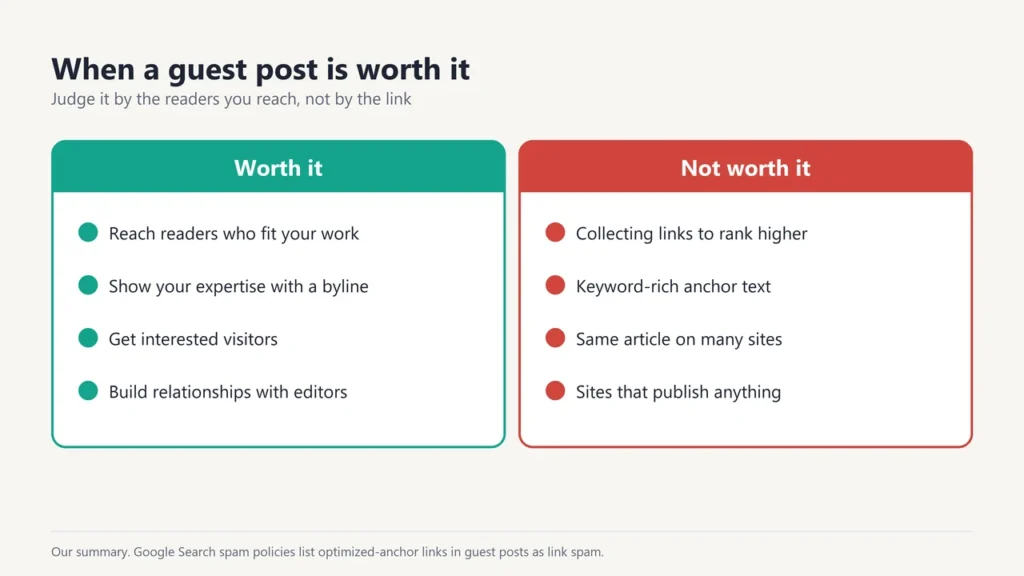
Guest posting pays off when the site’s readers are the people you want to reach. Google itself says it does not discourage these articles when they inform users, educate another site’s audience or bring awareness to your cause or company (Google Search Central blog, “A reminder about links in large-scale article campaigns”, May 2017).
A good guest post can give you:
- A new audience. Readers who would never find your site on their own see your best thinking.
- Proof of expertise. A byline on a respected site in your field is something you can show clients, editors and employers.
- Interested visitors. Readers who click through from a relevant article already know what you do.
- Relationships. Editors who like your work may invite you back or quote you later.
- A writing sample. One strong, public piece can win you more pitches than a portfolio page.
None of these depend on the link passing ranking credit. That is why a guest post can be worth it even when the link in your bio is nofollow.
When guest posting is not worth it
Guest posting is not worth it when the real goal is to collect links that push your pages up in Google. Google’s spam policies (last updated 28 August 2026) list “links with optimized anchor text in articles, guest posts, or press releases distributed on other sites” as an example of link spam. Paying for posts that contain links meant to pass ranking credit is also on the list.
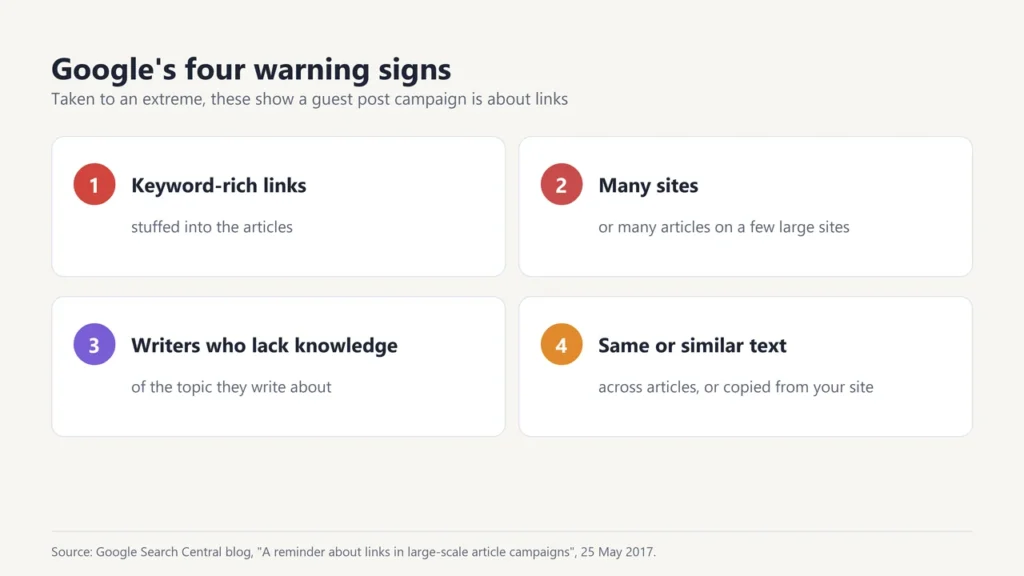
Google’s 2017 post names four signs that, taken to an extreme, show a guest post campaign is about links rather than readers:
- Stuffing keyword-rich links to your site into the articles.
- Publishing the articles on many different sites, or many articles on a few large sites.
- Using writers who don’t know the topic.
- Using the same or similar text across the articles, or copying articles from your own site.
Google also says a site that publishes articles with spammy links may be seen as lower quality, which can affect its ranking. So a low-quality guest post can harm the host site as well as do nothing for you. Guest posting is also a poor fit if you need results fast or at a fixed date. The editor decides if and when your piece goes live.
Does guest posting still work for SEO?
Not as a link-building shortcut. Guest posting can still help your search presence in indirect ways: more people learn your name and search for it, editors and writers who read your piece may cite you later, and you gain visitors who stay and come back. Google’s own advice in the same 2017 post is to focus on improving your site’s content, and links will follow.
Bulk guest posts are a bigger risk now that AI can write them in seconds. Google’s spam policies list using generative AI or similar tools to create many pages without adding value for users as scaled content abuse. One thoughtful article beats fifty generated ones.
Links in guest posts are not banned. A natural link that helps the reader, such as a link to a study you mention, is normal. The problem is links placed mainly to manipulate rankings. If a link in your guest post is there because you paid or traded for it, it must not pass ranking credit, for example by using rel=”nofollow”. Google’s spam policies say paid links are not a violation when they are qualified this way. For more on how links are judged, see what anchor text is and our guide to link building strategies.
How to tell if a site is worth a guest post
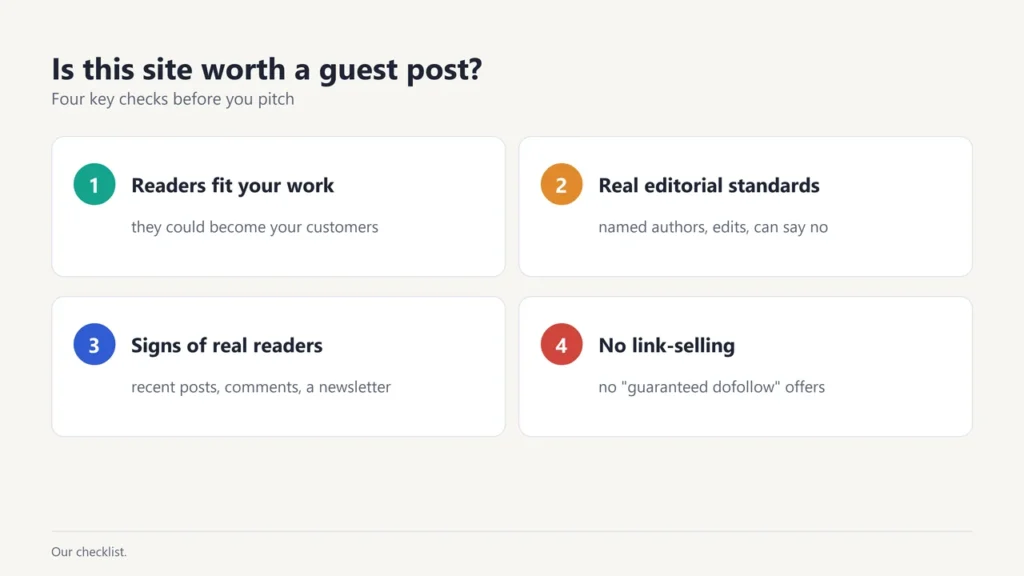
Judge the site by its readers and its standards, not by a third-party score. Check these before you pitch:
- Fit: it covers your topic, and its readers could become your customers or clients.
- Real content: named authors, an editorial policy and articles that answer questions well.
- Signs of real readers: recent posts, comments or shares, an active newsletter or social page.
- Editing: the editor asks for changes and can say no. A site that publishes anything is a warning sign.
- Search presence: search for the site’s name and a topic it covers. If it is hard to find, its articles probably are too.
Walk away from sites that sell guaranteed “dofollow” links, promise rankings, or publish posts on unrelated topics side by side (casino, loans and recipes on one blog). Google’s site reputation policy targets sites that host third-party content mainly to use the host’s ranking signals. It also says editorial columns, opinion pieces and work of an editorial nature are not a problem.
How to make a guest post worth the time
- Pick one goal. Reach, credibility or visits. It decides which sites you pitch and how you judge the result.
- Pitch a few well-matched sites. A short list of sites your buyers really read beats a long list of sites that accept anything.
- Write your best piece, not a spare one. Share original experience, data you collected yourself or a clear method. Editors and readers notice.
- Keep links useful. Link only where it helps the reader. Let the editor decide the link attributes.
- Write a real author bio. Say who you are and what you do, in one or two lines, with one link.
- Promote it. Share the post with your own audience. It helps the host and brings readers to your words.
- Track it. Add UTM tags to the link in your bio if the editor allows it, then watch referral visits and sign-ups in Google Analytics.
- Ask before you republish. If the same article will appear on both sites, agree with the host which copy is the original. For a guest post that copies an article already on your own site, Google’s 2017 post advises rel=”canonical” plus rel=”nofollow”.
Our guide to blogger outreach tools can help you find editors and keep track of pitches.
A note for freelancers and agencies
If you are a freelance writer and your goal is income, a paid contributor role is often a better use of your time than a free guest post. Some publications pay contributors. If you run an agency, be careful with “guest post packages” that promise a set number of followed links: the link-spam risk falls on your client’s site.
How to measure if your guest post worked
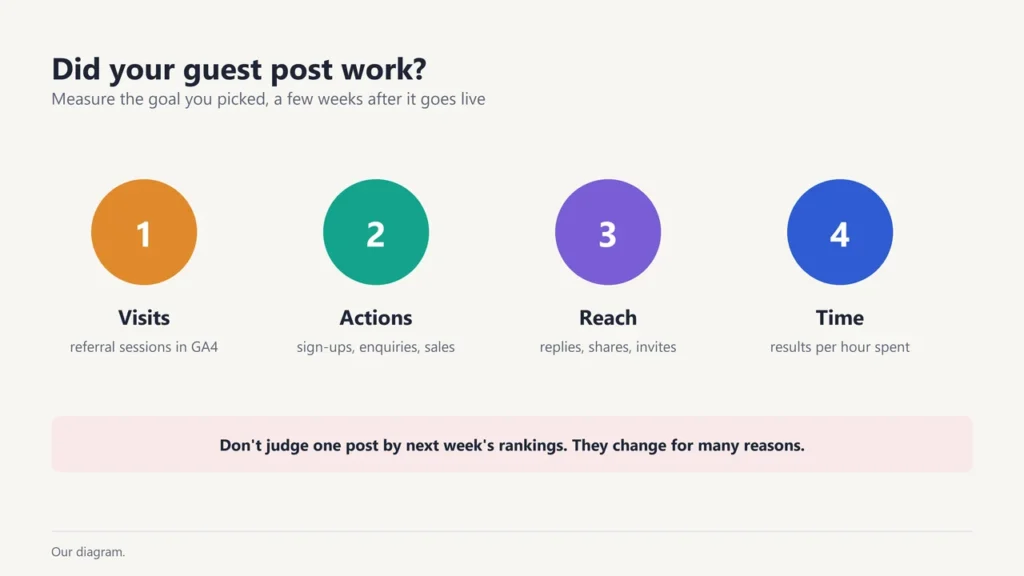
Measure the goal you picked, a few weeks after the post goes live:
- Visits: sessions from the host site in the Traffic acquisition report of Google Analytics 4 (change the table’s main dimension to Session source / medium and look for the host’s domain followed by “/ referral”).
- Actions: newsletter sign-ups, enquiries or sales from those visits.
- Reach: replies, shares, new followers and invitations to write or speak.
- Time: how many hours the post took. Divide your results by the hours to compare it with other channels.
Don’t judge a guest post by whether your rankings rose the next week. Rankings change for many reasons, and one post rarely explains them.
Guest post, sponsored article or product review?
If guest posting is too slow or too uncertain for your goal, two other routes reach a site’s readers:
- Sponsored article: you pay for a placement on an agreed date. It is an ad, so readers must be able to tell it is an ad; in practice that means a clear label. The US Federal Trade Commission’s guide to native advertising says “the watchword is transparency” and asks for disclosures in clear and unambiguous language. Paid links in it must not pass ranking credit. See how to advertise on blogs.
- Product review: you send a product and the reviewer decides what to say. Readers should be told the product was free (the FTC treats a free product as a material connection that must be disclosed). Any link to you must not pass ranking credit, because Google’s spam policies list sending a product in exchange for a review with a link as link spam. See how to get your product reviewed.
Other countries have their own advertising rules (for example, the UK’s CMA and ASA). Check the rules where your readers live. This guide is general information, not legal advice.
Want to reach Justwebworld readers?
Justwebworld is a digital magazine publishing since December 2012, with 8,000+ articles across 20 topics and a public editorial policy. We offer sponsored articles, product reviews, banner placements and newsletter sponsorship. Pricing is on request, and the team usually replies within 24-48 hours. Accepted drafts are edited to our house standards, links are an editorial decision, and we never promise backlinks, rankings or traffic. See Advertise with Justwebworld for the details, or email [email protected]. Expert writers can see Write for Us; free guest posting is closed.
Frequently asked questions
Is guest posting worth it for SEO?
Only indirectly. It can bring new readers, brand searches and natural mentions later. Using guest posts to build keyword-rich links for rankings is listed as link spam in Google’s spam policies.
Are guest post links bad for SEO?
No, not by default. A natural, useful link is fine. Links with optimized anchor text, links you paid for that pass ranking credit, and the same article spread across many sites are the problem.
Should links in guest posts be nofollow?
Links that were paid for or traded must not pass ranking credit, for example by using rel=”nofollow”. For an unpaid guest post, the host site’s editor decides. Google’s 2017 advice was for hosts to check that links of questionable intent use nofollow.
Is it OK to pay for a guest post?
Paying for a placement is normal advertising, but it makes the post an ad that readers must be able to recognise. What Google calls link spam is buying posts to get links that pass ranking credit.
How many guest posts should I write?
No set number works for everyone. A few strong posts on well-matched sites are worth more than many weak ones. Google names publishing articles across many sites as a warning sign when it is taken to an extreme.
Is guest posting free?
On many sites, yes: you give your time and your writing, and nobody pays. Some sites only accept paid, sponsored articles. Those are ads and must be disclosed as ads.
Does Justwebworld accept guest posts?
Free guest posting is closed. Expert writers can apply through Write for Us, and brands can ask about sponsored articles and reviews on the Advertise page.

Justwebworld has published guides since 2012. How we write and update articles Report an error
