

An invoice should include a unique invoice number and the date. It needs your business details and the customer’s name and address. It should describe what you supplied, the amount charged, any tax (such as VAT or GST) and the total due. Many countries add extra rules if you are registered for sales tax.
Getting an invoice right means you get paid faster and stay on the right side of tax rules. This guide gives a simple checklist that works almost anywhere. Then it shows the official rules in the UK, the EU and Australia as examples. Rules differ by country, so always check your own tax authority’s guidance.
- Who and when: invoice number, invoice date, supply date
- From and to: your business details and the customer’s details
- What: a clear description, quantity and price of each item
- How much: subtotal, tax amount and rate, total due
- How to pay: payment terms, due date and payment details
Invoice checklist: what to include
| Item | Why it matters |
|---|---|
| Unique invoice number | Lets you and your customer track each invoice; tax rules often require a sequence |
| Invoice date | Starts the clock for payment terms |
| Date of supply | When the goods or services were provided, if different |
| Your business name, address and contact details | Shows who is charging and where to send payment questions |
| Customer’s name and address | Shows who owes the money |
| Description of goods or services | Avoids disputes about what is being charged |
| Quantity and unit price | Makes the maths easy to check |
| Tax rate and tax amount | Needed if you charge VAT, GST or sales tax |
| Total amount due | The single number the customer must pay |
| Payment terms and details | Due date, accepted methods and bank details |
UK invoice requirements
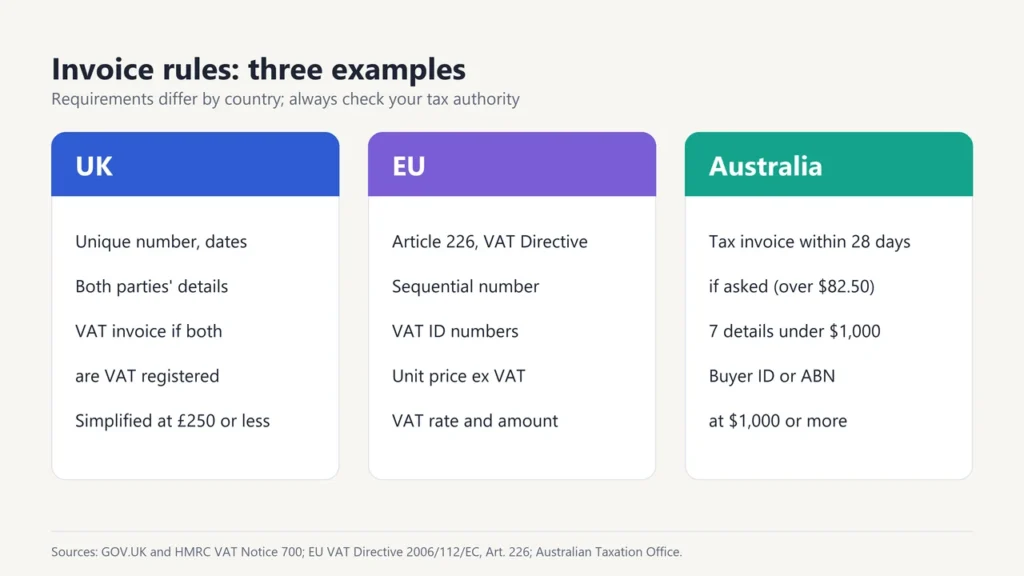
UK government guidance lists what an invoice must include. You need a unique number and your company name, address and contact details. Add the customer’s name and address and a clear description of what you are charging for. Show the supply date, the invoice date, the amounts, any VAT and the total owed.
- Sole traders must also show their name and any business name, plus an address where legal documents can be delivered if they use a business name.
- Limited companies must use their full company name, exactly as it appears on their certificate of incorporation. If you list any directors’ names, you must list all of them.
VAT invoices. If you and your customer are VAT registered, you must use VAT invoices. HMRC’s VAT Notice 700 adds more details for a full VAT invoice. It must show your VAT registration number and the time of supply (the tax point). For each item, show the quantity, the VAT rate and the amount without VAT. Then show the total VAT in pounds sterling. For sales of £250 or less, you can usually issue a simpler, less detailed VAT invoice if the customer agrees.
EU invoice requirements
Across the European Union, Article 226 of the EU VAT Directive (2006/112/EC) lists the details required on VAT invoices. They include:
- the date of issue;
- a sequential number that uniquely identifies the invoice;
- the seller’s VAT identification number, and in some cases the customer’s;
- the full name and address of the seller and the customer;
- the quantity and nature of the goods or services;
- the date of supply, where it differs from the invoice date;
- the taxable amount per rate, the unit price excluding VAT and any discounts;
- the VAT rate and the VAT amount payable.
Each EU country writes these rules into its own law, and some add more, so check the guidance of the country you invoice from.
Australia tax invoice requirements
In Australia, a GST-registered business must give a tax invoice within 28 days if a customer asks for one, unless the sale is $82.50 or less including GST. According to the Australian Taxation Office (ATO), a tax invoice for a taxable sale under $1,000 must clearly show 7 details:
- that the document is intended to be a tax invoice;
- the seller’s identity;
- the seller’s Australian business number (ABN);
- the date it was issued;
- a brief description of the items sold, including quantity and price;
- the GST amount, or the words “Total price includes GST” if GST is exactly one-eleventh of the total;
- the extent to which each sale is taxable.
For sales of $1,000 or more, the invoice must also show the buyer’s identity or ABN.
Invoice example
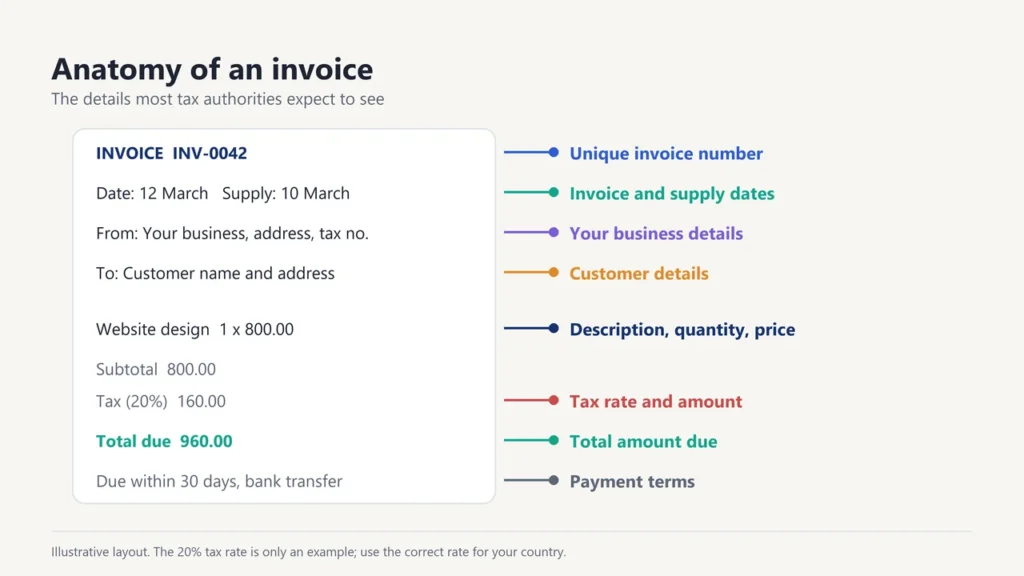
Here is a simple layout. Replace the details with your own and add the tax details your country requires:
| Invoice no. | INV-0042 |
| Invoice date / supply date | 12 March / 10 March |
| From | Your business name, address, email, tax number |
| To | Customer name and address |
| Item | Website design, 1 × 800.00 |
| Subtotal | 800.00 |
| Tax (20%) | 160.00 |
| Total due | 960.00 |
| Payment terms | Due within 30 days, by bank transfer to the account shown |
Tips to get paid faster
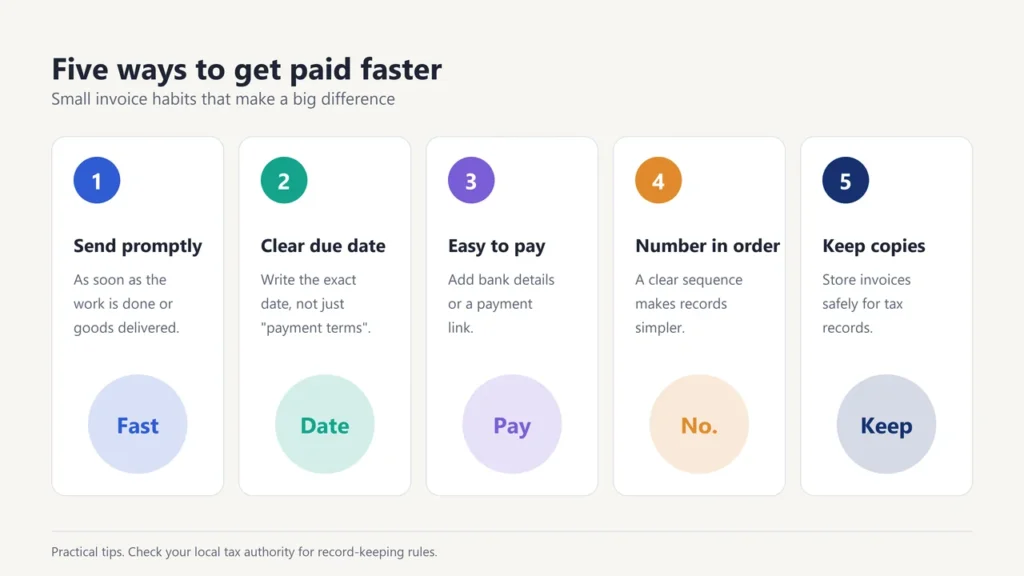
- Send it promptly, as soon as the work is done or the goods are delivered.
- State a clear due date, not just “payment terms”, so there is no confusion.
- Make paying easy. Include bank details or a payment link, and say which methods you accept.
- Number invoices in order. A clear sequence makes records and tax returns simpler.
- Keep copies. Tax authorities expect you to keep business records, so store invoices safely.
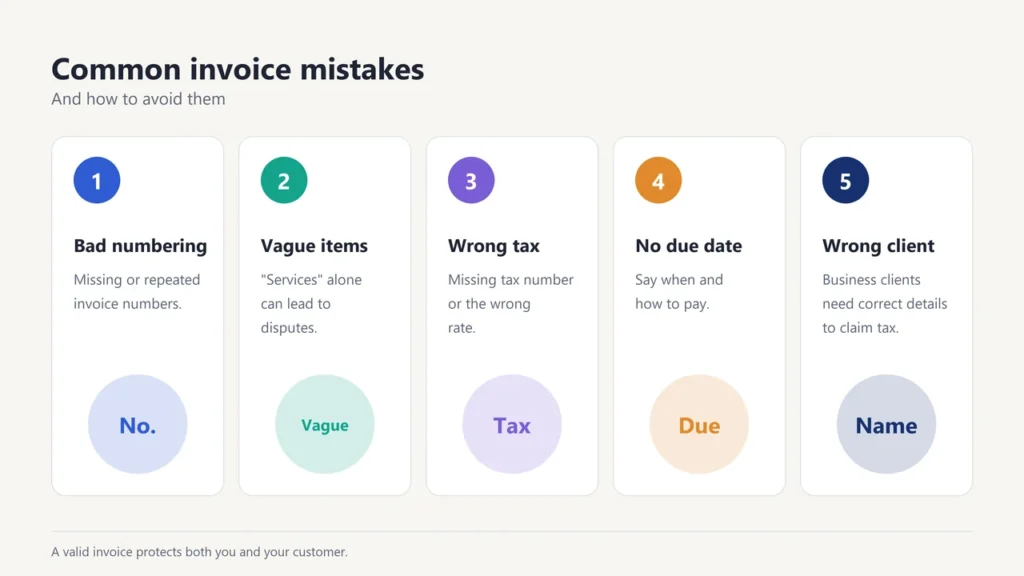
Common invoice mistakes
- Missing or repeated invoice numbers. Many tax rules require a unique sequence.
- A vague description, like “services”, which can lead to disputes.
- Wrong tax details, such as a missing tax number or the wrong rate.
- No due date or payment details.
- Wrong customer details, especially for business customers who need a valid invoice to claim tax back.
Want to save time on billing? See our guides to a free invoice generator, the benefits of an invoice template and how to choose an invoice app.
Frequently asked questions
What must an invoice include?
At minimum: a unique number, the date, your details and the customer’s details. Add a description, the amount, any tax and the total due. Check your country’s tax rules for extra items.
Does an invoice need an invoice number?
Yes. The UK requires a unique number on every invoice. The EU VAT Directive requires a number in sequence for each one.
What is the difference between an invoice and a receipt?
An invoice asks for payment; a receipt confirms that payment has been made.
What is a VAT invoice?
It is an invoice from a VAT-registered business. It shows extra details, such as the VAT number, rate and amount. This lets a VAT-registered customer claim the VAT back.
What does “net 30” mean on an invoice?
It means payment is due within 30 days of the invoice date. Writing the exact due date as well avoids confusion.
Can I send invoices by email?
Yes, digital invoices are widely used. Make sure they contain all the required details and that you keep copies for your records.

Justwebworld has published guides since 2012. How we write and update articles Report an error
