

Paid, owned and earned media are three ways people find out about a brand. Paid media is space you pay for, like ads or a sponsored article. Owned media is channels you control, like your website, blog or email list. Earned media is attention other people choose to give you for free, like news coverage, reviews and shares.
Most brands use all three. This guide explains each type with simple examples, where the lines blur (influencers, guest posts, social media), which rules apply to paid content, and how to measure each one honestly.
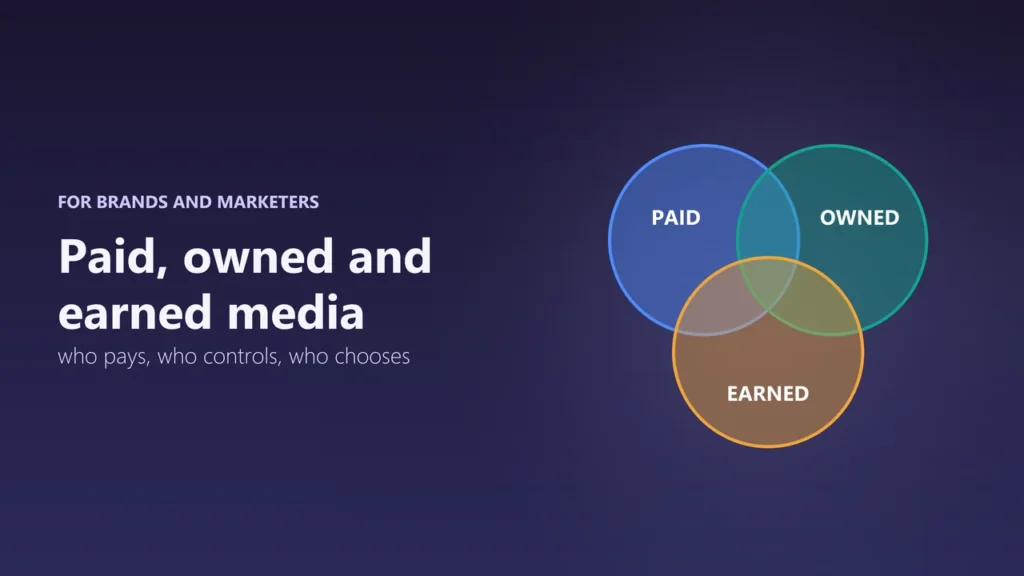
Paid, owned and earned media at a glance
| Paid media | Owned media | Earned media | |
|---|---|---|---|
| What it is | Space or reach you pay for | Channels you run yourself | Attention others give freely |
| Who decides what runs | You, within the seller’s rules | You | Editors, reviewers, customers |
| Examples | Search ads, social ads, banners, sponsored articles, paid newsletter slots | Website, blog, email newsletter, app, podcast | News stories, independent reviews, word of mouth, unpaid shares |
| Main strength | Fast, set date and reach | Full control, builds over time | High trust |
| Main weakness | Stops when you stop paying | Slow to grow an audience | You cannot control or buy it |
| Disclosure needed? | Usually. Readers must not be misled about what is paid | Your own brand is clear | No paid relationship, so no ad label |
What is paid media?
Paid media is any placement you pay money for. You decide the message, the timing and often who sees it.
Common examples:
- Search ads and social media ads
- Display banners on websites
- Sponsored articles and paid product reviews on blogs and magazines
- Paid slots in newsletters and podcasts
- Payments to influencers or creators to post about you
Paid media is quick. You can reach new people on a set date. The weakness is simple: when the budget stops, the reach stops.
Rules for paid media
Paid content must not pretend to be independent. In the US, the Federal Trade Commission (FTC) says in its native advertising guide that it is deceptive to mislead people about the commercial nature of content. Its watchword is “transparency”. In the UK, the CAP Code says marketing must be obviously identifiable as such. The FTC’s Endorsement Guides Q&A also says the law applies if a brand pays you or gives you something of value to mention its product, including free products or perks given with the expectation that you will promote them.
Google has its own rule for links. It says buying and selling links is a normal part of the web for advertising and sponsorship, as long as the links are qualified so they do not pass ranking credit, for example with rel=”nofollow”. You can read more in our guide to what sponsored content is and how to advertise on blogs.
What is owned media?
Owned media is any channel you control. You choose what goes on it, when, and how it looks.
- Your website and blog
- Your email newsletter and customer list
- Your app
- Your podcast or video series on your own site
- Guides, tools, case studies and help pages you publish
Owned media costs time more than money. It grows slowly, but it keeps working after a campaign ends. A helpful guide you publish today can still bring visitors years later.
What about your social media accounts? You run them, but the platform sets the rules and decides who sees your posts. Many people simply count your own social accounts as owned media. The PESO model splits them out as a separate type called “shared media” (see below), because you do not fully control them.
What is earned media?
Earned media is attention you did not pay for. Someone else chose to talk about you because they found you useful or interesting.
- A news site or magazine writes about your company
- An independent reviewer covers your product
- A customer recommends you to a friend
- People share your post or video without being paid
- Another website links to your guide because it helps its readers
Earned media carries trust, because an outside person chose it. That is also why you cannot buy it. If you pay for the mention, or give a free product on the condition of a positive post, it is no longer purely earned. It becomes a paid relationship that must be disclosed.
To learn how to win news coverage, see our step-by-step guide on how to get media coverage.
What about shared media and the PESO model?
Some marketers add a fourth type: shared media, meaning social media. The PESO model (paid, earned, shared, owned) was created by Gini Dietrich of the PR blog Spin Sucks. Spin Sucks says the model officially launched in 2014, when the book Spin Sucks was published. In a 2020 article on the model, Spin Sucks describes shared media as what you know as social media, and says owned media is called “owned” because you own it and are not renting it to anyone.
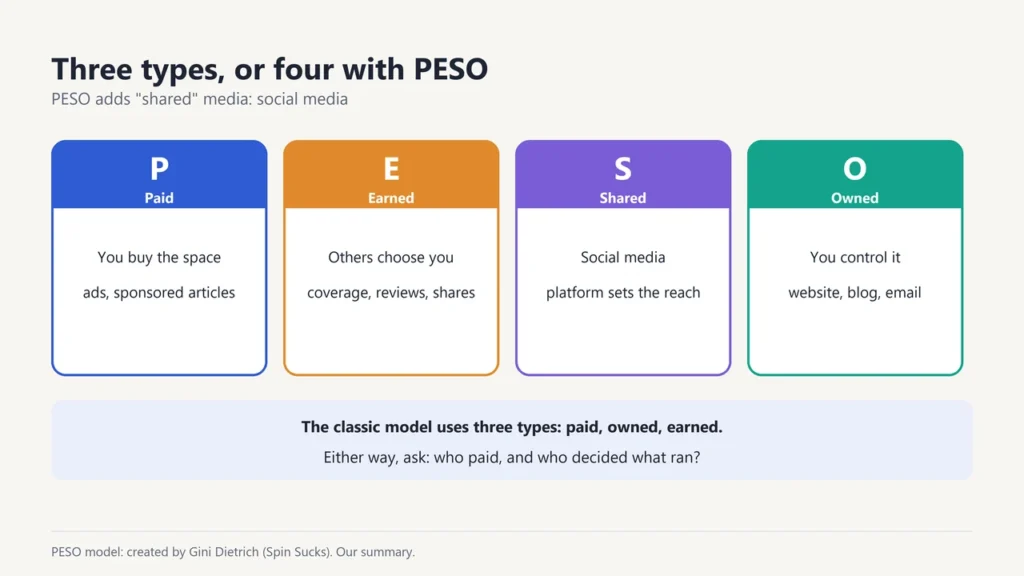
You do not have to use four types. The key idea is the same: who controls the message, and who paid for it.
How paid, owned and earned media work together
The three types work best as a loop. Here is a simple example for a small business that sells home coffee machines:
- Owned: it publishes a clear guide on how to clean a coffee machine on its own blog.
- Paid: it runs a small ad and a clearly labelled sponsored article to put that guide in front of new readers.
- Earned: some readers share the guide, a home-appliance blogger mentions it, and a local paper quotes the owner in a story about small shops.
- Back to owned: new visitors join the email list, so the brand can reach them again for free.
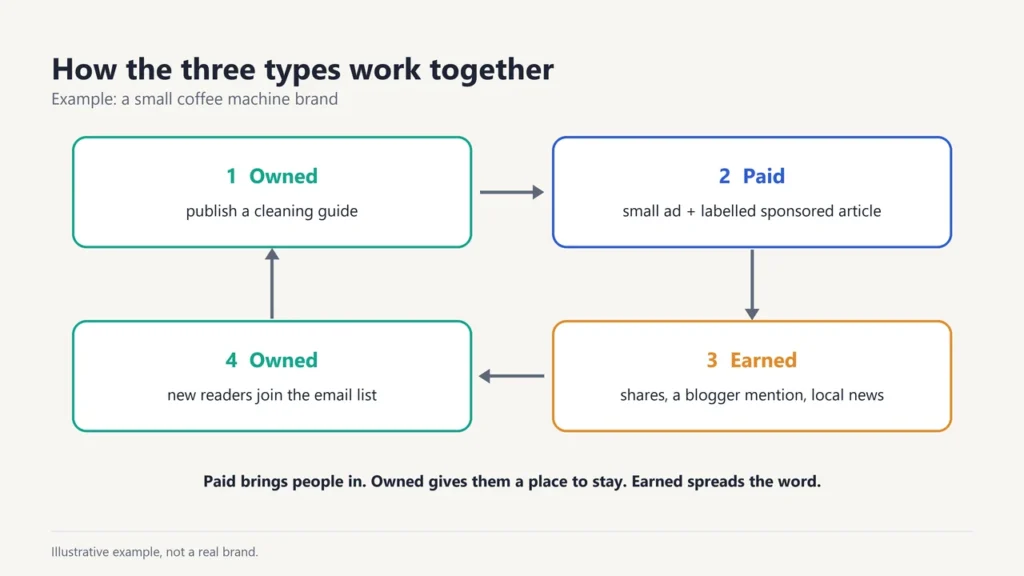
Paid media brings new people in quickly. Owned media gives them a place to stay. Earned media helps the word spread beyond your budget.
Grey areas: which type is it?
Real campaigns often mix the types. Ask two questions: who paid, and who decided what was published?
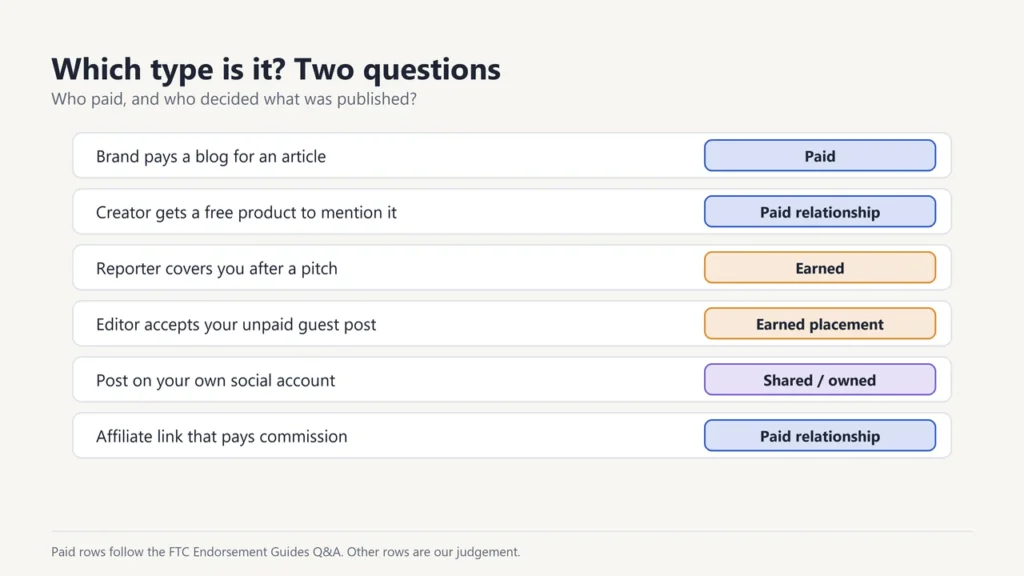
| Situation | Usually counts as | Why |
|---|---|---|
| A brand pays a blog for an article | Paid | Money changed hands. Readers must not be misled into thinking it is independent. |
| A creator posts about a product they were sent free, expecting a mention | Paid relationship | The FTC treats free products given for promotion as something of value. Disclose it. |
| A reporter writes about you after your pitch | Earned | The editor chose to run it, and nobody was paid. |
| You write an unpaid guest post that an editor accepts | Earned placement of content you wrote | The editor chose it. See is guest posting worth it? |
| Your post on your own social account | Shared (or owned, in the three-type model) | You run it, but the platform controls reach. |
| A customer’s unpaid review | Earned | They chose to write it. |
| An affiliate link that pays you a commission | Paid relationship | A commission is a payment. Disclose it near the link. |
If you are paying or giving something of value, treat it as paid and make that clear to readers. Our guide on how to get your product reviewed covers review requests in more detail.
How to measure each type
Each type needs different measures. Use numbers you can actually see in your own tools.
- Paid: cost per click, cost per sign-up or sale, and how many people the placement reached. Tag your links with UTM codes so you can see which placement worked.
- Owned: visits, time on page, email sign-ups, returning visitors, and sales from your site.
- Earned: where you were covered, whether your key message was in it, referral visits, and new enquiries that mention the article or review.
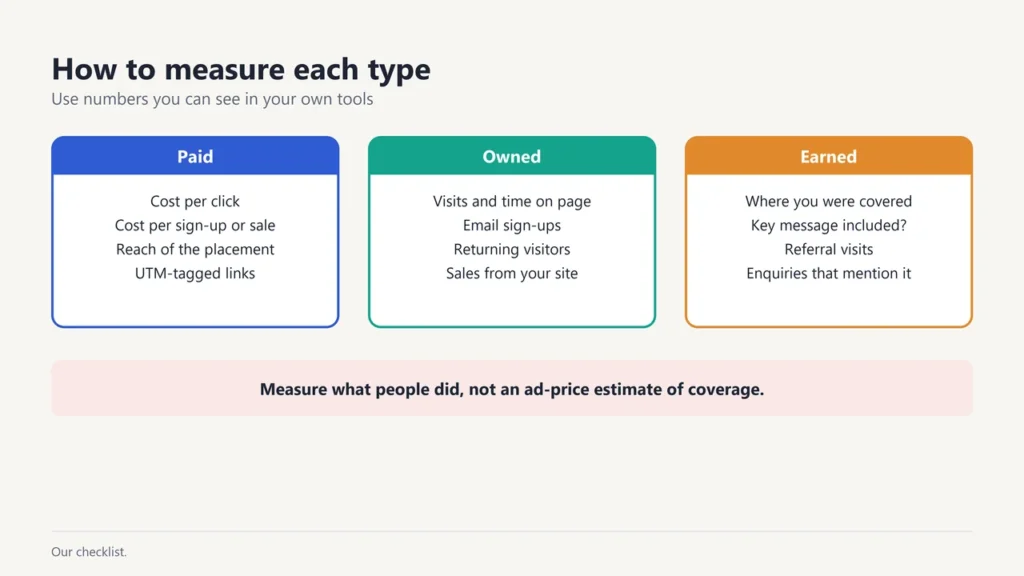
Avoid putting an ad-price value on earned coverage. Our guide on how to get media coverage explains how to measure coverage honestly. Focus on what people did.
Which type should you start with?
Match the channel to the goal:
| Your goal | Lean on | Why |
|---|---|---|
| Reach new people on a set date | Paid | You control timing and reach |
| Build trust with new buyers | Earned | An outside voice chose to talk about you |
| Keep people coming back | Owned | You can reach them again for free |
| Start conversations | Shared (social) | People can reply and share |
Example: planning a simple mix
This is an example to show the thinking, not a recommended budget. A small online bakery wants more local orders before a holiday:
- Owned first: add a clear holiday order page and a short guide to ordering on time.
- Paid next: run a small local ad pointing to that page for two weeks before the holiday.
- Earned alongside: pitch a local news site or food blogger a real story, such as a new recipe or a local supplier.
- Check results: compare orders and sign-ups from each source using tagged links.
More general starting points:
- New brand with little money: start with owned media. Build a website with useful pages and an email list. Then pitch a few relevant journalists or bloggers for earned coverage.
- Launch with a fixed date: add paid media so the right people see it on time.
- Established brand: keep owned content fresh, use paid media to test new audiences, and earn coverage with real news and data.
A common mistake is spending only on paid media. When the budget ends, nothing is left. Owned and earned media build value you keep.
Frequently asked questions
What is the difference between paid, owned and earned media?
Paid media is space you buy, such as ads or sponsored articles. Owned media is channels you control, such as your website and email list. Earned media is attention others give you for free, such as news coverage, reviews and shares.
Is social media owned or earned media?
It can be any of the three, depending on the post. Your own posts on your account are usually called owned or “shared” media. Ads on social media are paid. When other people share or talk about your post without being paid, that is earned.
Is SEO paid, owned or earned?
Your web pages are owned media. Unpaid visits from search results are often described as earned, because the search engine chose to show your page. Search ads are paid media.
Is influencer marketing paid or earned?
If you pay the creator or give them something of value to post, it is paid, and the post must make that clear. If a creator talks about you on their own, with no deal, it is earned.
What is the PESO model?
PESO stands for paid, earned, shared and owned media. It was created by Gini Dietrich of Spin Sucks. It adds “shared” media, meaning social media, to the three classic types.
Is a sponsored article paid or earned media?
A sponsored article is paid media, even though it appears on another site. You paid for it, so make sure readers are not misled about that. In the US and UK, a paid article that promotes you should be clearly labelled.
Which is more trusted: paid or earned media?
Earned media often carries more trust, because someone outside the brand chose it. Paid media is still useful when it is clearly labelled and genuinely helpful to readers.
Want to reach Justwebworld readers?
Justwebworld is a digital magazine that has published since December 2012, with 8,000+ articles across 20 topics and a public editorial policy. We offer sponsored articles, product reviews, banner placements and newsletter sponsorship. Pricing is on request, and the team usually replies within 24-48 hours. We never promise backlinks, rankings or traffic. See Advertise with Justwebworld for the details. Expert writers can see Write for Us; free guest posting is closed.

Justwebworld has published guides since 2012. How we write and update articles Report an error
