

In rugby union, a try is worth 5 points, a conversion 2, a penalty goal 3, a dropped goal 3 and a penalty try 7. In rugby league, a try is worth 4 points, a conversion or penalty goal 2 and a drop goal 1. The team with the most points at the end wins.
This guide explains each way to score, using World Rugby’s Laws of the Game for union and the International Rugby League (IRL) laws for league. It also covers sevens, bonus points in tournament tables, and a few surprising facts, such as which scores a union team can never finish on.
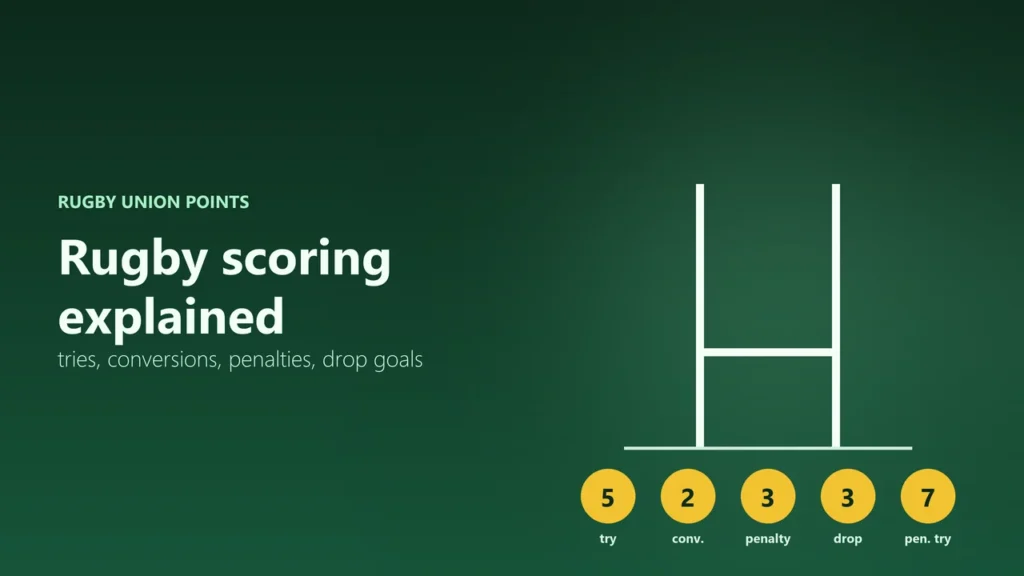
Rugby union scoring at a glance
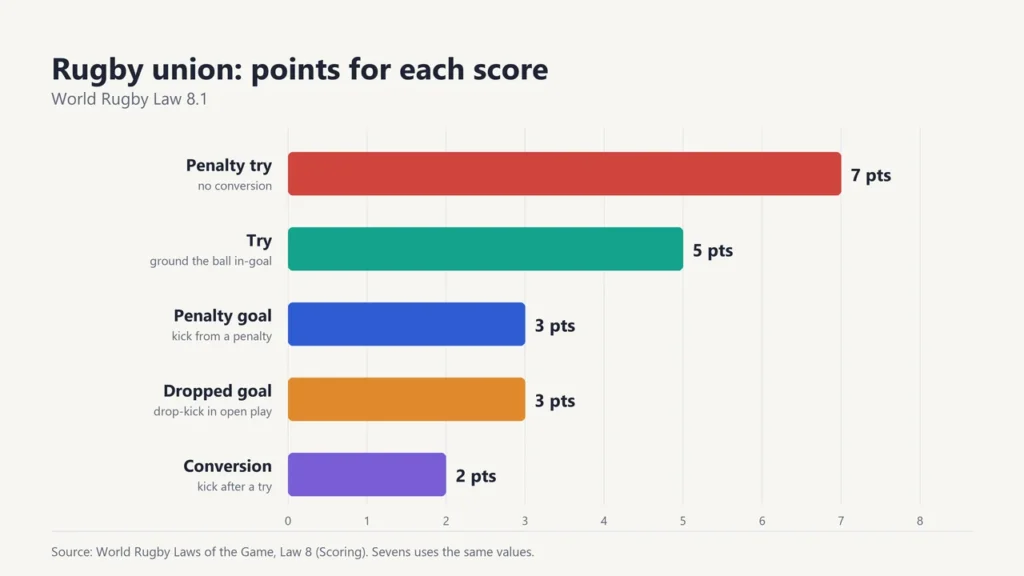
World Rugby Law 8.1 sets five ways to score:
| Score | Points | How you get it |
|---|---|---|
| Try | 5 | Ground the ball in the opponents’ in-goal area |
| Conversion | 2 | Kick the ball over the bar after a try |
| Penalty try | 7 | Awarded when foul play stops a probable try |
| Penalty goal | 3 | Kick at goal after the other team gives away a penalty |
| Dropped goal | 3 | Drop-kick the ball over the bar during open play |
A try followed by a successful conversion is worth 7 points in total. People often call it a “converted try”.
What is a try?
A try is the main way to score. It is worth 5 points in union. Under Law 8.2, a try is scored when an attacking player is first to ground the ball in the opponents’ in-goal area. That is the area between the try line and the dead-ball line.
Law 21.1 explains “grounding”. A player can hold the ball and touch the ground with it, or press down on the ball with a hand or hands, arm or arms, or the front of the body from the waist to the neck.
Law 8.2 also covers a few special cases:
- A scrum, ruck or maul is pushed over the try line and an attacker grounds the ball.
- A player is tackled just short, but their momentum carries them over in one movement.
- A tackled player near the line reaches out at once and grounds the ball.
How does a conversion work?
A conversion is a kick at goal taken after a try. It scores 2 points. Under Law 8.7, it can be a place-kick (from the ground or a kicking tee) or a drop-kick.
- The kick is taken from anywhere on a line through the spot where the try was scored, parallel to the touchlines. So a try scored near the corner gives a harder, wider kick. That is why players try to ground the ball near the posts.
- To succeed, the ball must go over the crossbar and between the posts (Law 8.4). If it goes higher than the posts, the kick counts if it would have gone between them had they been taller (Law 8.5).
- The defending team waits behind its try line. Its players may charge at the kicker once the kicker starts the run-up (Law 8.14), and they must not shout (Law 8.15).
- Time limit: the kicker has 60 seconds (playing time) from when the try is awarded. World Rugby lists this as a global law trial (Law 8.8c), so it may change.
- A team can choose not to take the conversion.
What is a penalty try?
A penalty try is worth 7 points, and no conversion is taken. Under Law 8.3, the referee awards it when foul play by the defending team stops a probable try, or stops a try being scored in a better position. It is awarded between the posts. The player who committed the foul must be shown a yellow card or sent off.
Penalty goals and dropped goals
Both are worth 3 points in union, but they happen in different ways.
Penalty goal
When the other team commits an offence, the referee may award a penalty. The team can then choose to kick at goal. Under Law 8.19 to 8.21:
- The team must say early that it will kick at goal. It can tell the referee, or show it by bringing out a kicking tee or sand, or by making a mark on the ground.
- Once it says it will kick at goal, it must kick at goal.
- The kick must be taken within 60 seconds (playing time) of that signal.
Teams do not always take the 3 points. They may kick the ball into touch instead. When a penalty is kicked into touch, the kicking team throws in at the lineout (Law 18), often close to the try line, and tries to score a try.
Dropped goal
A dropped goal is scored when a player drops the ball and kicks it on the half-volley over the bar during open play (Law 8.28). A team can try one from anywhere in open play, so it can be useful in a close match. One limit: a team given a free-kick cannot score a dropped goal until the ball is next dead or an opponent has played or touched it, or tackled the ball-carrier (Law 8.29).
Which scores are impossible in rugby union?
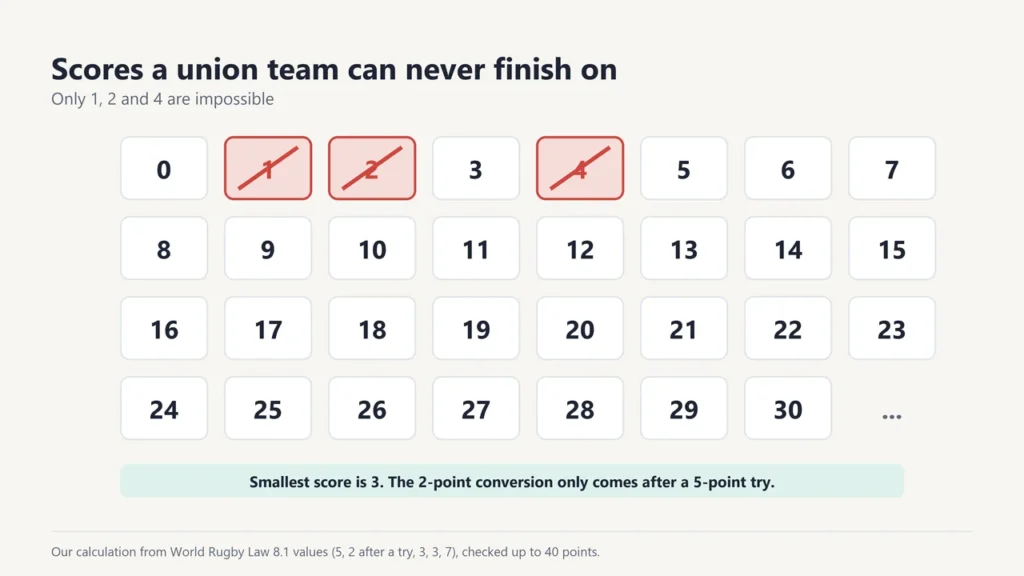
In union, a team can never finish a match on 1, 2 or 4 points. Every other whole number is possible.
This follows from the values. The smallest score is 3 (a penalty or dropped goal). The 2-point conversion only comes after a 5-point try. So 1, 2 and 4 cannot be made. But 3, 5, 6 (3+3), 7, 8 (5+3), 9 (3+3+3), 10 (5+5) and 11 (5+3+3) can. Once you can make those, adding 3 more points reaches every higher number. We also checked every combination up to 40 points with a short script.
Rugby sevens scoring
Rugby sevens uses the same points as fifteen-a-side union: 5 for a try, 2 for a conversion, 3 for a penalty goal or dropped goal, and 7 for a penalty try. The main differences are in how the kicks are taken. World Rugby’s sevens variations say:
- A conversion must be a drop-kick, not a place-kick, and it must be taken within 30 seconds (playing time) of the try being awarded.
- At a conversion, the defending players gather close to their own 10-metre line instead of waiting behind the try line to charge.
- A penalty kick at goal must also be a drop-kick, within 30 seconds (playing time) of the team saying it will kick.
Rugby league scoring
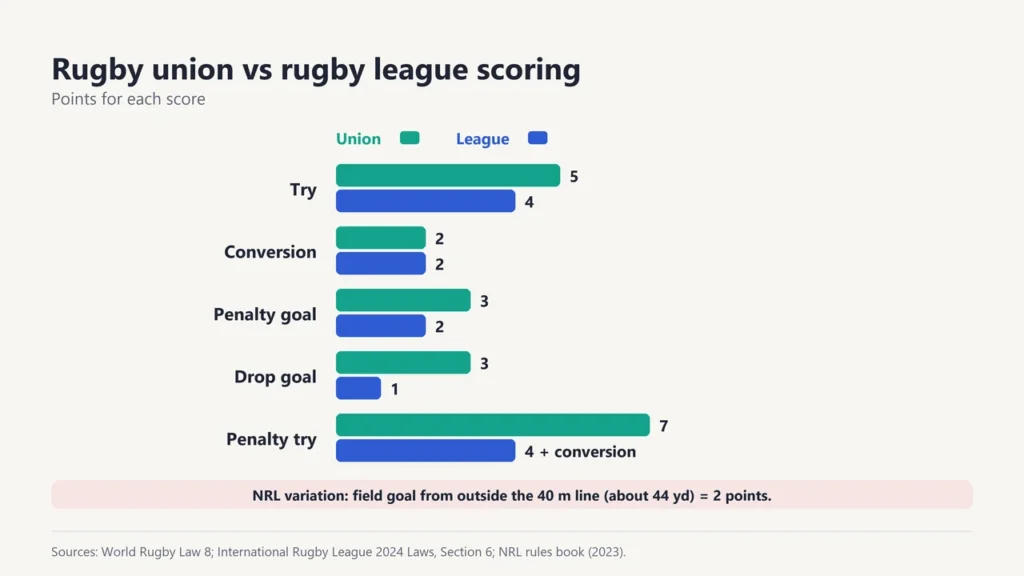
Rugby league is a separate sport with its own laws. The 2024 International Laws of the Game from International Rugby League give these values:
| Score | Points in rugby league | Points in rugby union |
|---|---|---|
| Try | 4 | 5 |
| Conversion | 2 | 2 |
| Penalty goal | 2 | 3 |
| Drop goal (field goal) | 1 | 3 |
| Penalty try | 4, then a conversion kick from in front of the posts | 7, no kick |
Some points that often confuse fans:
- Penalty try in league. The referee awards it if a try would have been scored but for unfair play by the defending team (union uses the test of a “probable” try). It is awarded between the posts wherever the foul happened, and the team then kicks the conversion as normal. The penalty try value of 7 with no kick is a union rule.
- The “eight-point try”. If a defender fouls a try scorer while they ground the ball, or before they get back on their feet, the scoring team takes its conversion and then an extra penalty kick at goal from in front of the posts. That can make 4 + 2 + 2 = 8 points from one move.
- Two-point field goal (NRL). Australia’s NRL rules book adds a variation: a field goal kicked in general play from outside the opponents’ 40-metre line (about 44 yards) is worth 2 points instead of 1. This is an NRL competition rule, not part of the IRL international laws.
- Odd scores need a drop goal. In league, tries and goals are even numbers. Under the IRL laws, an odd score like 13 or 25 means at least one drop goal was kicked. The NRL’s 2-point field goal is even too, so an odd NRL score still needs at least one 1-point field goal.
Team sizes differ too. World Rugby Law 3.1 allows up to 15 players a side in union. Rugby league teams have 13 players on the field, numbered 1 to 13 in the IRL laws.
Bonus points in rugby tables
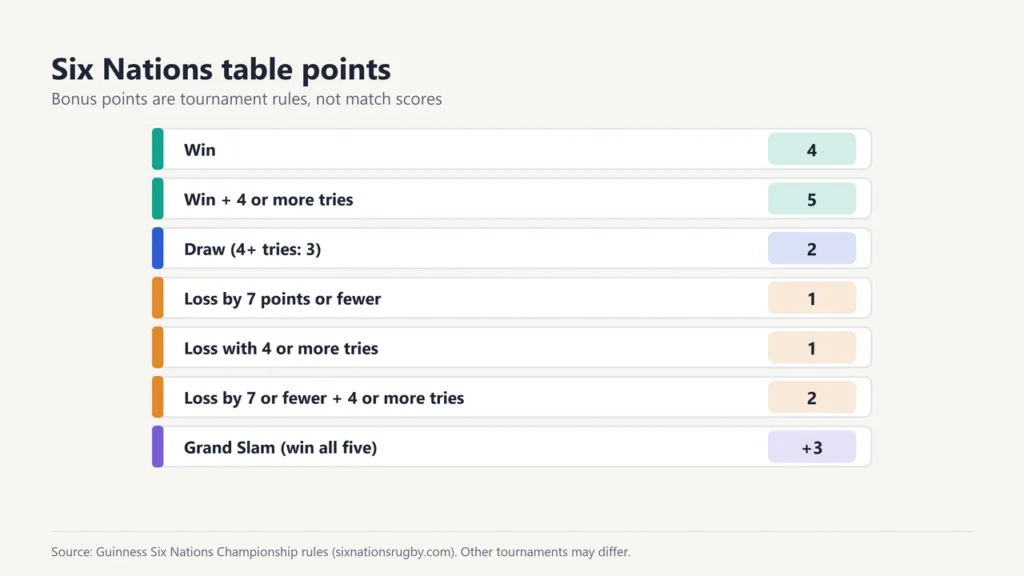
Bonus points are not part of the Laws of the Game. They are tournament rules for the league table. Many competitions, such as the Six Nations, use them to reward scoring tries and losing narrowly. The men’s Six Nations Championship rules give a clear example:
| Result | Table points (Six Nations) |
|---|---|
| Win | 4 |
| Win with 4 or more tries | 5 |
| Draw | 2 (3 with 4 or more tries) |
| Loss by 7 points or fewer | 1 |
| Loss with 4 or more tries | 1 |
| Loss by 7 or fewer and 4 or more tries | 2 |
| Grand Slam (win all five matches) | 3 extra points |
The 3-point Grand Slam bonus means a team that wins every match cannot finish below a team that lost a game. Other tournaments may use different bonus rules. Rugby league competitions also set their own table points. Check each competition’s own rules.
Worked examples
- Team A scores two tries, converts one, and kicks two penalties. 5 + 5 + 2 + 3 + 3 = 18 points.
- Team B scores a penalty try and a dropped goal. 7 + 3 = 10 points.
- A league team scores three tries, kicks two conversions and one drop goal. 4 + 4 + 4 + 2 + 2 + 1 = 17 points.
If you like learning how other sports count points, see our guides to tennis scoring, squash scoring, badminton scoring and golf scoring terms. Cricket fans can read how the LBW rule works.
Rugby scoring terms
- Try: grounding the ball in the opponents’ in-goal area.
- Conversion: the kick at goal after a try.
- Converted try: a try plus a successful conversion (7 points in union, 6 in league).
- Penalty goal: a kick at goal from a penalty.
- Dropped goal / drop goal / field goal: a drop-kick over the bar in open play.
- Penalty try: a try awarded because foul play stopped a probable try.
- In-goal: the area between the try line and the dead-ball line.
- Bonus point: an extra table point from tournament rules, not a match score.
Frequently asked questions
How many points is a try in rugby?
A try is worth 5 points in rugby union and sevens, and 4 points in rugby league.
Why is a penalty try worth 7 points?
A penalty try is worth the same as a try plus a successful conversion (5 + 2). Under Law 8.3, it is awarded between the posts and no conversion is attempted, so the team gets all 7 points at once.
Can you score 1 point in rugby union?
No. The lowest score in union is 3 points. In fact a union team can never finish on 1, 2 or 4 points. In rugby league, a drop goal is worth 1 point.
Can the other team block a conversion?
Yes, in fifteen-a-side union. The defending players wait behind their try line and may charge at the kicker once the kicker begins the run-up (Law 8.14). They may jump to block the kick, but team-mates must not lift or support them. In sevens, defenders gather near their own 10-metre line instead.
Do you have to take the conversion?
No. Under Law 5.8 a team can decline the conversion in union. The team tells the referee “no kick” after the try is awarded.
How many points is a drop goal?
A drop goal (dropped goal) is worth 3 points in rugby union and 1 point in rugby league. In Australia’s NRL, it is worth 2 points if kicked from outside the opponents’ 40-metre line.
What is a bonus point in rugby?
A bonus point is an extra point in a tournament table, not on the scoreboard. In the Six Nations, teams get one for scoring four or more tries, and a losing team gets one for losing by seven points or fewer.

Justwebworld has published guides since 2012. How we write and update articles Report an error
