

Note (October 2026): Earlier versions of this guide said an EXE file can be converted into a working APK with a converter tool. That is not technically possible, because the two formats contain code for different operating systems; this page now explains why and lists the methods that do work.
You cannot convert an EXE file into a working APK. An EXE is a Windows Portable Executable containing native Windows code, while an APK is a ZIP-based Android package containing Android Runtime code. No converter rewrites one into the other. To use Windows software on Android, look for an official Android version, run it through a Wine-based app such as Winlator, or stream it with remote desktop or cloud gaming.
Key Takeaways
- EXE files use the Windows Portable Executable (PE) format; APK files are ZIP archives that hold Android code (classes.dex), a manifest and resources.
- So-called EXE-to-APK converters cannot produce a working Android app from a Windows program, and downloads promising this deserve suspicion.
- The safest first step is to check whether the developer already publishes an Android version.
- Winlator, an open-source Android app, runs many x86-64 Windows programs using Wine and Box86/Box64, with mixed compatibility.
- Remote desktop and cloud gaming let an Android device use Windows software that keeps running on a PC or server.
An APK (Android Package) file is the package format Android uses to distribute and install apps. Android is the most-used operating system in the world: according to StatCounter, Android had 42.54% of worldwide operating system usage across all platforms in September 2026, ahead of Windows at 28.98%.
Many people also rely on Windows programs on their PCs and want to use them on an Android phone or tablet. Windows phones are no longer an option for the reverse: Microsoft ended support for Windows 10 Mobile on January 14, 2020.

Windows programs and Android apps are not directly compatible. Each is built for its own operating system, system libraries and usually its own processor instruction set, so a Windows program cannot simply be opened on Android, and vice versa.
What are EXE and APK?
An EXE file uses the Portable Executable (PE) format, which Wikipedia describes as the file format for native executable code on 32-bit and 64-bit Windows. An APK is a ZIP archive containing compiled Android code (classes.dex), an AndroidManifest.xml file and resources. Renaming or repackaging one as the other does not change the code inside, so converting an EXE file to APK, or vice versa, does not make a program work on the other operating system.
Concerns about viruses are justified: tools that promise to convert EXE files to APK cannot deliver a working app, and unverified downloads of this kind can carry unwanted software. Rooting an Android phone gives administrator access to Android; it does not turn the phone into a Windows device. Replacing a phone’s operating system entirely is a separate, difficult project that only makes sense in narrow cases, such as:
- If the existing operating system adds no benefit, and
- All your applications belong to the alternate operating system.
Replacing or modifying a phone’s operating system just to run three or four programs is not recommended.
How do you convert EXE to APK?
Android might have millions of applications on Play Store, but true gamers will know how hard they need to struggle for some of the Windows-exclusive games on their Android devices.
There are some other work-related applications that might have to be converted to APK to allow smooth on the go working. These apps, however, might have compatibility issues and need to be verified before actual or practical use.
Step No. 1
Today, most app developers are aware of their potential users. They want their apps to be available in all possible formats in the app stores of various operating systems as well as outside. It would be worthwhile first to look for an APK version through the official site of the app developer (if any).
Many app developers make APK as well as EXE version available on their website to allow easier access to the app users across different platforms. So, instead of following other lengthy steps, it is better to first check if the app or program is available in another format already or not. In case the app is popular, there are high chances that your quest will end on the Step no. 1 itself.
Step No. 2
The original version of this guide described a second step: using a desktop tool that claims to convert the EXE version into an APK. Those steps are kept below for reference only. Because an EXE and an APK contain code for different operating systems, such a tool cannot produce a working Android version of a Windows program, and the reliable alternatives are listed further down this page.
- The earlier text pointed readers to a tool called ‘Change My Software’, hosted on a third-party file-sharing site that Justwebworld has not verified; it is not recommended for converting EXE files to APK http://changemysoftware.org/APKconverter.
Note 1:
Installing files from outside an app store carries risk. On Android 8.0 and higher, the user must allow installs per source in the Install unknown apps settings screen, and on Android 7.1.1 and lower through the Unknown sources setting, according to Android’s developer documentation. The ‘Change My Software’ tool and other paid or free “EXE to APK converters” cannot change the underlying format limits, so this step is not recommended.
- Once, the selected tool has been installed, double-click on the file.
- There shall be two options, named ‘Setup files’ and ‘Portable application’.
- Select ‘Portable application’.

- All the files in your personal computer shall be open now, select the EXE file which you had like to convert.
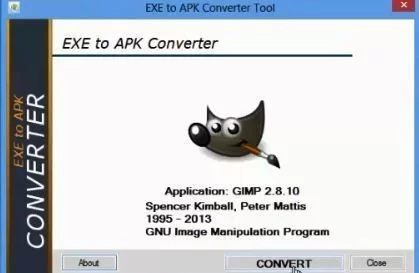
- After the file loads into the application, in the bottom of the dialogue box, you shall see three options ‘About’, ‘Convert’ and ‘Close’. Select ‘Convert’.
- A dialog box with a progress indicator appears, followed by a success message. A success message does not mean the result is a working Android app.

Note 2:
The earlier steps advised installing the EXE program first and waiting for larger files to finish, until an error message or a success message.
- Once, the success box has appeared, the process is not done! This file should reach the android device too.
- Connect your android device to the computer and then safely transfer the file to the android device and then eject the device.
- Open the file in android device and click on ‘Install’.
- If a file produced this way installs at all, it will not run the original Windows program; no reliable failure-rate figure exists for these tools, so treat any such file with caution and scan it with Google Play Protect.
What if things don’t go as planned?
Sometimes, it so happens that things do not go planned as the above steps. For instance, based on the conversion software used, there can be scenarios for error messages popping up while the conversion process is going on. This can be recurring.
The main reason is not a faulty converter or a corrupted EXE file: a Windows program simply cannot be translated into an Android app by a file converter.
Trying another third-party converter will not help. Instead, use one of the methods described below: an official Android version, a Wine-based app such as Winlator, remote desktop or cloud streaming.
Paid conversion tools do not solve this either, because the limit is technical, not a lock placed on certain programs.
Large commercial programs are often the ones people most want on Android. Step no. 1, checking for an official Android version, is the realistic way to convert EXE to APK. For everything else, the methods below are the practical options.
Why Can’t an EXE File Be Converted to an APK?
An EXE file and an APK file are different kinds of containers holding different kinds of code. According to Wikipedia, the Portable Executable (PE) format used by .exe files holds native executable code for Windows and supports instruction sets including IA-32, x86-64, ARM and ARM64. An APK, by contrast, is a ZIP archive extended from the Java JAR format; its classes.dex file holds compiled code executed by the Android Runtime.
A file converter can change how data is packaged, but it cannot rewrite a Windows program’s calls to Windows system libraries into Android equivalents. That job is called porting, and only the program’s developer, with the source code, can do it properly.
How to Tell the Two Formats Apart
The first bytes of a file, sometimes called its signature or magic number, show which format it really is. A Windows PE file starts with the bytes 4D 5A (“MZ” in ASCII), according to Wikipedia. An APK, being a ZIP archive, starts with 50 4B 03 04, which reads “PK”, the initials of ZIP inventor Phil Katz.
To check a file, open it in any hex viewer, copy the first few byte values and paste them into the Hex to Text converter. The tool decodes the hex pairs into characters, so “4D 5A” shows as MZ and “50 4B” shows as PK. A file renamed from .exe to .apk will still begin with MZ, which is why Android cannot install it. The reverse Text to Hex converter shows the byte values for any characters you type.
| Feature | EXE (Windows) | APK (Android) |
|---|---|---|
| Format | Portable Executable (PE) | ZIP archive, extended from JAR |
| First bytes | 4D 5A (“MZ”) | 50 4B 03 04 (“PK”) |
| Main code | Native machine code for Windows | classes.dex for the Android Runtime, plus optional native libraries in lib/ |
| Runs on | Windows (and compatible systems such as ReactOS) | Android and Android-based systems |
What Actually Works: Ways to Use Windows Software on Android
1. Use an Official Android Version
Many developers publish separate Windows and Android versions of the same app. Searching Google Play or the developer’s own website for the app name is the safest route, because the Android version is built for the platform and receives updates.
2. Run Windows Programs With Winlator (Wine and Box64)
Winlator is an Android application that runs Windows x86-64 applications using Wine and Box86/Box64, according to its project page on GitHub, where it is published under the LGPL-2.1 licence. Wine itself is a compatibility layer, not an emulator, that lets Windows software run on Unix-like systems. Compatibility varies by program and by phone, and demanding games or software may run slowly or not at all.
Wikipedia also notes that official experimental Wine builds for Android have been available since late 2017, but the default builds lack cross-architecture emulation, so an ARM build runs only ARM Windows applications.
3. Control a Windows PC Remotely
Remote desktop apps leave the program running on a Windows computer and show it on the phone. Google’s help page for Chrome Remote Desktop explains that a computer or mobile device can access files and applications on another computer: open the app on Android, choose the computer on the Remote Access page, enter its PIN, then control it by trackpad or touch. This works for almost any Windows program but needs the PC switched on and a steady internet connection.
For pairing a phone with a PC for messages, photos and notifications rather than full control, see our guide to pairing an Android phone with a Windows PC.
4. Stream Games From the Cloud
Cloud gaming services run the game on remote servers and stream it to the phone. According to Wikipedia, Xbox Cloud Gaming works with Android phones and tablets running at least Android 12.0 with Bluetooth 4.0, and is offered with Xbox Game Pass subscriptions; plan details change, so check the current terms before subscribing.
5. Ask the Developer or Build an Android App
If you own the program’s source code, the realistic path is to port it as a native Android app. Our guide to developing an Android app with Kotlin covers the basics. Google Play has required new apps to use the Android App Bundle format since June 30, 2021, and APKs are generated and signed from those bundles.
Comparison of the Methods
| Method | Runs the real Windows program? | Needs a PC? | Main limitation |
|---|---|---|---|
| Official Android version | No, a native equivalent | No | Only exists if the developer made one |
| Winlator / Wine | Yes, through a compatibility layer | No | Mixed compatibility and performance |
| Remote desktop | Yes, on the PC | Yes | Needs the PC on and a good connection |
| Cloud gaming | Yes, on remote servers | No | Subscription and supported titles only |
| EXE-to-APK converter | No | Yes | Cannot produce a working app; download risk |
How to Stay Safe When Installing Files From Outside Google Play
- Grant install permission narrowly. On Android 8.0 and higher, permission to install unknown apps is granted per source; turn it off again after use.
- Use Google Play Protect. Google says Play Protect checks devices for potentially harmful apps from other sources and may recommend scanning an app from outside Google Play that it has never seen before.
- Expect developer verification. Android’s developer documentation says that protections requiring apps to come from verified developers began on September 30, 2026, for certified Android devices in Brazil, Indonesia, Singapore and Thailand, with an advanced flow that still lets experienced users sideload unverified apps, and that Google plans to expand verification globally.
- Avoid “converter” downloads. A tool that claims to turn EXE files into APKs cannot do what it promises, so there is no reason to run it.
For more on how security software protects a device, read what virus protection does. Windows users who want to run another operating system on a PC can compare VirtualBox alternatives for Windows.
Frequently Asked Questions
Can I convert an EXE file to an APK?
No. An EXE file contains Windows program code in the Portable Executable format, and an APK contains Android code in a ZIP-based package. No converter can rewrite one into the other; the program has to be ported by its developer or run through Windows compatibility software.
Is there a working EXE to APK converter?
No reliable EXE to APK converter exists, because the limit is technical rather than a missing tool. Programs advertised as converters cannot produce a working Android version of a Windows program, and downloading them from file-sharing sites carries security risk.
How can I run Windows programs on Android?
The main options are an official Android version of the app, a Wine-based app such as Winlator that runs many x86-64 Windows programs, remote desktop access to a Windows PC, or cloud gaming for games. Compatibility and performance vary with each method.
What happens if I rename an .exe file to .apk?
Renaming changes only the file extension. The file still starts with the Windows “MZ” signature instead of the ZIP “PK” signature, so Android’s package installer cannot install it as an app.
Is it safe to install APK files from outside Google Play?
Installing APK files from unknown sources carries risk, and Google warns that such apps can put a device and personal information at risk. Only install from trusted sources, keep Google Play Protect turned on, and switch off the install permission after use.
What happened to Windows Subsystem for Android?
Windows Subsystem for Android ran Android apps on Windows 11 PCs, the reverse of running Windows apps on phones. Microsoft announced its deprecation on March 5, 2024, and support ended on March 5, 2025, according to Wikipedia.

Justwebworld has published guides since 2012. How we write and update articles Report an error
