Chess notation is a short code for writing down chess moves. In the standard system, called algebraic notation, every square has a name made of a letter and a number, like e4. A move is written as the piece’s letter plus the square it moves to. So Nf3 means “knight moves to f3”, and a plain e4 means “pawn moves to e4”.
The World Chess Federation, FIDE, says in its Laws of Chess that it recognises only this algebraic system for its own tournaments and matches. This guide shows you how the board is labelled, the letter for each piece, the symbols for captures, check and castling, and how to read a full game, step by step.
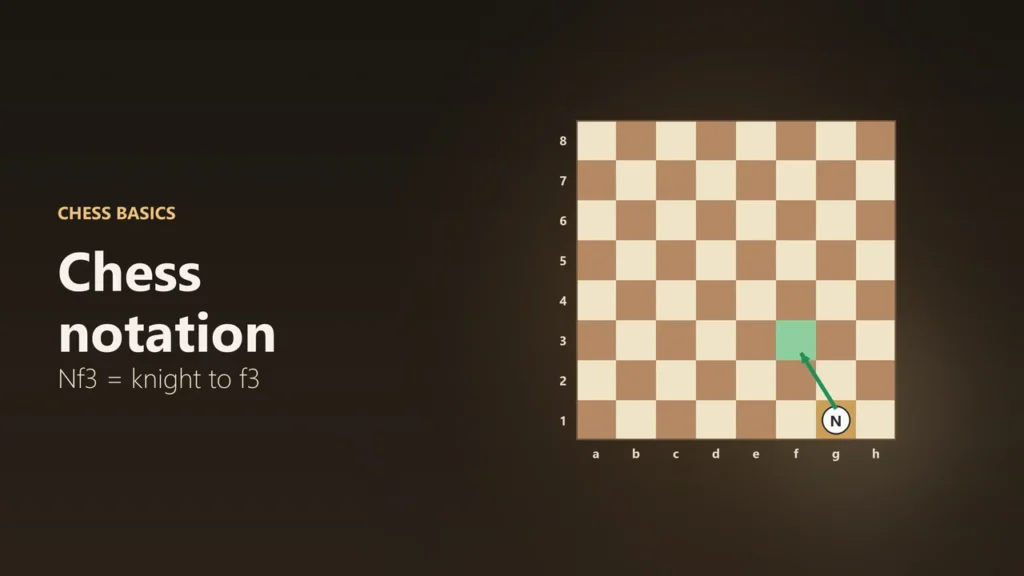
- Files (columns) are letters a to h. Ranks (rows) are numbers 1 to 8
- Pieces: K king, Q queen, R rook, B bishop, N knight. Pawns have no letter
- Captures: x, as in Bxe5. Check: +. Checkmate: #
- Castling: 0-0 (kingside) and 0-0-0 (queenside)
- Promotion: the new piece goes at the end, as in e8Q
How the chessboard squares are named
Picture the board from White’s side. The columns, called files, are lettered a to h from left to right. The rows, called ranks, are numbered 1 to 8 from White’s side to Black’s. Every square gets a unique name by putting its letter and number together: a1, e4, h8 and so on.
- White’s pieces start on ranks 1 and 2. Black’s pieces start on ranks 7 and 8.
- The white king starts on e1 and the white queen on d1. Black’s king and queen start on e8 and d8.
- FIDE’s rules say the board must be placed so the near corner square on each player’s right is white. So h1 is a light square and a1 is dark.
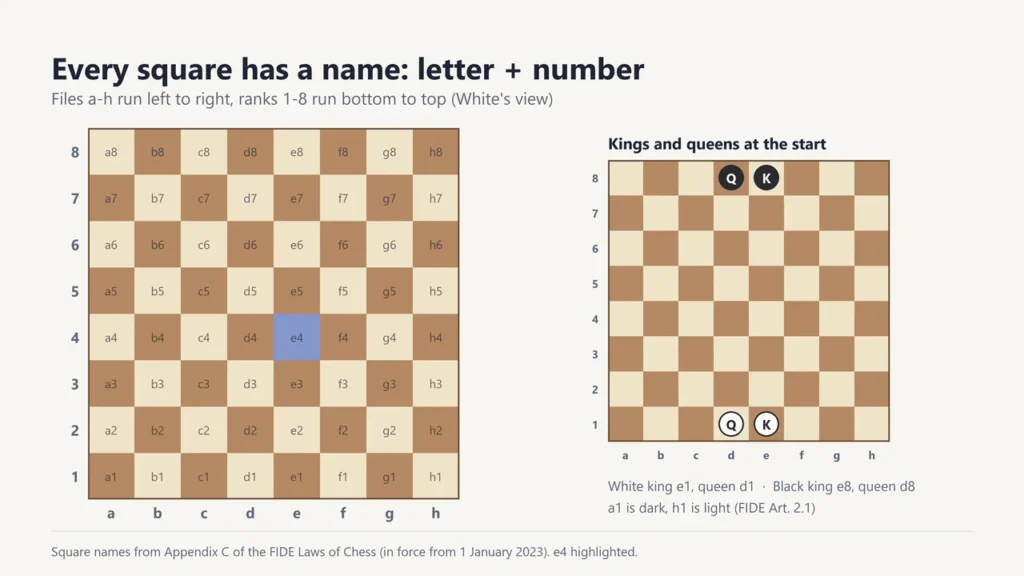
The names never change, even for Black. From Black’s side the letters run from right to left and the numbers from top to bottom, but e4 is still e4.
The letter for each chess piece
| Piece | Letter | Example move | Meaning |
|---|---|---|---|
| King | K | Ke2 | King moves to e2 |
| Queen | Q | Qh5 | Queen moves to h5 |
| Rook | R | Rd1 | Rook moves to d1 |
| Bishop | B | Bc4 | Bishop moves to c4 |
| Knight | N | Nf3 | Knight moves to f3 |
| Pawn | (none) | e4 | Pawn moves to e4 |
The knight uses N, because K is already taken by the king. FIDE’s rules also let players use the letters common in their own language. In French, for example, a bishop is a “fou”, so it is written F. Printed books and magazines often use small piece pictures, called figurines, instead of letters.
How to write a chess move
A normal move is just the piece letter + the square it lands on. You don’t write where it came from, and there is no hyphen. So it is Be5, not B-e5. For a pawn, write only the square: d4.
FIDE also accepts a longer form that includes the starting square, such as Ng1f3 or e2e4. You will see this “long algebraic” style in some books and chess software.
Captures
- A piece captures: put an x between the letter and the square. Bxe5 means “bishop takes on e5”.
- A pawn captures: write the file the pawn started on, then x, then the square. exd5 means “the e-pawn takes on d5”.
- En passant: write the normal pawn capture. You may add “e.p.”, as in exd6 e.p.
When two pieces can reach the same square
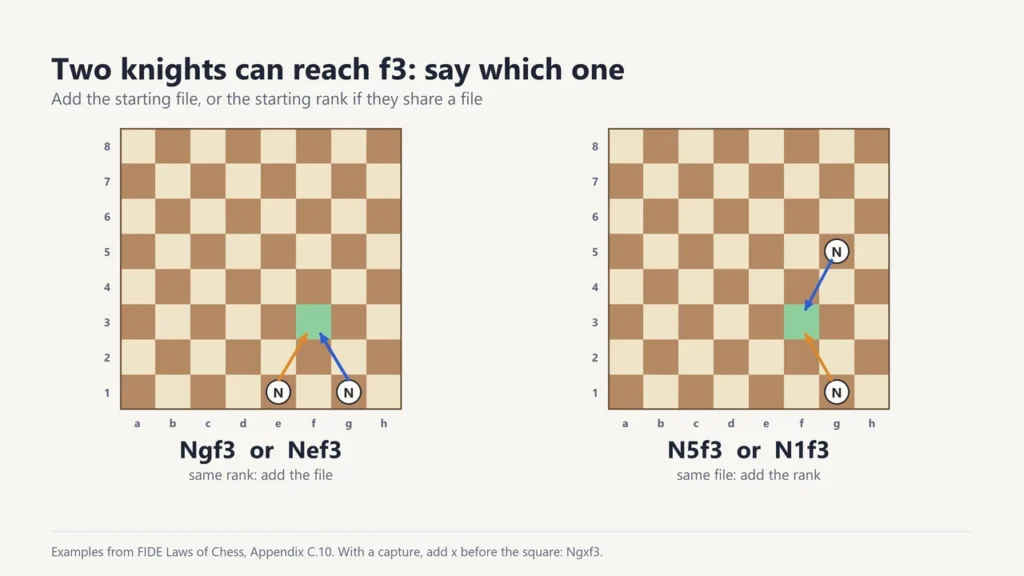
Sometimes two knights or two rooks could both move to the same square. Then you add one extra character to show which one moved:
- Add the starting file if that tells them apart. With knights on g1 and e1, write Ngf3 or Nef3.
- Add the starting rank if both are on the same file. With knights on g5 and g1, write N5f3 or N1f3.
- With a capture, the x goes before the square: Ngxf3.
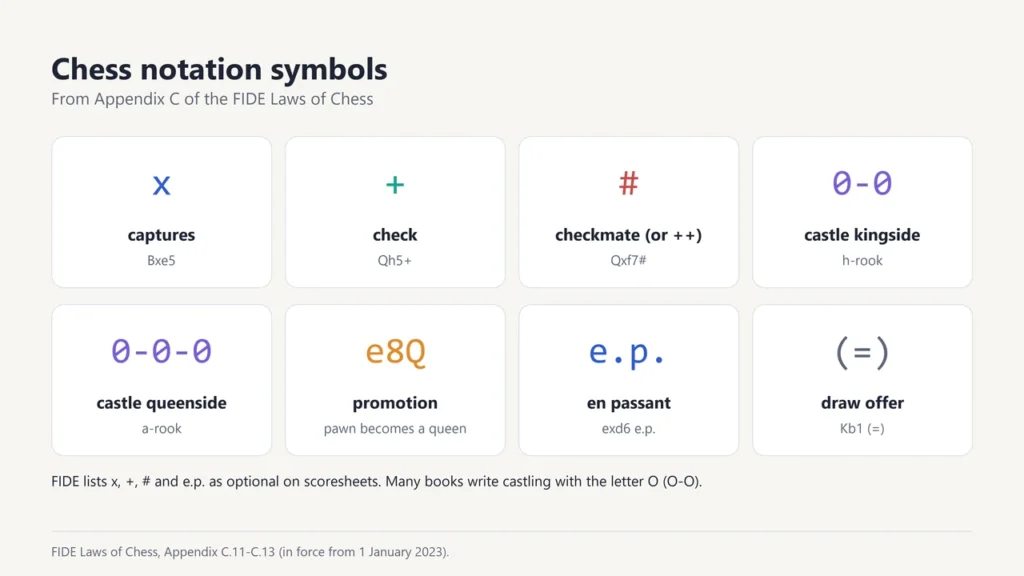
Chess notation symbols
| Symbol | Meaning | Example |
|---|---|---|
| x | captures | Nxe5 |
| + | check | Qh5+ |
| # or ++ | checkmate | Qxf7# |
| 0-0 | castling kingside (with the h-rook) | 0-0 |
| 0-0-0 | castling queenside (with the a-rook) | 0-0-0 |
| e.p. | en passant capture | exd6 e.p. |
| Q, R, B or N after a pawn move | promotion to that piece | e8Q, b1N |
| (=) | a draw offer | Kb1 (=) |
Two details surprise many players. First, FIDE’s rules list the x, +, # and e.p. symbols as optional. A scoresheet that reads Bh7 instead of Bxh7+ is still valid. Second, FIDE writes castling with the digit zero (0-0), while many books and chess programs use the capital letter O (O-O). Both mean the same thing.
Books also add comments after a move: ! for a good move, ? for a mistake, !! for a brilliant move and ?? for a blunder. These are notes from the writer, not part of the move itself.
How to read a chess game, move by move
Games are written with a move number, then White’s move, then Black’s move. Here is the famous four-move “Scholar’s Mate”:
1. e4 e5 2. Bc4 Nc6 3. Qh5 Nf6 4. Qxf7#
| Move | White | Black |
|---|---|---|
| 1 | e4: pawn to e4 | e5: pawn to e5 |
| 2 | Bc4: bishop to c4 | Nc6: knight to c6 |
| 3 | Qh5: queen to h5 | Nf6: knight to f6 |
| 4 | Qxf7#: queen takes on f7, checkmate | (game over) |
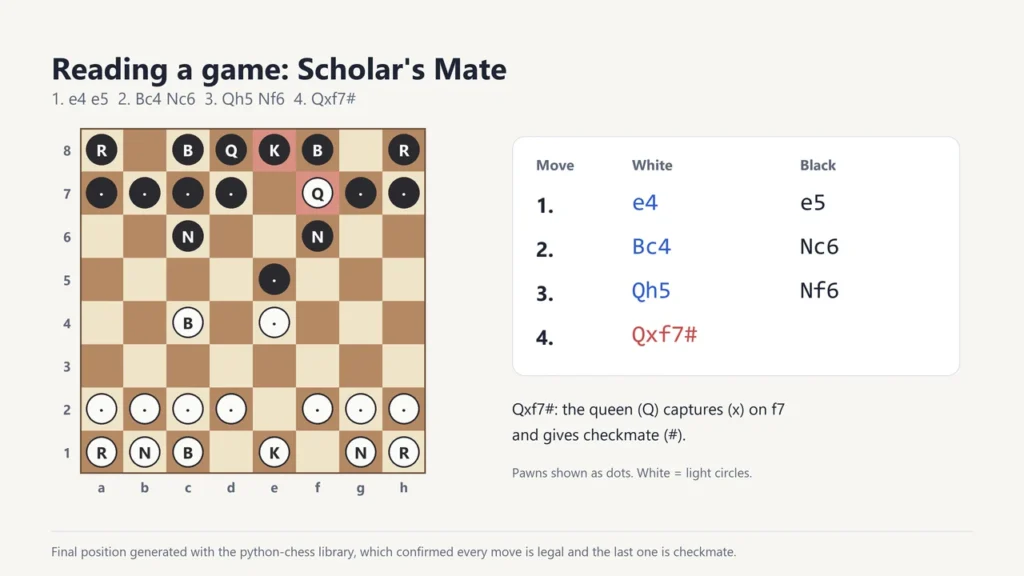
Black could have stopped it. At move 3, instead of 3…Nf6, a move like 3…g6 blocks the queen’s attack. When writers talk about Black’s move alone, they use three dots after the number, like 3…g6.
Old descriptive notation
Many older chess books, especially in English, use a different system called descriptive notation. Moves look like P-K4 (“pawn to king four”) instead of e4, and squares are named from each player’s own side, so the same square has two names. If you find a book like this, the moves are the same chess, just written another way. For tournament scoresheets, FIDE accepts only algebraic notation and says an arbiter should warn a player who uses another system.
Common chess notation mistakes
- Writing P for a pawn. FIDE’s examples say pawn moves are written e5, not Pe5.
- Using K for the knight. K is the king. The knight is N.
- Forgetting the file on pawn captures. Write exd5, not xd5.
- Mixing up 0-0 and 0-0-0. Two zeros is kingside castling, three is queenside.
- Writing a move that two pieces could make. If two knights can reach f3, write Ngf3 or Nef3, not just Nf3.
Ready to use your new skill? See how a top player’s career is written up in our profile of Arjun Erigaisi, or try one of these board games like chess.
Frequently asked questions
What does Nf3 mean in chess?
A knight moves to the square f3. N is the letter for knight, and f3 is the destination square.
What does x mean in chess notation?
It means a capture. Bxe5 means the bishop captures the piece on e5. FIDE’s rules say the x is optional on scoresheets.
What does 0-0 mean in chess?
Kingside castling: the king castles with the rook on h1 (or h8 for Black). 0-0-0 is queenside castling with the a-rook. Many books write O-O with the letter O.
How do you write checkmate in chess notation?
Add # to the move, as in Qxf7#. FIDE also accepts ++. A single + means check.
Why is the knight N and not K?
Because K is used for the king. FIDE’s rules say N is used for the knight to avoid confusion.
How do you write pawn promotion?
Write the pawn move, then the letter of the new piece straight after it: e8Q for a queen, or exf8N if the pawn captured on f8 and became a knight.
Which square is a1 on a chessboard?
The corner on White’s bottom left. It is a dark square, because FIDE’s rules put a light square in the near right-hand corner (h1).