

Dashboard warning lights use colours to show how urgent a problem is. Red means danger: stop as soon as it is safe and find out why. Amber or yellow means caution: something needs checking soon. Green and blue lights just tell you a system is switched on, such as your indicators or main-beam headlights.
Many of these symbols and colours are set by international vehicle rules, mainly UN Regulation No. 121 (used in Europe and many other countries) and the US federal motor vehicle safety standards. This guide explains what each common light means and what to do. Designs vary between cars, so always check your owner’s manual too.
What do the warning light colours mean?
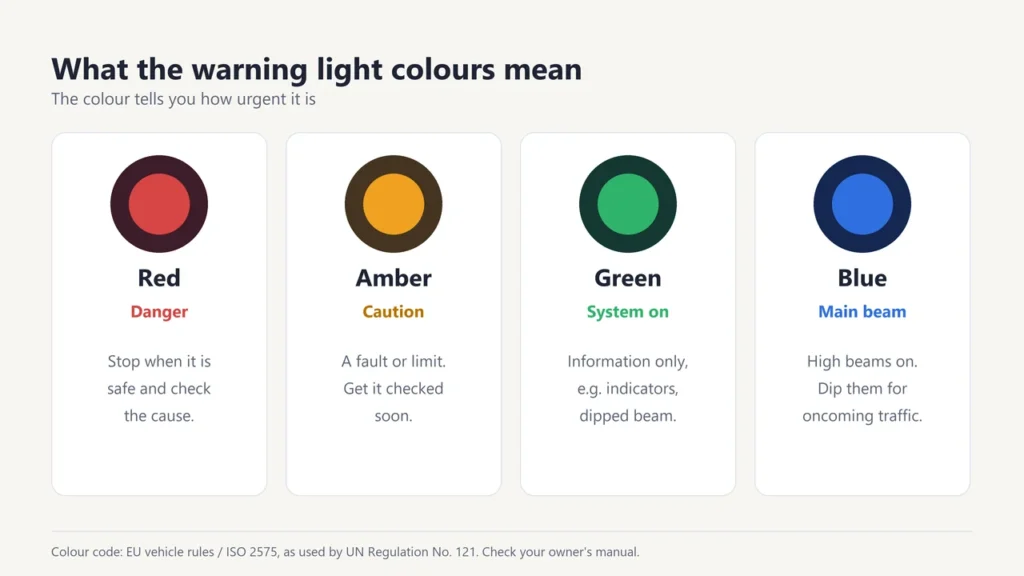
UN Regulation No. 121 sets the colour of each listed warning light, and it points to the general colour code in the standard ISO 2575. EU vehicle rules spell that code out simply: red for danger, amber for caution and green for safety, with blue reserved for the main-beam headlamp light.
| Colour | Meaning | What to do |
|---|---|---|
| Red | Danger or a serious problem | Stop when it is safe and check the cause before driving on |
| Amber / yellow | Caution: a fault or something outside normal limits | Drive carefully and get it checked soon |
| Green | A system is on and working | Nothing; it is information only |
| Blue | Main-beam (high-beam) headlights are on | Dip them for oncoming traffic |
Red warning lights
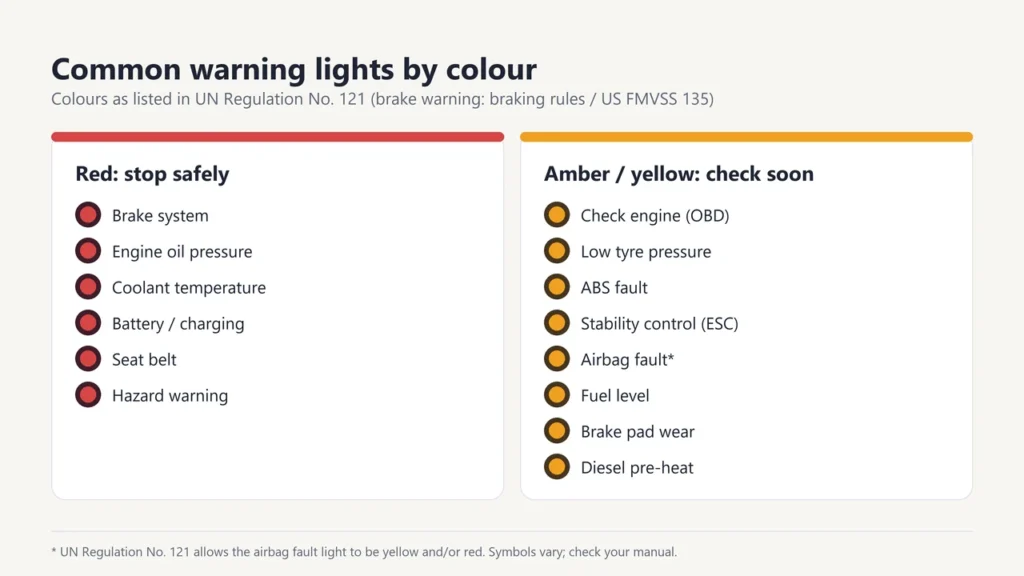
UN Regulation No. 121 lists the oil, coolant, charging, seat belt and hazard lights as red; the brake warning’s colour is set by the braking rules, and US rules require red. Treat a red light as serious: stop when it is safe, switch off if your manual tells you to, and find out what is wrong before you drive on.
- Brake system warning (often a circle with “!” or the word BRAKE): a problem with the brakes, or the parking brake is still on. US rules (FMVSS 135) require this warning to use red, and some cars without split braking systems must show “STOP – BRAKE FAILURE”.
- Engine oil pressure (an oil can): oil pressure is too low. Stop and check the oil level.
- Engine coolant temperature (a thermometer in liquid): the engine is too hot.
- Electrical charging (a battery): the battery is not being charged properly.
- Seat belt (a seated person with a belt): a seat belt is not fastened.
- Hazard warning (a red triangle): your hazard lights are switched on.
Amber and yellow warning lights
UN Regulation No. 121 lists these as yellow (amber). They mean “check soon”, not “stop now”, unless your manual says otherwise or the light is flashing.
- Check engine / engine malfunction (an engine outline): the on-board diagnostics (OBD) system has found a fault, often emissions-related. See steady vs flashing below.
- Low tyre pressure (a tyre cross-section with “!”): one or more tyres are low.
- ABS (the letters ABS in a circle): a fault in the anti-lock braking system.
- Electronic stability control (ESC) (a car with wavy tracks): a fault in the stability system, or a separate “ESC OFF” light if you’ve switched it off.
- Airbag (a seated person with a circle in front): a fault in the airbag system. UN Regulation No. 121 allows yellow and/or red for this one.
- Passenger airbag off: the front passenger airbag is switched off.
- Fuel level (a fuel pump): fuel is low.
- Brake lining wear: brake pads are worn and need checking.
- Diesel pre-heat (a coil): the glow plugs are warming up. Wait until it goes out before starting.
- Rear fog lamp: your rear fog light is on. This one is information, but it is yellow.
Green and blue lights
These lights simply confirm that something is switched on. Under UN Regulation No. 121, the direction indicators, dipped (low) beam, position lamps, parking lamps and front fog lamps are green. Main beam (high beam) is blue.
Steady vs flashing warning lights
A flashing light can mean something different from a steady one. Two important examples:
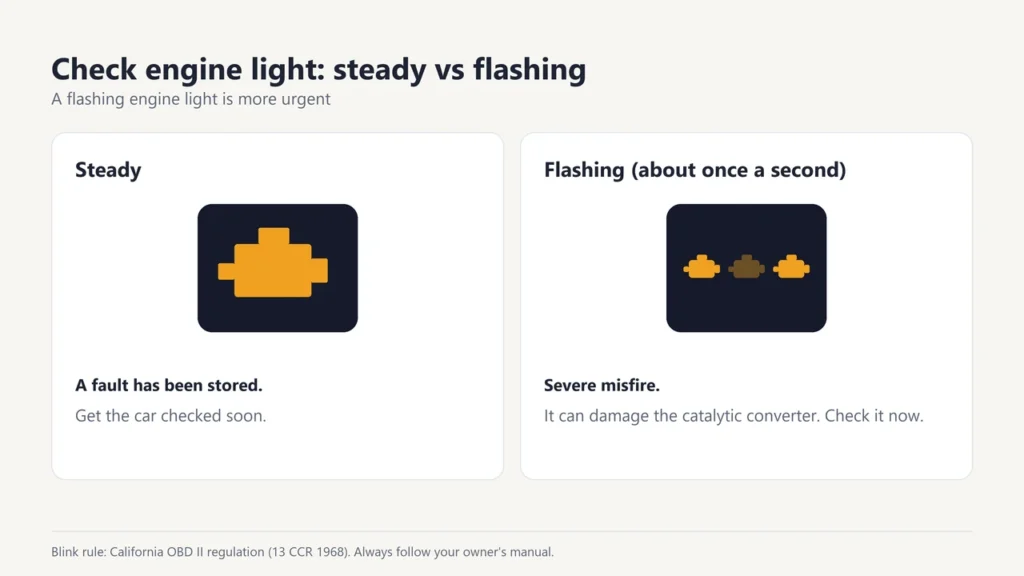
- Flashing check engine light: under California’s OBD II rules, which set the pattern for diagnostics in US cars, the light must blink once per second when the engine is misfiring badly enough to damage the catalytic converter. Treat a flashing engine light as urgent: reduce your speed and load, and get the car checked straight away. A steady light means a fault has been stored and the car should be checked soon.
- Flashing tyre pressure light: under the US tyre pressure standard (FMVSS 138), the light must come on within 20 minutes once a tyre is 25% below the recommended cold pressure. If the system itself has a fault, the light flashes for 60 to 90 seconds when you start the car and then stays on.
Why do all the lights come on when I start the car?
Many warning lights light up for a moment when you switch on the ignition. This is a bulb check: the car shows you that the lights work. UN Regulation No. 121 allows warning lights to come on during a bulb check. They should go out within a few seconds, or once the engine starts. If one stays on, it is reporting a real problem.
What to do when a warning light comes on
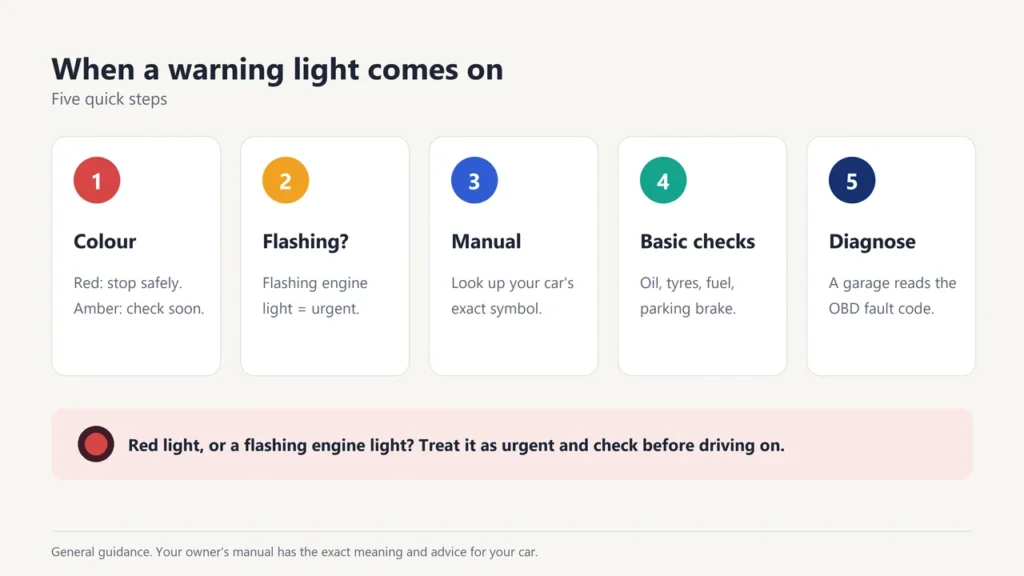
- Check the colour. Red means stop when it’s safe; amber means check soon.
- Check if it is flashing. A flashing engine light is more urgent than a steady one.
- Look it up in your owner’s manual, which shows your car’s exact symbols.
- Do the simple checks if it is safe: oil level, tyre pressures, fuel, parking brake, seat belts.
- Get a diagnosis. A garage can read the stored fault code from the OBD port.
For more car care basics, read what 5W-30 oil means, how to read a tyre size, and what an EGR valve does.
Frequently asked questions
What does a red warning light on the dashboard mean?
Red means danger or a serious problem, such as low oil pressure, an overheating engine, a brake fault or a charging fault. Stop when it is safe and check the cause.
Can I drive with the check engine light on?
If it is steady, you can usually drive carefully to a garage soon, but follow your owner’s manual. If it is flashing, the engine may be misfiring badly enough to damage the catalytic converter, so get it checked straight away.
What does the tyre pressure warning light mean?
One or more tyres are low. In the US, the light must come on once a tyre is 25% below the recommended cold pressure. Check and inflate your tyres as soon as possible.
Why is my tyre pressure light flashing?
A light that flashes for about a minute when you start the car and then stays on usually means a fault in the tyre pressure monitoring system itself, not just a low tyre.
What colour is the high beam light?
Blue. Blue is reserved for the main-beam (high-beam) headlamp light. Dipped beam is green.
Why do all my dashboard lights come on and then go off?
That is a bulb check when you switch on the ignition. The lights should go out after a few seconds. Any light that stays on is a real warning.
Are warning light symbols the same in every car?
Many are standardised by UN Regulation No. 121 and the US safety standards, so the main symbols look similar. Designs and extra lights still vary, so check your owner’s manual.

Justwebworld has published guides since 2012. How we write and update articles Report an error
