

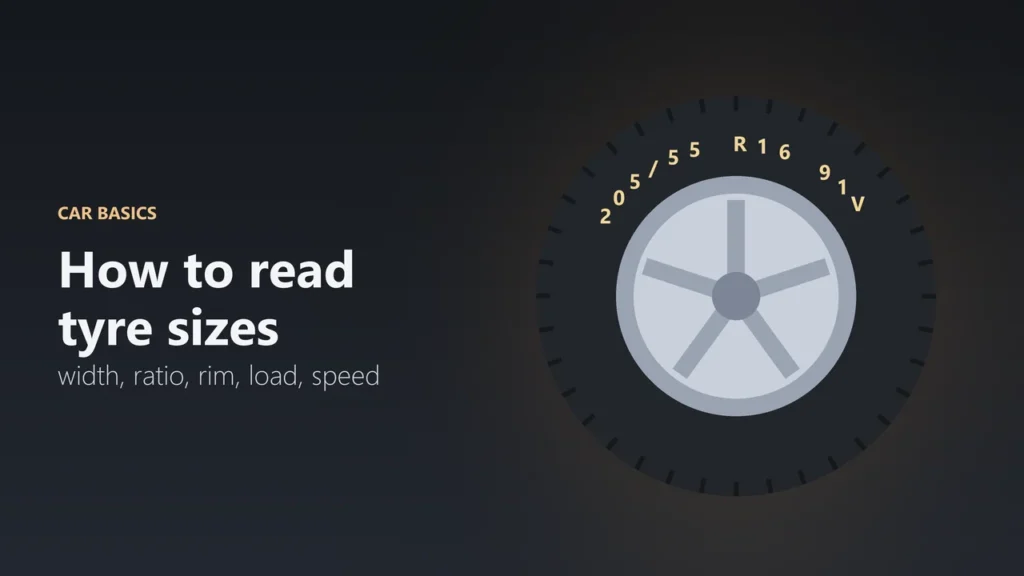
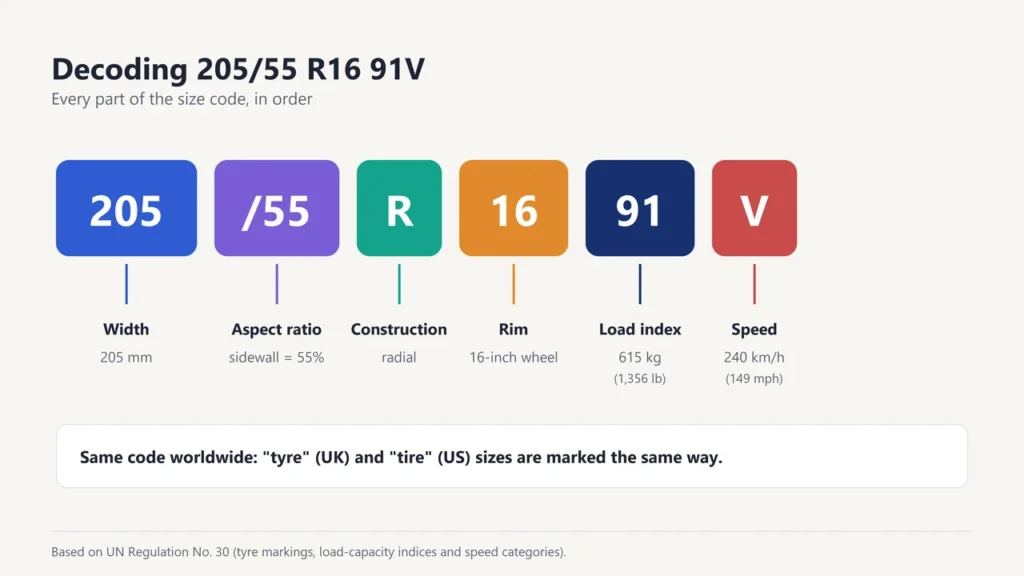
A tyre size like 205/55 R16 91V tells you five things. The tyre is 205 mm wide. Its sidewall height is 55% of that width. R means radial construction, and it fits a 16-inch wheel. 91 is the load index (615 kg, or 1,356 lb, per tyre), and V is the speed rating (up to 240 km/h, or 149 mph).
These markings follow international rules, so the same code appears on tyres worldwide, whether you spell it “tyre” or “tire”. This guide explains each part of the code in plain words, with full load index and speed rating tables, how to read a tyre’s age, and how to find the right size for your car.
| Part of 205/55 R16 91V | Name | Meaning |
|---|---|---|
| 205 | Width | 205 mm wide |
| 55 | Aspect ratio | Sidewall height is 55% of the width |
| R | Construction | Radial |
| 16 | Rim diameter | Fits a 16-inch wheel |
| 91 | Load index | Carries up to 615 kg (1,356 lb) |
| V | Speed rating | Up to 240 km/h (149 mph) |
Width: the first number
The first number is the tyre’s nominal section width in millimetres, measured from sidewall to sidewall. UN Regulation No. 30, the international standard for car tyres, says the width must be given in millimetres for most modern tyres. So a 205 tyre is about 205 mm (8.1 inches) wide.
Aspect ratio: the number after the slash
The aspect ratio is the sidewall height as a percentage of the width. For a 205/55 tyre, the sidewall is 55% of 205 mm, which is about 113 mm (4.4 inches) tall. A lower number means a shorter sidewall. The US National Highway Traffic Safety Administration (NHTSA) notes that a ratio of 50 or lower gives a short sidewall for improved steering response and handling. Higher numbers usually mean a softer, more cushioned ride.
Construction: what R, D and B mean
- R means a radial tyre. Almost all modern car tyres are radial.
- D, or no letter, means a diagonal (bias-ply) tyre.
- B means a bias-belted tyre.
- ZR appears on tyres made for speeds over 300 km/h (186 mph), together with a speed symbol in brackets, such as (95Y).
Rim diameter: the number after R
This number is the diameter of the wheel the tyre fits. UN Regulation No. 30 explains that numbers below 100 are codes, while numbers above 100 are millimetres. On everyday car tyres, the code matches the wheel size in inches, so R16 fits a 16-inch wheel. Always fit a tyre to a wheel with exactly the same rim diameter.
Load index chart
The load index is a number that stands for the maximum weight one tyre can carry. Multiply it by four for the whole car. Here are common values from Annex IV of UN Regulation No. 30:
| Load index | Max load per tyre |
|---|---|
| 75 | 387 kg (853 lb) |
| 80 | 450 kg (992 lb) |
| 85 | 515 kg (1,135 lb) |
| 88 | 560 kg (1,235 lb) |
| 91 | 615 kg (1,356 lb) |
| 94 | 670 kg (1,477 lb) |
| 95 | 690 kg (1,521 lb) |
| 97 | 730 kg (1,609 lb) |
| 100 | 800 kg (1,764 lb) |
| 104 | 900 kg (1,984 lb) |
| 110 | 1,060 kg (2,337 lb) |
Speed rating chart
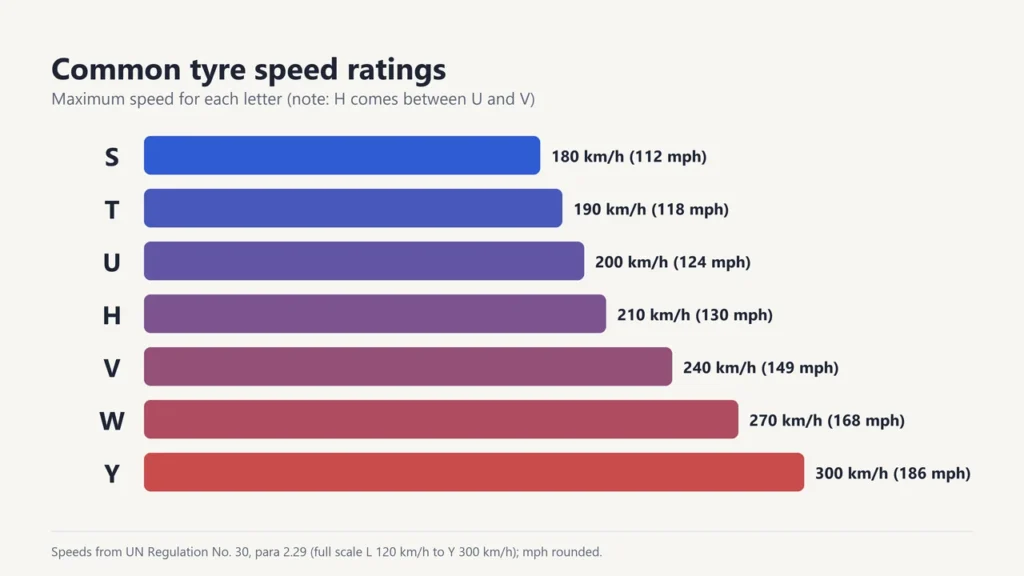
The letter after the load index is the speed rating: the maximum speed the tyre can sustain. Note that H sits between U and V, not in alphabetical order.
| Speed rating | Max speed |
|---|---|
| L | 120 km/h (75 mph) |
| M | 130 km/h (81 mph) |
| N | 140 km/h (87 mph) |
| P | 150 km/h (93 mph) |
| Q | 160 km/h (99 mph) |
| R | 170 km/h (106 mph) |
| S | 180 km/h (112 mph) |
| T | 190 km/h (118 mph) |
| U | 200 km/h (124 mph) |
| H | 210 km/h (130 mph) |
| V | 240 km/h (149 mph) |
| W | 270 km/h (168 mph) |
| Y | 300 km/h (186 mph) |
Other markings on the sidewall
- P or LT before the size (common in North America): P is for passenger cars, LT for light trucks. Tyres without a letter use the international metric size.
- M+S, M.S or M&S: a mud and snow tyre, under UN Regulation No. 30.
- TUBELESS: the tyre is designed to be used without an inner tube.
- DOT code: a tyre identification number found on tyres sold in the United States, which also shows when the tyre was made.
How to tell a tyre’s age
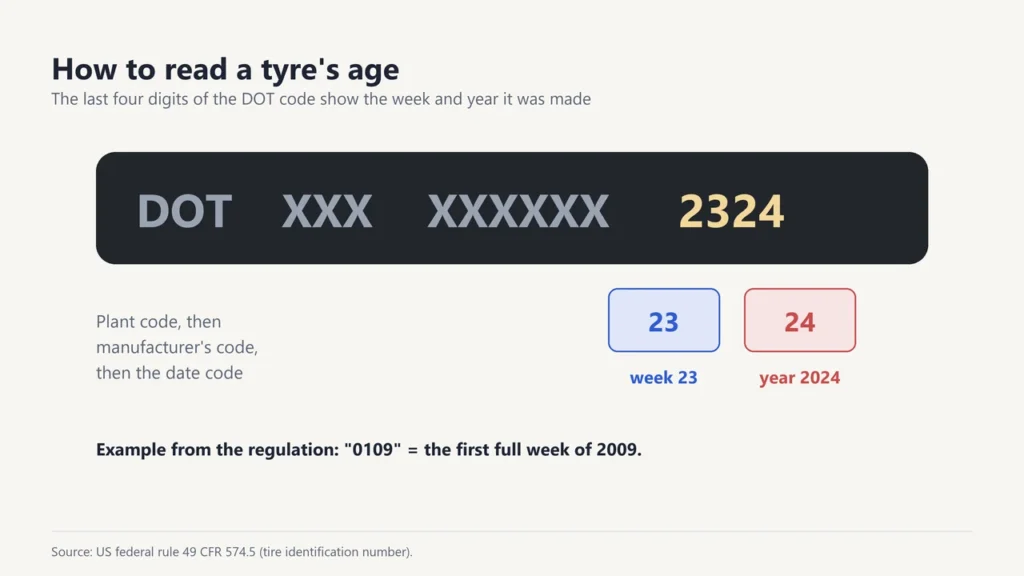
Look for the last four digits of the code that begins with “DOT”. Under US federal rules (49 CFR 574.5), the first two digits are the week and the last two are the year the tyre was made. So 2324 means week 23 of 2024. The regulation’s own example is “0109”, meaning the first full week of 2009. Many tyres sold outside the US carry the same code.
Worked example: how tall is a 205/55 R16 tyre?
- Sidewall height: 205 mm × 55% = about 113 mm.
- Wheel diameter: 16 inches × 25.4 = about 406 mm.
- Overall diameter: 406 mm + (2 × 113 mm) = about 632 mm, or 24.9 inches.
This is why changing the size can matter: a taller or shorter tyre changes how far the car travels per wheel turn, which can affect speedometer readings.
How to find the right tyre size for your car
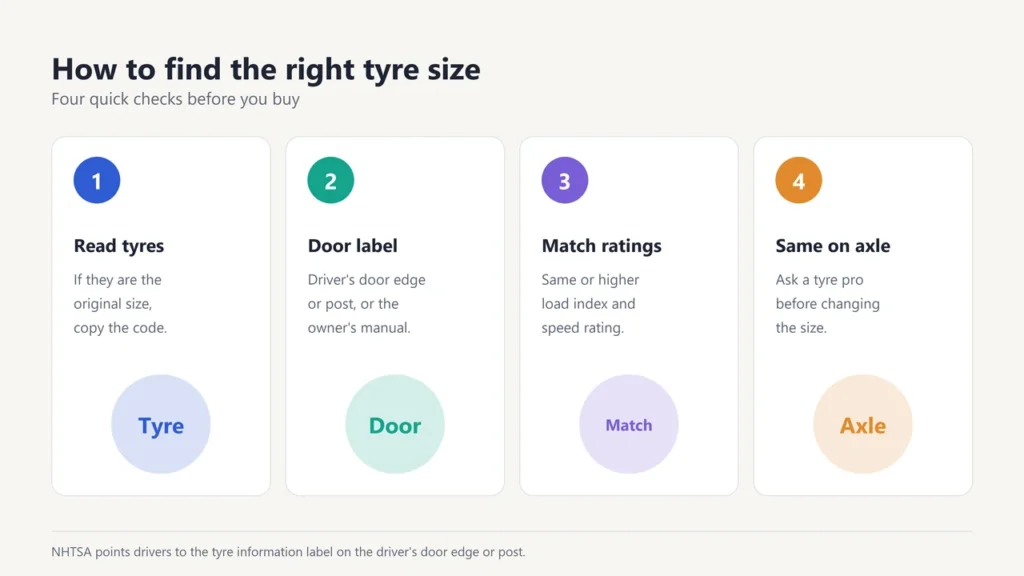
- Read your current tyres, as long as they are the size the car maker fitted.
- Check the tyre label on the driver’s door edge or door post, or in the owner’s manual. NHTSA points drivers to the same label for the recommended tyre pressure.
- Match the load index and speed rating shown by your car maker. Replacements usually need to be the same or higher.
- Fit the same size on each axle, and ask a tyre professional before changing size.
Shopping for tyres? Read our guide to buying tyres online and our Nexen tyres review. For more car basics, see what 5W-30 oil means.
Frequently asked questions
What does 205/55 R16 mean?
The tyre is 205 mm wide, its sidewall is 55% of that width, R means radial, and it fits a 16-inch wheel.
What does 91V mean on a tyre?
91 is the load index, meaning each tyre can carry up to 615 kg (1,356 lb). V is the speed rating, meaning up to 240 km/h (149 mph).
What does R mean on a tyre?
R means radial construction. It does not stand for “rim”, although the number after it is the rim diameter.
How do I know how old my tyres are?
Find the four-digit date code at the end of the DOT number. The first two digits are the week and the last two are the year, so 1523 means week 15 of 2023.
Can I use a different tyre size?
Only with care. A different size can change handling and speedometer readings. Check your car maker’s approved sizes and ask a tyre professional first.
Is “tyre” or “tire” correct?
Both. “Tyre” is the British spelling and “tire” is the American spelling. The size markings are the same.

Justwebworld has published guides since 2012. How we write and update articles Report an error
