

5W-30 is a motor oil’s viscosity grade: how thick or thin it is. The “W” stands for winter. The first number (5) describes how the oil behaves in the cold: the lower it is, the more easily the oil flows on a cold start. The second number (30) describes how thick the oil stays once the engine is hot: the higher it is, the thicker the oil.
The grading system comes from SAE International’s standard J300, and the “W” for winter is also how the US government’s fuel economy site, fueleconomy.gov, explains it. This guide shows how to read any oil grade, what the round API symbol on the bottle means, which service categories are current, and why using the grade in your owner’s manual matters.
- W = winter. 5W flows more easily when cold than 10W or 15W
- The second number is the hot-engine grade. 40 is thicker than 30, which is thicker than 20
- Use the grade in your owner’s manual. The wrong grade can cut fuel economy by 1% to 2%, says fueleconomy.gov
- Newest gasoline category: API SQ, introduced in March 2025
How to read an oil grade like 5W-30
Viscosity means how easily a liquid flows. Honey has high viscosity and water has low viscosity. Oil gets thicker when it is cold and thinner when it is hot, so an oil grade gives two ratings, one for each.
| Part of “5W-30” | What it means |
|---|---|
| 5 | The cold rating. Lower numbers flow more easily at low temperatures |
| W | Winter. It marks the cold-weather part of the grade |
| 30 | The hot rating: how thick the oil stays at normal engine running temperature. Higher numbers are thicker |
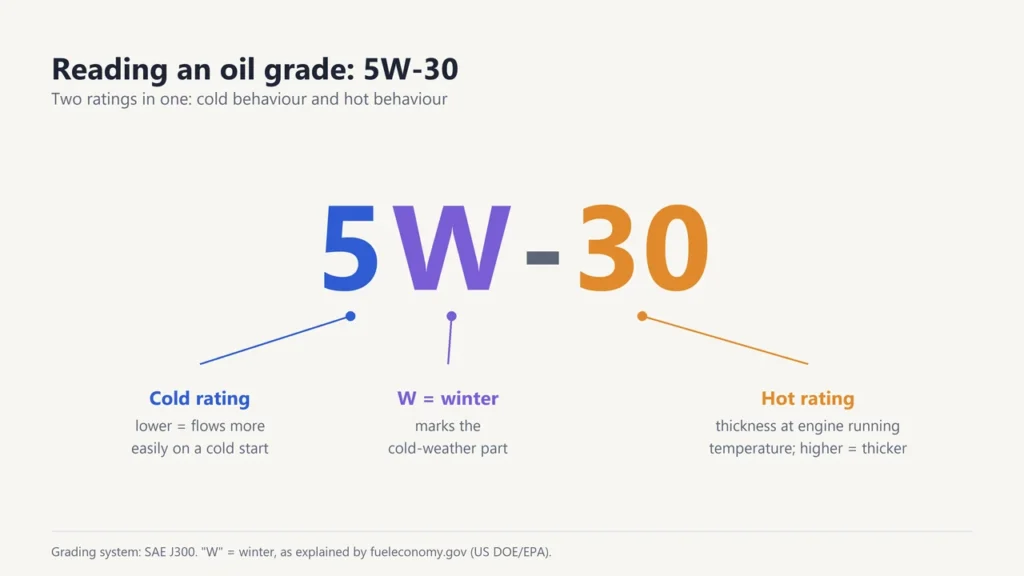
An oil with two numbers, like 5W-30, is called a multigrade oil. It behaves like a thin oil when cold and like a thicker oil when hot. An oil with one number, such as “SAE 30”, is a single-grade oil with only a hot rating.
Comparing common oil grades
Once you can read the numbers, you can compare any two grades. Look at each number separately:
| Compare | Cold (W) number | Hot number | In plain words |
|---|---|---|---|
| 5W-30 vs 5W-40 | Same (5W) | 40 is thicker | Same cold flow, thicker when hot |
| 5W-30 vs 10W-30 | 5W flows better cold | Same (30) | Easier cold starts, same when hot |
| 0W-20 vs 5W-30 | 0W flows better cold | 20 is thinner | Thinner both cold and hot |
| 5W-20 vs 5W-30 | Same (5W) | 20 is thinner | Same cold flow, thinner when hot |
“Thicker” doesn’t mean “better”. Engines are designed for a particular grade. The right grade is the one your vehicle maker lists.
Why the right grade matters: fuel economy
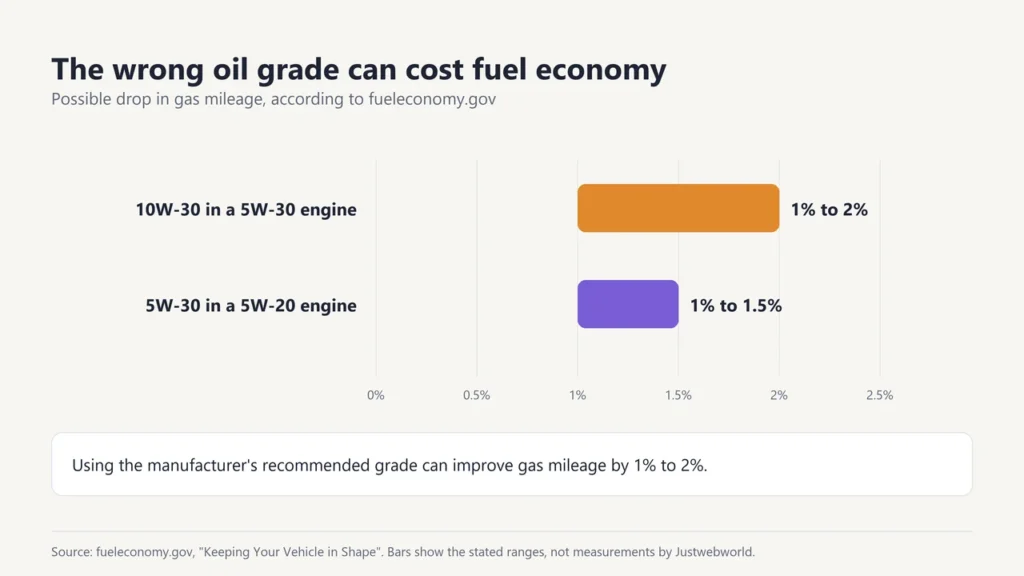
fueleconomy.gov, run by the US Department of Energy and the Environmental Protection Agency, says you can improve gas mileage by 1% to 2% by using the manufacturer’s recommended grade of motor oil. It gives two examples:
- Using 10W-30 in an engine designed for 5W-30 can lower gas mileage by 1% to 2%.
- Using 5W-30 in an engine designed for 5W-20 can lower gas mileage by 1% to 1.5%.
The grade for your car is in the owner’s manual. On some cars it is also shown on or near the oil filler cap. Some manuals list different grades for different climates, so check that part if you live somewhere very hot or very cold.
What the API “Donut” symbol on the bottle means
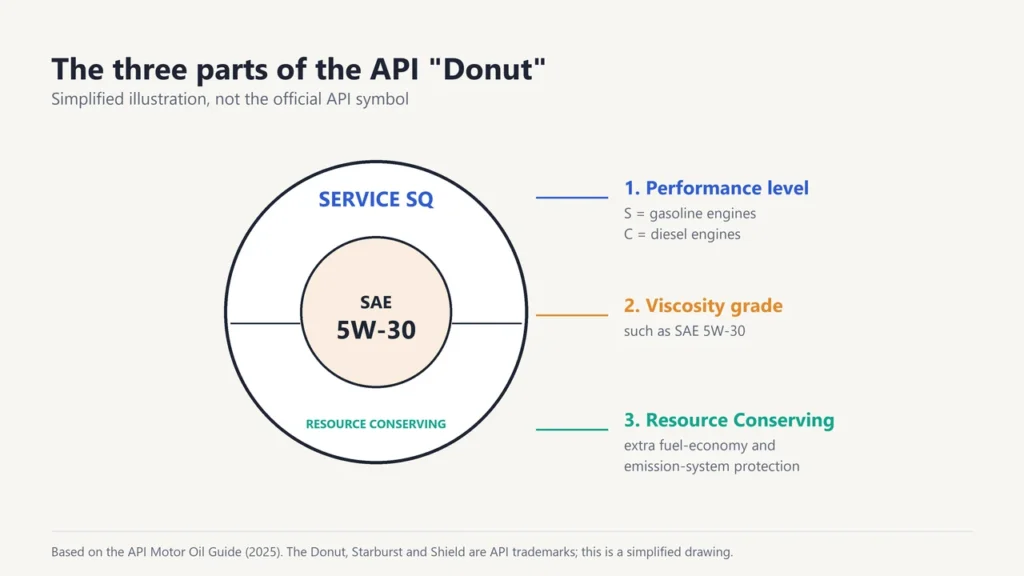
Many oil bottles carry a round symbol from the American Petroleum Institute (API), which API calls the Service Symbol or “Donut”. According to API’s Motor Oil Guide, it has three parts:
- Top: performance level. “S” (Service) categories are for gasoline engines in cars, vans and light trucks. “C” (Commercial) categories are for diesel engines.
- Centre: viscosity grade, such as SAE 5W-30.
- Bottom: “Resource Conserving”, shown on gasoline-engine oils that meet extra fuel-saving and emission-system protection tests.
API also licenses two certification marks. The “Starburst” means the oil meets the ILSAC GF-7A standard, set by a committee of US and Japanese car makers. The “Shield” means it meets ILSAC GF-7B, which applies only to the very thin 0W-16 grade. API’s guide says car makers recommend oils that carry these marks.
Current API service categories for gasoline engines
| Category | Status | Use |
|---|---|---|
| SQ | Current | Introduced in March 2025, with better protection against low-speed pre-ignition, timing chain wear and deposits |
| SP | Current | For 2025 and older engines |
| SN | Current | For 2020 and older engines |
| SM | Current | For 2010 and older engines |
| SL | Current | For 2004 and older engines |
| SJ | Current | For 2001 and older engines |
| SH and older | Obsolete | API warns they are not suitable for most modern gasoline engines |
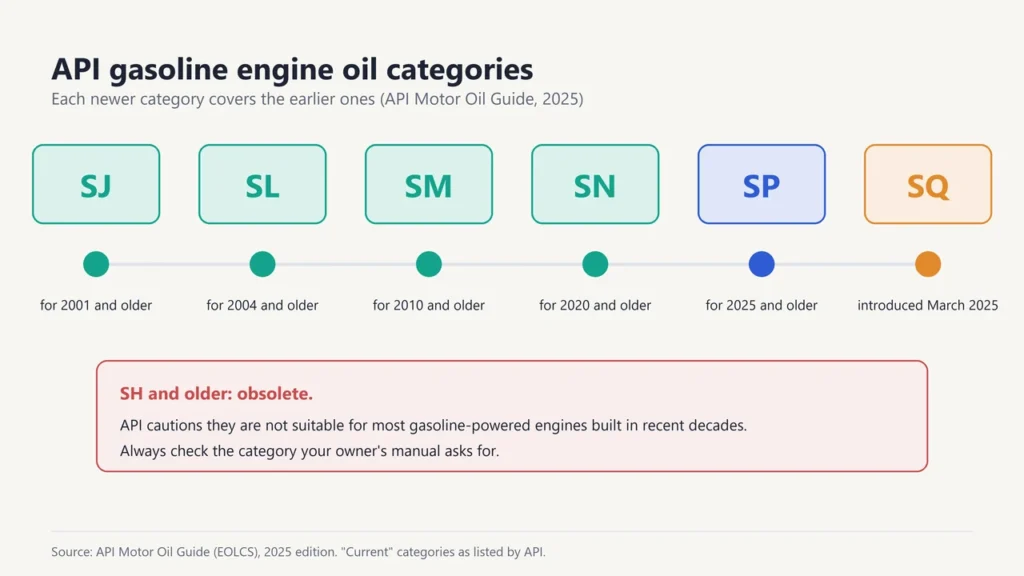
API says the latest gasoline category includes the performance of each earlier one. So an SQ oil can be used in older engines where an earlier category was recommended, as long as the viscosity grade is right.
Motorcycles and scooters often use a different standard, JASO, because many bikes share oil with the clutch. Our guide to the best engine oil brands for bikes and scooters explains JASO MA and MB.
Common motor oil mistakes
- Thinking the W stands for “weight”. It stands for winter.
- Choosing thicker oil “for extra protection”. Use the grade the maker lists. The wrong grade can cost fuel economy.
- Reading only one number. 5W-30 and 5W-40 share a cold rating but differ when hot.
- Ignoring the category. Check that the API category (such as SP or SQ) meets what your manual asks for.
- Buying an obsolete category. API warns that SH and older are not suitable for most modern gasoline engines.
Oil is only one part of looking after a car. For the bigger picture, see our car owner’s guide.
Next car basic to learn: how to read tyre size markings like 205/55 R16 91V.
If the oil pressure light comes on while you drive, see what each dashboard warning light means.
Frequently asked questions
What does the W in 5W-30 stand for?
Winter. The number before the W is the oil’s cold-weather rating. It does not stand for “weight”.
Is 5W-30 thicker than 5W-20?
Yes, when the engine is hot. Both have the same 5W cold rating, but 30 is a thicker hot grade than 20.
Can I use 5W-30 instead of 5W-20?
Follow your owner’s manual. fueleconomy.gov says using 5W-30 in an engine designed for 5W-20 can lower gas mileage by 1% to 1.5%.
What is the difference between 5W-30 and 10W-30?
They are the same when hot (30), but 5W-30 flows more easily in the cold. fueleconomy.gov notes that using 10W-30 in an engine designed for 5W-30 can lower gas mileage by 1% to 2%.
What does API SQ mean on oil?
It is the newest API service category for gasoline engines, introduced in March 2025. API says it improves protection against low-speed pre-ignition, timing chain wear and deposits.
Where do I find the right oil grade for my car?
In the owner’s manual. On some cars it is also shown on or near the oil filler cap.
What does SAE stand for?
SAE International, the engineering group (founded as the Society of Automotive Engineers) that publishes the J300 standard behind oil grades like 5W-30.

Justwebworld has published guides since 2012. How we write and update articles Report an error
