

Most websites do not need a dedicated IP address. Sharing an IP address with other sites is normal on shared hosting, and modern HTTPS works on shared addresses thanks to a technology called Server Name Indication. A dedicated IP is mainly worth paying for if you send email directly from your server, need a fixed address for firewall allowlists or remote access, or run software that requires it.
Hosts often offer dedicated IPs as an add-on, so it helps to know what they actually change. This guide explains the difference between shared and dedicated IP addresses, the myths about SSL and search rankings, and the situations where a dedicated IP genuinely helps.
Key takeaways
- Shared IPs are normal. Many websites can share one address without any problem.
- SSL does not need a dedicated IP today, because of Server Name Indication (SNI).
- Email reputation is the main real reason, if you send mail from your own server.
- Allowlists and direct access are other good reasons.
- A CDN means visitors see the CDN’s address anyway.
Shared vs dedicated IP: what is the difference?
Every website is reached through an IP address. On a shared IP, many websites use the same address, and the server tells them apart by the domain name each visitor asks for. On a dedicated IP, the address belongs only to your site or server.
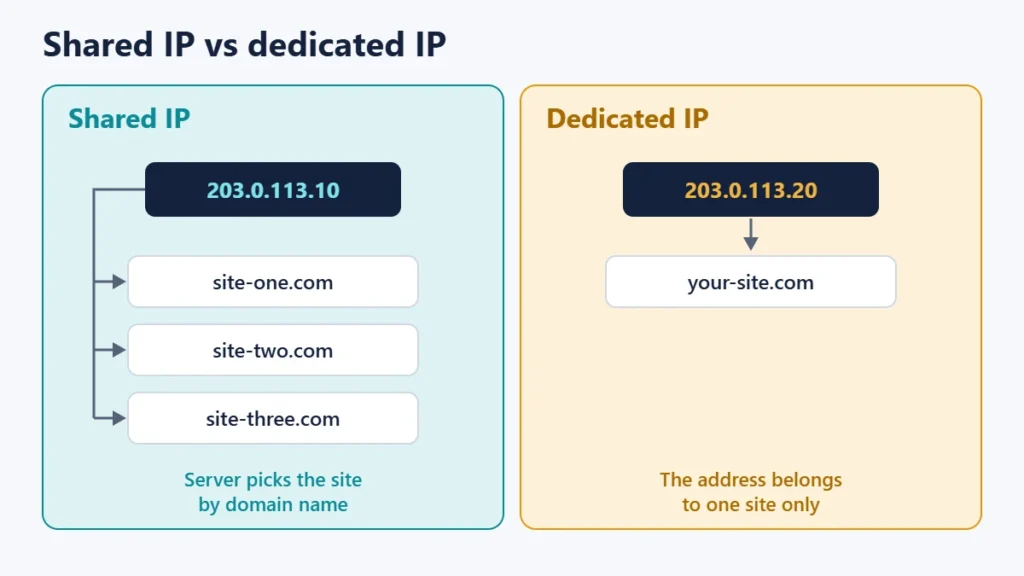
| Shared IP | Dedicated IP | |
|---|---|---|
| Who uses it | Many websites | Only your site or server |
| Cost | Included with most plans | Often an add-on, or included with VPS and dedicated servers |
| HTTPS | Works, using SNI | Works |
| Email sending reputation | Shared with other senders | Yours alone |
| Reach site by IP address alone | No | Usually yes |
| Fixed address for allowlists | Unsuitable | Suitable |
If you want to see which address a website uses, our guide to finding who hosts a website shows how to look it up, and our guide to nameservers and A records explains how domains point to IP addresses.
Myth: you need a dedicated IP for SSL
This used to be true, because a server could not tell which site’s certificate to present before the secure connection began. Server Name Indication (SNI) solved that. The TLS extensions standard, RFC 6066, describes SNI as a way for clients to name the server they want, so that secure connections can work with servers that host multiple virtual servers at a single underlying network address.
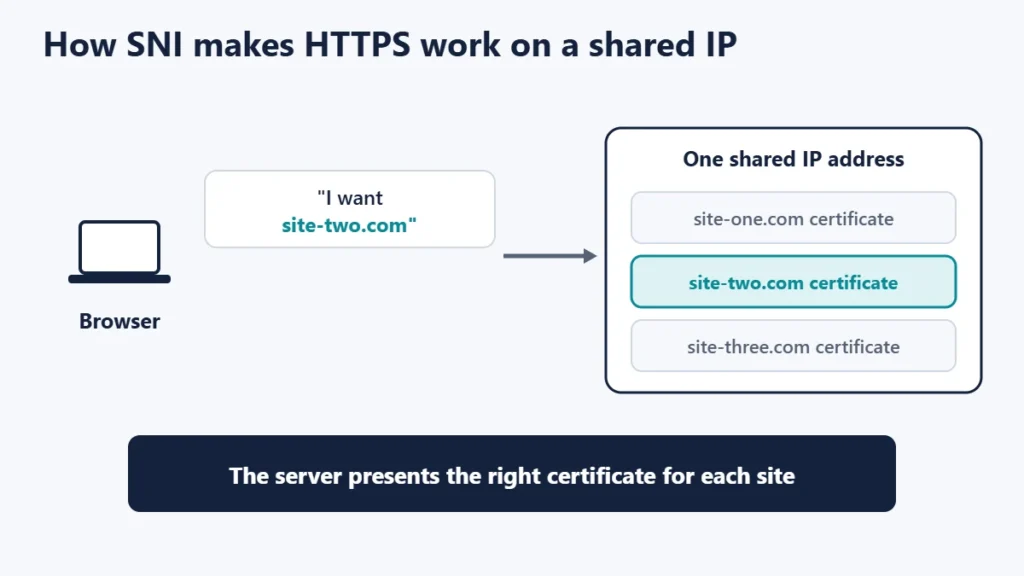
Current browsers and operating systems support SNI, so a certificate on a shared IP works for practically all visitors. If your site shows a security warning, the cause is almost certainly elsewhere; our guide to fixing “Not secure” warnings covers the real causes.
Myth: a dedicated IP improves search rankings
Google’s Search Central documentation contains no guidance saying that shared IP addresses or shared hosting harm rankings. What matters for search is that your site is fast, available and returns the right responses. A dedicated IP does not change those things by itself.
When a dedicated IP genuinely helps
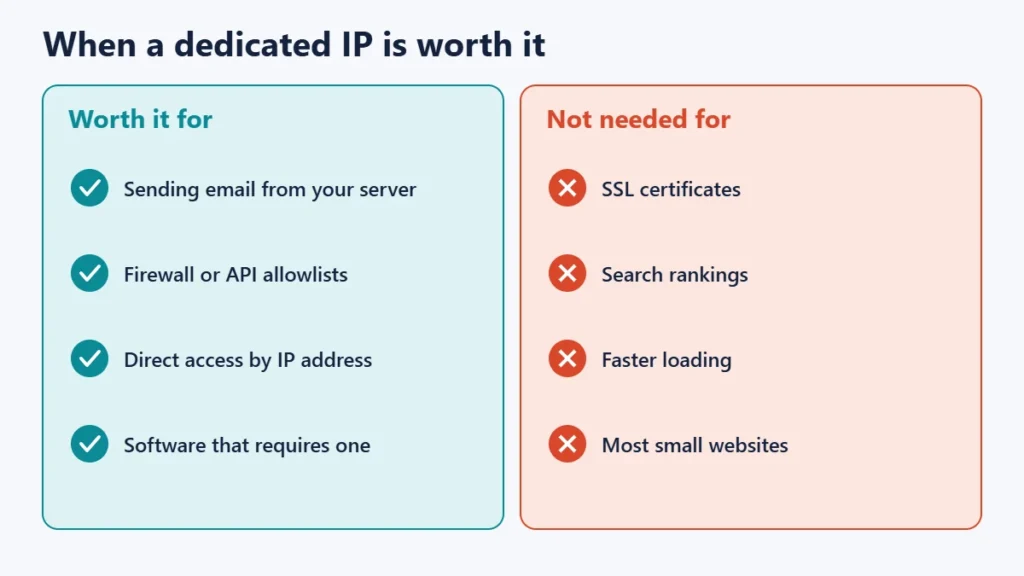
1. Sending email from your own server
This is the strongest reason. Google’s email sender guidelines explain that on a shared IP address, the activity of every sender using that address affects the reputation of all of them, and a negative reputation can hurt delivery. They also note that sending limits for an address can be shared, so when it hits its quota, every domain sending from it stops. Google advises sending from the same IP address where possible and keeping forward and reverse DNS records in place.
If you use a separate email service, such as a business email provider or a newsletter platform, your website’s IP address does not affect that mail. Our guides to why emails land in spam and email authentication cover the other factors involved.
2. Firewall and API allowlists
Some payment processors, partner systems and corporate firewalls only accept connections from approved IP addresses. If your server needs to connect to them, a fixed dedicated address makes that possible.
3. Direct access by IP address
A dedicated IP lets you reach your server by address alone, which helps when testing a site before its domain points there, or for some administrative tools.
4. Software or services that require one
Certain control panels, applications and older systems still expect a dedicated address. Check the documentation of any software you plan to run.
Things to know before you pay
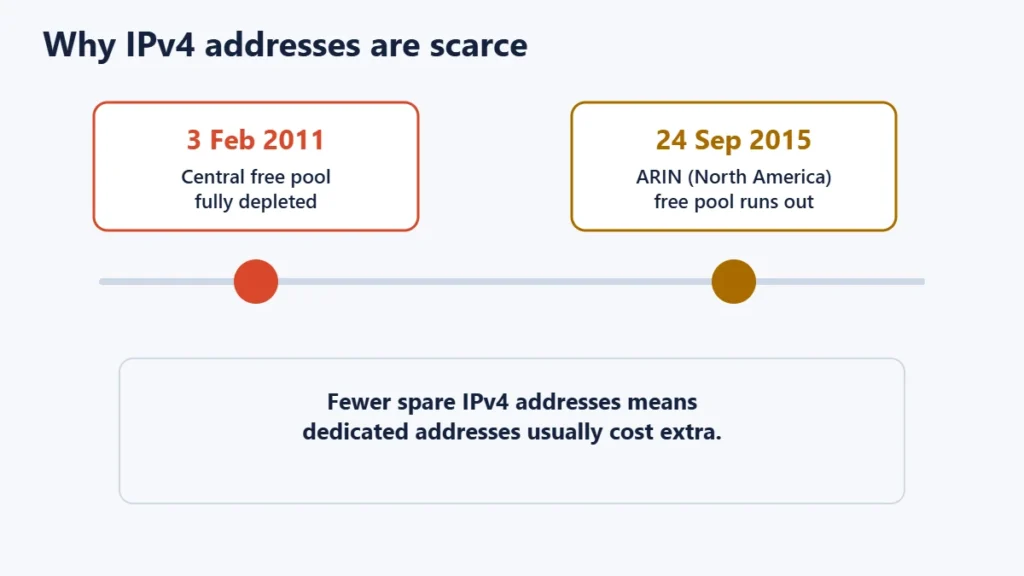
- IPv4 addresses are scarce. The Number Resource Organization announced on 3 February 2011 that the central free pool of IPv4 addresses had been fully depleted. ARIN, the registry for North America, says its own free pool ran out on 24 September 2015. That scarcity is one reason dedicated IPv4 addresses cost extra.
- A CDN changes the picture. If your site sits behind a CDN, visitors connect to the CDN’s addresses, not yours. Our guide to CDNs explains how this works.
- A “dedicated IP” is not a dedicated server. You may still share the server’s CPU and memory with other sites.
- Reputation is yours alone. A dedicated IP protects you from other senders, but you are fully responsible for the address’s history from then on.
- Check what the address was used for before, if your host lets you, especially for email.
Common mistakes
- Buying a dedicated IP just for SSL. SNI makes this unnecessary.
- Expecting an SEO boost. Google’s documentation offers no support for this.
- Confusing a dedicated IP with dedicated resources. Speed depends on the server, not the address.
- Sending bulk email from a web server without proper DNS records. Even a dedicated IP needs authentication and reverse DNS.
- Forgetting the CDN. Behind a CDN, your server’s address is rarely visible to visitors.
Frequently asked questions
Is a shared IP address bad?
No. Shared IPs are normal and work well for most websites. They matter mainly if you send email from the same address as other senders.
Do I need a dedicated IP for an SSL certificate?
Not today. Server Name Indication lets many HTTPS sites share one IP address.
Does a dedicated IP make my website faster?
Not by itself. Speed depends on the server’s resources, caching and configuration.
Does a dedicated IP help email deliverability?
It can, if you send email from your own server, because your reputation is no longer shared with other senders. Authentication and good sending practices still matter.
How much does a dedicated IP cost?
It varies by host and plan. Some include one with VPS or dedicated servers, while shared hosting plans usually charge extra.
What is the difference between a dedicated IP and a static IP?
A static IP does not change. A dedicated IP is used only by you. Most dedicated hosting IPs are also static.
The short version
Skip the dedicated IP unless you have a specific reason. Shared addresses handle HTTPS through SNI and do not harm rankings according to Google’s documentation. Pay for a dedicated IP if you send email from your own server, need a fixed address for allowlists or direct access, or run software that requires one. For more on how hosting plans differ, see our guide to what web hosting is.

Justwebworld has published guides since 2012. How we write and update articles Report an error
