

Spaced repetition means reviewing what you learn at increasing intervals instead of cramming it all at once. It works because of the spacing effect: information you revisit after a gap sticks better than information you study in one long session. Research also shows the best gap depends on how long you need to remember it.
The idea goes back to the German psychologist Hermann Ebbinghaus, who drew the first “forgetting curve” in 1885. This guide explains the forgetting curve in simple words, what the research says about the best timing, a simple schedule you can use for exams, languages or work skills, and the most common mistakes.
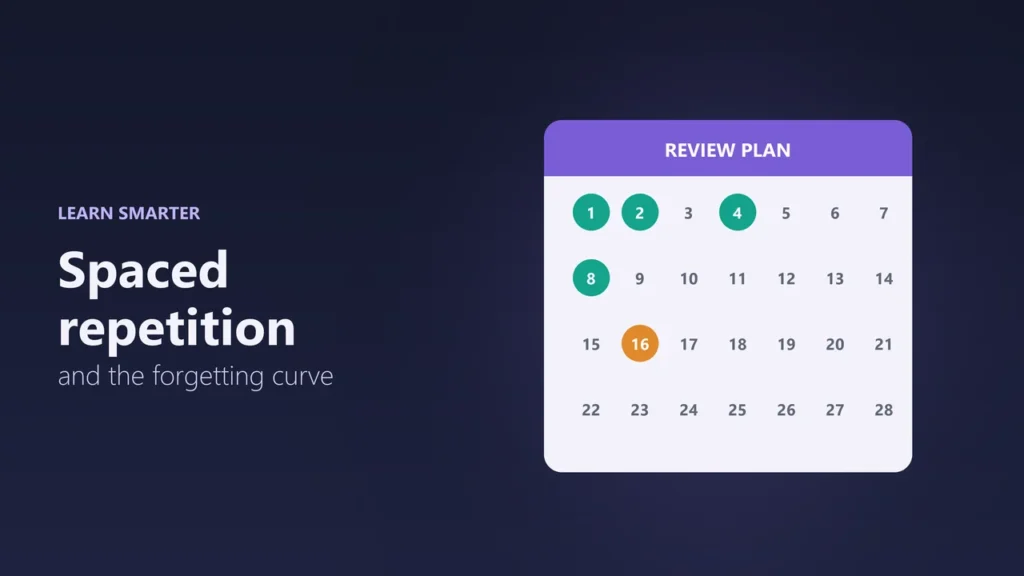
- What it is: reviewing material several times, with gaps in between
- Why it works: we forget fast at first, then more slowly; each review resets the curve
- Best gap: about 20 to 40% of the time until your test, for a test a week away
- Longer goals, longer gaps: for a test a year away, about 5 to 10% of that time
- Easy tools: flashcards, self-quizzes and a simple calendar
The forgetting curve: how fast we forget
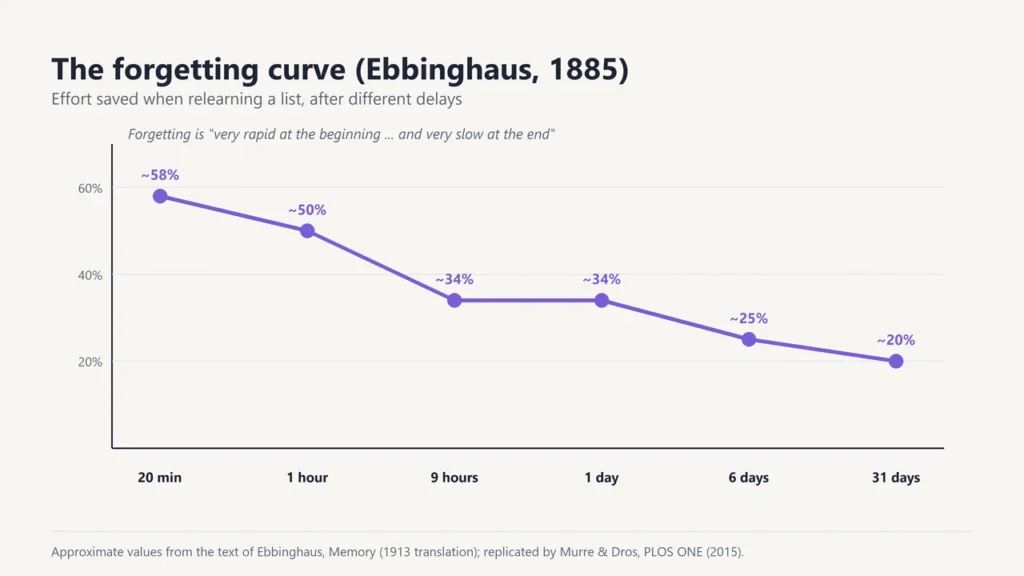
In his 1885 book, translated into English in 1913 as Memory: A Contribution to Experimental Psychology, Ebbinghaus tested himself on lists of nonsense syllables. He measured memory by how much effort he saved when relearning a list later. His results showed that forgetting is “very rapid at the beginning of the process and very slow at the end”.
| Time after learning | Effort saved when relearning |
|---|---|
| About 20 minutes | About 58% |
| 1 hour | About half of the work had to be done again |
| About 8 to 9 hours | About two-thirds of the work had to be done again |
| 1 day | About 34% |
| 6 days | About one quarter |
| 31 days | About one fifth |
Was he right? In 2015, Jaap Murre and Joeri Dros repeated the experiment and published the results in the journal PLOS ONE. They reported that the forgetting curve “has indeed been replicated”. They also found a small upward jump at the 24-hour point, which they suggest may be linked to sleep, although they say this needs more testing.
What the research says about spacing
The spacing effect is one of the best-tested findings in memory research.
- A big review (2006): Nicholas Cepeda and colleagues, in Psychological Bulletin, analysed 839 measurements from 317 experiments in 184 articles. They found that the gap between study sessions that gives the best memory grows as the time you need to remember grows.
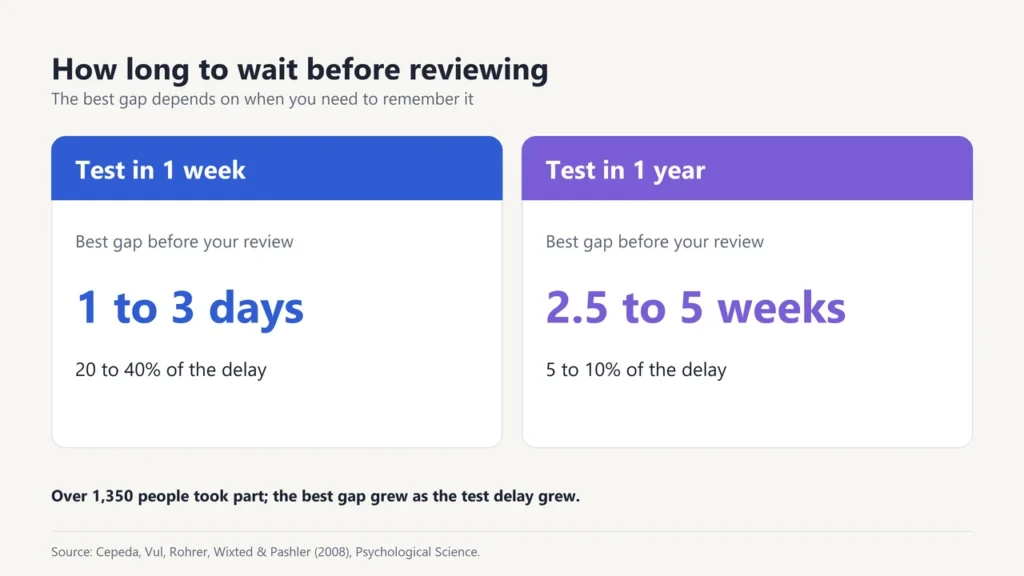
- A large experiment (2008): in Psychological Science, the same group taught more than 1,350 people a set of facts, reviewed them after gaps of up to 3.5 months, and tested them up to a year later. The best gap was about 20 to 40% of a one-week test delay, falling to about 5 to 10% of a one-year test delay. The authors concluded that many educational practices are “highly inefficient”.
In plain words: if your exam is a week away, review again in about 1 to 3 days. If you want to remember something for a year, gaps of a few weeks work better than reviewing every day.
| When you need to remember it | Best gap before reviewing |
|---|---|
| In 1 week | About 1 to 3 days (20 to 40% of a week) |
| In 1 year | About 2.5 to 5 weeks (5 to 10% of a year) |
A simple spaced repetition schedule
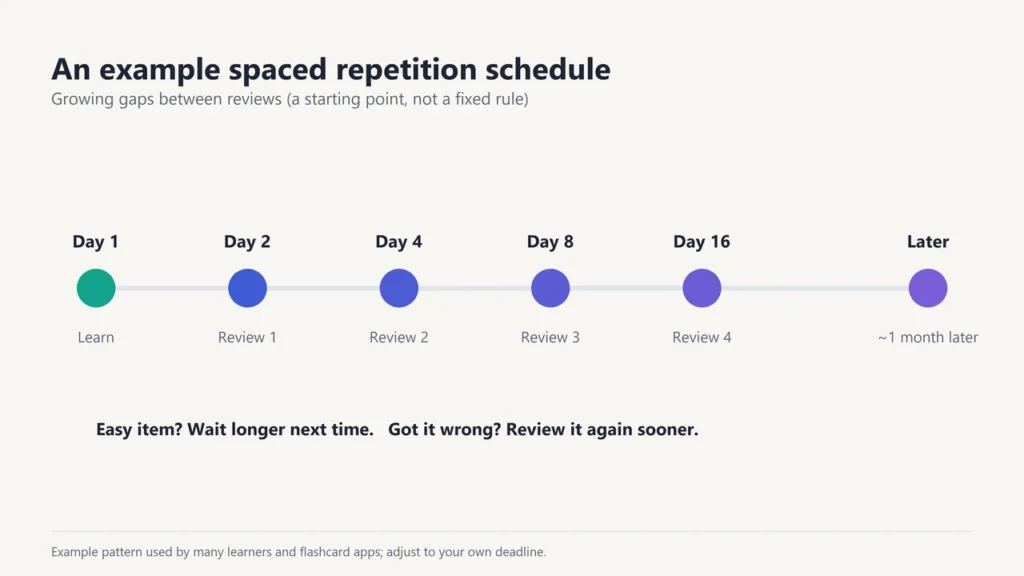
Research gives the principle, not one exact timetable. Many learners and flashcard apps use a pattern of growing gaps like this one. Treat it as a starting point and adjust it to your deadline:
- Day 1: learn the material.
- Day 2: first review.
- Day 4: second review.
- Day 8: third review.
- Day 16, then about a month later: keep reviewing anything you still find hard.
If an item is easy, wait longer before the next review. If you got it wrong, review it again sooner.
How to use spaced repetition
- Make flashcards. Put a question on one side and the answer on the other. Paper cards or an app both work.
- Test yourself, don’t just reread. Try to recall the answer before you look.
- Sort cards into piles. Cards you know move to a “review later” pile; cards you miss stay in the “review soon” pile.
- Keep sessions short. Fifteen to twenty minutes a day is easier to keep up than one long weekly session.
- Start early. Spacing needs time, so it can’t rescue you the night before an exam.
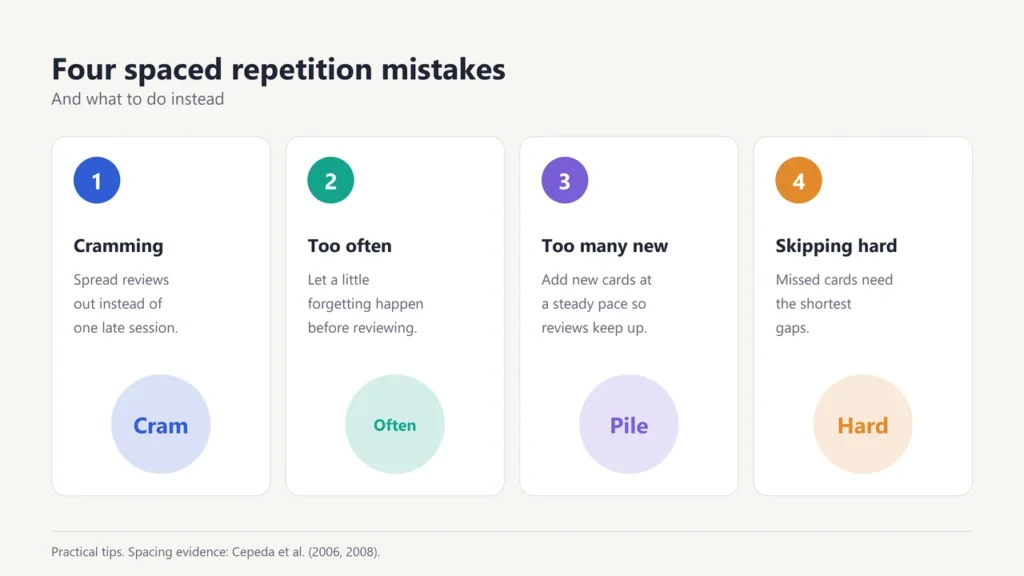
Common mistakes
- Cramming everything at the end. It can feel productive, but the research above shows spaced study lasts longer.
- Reviewing too often. Reviewing every hour wastes time. Let a little forgetting happen first.
- Too many new cards at once. Reviews pile up quickly. Add new material at a steady pace.
- Skipping hard items. The cards you get wrong are the ones that need the shortest gaps.
Want more study tips? Read our guides to memorization strategies, whether overnight cramming works, and the Pomodoro Technique for focused study sessions.
Frequently asked questions
What is spaced repetition in simple words?
Reviewing something several times with gaps in between, and making the gaps longer as you learn it, instead of studying it all in one go.
What is the forgetting curve?
A graph showing how quickly we forget new information. Hermann Ebbinghaus first measured it in 1885: forgetting is fast at first and slows down over time.
Does spaced repetition really work?
Yes. A 2006 review of 317 experiments and a 2008 study of more than 1,350 people both found that spacing study sessions improves long-term memory.
How long should I wait between reviews?
It depends on when you need the information. For a test a week away, about 1 to 3 days. For something you want to remember for a year, gaps of a few weeks.
Can I use spaced repetition to learn a language?
Yes. It is widely used for vocabulary. Put a word on one side of a card and its meaning on the other, and review it at growing intervals.
Is cramming ever useful?
Cramming may help for a test the next morning, but you are likely to forget much of it soon after. For anything you need to keep, spaced reviews work better.

Justwebworld has published guides since 2012. How we write and update articles Report an error
