

At first glance, Web3 often feels almost frictionless. A wallet connects in seconds, tokens move across networks, balances update on the fly. For someone new to the space, this can look deceptively simple, as if the complexity somehow disappeared. In reality, it did not. It was abstracted.
Much of that abstraction happens through APIs.
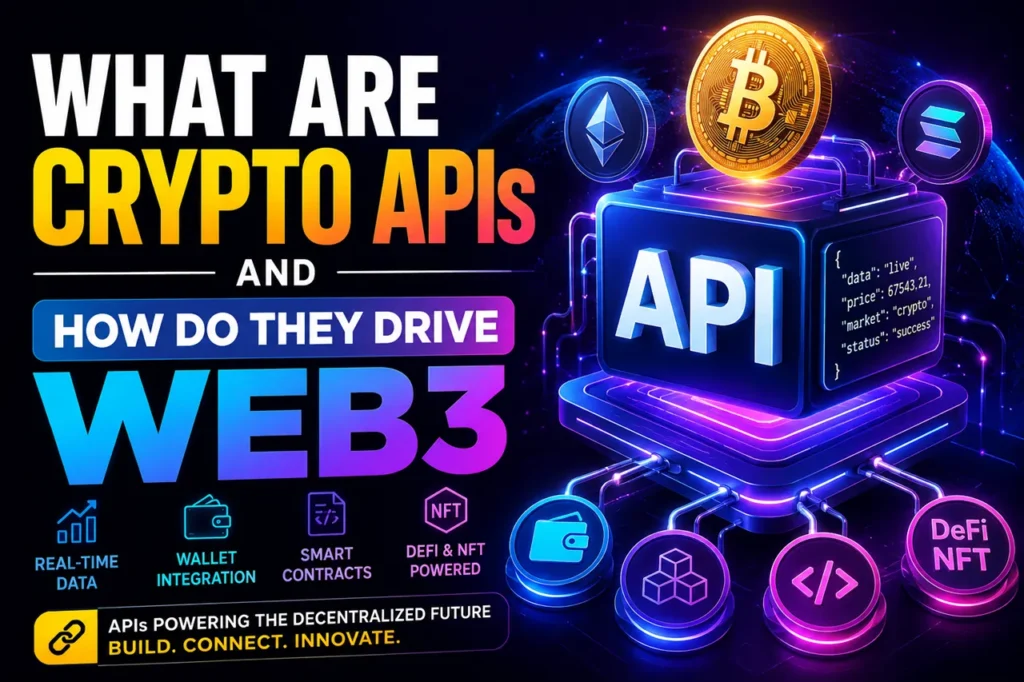
Application Programming Interfaces, usually shortened to APIs, serve as the connective layer between systems that would otherwise struggle to communicate. In the context of crypto, they allow applications to interact with blockchains, exchanges, and wallets without rebuilding core infrastructure piece by piece. Blockchains define the rules, but APIs make those rules usable in everyday products.
For developers, this distinction matters. Integrating directly with multiple networks is not just time-consuming; it can quickly become unsustainable. Different protocols, different standards, different edge cases. To avoid this, many teams solve infrastructure challenges via crypto APIs, which make it possible to integrate exchange functionality without building a trading engine or sourcing liquidity independently.
What Is a Crypto API?
Put simply, a crypto API is a structured interface that allows one application to request data or trigger actions in another.
There is nothing uniquely “crypto” about the concept itself. APIs are everywhere: powering payment processing, aggregating travel data, delivering weather forecasts. What changes in Web3 is the type of data and, to some extent, the level of fragmentation behind it.
Depending on the use case, crypto APIs can provide:
- Real-time and historical price data
- Wallet balances and transaction history
- On-chain activity and confirmations
- Token metadata
- Exchange rates and swap execution
- NFT-related information
Instead of querying blockchains directly or maintaining full nodes, developers send standardized requests and receive structured responses. It is a simplification, but a necessary one given how uneven the underlying infrastructure can be.
Why Web3 Depends on APIs
Web3 is often framed as a cleaner, more open alternative to traditional internet models. That framing is not wrong, but it tends to gloss over a practical detail: decentralization does not eliminate complexity; it redistributes it.
Each blockchain brings its own architecture, its own logic, its own quirks. Supporting several networks at once is not just a matter of scaling, it is a matter of compatibility.
APIs step in as a kind of translation layer. They do not unify blockchains in a strict sense, but they make interaction more predictable. From a developer’s perspective, that predictability is often more valuable than full control over infrastructure.
Common Types of Crypto APIs
Not all APIs operate at the same level. Most fall into a few recognizable categories, each addressing a specific part of the stack.
Market Data APIs
These provide pricing data, trading volumes, and historical trends. They are the backbone of dashboards, analytics platforms, and financial content. Without them, even basic features like portfolio tracking become unnecessarily complex.
Blockchain APIs
Blockchain APIs expose on-chain data in a more accessible format. They can return balances, track transactions, estimate fees, or broadcast signed transactions. Running nodes can achieve the same outcome, but it comes with significantly higher overhead.
Exchange APIs
Exchange APIs connect applications to trading infrastructure. Through them, users can buy, sell, or swap assets without leaving the interface. Some APIs link to individual exchanges; others aggregate liquidity across multiple sources, which can improve pricing under certain conditions.
Wallet APIs
Wallet APIs handle address generation, transaction creation, and balance tracking. In practice, most wallet applications rely on several APIs at once, even if this is not visible to the end user.
Where APIs Show Up in Practice
Most users interact with crypto APIs constantly, just not directly.
A wallet displaying a token balance is typically pulling data from a blockchain API. Price feeds come from market data providers. When a user swaps assets inside a wallet, there is a good chance an exchange API is involved somewhere in the background.
Even blockchain explorers depend heavily on APIs. They take raw, fragmented data and turn it into something navigable. Without that intermediary layer, the user experience would be far less intuitive.
Why Teams Don’t Build Everything Themselves
In theory, a team could control the entire stack: run nodes, manage liquidity, build matching engines. Some large exchanges still operate this way. In practice, most teams choose a different path. Infrastructure is not static. Networks evolve, standards shift, and usage patterns change over time. Maintaining compatibility across multiple chains becomes an ongoing effort, one that does not directly improve the product from a user’s perspective. This is where third-party providers come in. The benefits of using third party crypto providers are usually reduced development time, lower infrastructure costs, faster time to market, and access to reliable, ready-made integrations.
That said, outsourcing introduces its own constraints. Reliability, uptime, and security practices are no longer fully under the team’s control. As a result, choosing an API provider becomes less of a technical detail and more of a strategic decision.
How APIs Influence Innovation
One of the more subtle effects of APIs is how they shift development priorities.
When infrastructure becomes modular, teams spend less time rebuilding core components and more time refining the product itself. Features that once required months of work can now be integrated relatively quickly.
This pattern is not unique to crypto, it reflects a broader evolution in software development. What makes Web3 different is the level of complexity being abstracted. APIs do not remove that complexity entirely, but they make it manageable.
Are Crypto APIs Secure?
Security, in this context, depends largely on implementation.
Well-designed APIs use encrypted connections, authentication mechanisms, and rate limiting. More importantly, they are structured in a way that keeps sensitive data, such as private keys, out of external systems. Transactions are typically signed locally, with APIs handling only the transmission.
Even so, not all APIs are equal. Poor documentation, inconsistent uptime, or weak security practices can create risks. For developers, evaluating providers is not optional, it is part of building a stable system.
The Future of APIs in Web3
If anything, the role of APIs is becoming more pronounced. The Web3 ecosystem continues to expand in multiple directions at once: Layer 2 scaling solutions, cross-chain protocols, new token standards. Integration is getting harder, not easier. APIs offer a way to keep pace without constantly rebuilding infrastructure. They allow applications to adapt, even as the underlying landscape shifts.
From the user’s perspective, this layer remains mostly invisible. From the developer’s side, it is foundational. APIs connect systems that were never designed to work seamlessly together—and, in doing so, make Web3 feel more coherent than it actually is under the hood.

Justwebworld has published guides since 2012. How we write and update articles Report an error
