

Test your smoke alarms once a month and replace each alarm 10 years from the date it was made. If your alarm uses a replaceable 9-volt battery, change the battery at least once a year. This is the advice of the US Fire Administration and the National Fire Protection Association (NFPA).
Working smoke alarms save lives. According to NFPA research, the risk of dying in a home fire is cut in half in homes with working smoke alarms. This guide explains how often to test and replace them, where to put them, how to stop the chirping, and what to check if you are buying new ones, wherever you live.
- Test: every month, by pressing the test button
- Replace the alarm: 10 years from its manufacture date
- Replace 9-volt batteries: at least once a year
- Where: every bedroom, outside each sleeping area, and on every level
- Best setup: interconnected alarms, so when one sounds, they all sound
Why working smoke alarms matter
NFPA’s research shows how big the difference is:
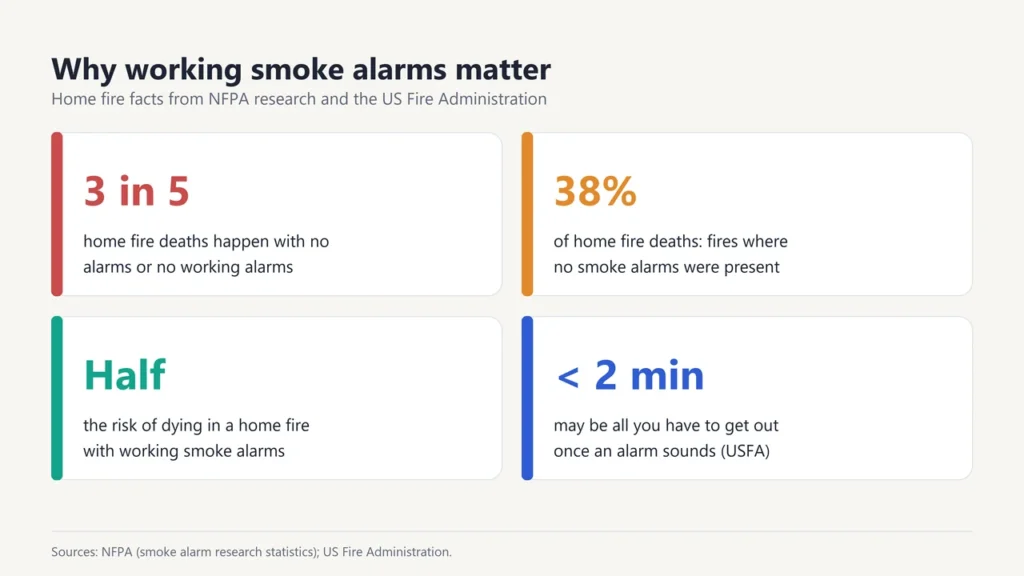
- Roughly three out of five home fire deaths happen in homes with no smoke alarms or no working smoke alarms.
- More than one-third (38%) of home fire deaths come from fires where no smoke alarms were present.
- The risk of dying in a home fire is cut in half in homes with working smoke alarms.
Speed is everything. The US Fire Administration warns that when a smoke alarm sounds, you may have less than 2 minutes to get everyone out safely.
How often to test, change batteries and replace smoke alarms
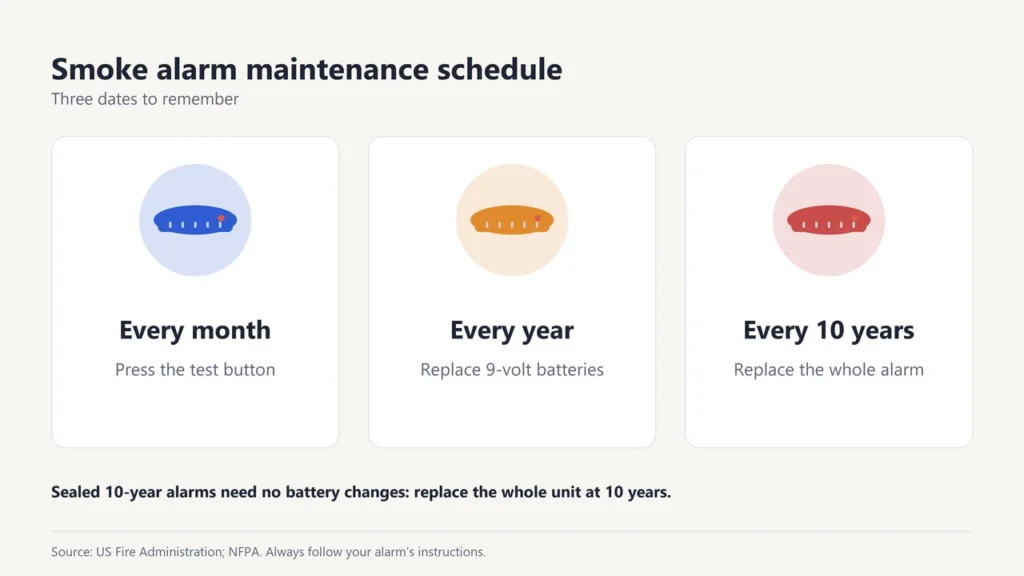
| Task | How often |
|---|---|
| Press the test button | Every month |
| Replace a 9-volt battery | At least once a year |
| Sealed 10-year battery alarm | No battery changes; replace the whole alarm at 10 years |
| Replace the whole alarm | 10 years from the manufacture date |
Where do you find the manufacture date? It is usually printed on the back of the alarm. If you can’t find a date, or the alarm is older than 10 years, replace it.
How to test a smoke alarm
- Tell everyone at home you are testing, so nobody panics.
- Press and hold the test button until the alarm sounds. Use a broom handle if it’s out of reach.
- Listen from other rooms. Make sure the alarm can be heard in bedrooms with the doors closed.
- If it doesn’t sound, replace the battery. If it still doesn’t work, replace the alarm.
- Test every alarm in the home, not just one.
Where to put smoke alarms
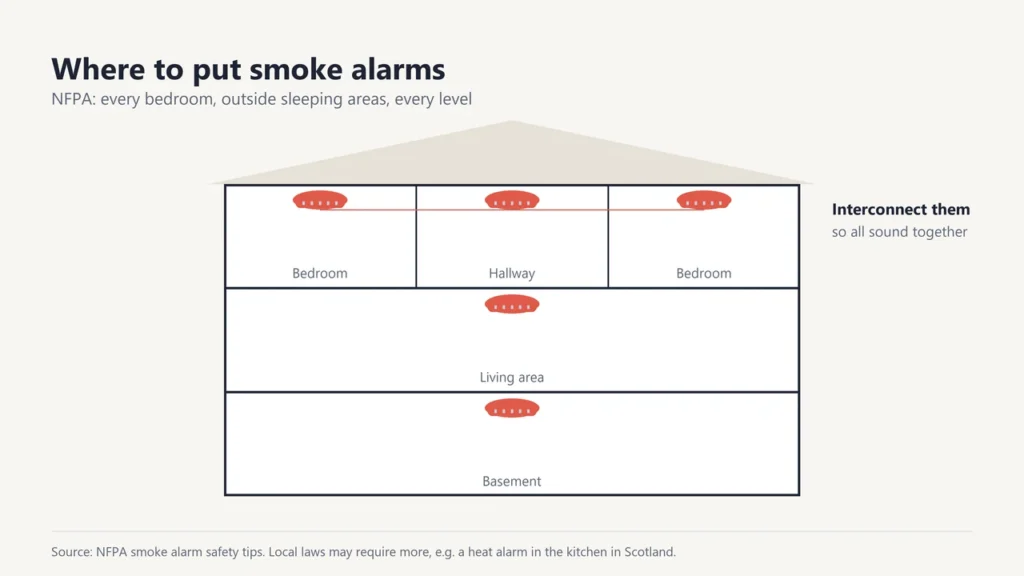
NFPA’s safety tips say to install smoke alarms:
- in every bedroom (every sleeping room);
- outside each separate sleeping area, such as the hallway outside bedrooms;
- on every level of the home, including the basement.
NFPA also says it is best to use interconnected smoke alarms, so that when one sounds, they all sound. This matters because you may not hear an alarm on another floor or behind a closed door.
Rules can differ by country
Many countries and regions have their own legal requirements, so check the rules where you live. For example, since February 2022, every home in Scotland must have interlinked alarms. The Scottish Government requires a smoke alarm in the most-used room, one in every hallway or landing on each floor, and a heat alarm in the kitchen, all ceiling-mounted. A carbon monoxide detector is also needed wherever there is a fuel-burning appliance such as a boiler. Alarms there can be sealed long-life battery units or mains-wired, and mains-wired ones must be fitted by a qualified electrician.
Why is my smoke alarm chirping?
A short chirp every minute or so usually means the battery is low. Replace it straight away. If a sealed 10-year alarm chirps, or an alarm keeps chirping after a new battery, it may have reached the end of its life and need replacing. Check the instructions for your model, as some use different chirp patterns.
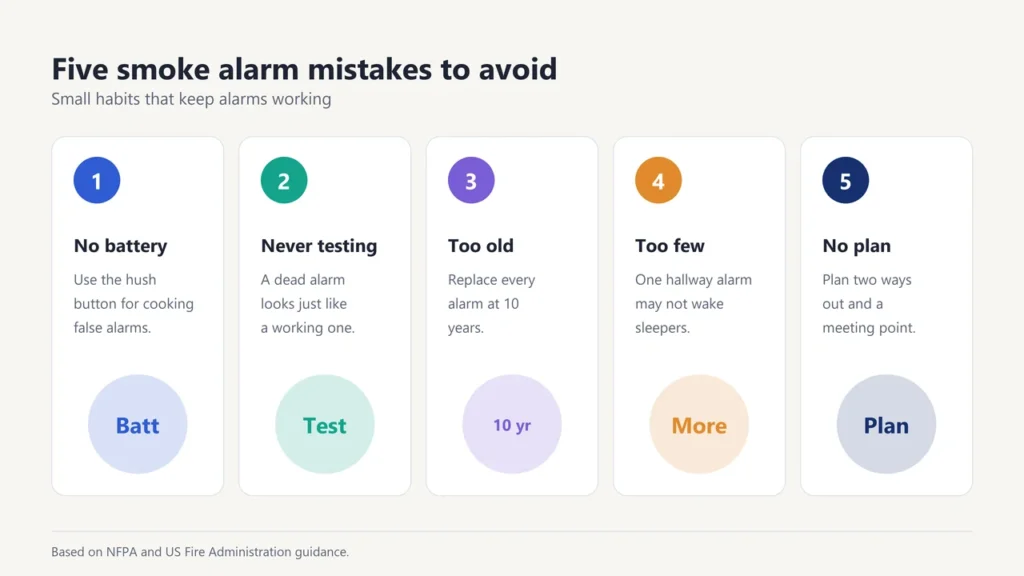
Common smoke alarm mistakes
- Taking the battery out because of cooking false alarms. Fan the smoke away or use the hush button instead.
- Never testing. A dead alarm looks exactly like a working one.
- Keeping alarms past 10 years. USFA reminds us that smoke alarms do not last forever.
- Too few alarms. One alarm in a hallway may not wake people behind closed bedroom doors.
- No escape plan. NFPA calls working smoke alarms an important part of a home fire escape plan. Plan two ways out of each room and a meeting point outside.
Want a safer, smarter home? Read our guides to smart home devices and how to pass an electrical safety inspection.
Frequently asked questions
How often should you replace smoke detectors?
Every 10 years from the date of manufacture, according to the US Fire Administration.
How often should you change smoke alarm batteries?
Replace 9-volt batteries at least once a year. Sealed 10-year alarms don’t need battery changes; replace the whole unit after 10 years.
How often should you test a smoke alarm?
At least once a month. Press the test button and make sure the alarm sounds.
Where is the best place for a smoke alarm?
In every bedroom, outside each sleeping area and on every level of the home, according to NFPA. Interconnected alarms are best.
What is the difference between a smoke alarm and a smoke detector?
In everyday use, people mean the same thing. Strictly, a smoke alarm has its own sounder, while a smoke detector may be one part of a larger alarm system.
Why does my smoke alarm beep for no reason?
A regular chirp usually means a low battery or an alarm near the end of its life. Replace the battery first, and replace the alarm if it is over 10 years old.

Justwebworld has published guides since 2012. How we write and update articles Report an error
