

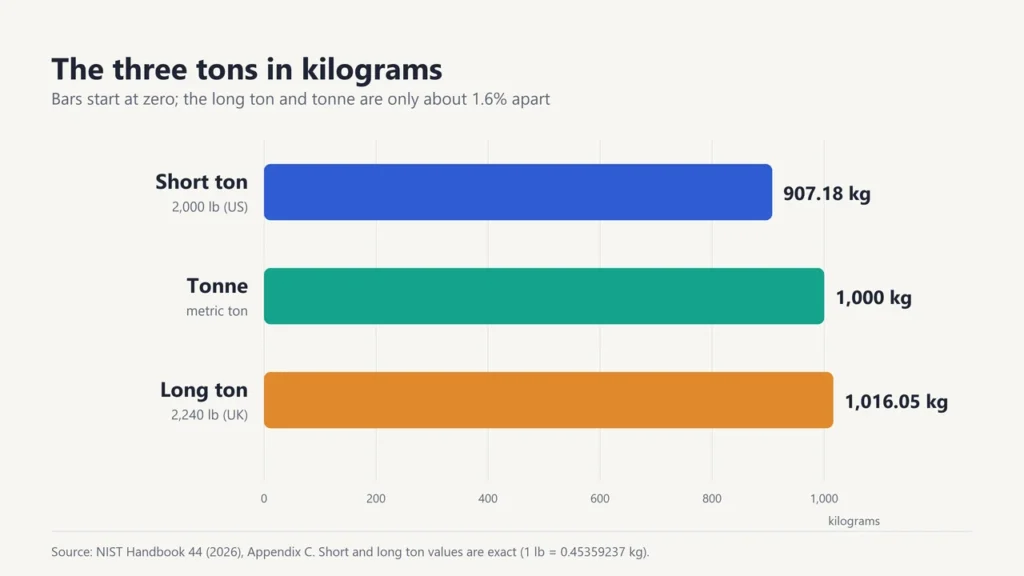
There are three common kinds of ton, and they are not the same weight. A short ton (the US ton) is 2,000 pounds, or about 907 kg. A long ton (the British or imperial ton) is 2,240 pounds, or about 1,016 kg. A metric ton, also spelled tonne, is exactly 1,000 kg, or about 2,205 pounds.
So the long ton is the heaviest, the tonne is in the middle, and the short ton is the lightest. The gap matters. A long ton is 12% heavier than a short ton. This guide explains where each ton is used, how to convert between them, and why the word “ton” can mean things that aren’t weights at all. The figures come from the US National Institute of Standards and Technology (NIST), the International Bureau of Weights and Measures (BIPM) and the UK Weights and Measures Act 1985.
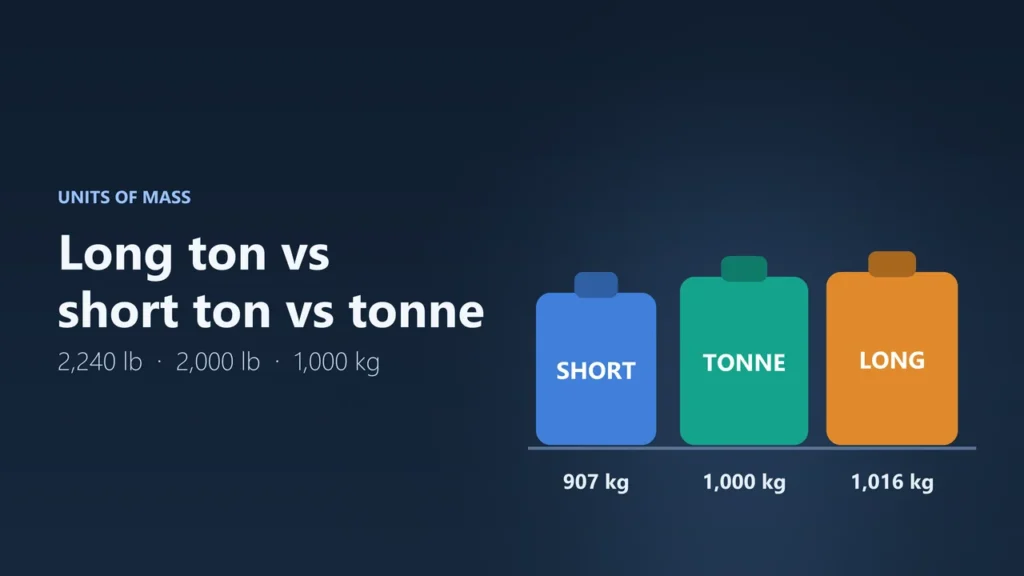
- Short ton (US ton): 2,000 lb = 907.18474 kg exactly
- Long ton (UK or imperial ton): 2,240 lb = 1,016.0469088 kg exactly
- Tonne (metric ton): 1,000 kg = about 2,204.62 lb
- Order, heaviest first: long ton, tonne, short ton
- Symbols: t for tonne, tn for short ton
Long ton vs short ton vs tonne: comparison table
| Short ton | Long ton | Tonne (metric ton) | |
|---|---|---|---|
| Other names | US ton, net ton | Imperial ton, British ton, gross ton | Metric ton |
| Pounds | 2,000 | 2,240 | 2,204.623 |
| Kilograms | 907.18474 | 1,016.0469088 | 1,000 |
| In short tons | 1 | 1.12 | 1.102311 |
| In long tons | 0.8928571 | 1 | 0.9842065 |
| In tonnes | 0.90718474 | 1.0160469088 | 1 |
| Symbol | tn | none official | t |
| Main use today | United States | Older British use; limited industrial use in the US | Most of the world, science and trade |
What is a short ton?
A short ton is 2,000 pounds. It is the ton used in the United States. When Americans say “ton” without any other word, they mean the short ton. NIST says that when “ton” is used unmodified, it is “commonly understood” to mean the 2,000-pound ton. It can be called a “net” or “short” ton when you need to tell it apart from the long ton.
Since the pound is defined as exactly 0.45359237 kg, a short ton is exactly 907.18474 kg. That is a little over nine-tenths of a tonne. NIST Handbook 44 also says that “tn” is the required abbreviation for the short ton on US weighing devices, as of 1 January 2014.
What is a long ton?
A long ton is 2,240 pounds, which is exactly 1,016.0469088 kg. It is the traditional British ton. In US tables it is also called the “gross ton”.
In the UK, the Weights and Measures Act 1985 still defines the ton as 2,240 pounds. But that definition sits in a part of the Act that lists units which “may not be used for trade except as supplementary indications”. In plain words, a UK shop can’t sell by the ton alone. It can only show tons next to the metric amount. In the US, NIST says the long ton is used commercially only “to a very limited extent, usually in restricted industrial fields”.
What is a tonne (metric ton)?
A tonne is exactly 1,000 kilograms. It is also called a metric ton, mostly in the United States. Its symbol is a lowercase t.
The tonne is not one of the SI base units, but the SI Brochure, published by the BIPM, lists it as a unit accepted for use with the SI: 1 t = 1 megagram = 1,000 kg. The BIPM notes that the tonne and its symbol were adopted in 1879. It also says the unit is “sometimes referred to as ‘metric ton'” in some English-speaking countries. NIST’s own guide uses both names: “tonne (called ‘metric ton’ in U.S.)”.
Because 1 t is the same as 1 megagram, the tonne fits neatly with the metric prefixes. A kilotonne is 1,000 tonnes, or a million kilograms. In countries that use the metric system, the tonne is the usual unit for large masses.
Why are there two different tons?
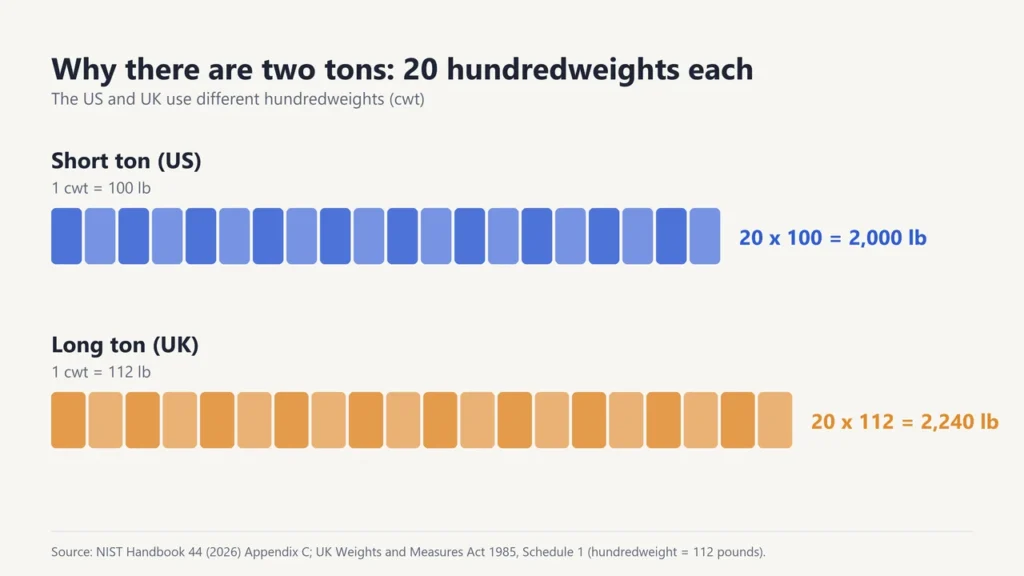
Both tons are 20 hundredweights. The difference is that the two countries use different hundredweights:
- US: 1 hundredweight = 100 pounds, so 20 hundredweights = 2,000 pounds (short ton).
- UK: 1 hundredweight = 112 pounds, so 20 hundredweights = 2,240 pounds (long ton).
The British hundredweight of 112 pounds is the same as 8 stone of 14 pounds. The US hundredweight is a round 100 pounds. Both sets of numbers appear in NIST Handbook 44 and in the UK Act. You can turn either hundredweight into pounds with our hundredweight to pounds converter.
How to convert between tons
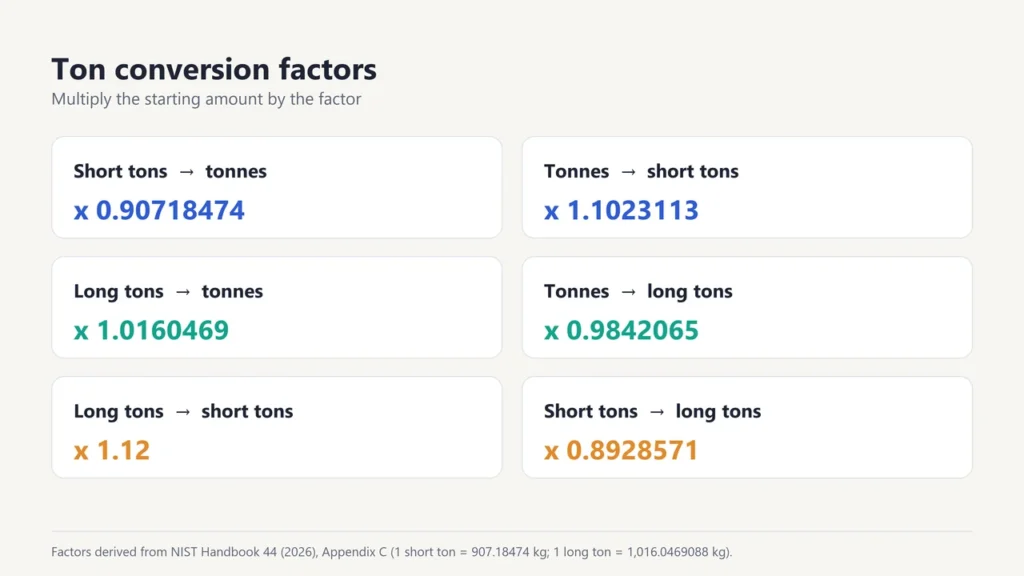
Multiply by the number in the row that matches what you want to do:
| To convert | Multiply by | Example |
|---|---|---|
| Short tons to tonnes | 0.90718474 | 5 short tons = 4.536 t |
| Tonnes to short tons | 1.1023113 | 10 t = 11.023 short tons |
| Long tons to tonnes | 1.0160469 | 3 long tons = 3.048 t |
| Tonnes to long tons | 0.9842065 | 10 t = 9.842 long tons |
| Long tons to short tons | 1.12 | 5 long tons = 5.6 short tons |
| Short tons to long tons | 0.8928571 | 5 short tons = 4.464 long tons |
| Short tons to kilograms | 907.18474 | 2 short tons = 1,814.37 kg |
| Long tons to kilograms | 1,016.0469 | 3 long tons = 3,048.14 kg |
Worked example: a car weighs 1,500 kg. That is 1.5 tonnes. In short tons it is 1.5 × 1.1023113 = 1.65 short tons. In long tons it is 1.5 × 0.9842065 = 1.48 long tons.
To skip the maths, use our converters: US tons to metric tonnes, metric tonnes to US tons, long tons to short tons, long tons to metric tonnes and long tons to kilograms. For any other weight unit, try the mass converter.
How big is the difference?
- Long ton vs short ton: 240 lb (108.86 kg) apart. The long ton is 12% heavier.
- Tonne vs short ton: about 204.6 lb (92.82 kg) apart. The tonne is about 10.2% heavier.
- Long ton vs tonne: about 35.4 lb (16.05 kg) apart. The long ton is about 1.6% heavier.
The long ton and the tonne are close, within about 1.6%. That is why people sometimes treat them as the same. The short ton is the odd one out. If a price is “per ton” and you don’t know which ton, a 1,000-ton order could be off by about 100 tonnes. Always check which ton a document means, especially in shipping, mining and international trade.
Other units called a “ton”
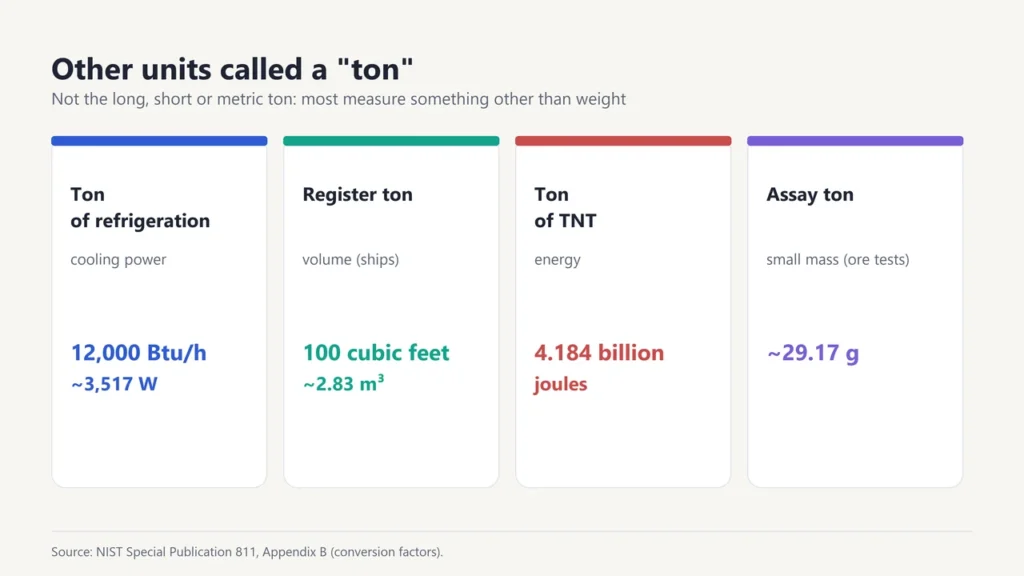
The word “ton” also turns up in other units. Most of them measure something other than weight. NIST’s guide to SI units lists these:
| Unit | What it measures | Value |
|---|---|---|
| Ton of refrigeration | Cooling power (air conditioners, chillers) | 12,000 Btu per hour = about 3,517 watts |
| Register ton | Volume (used for the capacity of ships) | About 2.83 cubic meters (100 cubic feet) |
| Ton of TNT | Energy (explosions) | 4.184 billion joules |
| Assay ton | A small mass used when testing ore for precious metals | About 29.17 grams |
| Ton-force (2,000 lbf) | Force | About 8,896 newtons |
So a “1.5-ton” air conditioner does not weigh 1.5 tons. The number describes its cooling power: 1.5 tons of refrigeration is 18,000 Btu per hour.
Ton or tonne: which word should you use?
- Writing for a global or scientific audience: use tonne (t) and give the value in kilograms if needed.
- Writing for US readers: “ton” means 2,000 pounds. Write “metric ton” if you mean 1,000 kg.
- Reading old British documents: “ton” usually means the 2,240-pound long ton.
- When in doubt: write the amount in kilograms or pounds as well, so nobody has to guess.
Big numbers in tonnes are often written in scientific notation, such as 2.5 × 10⁶ t for 2.5 million tonnes. If you work with tonnes a lot, it helps to learn both.
Frequently asked questions
Which is heavier, a ton or a tonne?
It depends on which ton. A tonne (1,000 kg) is heavier than a US short ton (907 kg), but lighter than a British long ton (1,016 kg).
How many pounds are in a ton?
A short (US) ton is 2,000 pounds. A long (UK) ton is 2,240 pounds. A metric ton, or tonne, is about 2,204.6 pounds.
How many kg are in a ton?
A short ton is 907.18474 kg, a long ton is 1,016.0469088 kg, and a tonne is exactly 1,000 kg.
Is a metric ton the same as a tonne?
Yes. Both mean 1,000 kilograms. “Tonne” is the spelling used by the BIPM and most countries. “Metric ton” is the name more common in the United States.
Does the UK use long tons or tonnes?
For trade, the UK uses the tonne. The 2,240-pound ton is still defined in the Weights and Measures Act 1985. But it may only be used for trade as a supplementary indication next to the metric amount.
What is the symbol for a tonne and a short ton?
The tonne’s symbol is a lowercase t. NIST requires “tn” as the abbreviation for the short ton on US weighing devices. The long ton has no official symbol in the NIST tables, so it is safest to write “long ton” in full.
Why is it called a short ton?
Because it is shorter, or lighter, than the long ton. The short ton is 20 hundredweights of 100 pounds. The long ton is 20 hundredweights of 112 pounds.

Justwebworld has published guides since 2012. How we write and update articles Report an error
