

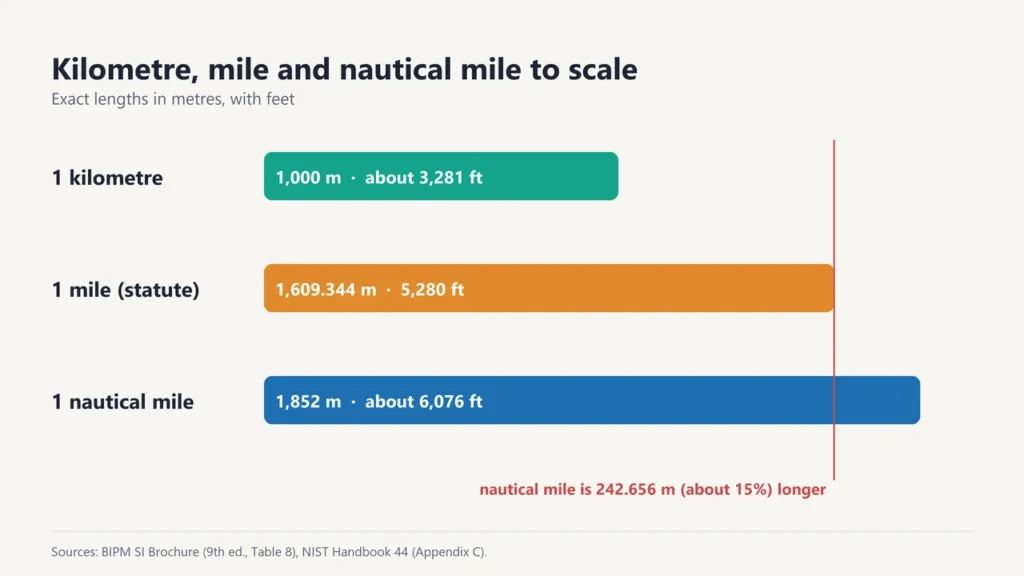
A nautical mile is longer than a regular mile. One nautical mile is exactly 1,852 metres (about 6,076 feet), while a regular mile, also called a statute or land mile, is exactly 1,609.344 metres (5,280 feet). So 1 nautical mile is about 1.15 miles, and 1 mile is about 0.87 nautical miles.
Ships and aircraft use nautical miles because one nautical mile was chosen to match one minute of latitude on a map. Road signs in the US and UK use regular miles. This guide shows the exact numbers, how to convert, and where each one is used.
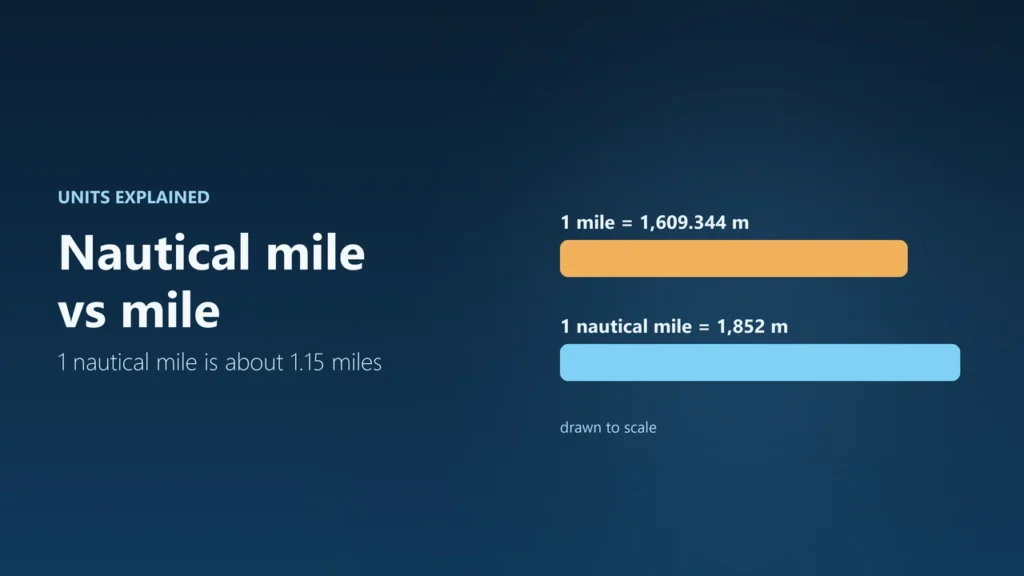
Nautical mile vs mile at a glance
| Nautical mile | Mile (statute) | |
|---|---|---|
| Exact length | 1,852 m | 1,609.344 m |
| In feet | about 6,076.12 ft | 5,280 ft |
| In kilometres | 1.852 km | about 1.609 km |
| In the other unit | about 1.1508 miles | about 0.8690 nautical miles |
| Speed unit | knot (1 nautical mile per hour) | mph (miles per hour) |
| Used for | sea and air navigation | roads and land distances (mainly US and UK) |
Why is a nautical mile longer?
Because it comes from the shape of the Earth, not from feet and yards. The two units were built in completely different ways.
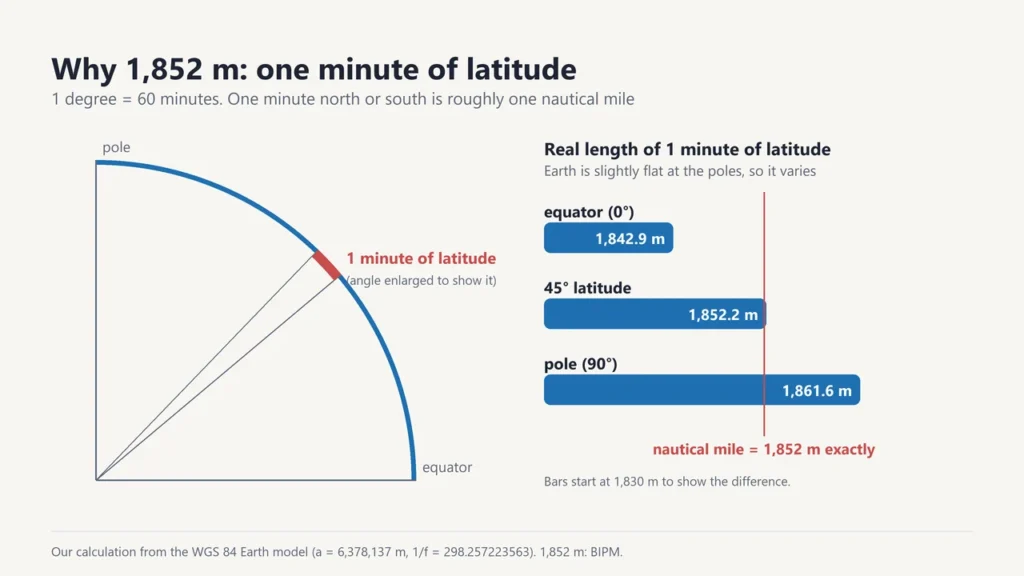
- The nautical mile was based on one minute of latitude. A circle has 360 degrees, and each degree has 60 minutes. Going one minute north or south on the Earth’s surface is roughly one nautical mile.
- The regular mile is 5,280 feet, or 1,760 yards. Since 1959 the yard has been defined as exactly 0.9144 m, which makes the mile exactly 1,609.344 m.
So one unit comes from the size of the Earth and the other from feet and yards. They were never meant to match, and the nautical mile ends up about 15% longer.
Is a nautical mile exactly one minute of latitude?
Not exactly. The Earth is slightly flattened at the poles, so one minute of latitude is a little shorter near the equator and a little longer near the poles. To stop the unit changing from place to place, it was fixed at exactly 1,852 m.
We worked out the real length of one minute of latitude using the WGS 84 Earth model that GPS uses. It is about 1,843 m at the equator, about 1,852 m at 45 degrees and about 1,862 m at the poles. So 1,852 m sits right in the middle.
How to convert nautical miles and miles
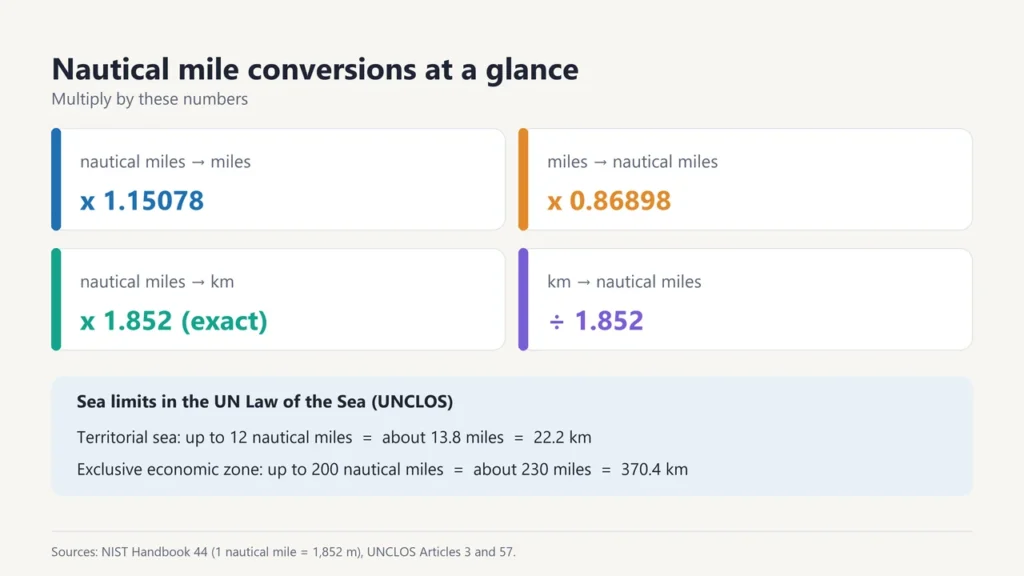
- Nautical miles to miles: multiply by 1.15078
- Miles to nautical miles: multiply by 0.86898
- Nautical miles to kilometres: multiply by 1.852 (exact)
- Kilometres to nautical miles: divide by 1.852
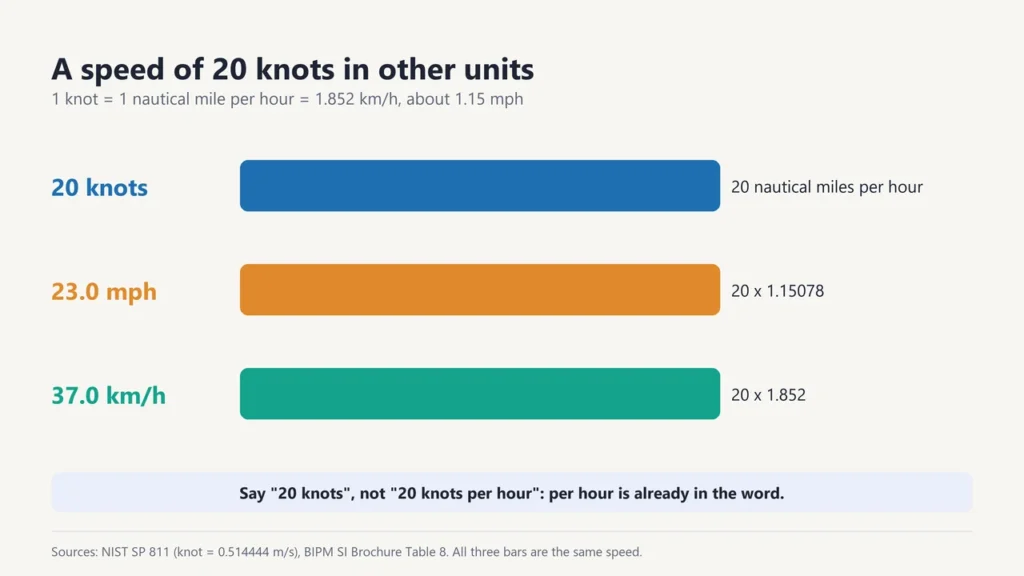
Example: a boat trip of 20 nautical miles is 20 x 1.15078 = about 23 miles, or 20 x 1.852 = 37.04 km. For a quick guess in your head, add about 15% to nautical miles to get miles.
| Nautical miles | Miles | Kilometres |
|---|---|---|
| 1 | 1.15 | 1.852 |
| 5 | 5.75 | 9.26 |
| 10 | 11.51 | 18.52 |
| 12 | 13.81 | 22.224 |
| 50 | 57.54 | 92.6 |
| 100 | 115.08 | 185.2 |
| 200 | 230.16 | 370.4 |
What is a knot?
A knot is a speed, not a distance. 1 knot = 1 nautical mile per hour, which is 1.852 km/h or about 1.15 mph. A ship moving at 20 knots covers 20 nautical miles in one hour, which is about 23 mph or 37 km/h.
Say “a speed of 20 knots”, not “20 knots per hour”. The “per hour” is already inside the word knot.
Where each unit is used
- Nautical miles and knots: ships, boats, sea charts and aircraft. The BIPM, which looks after the metric system, lists both as non-SI units used in sea and air navigation.
- Sea borders: the UN Convention on the Law of the Sea measures a country’s territorial sea (up to 12 nautical miles) and exclusive economic zone (up to 200 nautical miles) in nautical miles.
- Regular miles: road signs and speed limits in the US and UK, and everyday land distances in those countries.
- Kilometres: road distances in most other countries.
So a territorial sea of 12 nautical miles reaches about 13.8 miles, or 22.2 km, out from the coast. On sea charts and aviation charts, distances are given in nautical miles. Distances shown to travellers, such as on a flight booking site, may be in regular miles or kilometres, so check the unit.
A short history of the nautical mile
- 1929: the First International Extraordinary Hydrographic Conference in Monaco set the “international nautical mile” at 1,852 m.
- 1954: the United States adopted it from 1 July 1954. Before that, the US used 6,080.20 feet.
- 1970: the United Kingdom adopted it, according to NOAA.
There is still no official, worldwide symbol for the nautical mile. You will see short forms such as NM and nmi, so check which one a source uses.
Facts in this guide come from the BIPM SI Brochure (9th edition, Table 8), NIST Handbook 44 (Appendix C), NIST Special Publication 811, NOAA’s National Ocean Service and the UN Convention on the Law of the Sea (Articles 3 and 57). For other unit puzzles, see long ton vs short ton, metric prefixes, scientific notation and significant figures.
Frequently asked questions
Which is longer, a nautical mile or a mile?
A nautical mile. It is 1,852 m, while a mile is 1,609.344 m, so a nautical mile is about 15% longer.
How many miles is 1 nautical mile?
About 1.15 miles (1.15078 to five decimal places).
How many feet are in a nautical mile?
About 6,076 feet (6,076.115 feet more precisely). A regular mile is 5,280 feet.
Why do planes use nautical miles?
Pilots, like sailors, plan routes with latitude and longitude. Since a nautical mile is tied to a minute of latitude, distances on charts are easy to measure.
Is a knot faster than a mile per hour?
Yes. 1 knot is about 1.15 mph, or 1.852 km/h.
Why don’t we use nautical miles on land?
On land, people follow roads and paths, not lines of latitude, so the link to a minute of latitude does not help. Countries use their own legal road units instead: miles in the US and UK, kilometres in most other places.
Is there a nautical kilometre?
No. The same nautical mile of 1,852 m is used at sea and in the air around the world, including in countries that use kilometres on land.

Justwebworld has published guides since 2012. How we write and update articles Report an error
