

A metric prefix is a word you put in front of a unit to make it bigger or smaller by a power of 10. Kilo means 1,000, so 1 kilometre is 1,000 metres. Milli means one thousandth, so 1 millimetre is 0.001 metres. The same prefixes work with every metric unit: grams, litres, seconds, watts, bytes and more. For example, a tonne (t) is the same as a megagram: 1,000 kilograms. Our long ton vs short ton vs tonne guide compares it with the US and UK tons.
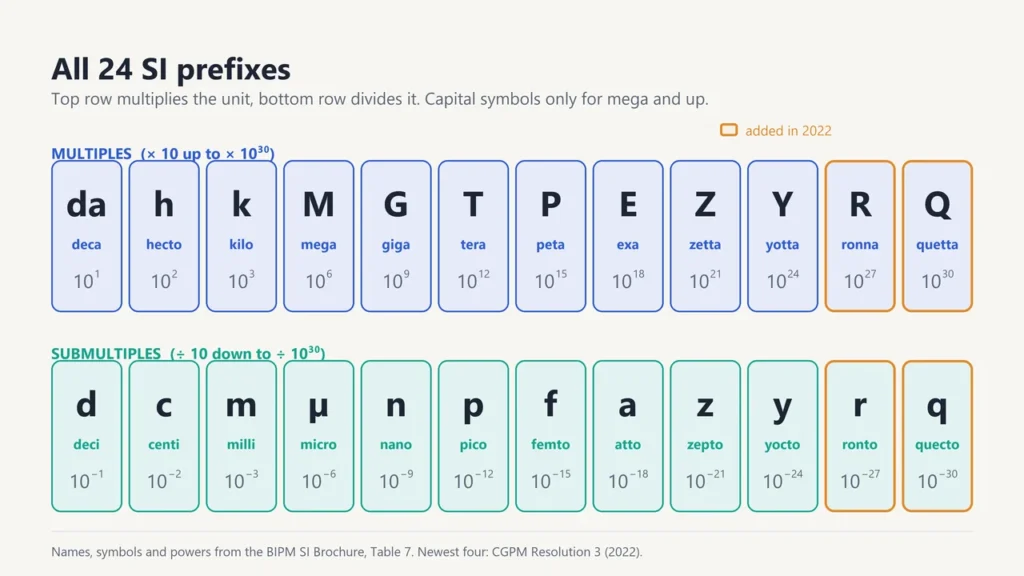
There are 24 official SI prefixes, from quecto (10−30) to quetta (1030). The newest four were added in 2022. This guide gives you the full chart from smallest to largest, the rules for writing them, an easy way to convert between them, and why your 1 TB drive shows up as about 931 GB.
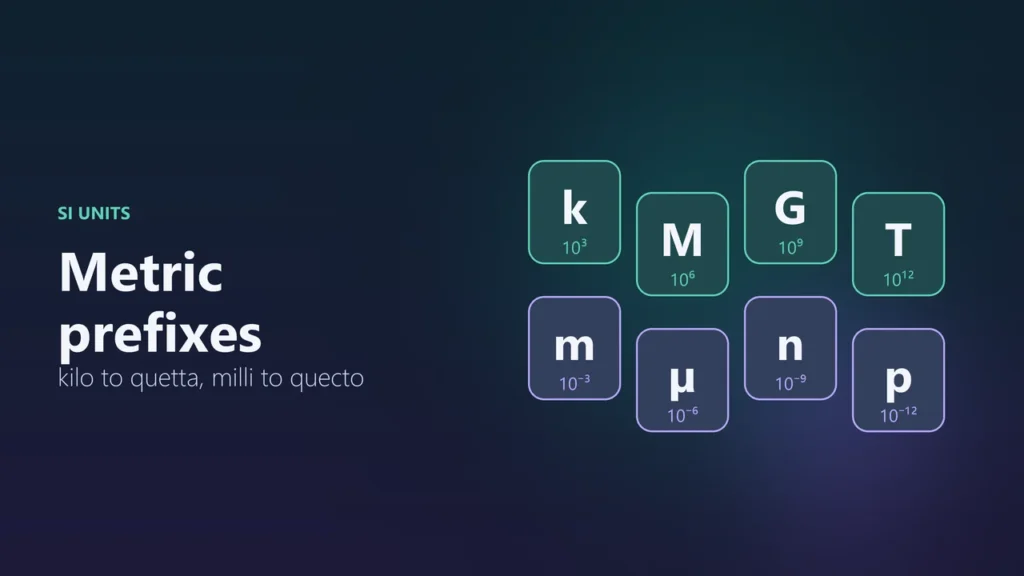
- Most used: kilo (k) = 1,000, centi (c) = 1/100, milli (m) = 1/1,000, micro (µ) = 1/1,000,000
- Large steps: mega (M) = million, giga (G) = billion, tera (T) = trillion
- Total: 24 prefixes, set by the General Conference on Weights and Measures (CGPM)
- Newest: ronna, quetta, ronto and quecto (2022)
- Case matters: M (mega) is a billion times bigger than m (milli)
Metric prefixes chart: all 24 SI prefixes
This is the full list from the SI Brochure, the official rulebook of the International Bureau of Weights and Measures (BIPM). The “In words” column uses the short-scale names used in the US and UK, as listed by the US National Institute of Standards and Technology (NIST).
| Prefix | Symbol | Power of 10 | In words |
|---|---|---|---|
| quetta | Q | 1030 | nonillion |
| ronna | R | 1027 | octillion |
| yotta | Y | 1024 | septillion |
| zetta | Z | 1021 | sextillion |
| exa | E | 1018 | quintillion |
| peta | P | 1015 | quadrillion |
| tera | T | 1012 | trillion |
| giga | G | 109 | billion |
| mega | M | 106 | million |
| kilo | k | 103 | thousand |
| hecto | h | 102 | hundred |
| deca (deka in the US) | da | 101 | ten |
| (no prefix) | – | 100 | one |
| deci | d | 10−1 | tenth |
| centi | c | 10−2 | hundredth |
| milli | m | 10−3 | thousandth |
| micro | µ | 10−6 | millionth |
| nano | n | 10−9 | billionth |
| pico | p | 10−12 | trillionth |
| femto | f | 10−15 | quadrillionth |
| atto | a | 10−18 | quintillionth |
| zepto | z | 10−21 | sextillionth |
| yocto | y | 10−24 | septillionth |
| ronto | r | 10−27 | octillionth |
| quecto | q | 10−30 | nonillionth |
Notice the pattern. From kilo upward, and from milli downward, each step is a jump of 1,000 (three powers of 10). Only the four prefixes in the middle, hecto, deca, deci and centi, move in steps of 10.
The prefixes you will use most
| Prefix | Means | Everyday examples |
|---|---|---|
| kilo (k) | × 1,000 | kilometre (km), kilogram (kg), kilowatt (kW) |
| centi (c) | ÷ 100 | centimetre (cm) |
| milli (m) | ÷ 1,000 | millimetre (mm), millilitre (mL), milligram (mg) |
| micro (µ) | ÷ 1,000,000 | micrometre (µm), microsecond (µs) |
| nano (n) | ÷ 1,000,000,000 | nanometre (nm), nanosecond (ns) |
| mega (M) | × 1,000,000 | megawatt (MW), megahertz (MHz), megabyte (MB) |
| giga (G) | × 1,000,000,000 | gigahertz (GHz), gigabyte (GB) |
| tera (T) | × 1,000,000,000,000 | terabyte (TB) |
For the steps between kilo and milli, many students learn the line “King Henry Died By Drinking Chocolate Milk”: kilo, hecto, deca, base unit, deci, centi, milli. It is just a memory trick, not part of any standard.
You meet milli in the kitchen too: a metric tablespoon is 15 mL, or 15 thousandths of a litre. Our guide to how many tablespoons are in a cup compares US and metric kitchen measures.
How to convert between metric prefixes
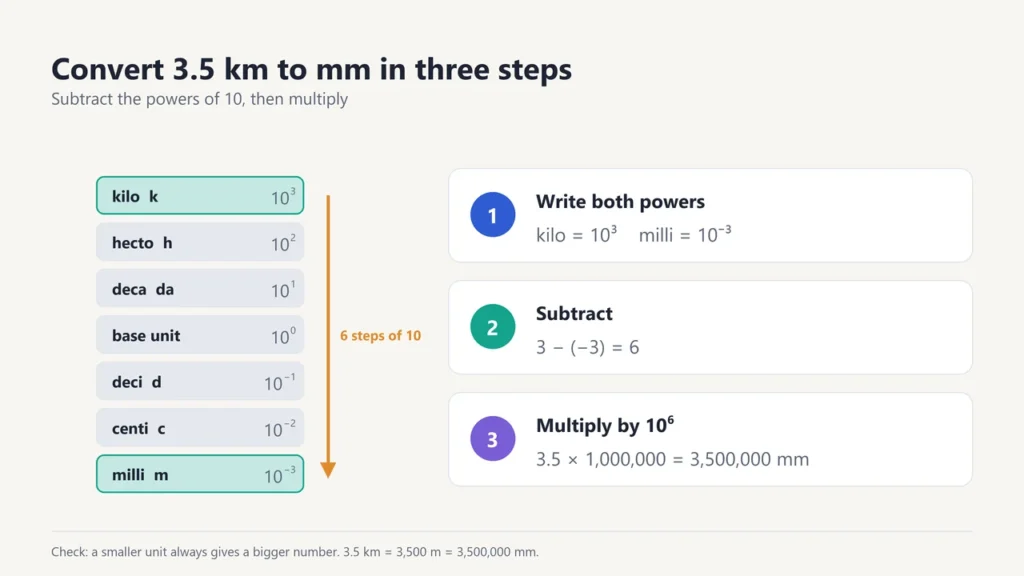
Subtract the powers of 10. Take the power of the prefix you have, minus the power of the prefix you want. Then multiply by 10 to that number.
- Write down both powers. To change 3.5 km into mm: kilo is 103 and milli is 10−3.
- Subtract: 3 − (−3) = 6.
- Multiply by 106: 3.5 × 1,000,000 = 3,500,000 mm.
| Convert | Power difference | Answer |
|---|---|---|
| 250 mg to g | −3 − 0 = −3 | 250 × 10−3 = 0.25 g |
| 5 GHz to Hz | 9 − 0 = 9 | 5 × 109 = 5,000,000,000 Hz |
| 2 L to mL | 0 − (−3) = 3 | 2 × 103 = 2,000 mL |
| 750 nm to µm | −9 − (−6) = −3 | 750 × 10−3 = 0.75 µm |
| 1.2 MW to kW | 6 − 3 = 3 | 1.2 × 103 = 1,200 kW |
A quick sense check: going to a smaller unit gives a bigger number, and going to a bigger unit gives a smaller number. If you work with powers of 10 often, our guide to scientific notation shows how to handle them without counting zeros. For weights, the Metric Weight Converter and the Grams to Milligrams tool do the sums for you.
Rules for writing metric prefixes
The SI Brochure sets a few simple rules. Following them stops your numbers from meaning something else.
- Capital or small letter matters. Symbols for big prefixes are capital letters (M, G, T), except k (kilo), h (hecto) and da (deca). Symbols for small prefixes are always lowercase (m, µ, n).
- Prefix names are lowercase unless they start a sentence: kilometre, not Kilometre.
- No space between the prefix and the unit symbol: write km, not k m.
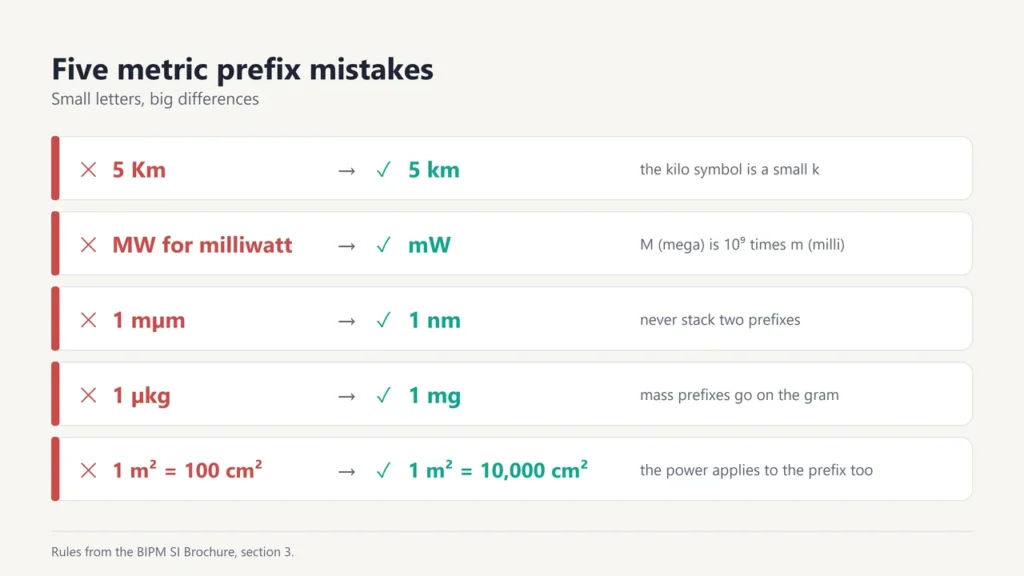
- Never stack two prefixes. Write nm (nanometre), not mµm.
- A prefix never stands alone. “5 k” is not a unit. Write 5 km, 5 kg, and so on.
- Mass uses the gram. The kilogram is the only SI base unit with a prefix already in its name. So 10−6 kg is written 1 mg, not 1 µkg.
- Powers apply to the prefix too. 1 cm3 means (1 cm)3, which is 10−6 m3, not 10−2 m3.
Rule 1 is the one that causes real mix-ups. 1 Mm (megametre) is 1,000 km, while 1 mm (millimetre) is one thousandth of a metre. They differ by 109. In the same way, 5 mW is 0.005 watts, while 5 MW is 5,000,000 watts.
Kilobyte vs kibibyte: why a 1 TB drive shows 931 GB
The SI Brochure is clear that metric prefixes mean powers of 10, never powers of 2. It gives this example: one kilobit is 1,000 bits, not 1,024 bits. But computers count memory in powers of 2, and for years “kilo” was loosely used for 1,024.
To fix this, the International Electrotechnical Commission (IEC) approved separate binary prefixes in December 1998, NIST reports. They take the first two letters of the metric prefix and add “bi” (for binary):
| Decimal (SI) | Bytes | Binary (IEC) | Bytes | Binary is bigger by |
|---|---|---|---|---|
| kilobyte (kB) | 1,000 | kibibyte (KiB) | 1,024 | 2.4% |
| megabyte (MB) | 1,000,000 | mebibyte (MiB) | 1,048,576 | 4.9% |
| gigabyte (GB) | 1,000,000,000 | gibibyte (GiB) | 1,073,741,824 | 7.4% |
| terabyte (TB) | 1,000,000,000,000 | tebibyte (TiB) | 1,099,511,627,776 | 10.0% |
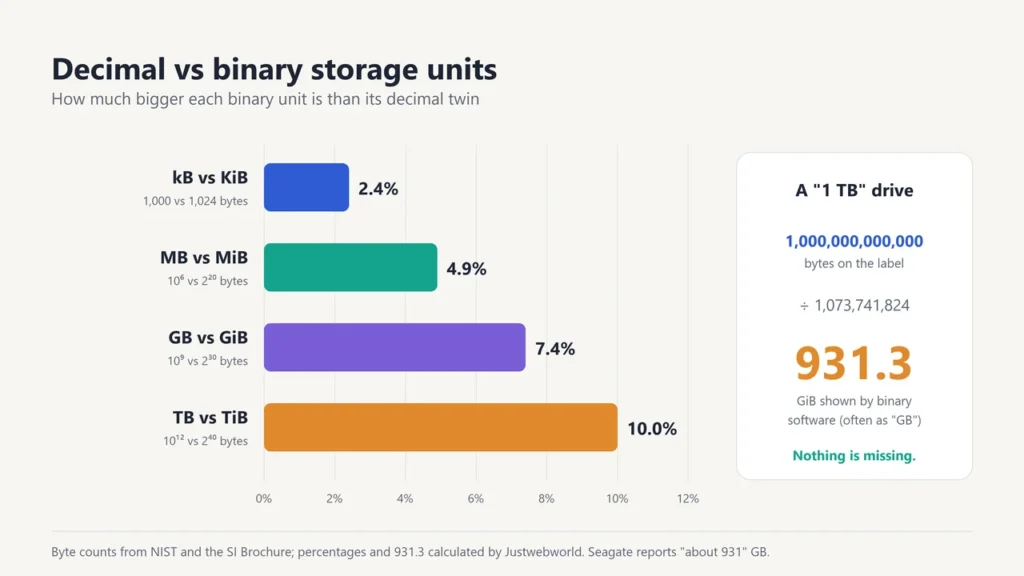
Drive makers label storage in decimal units. Apple’s packaging, for example, says “1GB = 1 billion bytes, and 1TB = 1 trillion bytes”. Some software counts in binary units but still prints “GB”. Seagate’s support page gives the classic case: a new 1 TB drive “reporting only about 931 gigabytes”. Nothing is missing. 1,000,000,000,000 bytes ÷ 1,073,741,824 = 931.3 GiB. In the same way, a 500 GB drive shows about 465.7 and a 256 GB phone about 238.4 in binary units.
The same bits-and-bytes confusion affects internet speeds, as our guide to Mbps vs MB/s explains.
Which number you see depends on the software. Apple’s support page names iOS 10 and earlier and OS X Leopard and earlier as systems that report storage in binary. The gap grows with every step: 2.4% at kilo, but 10% at tera.
The newest prefixes: ronna, quetta, ronto and quecto
In 2022, the 27th General Conference on Weights and Measures adopted four new prefixes in its Resolution 3: ronna (R, 1027), quetta (Q, 1030), ronto (r, 10−27) and quecto (q, 10−30). The resolution points to data science, which will soon need to count digital information beyond 1024.
Prefixes have been added in stages since the SI began in 1960. The BIPM lists these steps:
| Year | Prefixes added |
|---|---|
| 1960 | The original set, from tera to pico |
| 1964 | femto and atto |
| 1975 | peta and exa |
| 1991 | zetta, zepto, yotta and yocto |
| 2022 | ronna, ronto, quetta and quecto |
The current SI Brochure also lists binary prefixes to match the biggest ones: zebi (Zi), yobi (Yi), robi (Ri) and quebi (Qi), up to 2100.
Common metric prefix mistakes
- Capital K for kilo. The SI symbol is lowercase k: km, kg, kW. (KiB, the binary kibibyte, does use a capital K.)
- Mixing M and m. MW is megawatt. mW is milliwatt. That is a factor of a billion.
- Writing “mcm” or “mµ” for a micrometre. The symbol is µm. No double prefixes.
- Thinking a kilobyte is always 1,024 bytes. In SI it is 1,000. Use KiB for 1,024.
- Forgetting the power on area and volume. 1 m2 is 10,000 cm2, not 100 cm2, because (100 cm)2 = 10,000 cm2.
Prefixes show up with time units too. Computers often count time in milliseconds (ms), as our guide to the Unix timestamp explains.
Choosing a prefix also changes how many digits you write; our guide to significant figures explains which ones count.
You will see the milli prefix on batteries too: capacity is measured in milliamp-hours. See how AA and AAA batteries compare.
Not every unit in daily use is metric. Ships and aircraft still measure distance in nautical miles of exactly 1,852 m; see nautical mile vs mile.
The hecto- prefix lives on in the hectare, a land unit of 100 m × 100 m. See acre vs hectare.
Frequently asked questions
How many metric prefixes are there?
24 official SI prefixes: 12 for big multiples (deca up to quetta) and 12 for small fractions (deci down to quecto). Older charts show only 20 because they were made before 2022.
What are the metric prefixes from smallest to largest?
quecto, ronto, yocto, zepto, atto, femto, pico, nano, micro, milli, centi, deci, (base unit), deca, hecto, kilo, mega, giga, tera, peta, exa, zetta, yotta, ronna, quetta.
What comes after tera?
Peta (1015), then exa (1018), zetta (1021), yotta (1024), ronna (1027) and quetta (1030).
What is the largest metric prefix?
Quetta (Q), which means 1030. The smallest is quecto (q), which means 10−30. Both were added in 2022.
Is the symbol for kilo a capital K?
No. The SI symbol for kilo is a small k. Only the binary prefix kibi uses a capital K (Ki).
Why is the kilogram the base unit if it has a prefix?
For historical reasons, the SI Brochure says. The kilogram is the only base unit with a prefix in its name. Other mass units are built from the gram instead, such as milligram and microgram.
Is a gigabyte 1,000 or 1,024 megabytes?
Under SI rules, 1 gigabyte is 1,000 megabytes (1,000,000,000 bytes). 1,024 mebibytes make 1 gibibyte (GiB). Some software still says “GB” when it means GiB, which is why drives can look smaller than the label.

Justwebworld has published guides since 2012. How we write and update articles Report an error
