

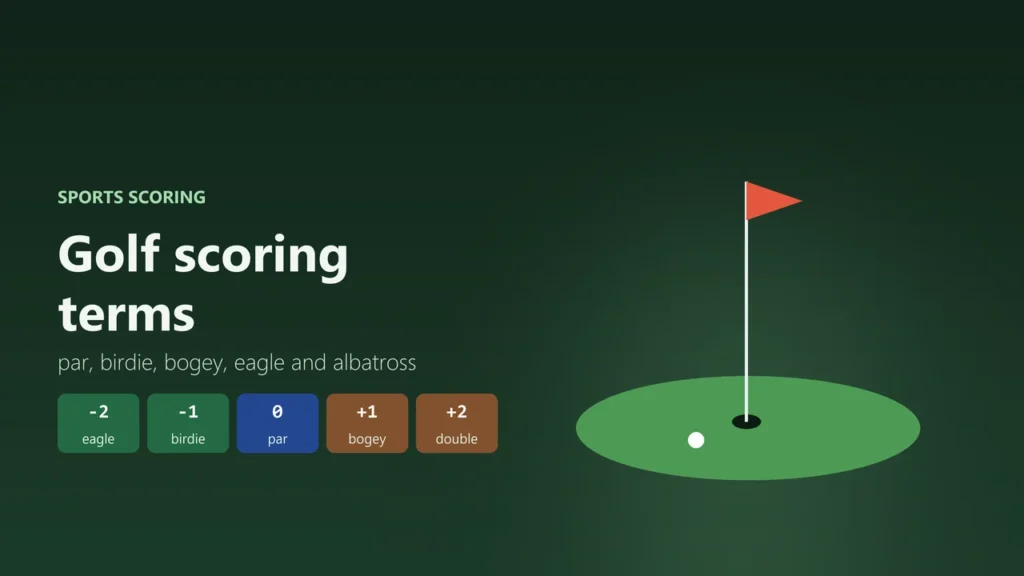
In golf, every hole has a par: the number of strokes a very good player is expected to need. Your score on the hole gets a name based on how far you are from par. One under par is a birdie, two under is an eagle and three under is an albatross (also called a double eagle). One over par is a bogey, two over is a double bogey and three over is a triple bogey.
This guide lists every scoring term in order, with examples for par-3, par-4 and par-5 holes. It also explains how par is set, where the bird names come from, and how Stableford points and the net double bogey limit work. The rules facts come from the R&A and USGA.
| Term | Score vs par | On a par 3 | On a par 4 | On a par 5 |
|---|---|---|---|---|
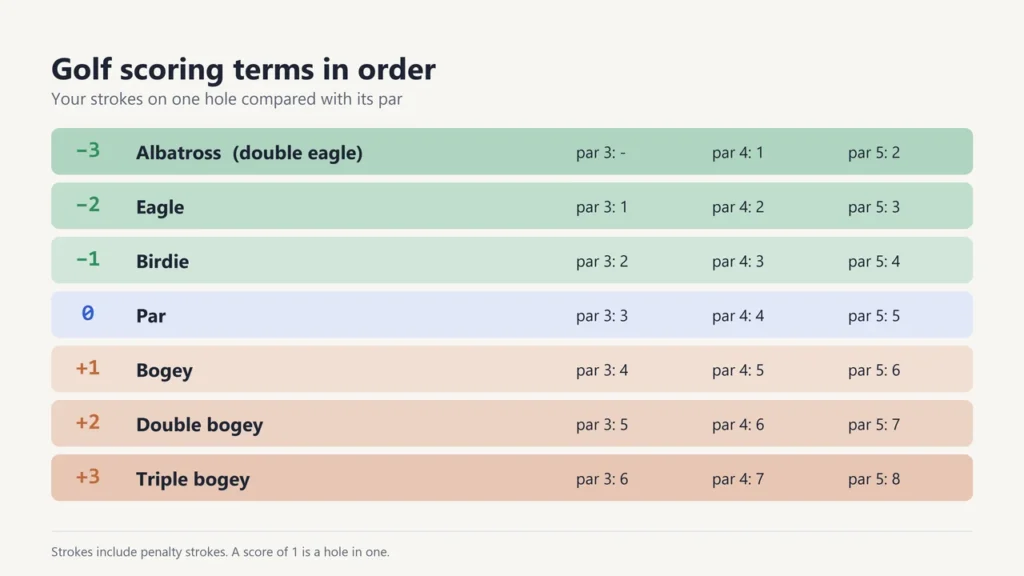
| Albatross (double eagle) | 3 under (−3) | not possible | 1 (hole in one) | 2 |
| Eagle | 2 under (−2) | 1 (hole in one) | 2 | 3 |
| Birdie | 1 under (−1) | 2 | 3 | 4 |
| Par | level (0) | 3 | 4 | 5 |
| Bogey | 1 over (+1) | 4 | 5 | 6 |
| Double bogey | 2 over (+2) | 5 | 6 | 7 |
| Triple bogey | 3 over (+3) | 6 | 7 | 8 |
What does par mean in golf?
Par is the score a scratch player (a very good golfer) is expected to make on a hole. Most holes are par 3, par 4 or par 5. Add up the pars of all 18 holes and you get the par for the course.
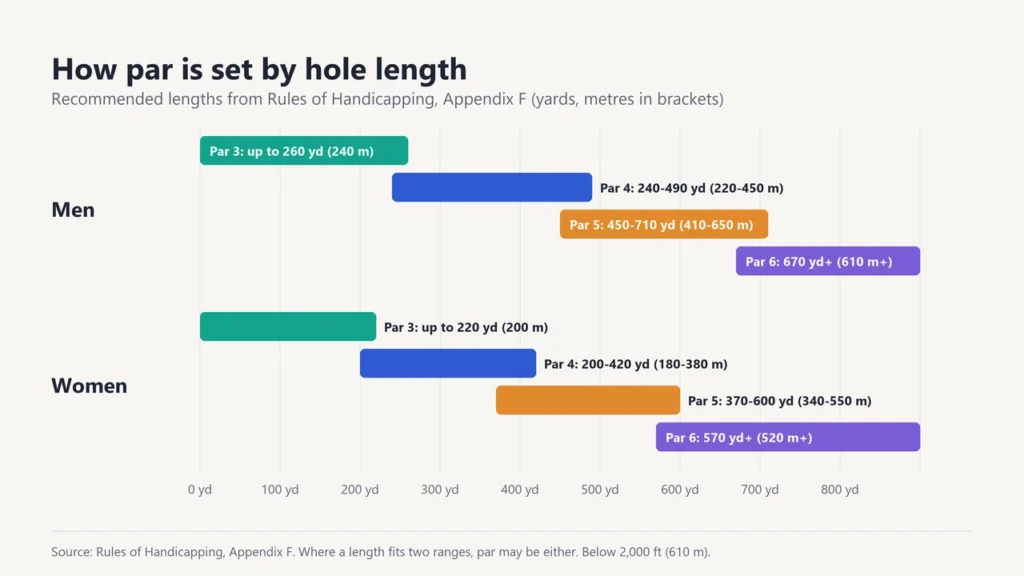
Length is the main guide. The Rules of Handicapping (Appendix F, published by the USGA and the R&A) recommend these hole lengths:
| Par | Men | Women |
|---|---|---|
| 3 | up to 260 yd (240 m) | up to 220 yd (200 m) |
| 4 | 240-490 yd (220-450 m) | 200-420 yd (180-380 m) |
| 5 | 450-710 yd (410-650 m) | 370-600 yd (340-550 m) |
| 6 | 670 yd (610 m) and up | 570 yd (520 m) and up |
Some lengths fit two ranges. Appendix F says a 470-yard (430 m) hole for men, or a 400-yard (366 m) hole for women, may be a par 4 or a par 5. How hard the hole plays can be taken into account: hills, wind, and shots you are forced to lay up. Appendix F even gives a range for par 6 holes.
Scores under par: birdie, eagle and albatross
- Birdie (−1): one stroke under par. A 3 on a par 4 is a birdie.
- Eagle (−2): two under par. A 3 on a par 5 is an eagle. A hole in one on a par 3 is also an eagle.
- Albatross (−3): three under par. A 2 on a par 5 or a hole in one on a par 4. In North America it is more often called a double eagle. Both names mean the same score.
- Condor (−4): some golfers use this informal nickname for four under par on one hole, such as a hole in one on a par 5. Collins English Dictionary does not list a golf meaning for it.
A hole in one (or “ace”) is not a score name by itself. It means your first shot went in. What it counts as depends on the par: an eagle on a par 3, an albatross on a par 4.
Scores over par: bogey, double bogey and more
- Bogey (+1): one over par. A 5 on a par 4.
- Double bogey (+2): two over par. A 6 on a par 4.
- Triple bogey (+3): three over par. A 7 on a par 4.
- Quadruple bogey (+4) and beyond: golfers often just say the number, such as “an 8”.
How to say your total score
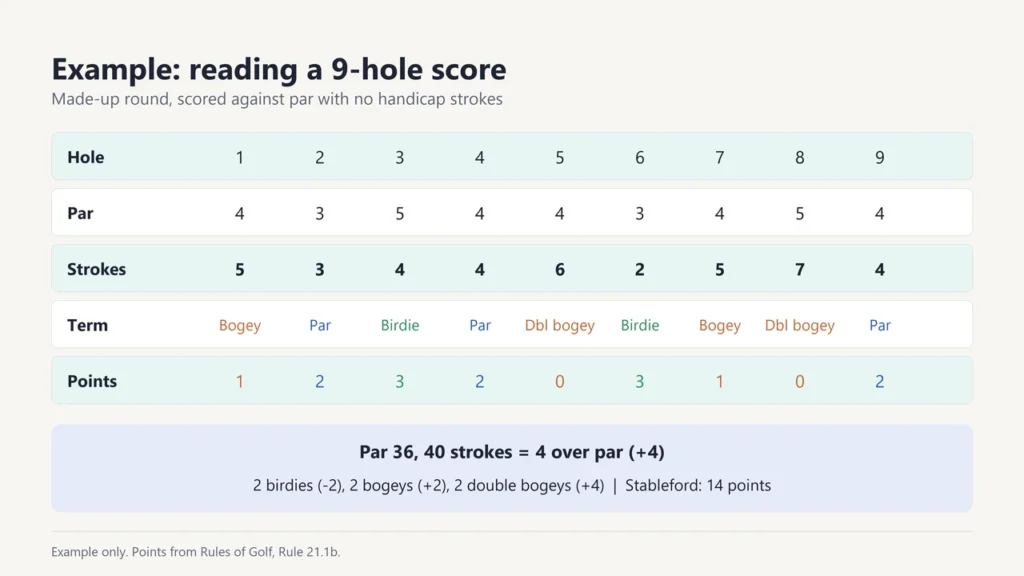
For a whole round, compare your total strokes with the course par. On a par-72 course, a 75 is “3 over par” (+3). A 70 is “2 under par” (−2). A 72 is “level par” or “even par”.
You can also add up the hole names. Two birdies (−2) and three bogeys (+3) with pars on every other hole leaves you 1 over par for the round.
Where do birdie, eagle and bogey come from?
A USGA history article (January 2026) traces the main names:
- Par is Latin for “equal”. An early golf use came after the 1870 Open, when writer A.H. Doleman said Young Tom Morris had finished two “over par”. The USGA made it official in 1911 and the R&A in 1925.
- Bogey began in 1890 at Coventry Golf Club in England, where it meant the target score for a hole, much like par today. Golfers in the US later started using it for one over par.
- Birdie comes from American slang, where “bird” meant anything excellent. According to legend, it started at Atlantic City Country Club in New Jersey. The club’s plaque dates the moment to 1903.
- Eagle followed soon after, for an even better score. The USGA says albatross emerged as the preferred name for three under in the 1920s, though nobody wrote down exactly why. North Americans still more often say double eagle.
How Stableford points match the scoring terms
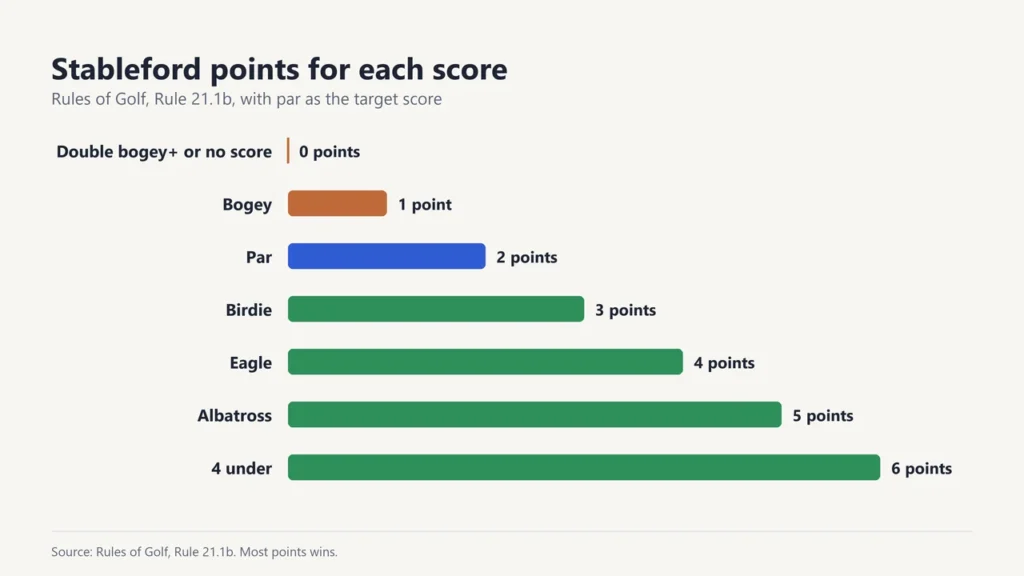
Stableford is a popular format where you score points instead of counting total strokes. Rule 21.1b of the Rules of Golf gives points by comparing your score with a fixed target score, which is par unless the committee sets a different one:
| Score on the hole | Points |
|---|---|
| Double bogey or worse, or no score returned | 0 |
| Bogey (1 over) | 1 |
| Par | 2 |
| Birdie (1 under) | 3 |
| Eagle (2 under) | 4 |
| Albatross (3 under) | 5 |
| 4 under | 6 |
The rule also encourages players to stop playing a hole once they cannot score a point. That keeps the game moving.
What is a net double bogey?
It is the highest score you can count on one hole when you post a score for your handicap. Rule 3.1b of the Rules of Handicapping sets it as:
Par of the hole + 2 + any handicap strokes you get on that hole.
Example: on a par 4 where you get one handicap stroke, your highest counted score is 4 + 2 + 1 = 7. If you took 9, you post 7. A plus-handicap player subtracts any strokes they give back on the hole. If your Course Handicap is over 54 and you get 4 or more strokes on a hole, the maximum is par + 5. A player who has not yet got a Handicap Index also uses par + 5. The same rule notes that a net double bogey is the lowest score that earns zero Stableford points.
Some competitions also cap scores. In the Maximum Score format (Rule 21.2), the committee sets the cap, for example two times par, a fixed number, or net double bogey.
Common mistakes
- Forgetting penalty strokes. Your score on a hole includes every stroke you made plus any penalty strokes.
- Calling every hole in one an eagle. It is only an eagle on a par 3.
- Calling a hole in one on a par 5 an albatross. It is 4 under par, not 3.
- Thinking par is the same on every scorecard. The same hole can have a different par from different tees. Always read the par printed on your card.
Like scoring guides? Try darts scoring, bowling scoring and tennis scoring. Planning a night out instead? Read our pub golf rules.
Frequently asked questions
What are the golf scoring terms in order?
From best to worst: albatross (−3), eagle (−2), birdie (−1), par (0), bogey (+1), double bogey (+2), triple bogey (+3).
Is a birdie or an eagle better?
An eagle. It is two strokes under par, while a birdie is one under.
What is a double eagle in golf?
Three strokes under par on one hole, such as a 2 on a par 5. It is the same as an albatross.
What is a bogey in golf?
One stroke over par on a hole, such as a 5 on a par 4.
What is a condor in golf?
An informal nickname for four under par on one hole, such as a hole in one on a par 5. Collins English Dictionary does not list a golf meaning for it.
What is a hole in one on a par 4 called?
An albatross (or double eagle), because it is three under par.
How many Stableford points is a birdie?
Three points when par is the target score. Par is 2 points and a bogey is 1.

Justwebworld has published guides since 2012. How we write and update articles Report an error
