

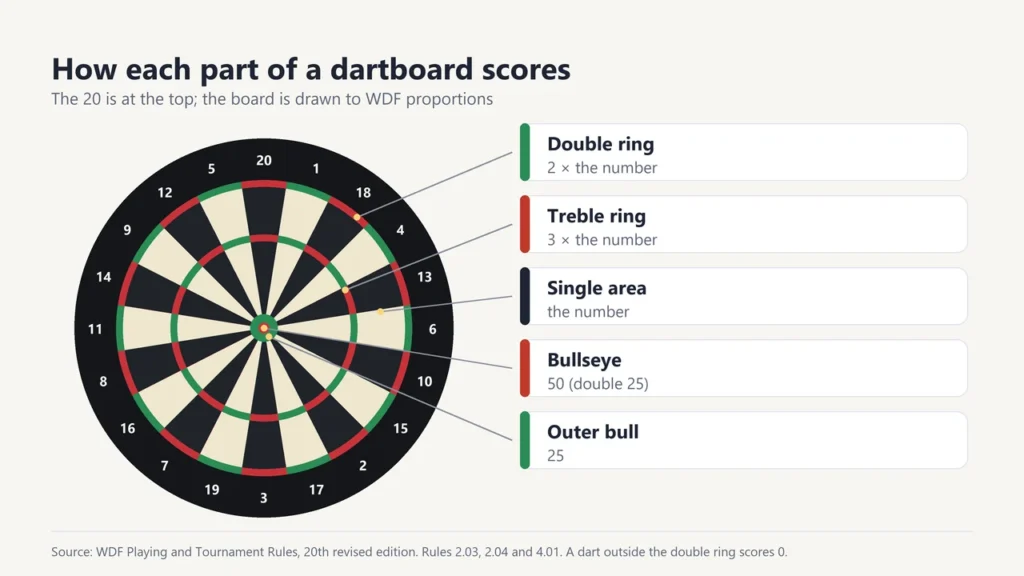
In darts, each dart scores the number of the section it lands in. The thin outer ring scores double that number, and the thin inner ring scores treble. The green outer bull is worth 25 and the red bullseye is worth 50. In the most common game, 501, you take away each score from 501. To win, you must hit exactly zero, and your last dart must land in a double or the bullseye.
This guide explains darts scoring step by step: how the board scores, how a game of 501 works, the bust rule, the highest scores and checkouts, and the standard board height and throwing distance. The rules come from the World Darts Federation (WDF) Playing and Tournament Rules, 20th revised edition. The checkout numbers are our own calculations from those rules.
How a dartboard scores
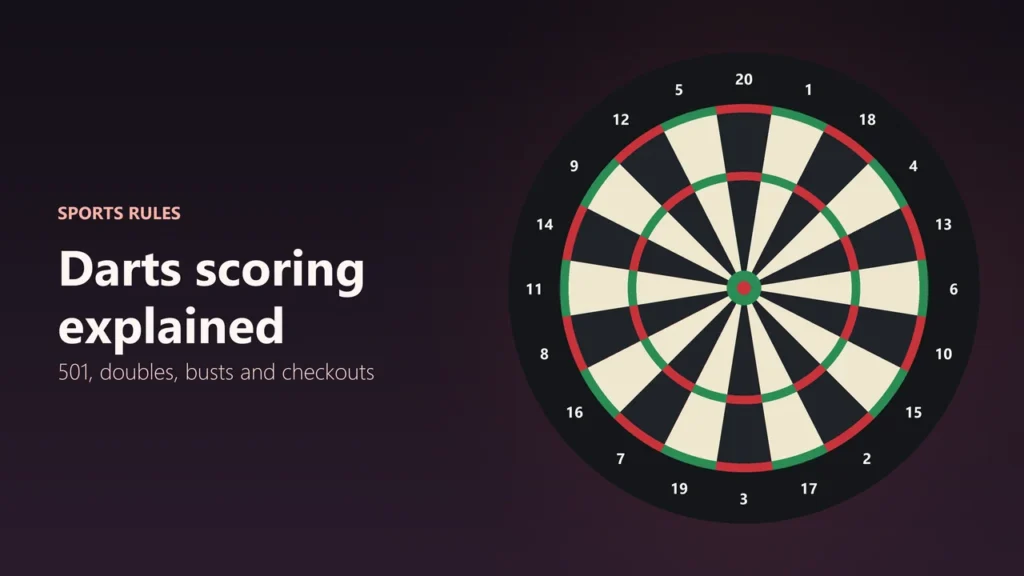
A standard dartboard has 20 numbered sections arranged like a clock, with 20 at the top. Under the WDF’s board rules, every area scores like this:
| Where the dart lands | Score | Example |
|---|---|---|
| Large single area | The section number | Single 20 = 20 |
| Treble ring (thin inner ring) | 3 × the number | Treble 20 = 60 |
| Double ring (thin outer ring) | 2 × the number | Double 16 = 32 |
| Outer bull (green ring) | 25 | – |
| Bullseye (red centre) | 50 (counts as double 25) | – |
| Outside the double ring | 0 | – |
A dart scores only if its point stays in the board, inside the outer double wire, until the throw is over and the score has been called. If the point lands right on a wire, the score is counted from the side of the wire where the point went in.
How to play and score 501
501 is the standard game in WDF events. Each player starts on 501 points and works down to zero. Here is how a game (called a leg) works:
- Take turns. Each turn (a “throw” or “visit”) is up to three darts.
- Start straight away. WDF games use a straight start. Any dart that lands inside the double wire counts from the first throw.
- Add up and subtract. Add the three darts together and take the total away from your score.
- Finish on a double. To win, your last dart must land in the double that equals your remaining score, or in the bullseye if you need exactly 50.
Example: You start on 501 and throw treble 20, single 20 and single 5. That is 60 + 20 + 5 = 85, so you now need 416. Later, you are left on 32. A dart in double 16 (2 × 16 = 32) wins the leg. A dart in single 16 would leave you on 16, needing double 8.
The first player to finish wins the leg. Once you check out, you don’t throw any more darts in that turn, and a dart thrown after the finish doesn’t count.
The bust rule
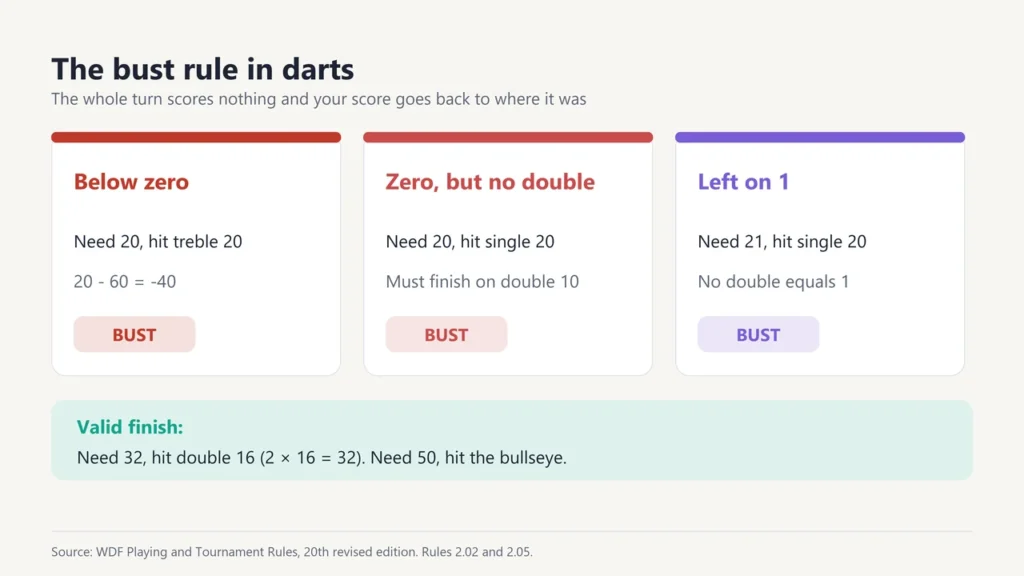
You bust if your throw would break the finishing rule. When you bust, the whole turn scores nothing and your score goes back to what it was before the turn. Under WDF rule 2.05, you bust if you:
- Go below zero. You need 20 and hit treble 20.
- Reach zero without a double. You need 20 and hit single 20.
- Leave exactly 1. No double equals 1, so you could never finish.
Which darts count?
- Bounce-outs: a dart that bounces off or falls out of the board scores nothing, and you can’t throw it again.
- Darts that fall out early: a dart that falls out before the throw is finished and the darts are pulled out doesn’t count.
- No pushing: you can’t push a loose dart into the board or hold it in place. If you do, it doesn’t count.
- Throw properly: each dart must be thrown by hand, one at a time, point first. Otherwise it is a “foul throw” and doesn’t count.
- Touching the board: if you touch a dart in the board during your turn, your turn ends there.
The highest scores in darts
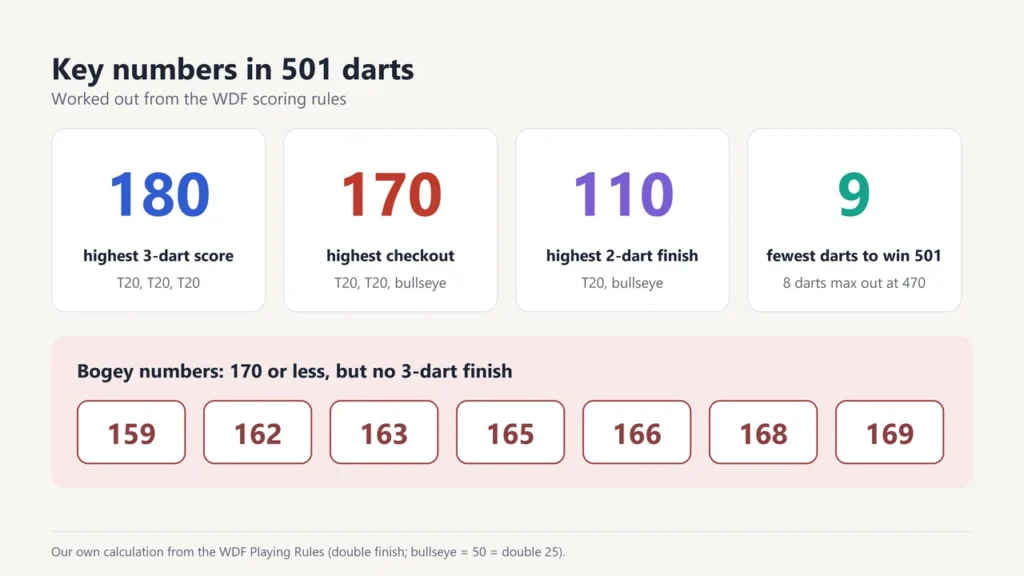
The highest score with three darts is 180: three trebles in the 20 (60 + 60 + 60). We worked out the other key numbers from the WDF scoring rules:
- Highest checkout: 170. Treble 20, treble 20, then the bullseye (60 + 60 + 50).
- Highest two-dart finish: 110. Treble 20, then the bullseye.
- One-dart finishes: any even number from 2 to 40 (double 1 to double 20), plus 50 (the bullseye).
- Fewest darts to win 501: 9. Eight darts can score at most 470 (seven treble 20s and a bullseye), so a 501 leg needs at least nine darts. This is the famous “nine-darter”.
- Scores you can’t make with three darts: 163, 166, 169, 172, 173, 175, 176, 178 and 179.
What are bogey numbers in darts?
A bogey number is a score of 170 or less that you can’t finish in one turn of three darts. There are seven of them: 159, 162, 163, 165, 166, 168 and 169. If you are left on one of these, you can’t win this turn, so the smart move is to score enough to leave an easier finish for next time.
| Score left | One way to finish |
|---|---|
| 170 | Treble 20, treble 20, bullseye |
| 167 | Treble 20, treble 19, bullseye |
| 164 | Treble 20, treble 18, bullseye |
| 161 | Treble 20, treble 17, bullseye |
| 160 | Treble 20, treble 20, double 20 |
| 100 | Treble 20, double 20 |
| 50 | Bullseye (or single 10, double 20) |
| 40 | Double 20 |
| 32 | Double 16 |
32 (double 16) is a handy score to be left on, because a miss into single 16 leaves 16 (double 8), then 8 (double 4), and so on. You keep getting another double to aim at without busting.
Legs, sets and who throws first
- Leg: one game from 501 down to zero.
- Set: a group of legs, such as best of five. The WDF says the number of legs in a set, and of sets in a match, must be odd, so there is always a winner.
- Match: played as best of a fixed number of legs or sets. Once a player has won a majority, the remaining legs aren’t played.
- Who throws first: each player throws one dart at the bull. The dart nearer the centre wins, and that player throws first in the match and in every odd-numbered leg after it.
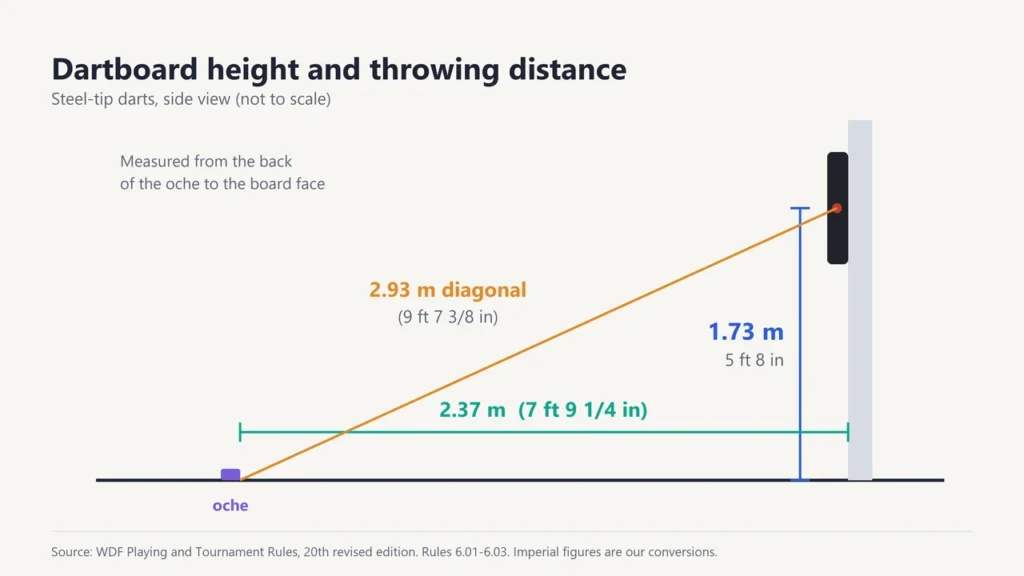
Dartboard height and throwing distance
The WDF sets these measurements for steel-tip darts:
| Measurement | Metric (WDF) | Imperial (approx.) |
|---|---|---|
| Floor to centre of the bull | 1.73 m | 5 ft 8 in |
| Back of the oche to the board face | 2.37 m | 7 ft 9 1/4 in |
| Diagonal: bull to back of the oche at floor level | 2.93 m | 9 ft 7 3/8 in |
| Raised oche (throw line) | 38 mm high, 610 mm long | 1 1/2 in high, 2 ft long |
| Dart length / weight (max.) | 30.5 cm / 50 g | 12 in / 1.76 oz |
The oche (say “ockey”) is the line you stand behind. You can’t step on or over it while you throw. If you throw from the side, your feet must stay behind an imaginary line that extends the oche. Soft-tip electronic boards often use a longer throw line; our guide to choosing an electronic dartboard covers that setup.
301, 701 and other darts games
The WDF rules allow games from any fixed odd number, such as 501, 701 or 1001, with the same double finish and bust rule. Shorter games like 301 are popular for casual play and work the same way. Some leagues and pub games add a “double in” rule, where your scoring only starts once you hit a double. WDF events use a straight start, so agree on the rule before you begin.
Games like Cricket and Around the Clock are different games with their own scoring. They are not covered by the WDF’s 501 rules. If you like comparing sports scoring systems, see how tennis scoring and badminton scoring work too.
How to keep score
- Write both names at the top of a board or sheet, with 501 under each.
- After each turn, write the score thrown and the new total left. The WDF requires the score each player needs to be shown clearly.
- Check the maths before the next turn. Under WDF rules, a sum written wrongly stands unless it is fixed before that player’s next throw.
- In WDF events, the scorer only calls the number left (“32”), not the double to aim for (“double 16”).
Frequently asked questions
How much is the bullseye worth in darts?
The red bullseye is worth 50 and the green ring around it is worth 25. The bullseye counts as a double 25, so you can use it to finish a leg when you need exactly 50.
Can you finish on the outer bull?
No. The outer bull (25) is a single, not a double, so it can’t be your finishing dart in a double-out game. If you need 25, you’d normally hit a single number first to leave a double.
What happens if you are left on 1 in darts?
That’s a bust. A score of 1 can’t be finished with a double, so the turn doesn’t count and your score goes back to what it was before the turn.
What is the highest checkout in darts?
The highest checkout is 170: treble 20, treble 20 and the bullseye.
Do you have to throw all three darts?
A turn is up to three darts. If you finish the leg with your first or second dart, the leg is over and you don’t throw the rest.
What if a dart bounces out?
It scores nothing, and you can’t throw it again in that turn.
How far do you stand from a dartboard?
For steel-tip darts, the WDF sets the oche 2.37 m (about 7 ft 9 1/4 in) from the board face, with the centre of the bull 1.73 m (about 5 ft 8 in) above the floor.

Justwebworld has published guides since 2012. How we write and update articles Report an error
