

A badminton match is the best of three games, and you score a point on every rally. Today a game goes to 21 points. At 20-all you need a two-point lead, and at 29-all the next point wins, so no game goes past 30. From 4 January 2027 the standard game is shorter: first to 15, a two-point lead at 14-all, and a cap of 21 points.
The change is real and official. The Badminton World Federation (BWF) approved the new “3×15” system at its 87th Annual General Meeting on 25 April 2026, with the two-thirds majority it needed. This guide explains both systems side by side, plus the rules people get wrong most: where to stand when you serve, what counts as a fault, and when a rally is replayed.
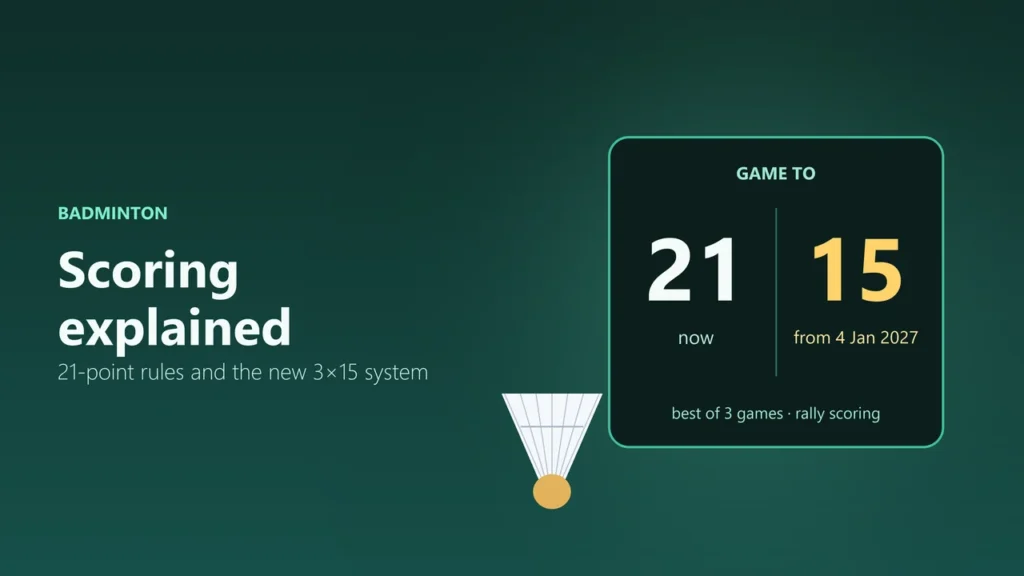
Badminton scoring at a glance: 21-point vs 15-point games
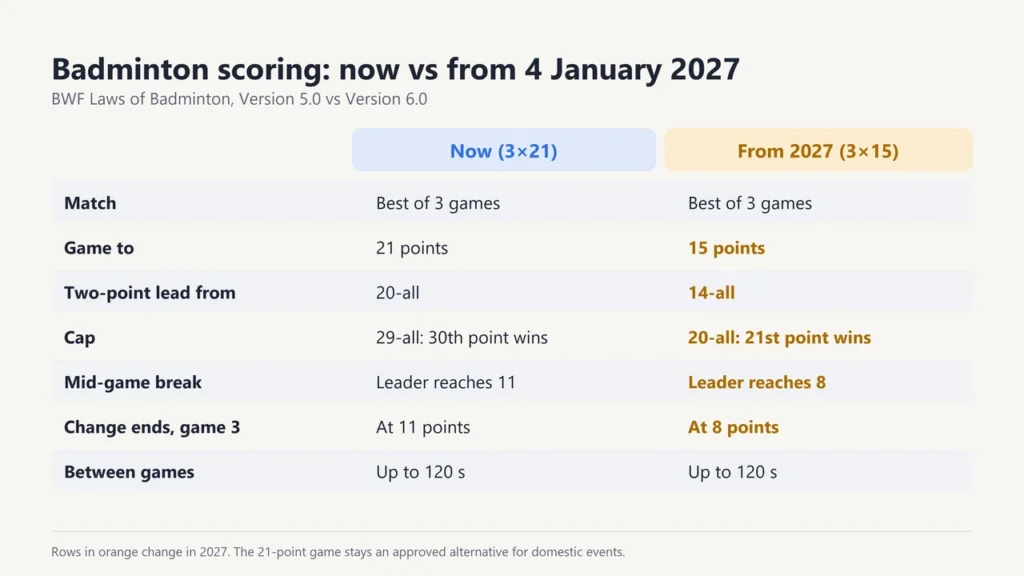
The table compares the BWF Laws of Badminton in force now (Version 5.0, from 26 April 2025) with the version that takes over on 4 January 2027 (Version 6.0).
| Rule | Now (3×21) | From 4 Jan 2027 (3×15) |
|---|---|---|
| Match | Best of 3 games | Best of 3 games |
| Points to win a game | 21 | 15 |
| Two-point lead needed from | 20-all | 14-all |
| Cap (next point wins) | At 29-all, the 30th point wins | At 20-all, the 21st point wins |
| Who scores | The winner of every rally | The winner of every rally |
| Short break in each game | Up to 60 seconds when the leader reaches 11 | Up to 60 seconds when the leader reaches 8 |
| Change ends in game 3 | When a side first reaches 11 | When a side first reaches 8 |
| Break between games | Up to 120 seconds | Up to 120 seconds |
| Who serves first in the next game | The winner of the last game | The winner of the last game |
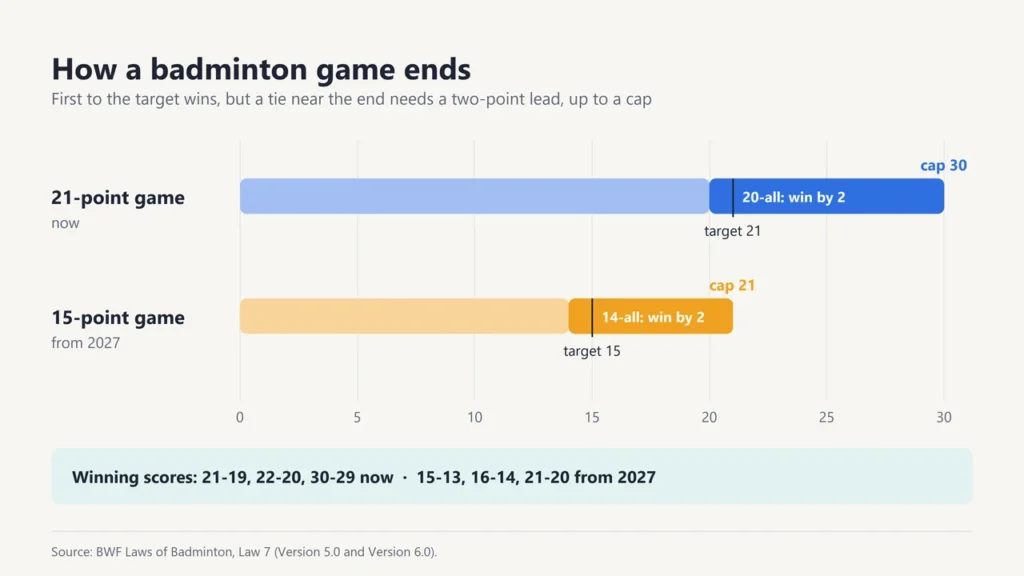
How rally scoring works
Every rally gives someone a point, no matter who served. Under Law 7, you win a rally when your opponent makes a fault, or when the shuttle hits the floor inside their court.
- If the server wins the rally: the server scores a point and serves again, this time from the other service court.
- If the receiver wins the rally: the receiver scores a point and becomes the new server.
So the serve passes across the net each time the receiving side wins a rally.
What happens at 20-all in badminton?
At 20-all in a 21-point game, play goes on until one side leads by two points. If it reaches 29-all, the next point wins, so the highest possible score is 30-29.
Some real finishes under the current rules look like this: 21-19, 22-20, 26-24 and 30-29. A score of 21-20 cannot end a game today, because the leader is only one point ahead.
The new 15-point game works the same way, just lower down. At 14-all, you need a two-point lead. At 20-all, the next point wins. So 15-13, 16-14 and 21-20 are all winning scores from 2027, and 21-20 is the longest a game can go.
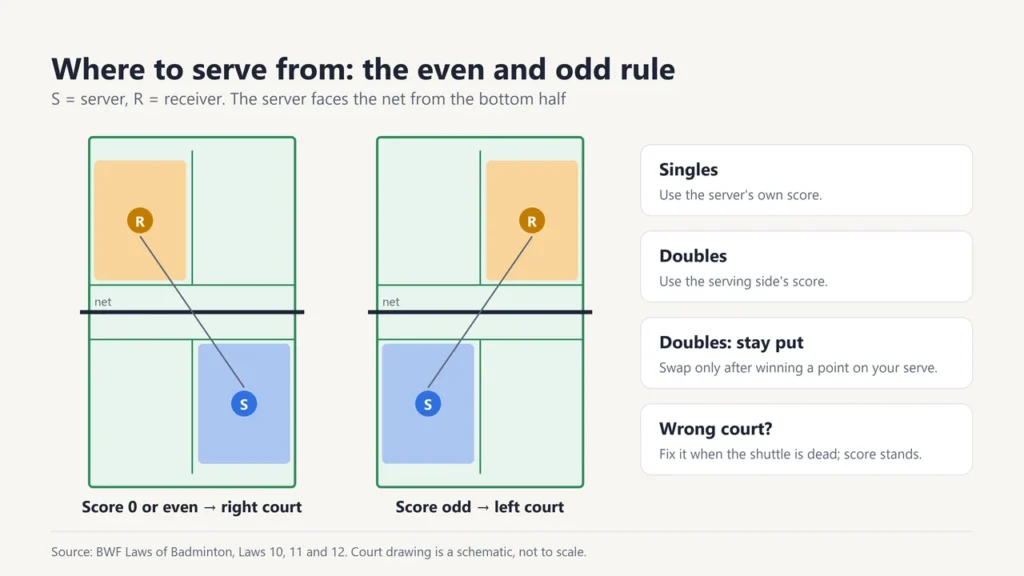
Where do you serve from? The even and odd rule
Your score decides your service court. If the server’s score is 0 or even, serve from the right service court. If it is odd, serve from the left. The receiver stands in the service court diagonally opposite.
Singles
In singles, both players move to match the server’s score. At 0-0 the server serves from the right. If the server wins and leads 1-0, they serve again from the left. If the receiver wins that rally instead, the receiver now serves, using their own score to pick the side.
Doubles
Doubles uses the same even and odd rule, based on the serving side’s score. There is one more rule that confuses beginners: players only swap service courts after they win a point while their side is serving. The receiving pair stays where they are.
Under Law 11.4, the right to serve passes in this order: the player who started the game from the right court, then the partner of the first receiver, then the partner of the first server, then the first receiver, and round again. A player may not receive two services in a row in the same game.
Standing in the wrong court, or serving out of turn, is called a service court error. Under Law 12 it is put right when the shuttle is not in play, and the score stays as it is.
Service rules: what makes a legal serve
A serve must go upwards from the racket, pass over the net and land in the receiver’s service court. Law 9 adds these checks:
- Height: the whole shuttle must be below 1.15 metres from the court floor when the racket hits it.
- Feet: both players must have part of both feet on the floor, not moving, from the start of the serve until the shuttle is hit. Neither may touch the lines of their service court.
- Contact: release the shuttle without adding spin, and hit the base (the cork end) first.
- One smooth action: once the racket starts moving forward, it must keep going forward until the serve is made.
- No delay: neither side may hold up the serve once both players are ready.
- Do not miss: swinging at the shuttle and missing it is a fault.
The BWF’s Alternative Laws also describe a different way to judge serve height: the shuttle must be below the server’s waist (the lowest rib), and the racket shaft and head must point downwards. Para badminton standing classes use these alternative service rules.
Common faults in badminton
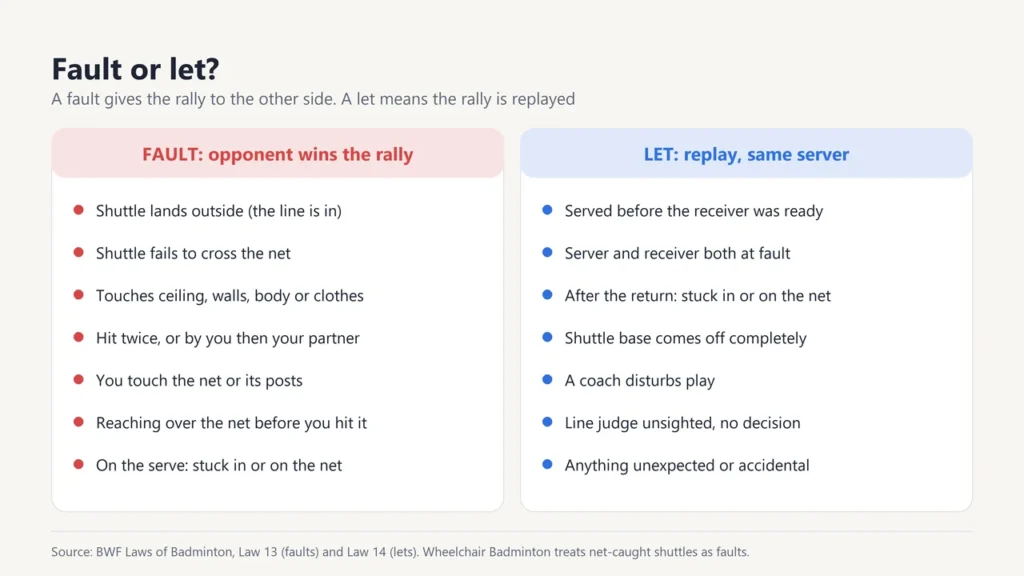
A fault ends the rally, and the other side wins the point. These are the faults in Law 13 that come up most often:
- The shuttle lands outside the court. A shuttle on the line is in, because the court includes its boundary lines.
- The shuttle does not get over the net.
- The shuttle touches the ceiling, the side walls, or a player’s body or clothes.
- The same player hits it twice in a row, or a player and then their partner hit it one after the other. Hitting it with the frame and the strings in a single stroke is allowed.
- A player touches the net or its posts with their racket, body or clothes while the shuttle is in play.
- A player reaches over the net into the other court. You may follow through over the net only after hitting the shuttle on your own side.
- A player blocks an opponent’s legal shot, or tries to distract them by shouting or waving.
- On the serve, the shuttle gets stuck on top of the net or caught in the net after crossing it, or the receiver’s partner hits it.
When is a let called?
A let means the rally does not count and the same server serves again. Law 14 lists these cases:
- The server serves before the receiver is ready.
- The server and the receiver are both at fault on the same serve.
- After the serve is returned, the shuttle gets stuck on top of the net, or is caught in the net after crossing it.
- The shuttle falls apart and its base comes off completely.
- A coach disturbs play or distracts a player.
- A line judge could not see, and the umpire (or the review system) cannot decide.
- Anything else unexpected or accidental happens.
Note the difference: a shuttle caught in the net on the serve is a fault, but caught in the net later in the rally it is a let. In Wheelchair Badminton, both cases are faults.
Intervals and changing ends
Players change ends after game 1, after game 2 if a third game is needed, and partway through game 3. Under the current laws that is when a side first reaches 11 points. From 2027 it is at 8 points.
Each game has one short break of up to 60 seconds, taken when the leading score reaches 11 now, or 8 from 2027. There is a break of up to 120 seconds between games. Players may only get advice from coaches when the shuttle is not in play, and they may not leave the court without the umpire’s permission, except during these breaks.
What changes on 4 January 2027?
From 4 January 2027, the BWF’s standard scoring becomes three games to 15 points. Rally scoring stays the same. According to the BWF’s list of key changes, published on 26 April 2026:
- Matches stay best of three games.
- Each game is played to 15 points, not 21.
- At 14-all, a two-point lead is needed. At 20-all, the next point wins.
- The break inside each game, and the change of ends in game 3, both move to 8 points.
- The 120-second break between games does not change.
- The winner of a game still serves first in the next one.
- The 21-point game stays as an official alternative. National associations, clubs, leagues and domestic organisers can choose an approved alternative for their own events.
So your local club or school league may keep playing to 21 after 2027. Check the event rules before you start. The BWF says the new format aims to bring more exciting and competitive matches, more predictable match lengths and better recovery for players. Some in the sport raised concerns before the vote. The BWF said the skills and tactics of badminton stay the same, and that it will keep listening to members and players as the sport adapts.
Other official scoring formats
The BWF’s Alternative Laws (Version 2.0, in force from 4 January 2027) allow three other formats, if they are agreed before play:
- One game of 21 points. Players change ends when a side reaches 11.
- Best of three games of 21 points. These are today’s familiar rules: a two-point lead from 20-all and a cap at 30 points.
- Best of five games of 11 points. Players change ends in game 5 when a side reaches 6. The only short break inside a game is in game 5, at 6 points.
For a casual game with friends, a single game to 21 or to 15 works well. Agree the format before the first serve, so nobody argues at 20-all.
If you enjoy racket sports, see how the scoring compares in our guides to pickleball scoring and how tennis scoring works. For the players who made these rules famous, read our list of the greatest badminton players of all time.
Badminton scoring FAQ
How many points is a game of badminton?
21 points under the current BWF laws. From 4 January 2027 the standard game is 15 points, but the 21-point game stays as an approved alternative.
Is badminton changing to 15 points?
Yes. BWF members voted for the 3×15 system on 25 April 2026, and it comes into effect on Monday 4 January 2027. Domestic events may still choose to play to 21.
What happens at 29-all in badminton?
The next point wins. Whoever scores the 30th point takes the game, even with only a one-point lead, so 30-29 is the longest a 21-point game can go.
Can you score a point when you are not serving?
Yes. Badminton uses rally scoring, so the winner of every rally scores a point. If the receiver wins the rally, they also win the right to serve.
Is the line in or out in badminton?
In. The laws say the shuttle must land “on or within” the boundary lines, so a shuttle touching the line counts as good.
How high can you serve in badminton?
The whole shuttle must be below 1.15 metres from the court floor at the moment the racket hits it. A higher contact point is a fault.
Can you touch the net in badminton?
No. Touching the net or its posts with your racket, body or clothes while the shuttle is in play is a fault, and your opponent wins the rally.
Which side do you serve from in badminton?
From the right service court when the server’s score (or, in doubles, the serving side’s score) is 0 or even, and from the left when it is odd.

Justwebworld has published guides since 2012. How we write and update articles Report an error
