

In ten-pin bowling, a game has 10 frames, and you get up to two balls in each frame. An open frame scores the number of pins you knock down. A spare (all 10 pins in two balls) scores 10 plus the pins from your next ball. A strike (all 10 pins with your first ball) scores 10 plus the pins from your next two balls. A strike or spare in the 10th frame earns extra balls, and the highest possible score is 300.
This guide shows how to score bowling by hand, step by step. It covers the symbols on a score sheet, a full game scored frame by frame, the 10th frame, fouls, and the highest scores. The rules come from the United States Bowling Congress (USBC) Playing Rules 2026-2027 and the International Bowling Federation (IBF) Universal Playing Rules. Both use the same scoring system. Every total in our examples was checked with our own scoring calculator.

Bowling scoring at a glance
| Result in a frame | Symbol | What it scores |
|---|---|---|
| Strike: all 10 pins with the first ball | X | 10 + the pins from your next two balls |
| Spare: all 10 pins with two balls | / | 10 + the pins from your next ball |
| Open frame: pins still standing after two balls | the pin counts | Just the pins you knocked down |
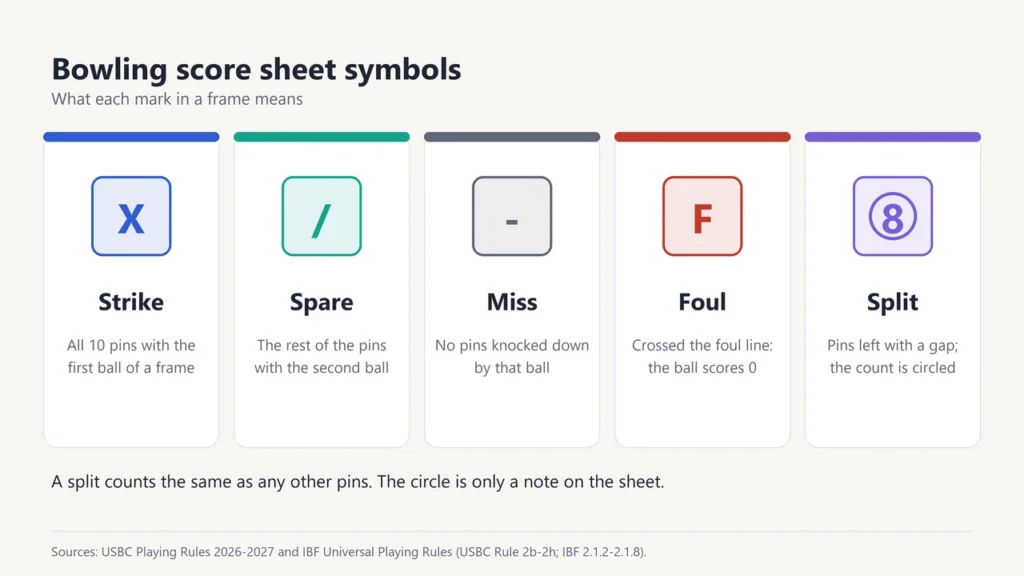
| Miss: a ball that knocks down no pins | – | 0 for that ball |
| Foul: you cross the foul line | F | 0 for that ball (the ball still counts as a turn) |
The big idea is that a strike or spare isn’t scored straight away. You wait for the bonus balls, then add them to that frame. That’s why the score for a strike frame is often blank for a turn or two.
How a frame works
Each frame is a box on the score sheet. Small squares at the top hold what each ball knocked down. The big space below holds your running total, which is your score so far.
- Frames 1 to 9: you roll two balls, unless your first ball is a strike. After a strike, that frame is over.
- Frame 10: you roll three balls if you get a strike or a spare. If you don’t, you roll two balls and the game ends.
- Every frame must be finished, with each player bowling in turn.
A miss is marked with a dash (-). If you leave a split (pins standing with a gap between them, after the head pin is down), the count is usually circled. A split doesn’t change the score. It’s just a note on the sheet.
How to score a strike
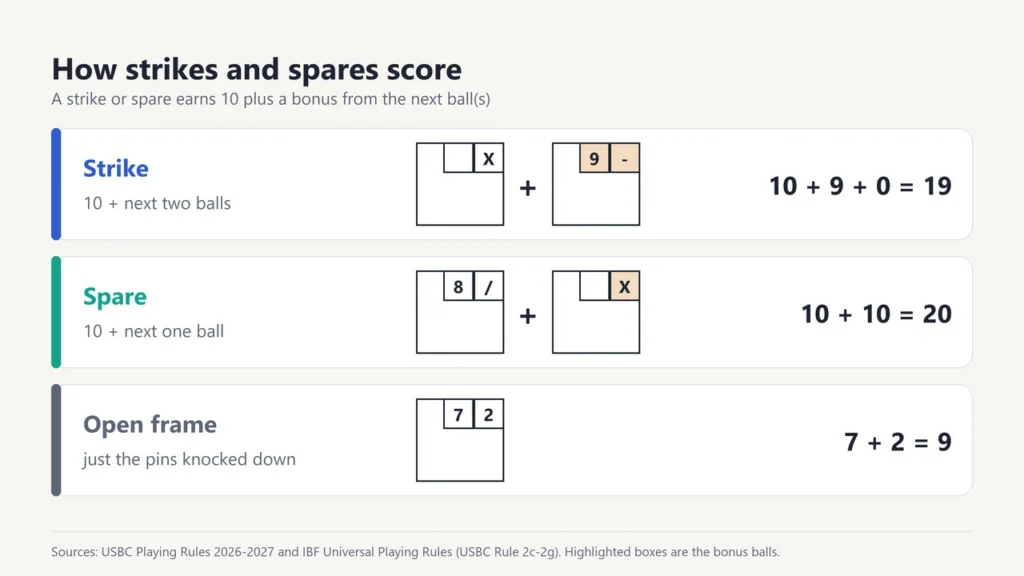
A strike is worth 10 plus the pins you knock down with your next two balls. Note that it’s the next two balls, not the next two frames. Mark an X, then wait.
- Strike, then 9 and a miss: 10 + 9 + 0 = 19 for the strike frame.
- Strike, then a spare: 10 + 10 = 20, because the next two balls knocked down all 10 pins.
- Two strikes in a row (a double): the first strike is worth 20 plus the pins from the next ball.
- Three strikes in a row (a turkey): the first strike is worth 30, the most any single frame can score.
How to score a spare
A spare is worth 10 plus the pins you knock down with your next ball. Mark a slash (/) in the second square, then wait for one more ball.
- Spare, then a 7 first ball: 10 + 7 = 17 for the spare frame.
- Spare, then a strike: 10 + 10 = 20.
- Gutter ball, then all 10 pins: this is a spare, not a strike. A strike only happens with the first ball of a frame.
Example: a full game scored frame by frame
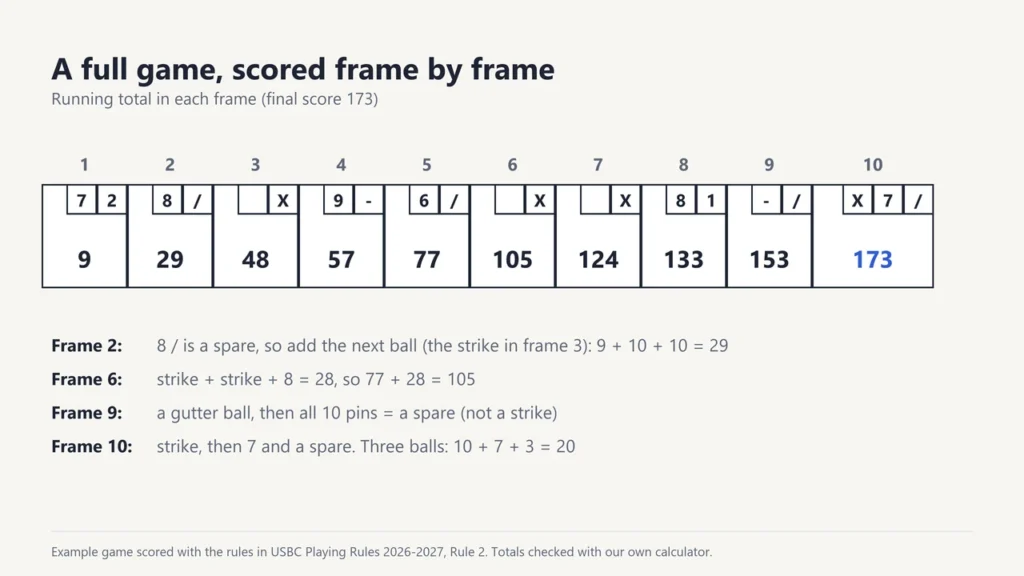
Here is one complete game. The first column shows what each ball did. The last column is the running total you write in the frame.
| Frame | Balls | How to work it out | Total |
|---|---|---|---|
| 1 | 7, 2 | Open frame: 7 + 2 = 9 | 9 |
| 2 | 8, / | Spare: 10 + next ball (strike, 10) = 20 | 29 |
| 3 | X | Strike: 10 + next two balls (9, 0) = 19 | 48 |
| 4 | 9, – | Open frame: 9 + 0 = 9 | 57 |
| 5 | 6, / | Spare: 10 + next ball (strike, 10) = 20 | 77 |
| 6 | X | Strike: 10 + next two balls (10, 8) = 28 | 105 |
| 7 | X | Strike: 10 + next two balls (8, 1) = 19 | 124 |
| 8 | 8, 1 | Open frame: 8 + 1 = 9 | 133 |
| 9 | -, / | Spare (gutter, then 10): 10 + next ball (strike, 10) = 20 | 153 |
| 10 | X, 7, / | Strike, then 2 more balls: 10 + 7 + 3 = 20 | 173 |
Look at frame 3. You can’t write its score until two more balls have been rolled, in frame 4. In frame 6, the strike has to wait for frame 7 (another strike) and the first ball of frame 8. This waiting is the only tricky part of bowling scoring.
How the 10th frame works
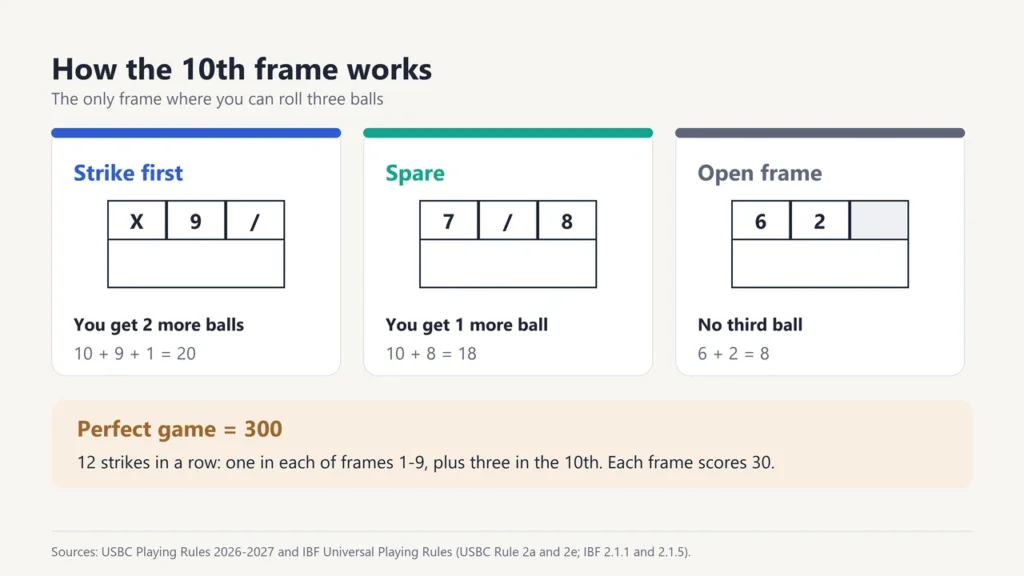
The 10th frame is the only one where you can roll three balls. The extra balls exist so that a strike or spare in the last frame can still get its bonus.
- Strike on the first ball: you get two more balls. The pins are reset after each strike. Example: X, 9, / scores 10 + 9 + 1 = 20.
- Spare in the first two balls: you get one more ball. Example: 7, /, 8 scores 10 + 8 = 18.
- Open frame: no third ball. Example: 6, 2 scores 8, and your game is over.
The bonus balls in the 10th frame only count toward that frame. They don’t start a new frame.
What is the highest score in bowling?
The highest score is 300, called a perfect game. To get it, you must roll 12 strikes in a row: one in each of frames 1 to 9, plus three in the 10th frame. Every frame then scores 30 (10 for the strike plus 20 from the next two strikes), and 10 frames × 30 = 300.
We worked out a few more key numbers with the same rules:
- 11 strikes, then 9 pins: 299. One missed pin on the very last ball costs a point.
- Best game with spares only: 191. Throw 9 then a spare in every frame, and a strike on the last bonus ball. Each spare earns just 9 bonus pins.
- 9 pins and a miss every frame: 90. Without strikes or spares, you get no bonus at all.
The jump from 90 to 191 shows how much spares matter. Each spare roughly doubles what that frame is worth.
Fouls and pins that don’t count
Under USBC Rule 5a, a foul happens when any part of your body goes over the foul line and touches the lane, the equipment or any part of the building, during or after your throw. The ball still counts as one of your balls, but you get no pins for it. It’s marked F.
- Foul on the first ball: any pins it knocked down are set back up. You then roll your second ball at all 10 pins.
- Ball leaves the lane: if the ball goes into the gutter and then bounces back onto the pins, those pins don’t count (USBC Rule 6b).
- Ball bounces back off the rear cushion and knocks pins over: those pins don’t count either.
- Pins that bounce back and stand on the lane count as standing pins (IBF rule 2.5.3).
How to keep score on paper
- Draw 10 boxes per player. Make the 10th box wide enough for three small squares.
- After each ball, write the pins knocked down in the small square, or X, / or -.
- Write the running total for an open frame straight away.
- Leave strike and spare frames blank until their bonus balls are rolled, then fill them in.
- Check that each total equals the last total plus that frame’s score.
Most bowling centres score automatically, but knowing the maths helps you check the screen. It also tells you what you need in the last frames of a close game. If you like comparing how sports count points, see our guides to darts scoring, tennis scoring, badminton scoring and pickleball scoring.
This guide covers ten-pin bowling. Five-pin, candlepin and duckpin bowling are different games with their own rules and scoring.
Frequently asked questions
How many points is a strike in bowling?
A strike is worth 10 points plus the pins from your next two balls, so one strike frame can score from 10 to 30.
How many points is a spare in bowling?
A spare is worth 10 points plus the pins from your next ball, so a spare frame can score from 10 to 20.
How many frames are in a game of bowling?
A game of ten-pin bowling has 10 frames. You roll up to two balls in frames 1 to 9 and up to three in the 10th.
What is a turkey in bowling?
A turkey is three strikes in a row. The first of those strikes scores 30. Two strikes in a row is called a double.
Is knocking all the pins down with the second ball a strike?
No. A strike only counts on the first ball of a frame. If your first ball is a gutter ball and your second knocks down all 10 pins, that’s a spare.
Why does a perfect game need 12 strikes and not 10?
Each strike needs two bonus balls. The strike in the 10th frame gets its bonus from two extra balls, and both must be strikes too. That makes 9 + 3 = 12 strikes.
What happens if you foul in bowling?
The ball counts as one of your balls, but you score zero pins for it. If it was your first ball, the pins are set back up for your second ball.

Justwebworld has published guides since 2012. How we write and update articles Report an error
