

To get your product reviewed, find a short list of reviewers whose readers would actually buy it, send each one a short personal pitch, and offer a free sample with no strings attached. Give them the facts and the time they need, and accept an honest verdict, good or bad. If you give a reviewer a free product, the review must say so clearly. The US FTC counts a free product as a material connection that has to be disclosed, and the UK CMA counts it as payment, so the post must be labelled as an ad.
This guide is for founders, marketers and PR teams who want independent reviews from blogs, magazines and creators. It covers how to prepare, who to pitch, what to write, the rules in the US and UK, and Google’s rules on links. If you want reviews from your own customers instead, see our guide to collecting and using customer reviews.
Four ways to get a product reviewed
“Getting reviewed” can mean four different things. They differ in who decides what is written and whether you pay.
| Route | What you give | Who controls the words | Best for |
|---|---|---|---|
| Independent review | A free sample or loan | The reviewer | Trust and honest feedback |
| Paid review (an advert) | A fee, plus the product | The reviewer; only the date and format are agreed in advance | A guaranteed slot and date |
| Product seeding | Free products to many creators | Each creator; posting is optional | Spreading awareness fast |
| Customer reviews | A request after purchase | Your buyers | Proof from real users |
Many brands start with independent reviews because the reviewer, not the brand, decides the verdict. A paid review is an advert, so it has to be labelled as one, and you still can’t buy a good verdict.
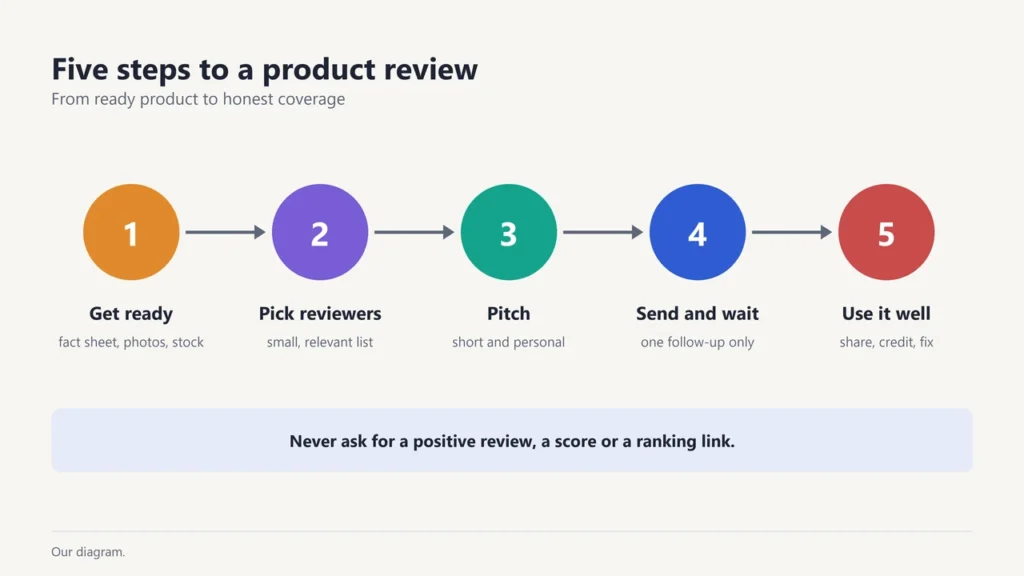
Step 1: Make your product ready for review
Reviewers judge what you send, so send the finished product, not a prototype. Before you pitch anyone, have these ready:
- A one-page fact sheet: price, sizes, materials or specs, where it is sold and which countries you ship to.
- Good photos: plain, high-resolution product shots the reviewer may use.
- A contact person: someone who answers technical questions within a day or two.
- Clear terms: say whether the sample is a gift or a loan you want back, and who pays for return postage.
- Stock: make sure people can buy it on the day the review goes live.
Step 2: Find reviewers whose readers would buy it
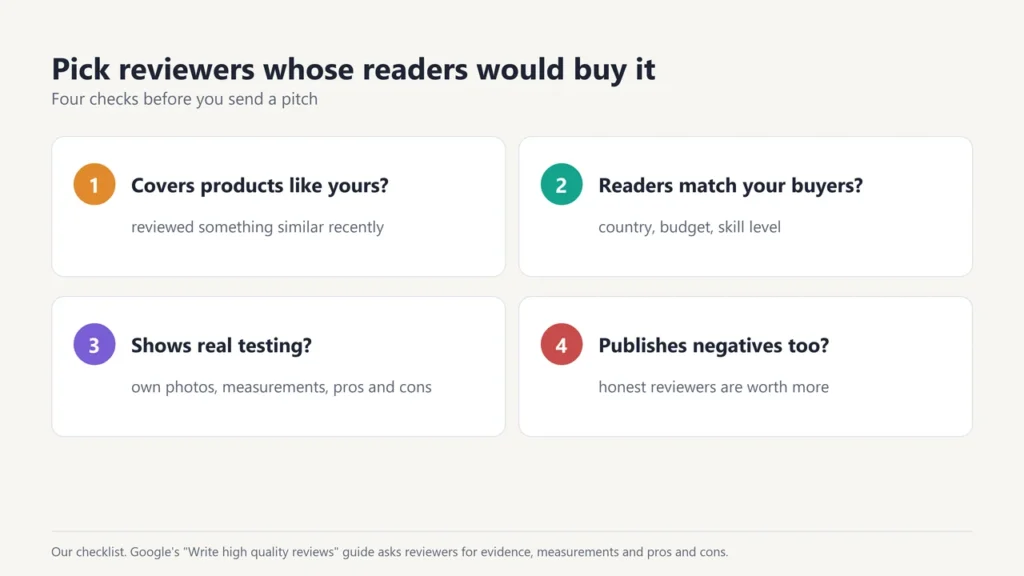
A small list of the right reviewers beats a big list of random ones. Search Google for “[your product type] review” and note who appears. Then check each site or channel:
- Have they reviewed similar products in the last few months?
- Do their readers match your buyers (country, budget, skill level)?
- Do they show real testing: their own photos, measurements, pros and cons?
- Do they have a review policy, a “work with us” page or a press contact?
- Do they publish negative points? A reviewer who loves everything is not much use to readers or to you.
Google’s own guide for review writers, “Write high quality reviews”, asks reviewers to share evidence of their own experience, measurements, comparisons with rivals, and benefits and drawbacks. Pick reviewers who already work this way. Reviews like these give readers evidence, not just opinion.
Step 3: Write a short, personal pitch
Reviewers get many emails. Keep yours under about 150 words, use their name, and show you have read their work. Here is a simple template you can change:
Subject: Review sample: [product] for [their site or channel]

Hi [name],

I read your review of [similar product] and liked how you
[tested it / compared it with X]. We make [product], a
[one-line description] that costs [price] in [countries].

Would you like a free sample to review? There is no
obligation to write about it, and your verdict is yours.
If you do review it, please say clearly, near the top,
that we sent it free. (For UK audiences, please label
the post as an ad.)

I can send a fact sheet, photos and answers to any
questions. [Sample is yours to keep / We'll send a
prepaid label to return it.]

Thanks,
[your name, role, company, phone]
Leave out three things: demands for a positive review, a deadline they have not agreed to, and any request for a link. Each one puts a good reviewer off. The first goes against FTC guidance that a review must be the reviewer’s honest opinion, and asking for a link in return for the product is a link scheme under Google’s spam policies. Both are covered below.
Step 4: Send the sample, then step back
Ship the product with the fact sheet inside. Ask when they hope to test it, then let them work. Don’t ask to approve the review before it goes live. You can offer to check facts such as price or specs, but the opinion belongs to the reviewer.
If you hear nothing, send one polite follow-up after a week or two. If there is still no reply, move on. Sending a product does not oblige anyone to write about it.
Step 5: Use the review well
- Share it: post the review on your social channels and credit the reviewer. Ask before you copy long quotes onto your own site.
- Quote fairly: don’t cut a sentence so it sounds more positive than the reviewer meant.
- Fix what they found: a critical review is free product testing. Thank them, fix the problem, and tell them when you have.
- Don’t argue in public: correct real factual errors politely and privately.
What about product seeding?
Product seeding means sending free products to many creators at once, with no obligation to post. It can spread the word fast, but the same rules apply to every post that results: the free product must be disclosed, and in the UK the post must be labelled as an ad. Keep a simple list of who received what, send each person short disclosure instructions, and check what gets posted. That is the kind of monitoring the FTC expects from brands.
Free sample vs paid review: what is the difference?
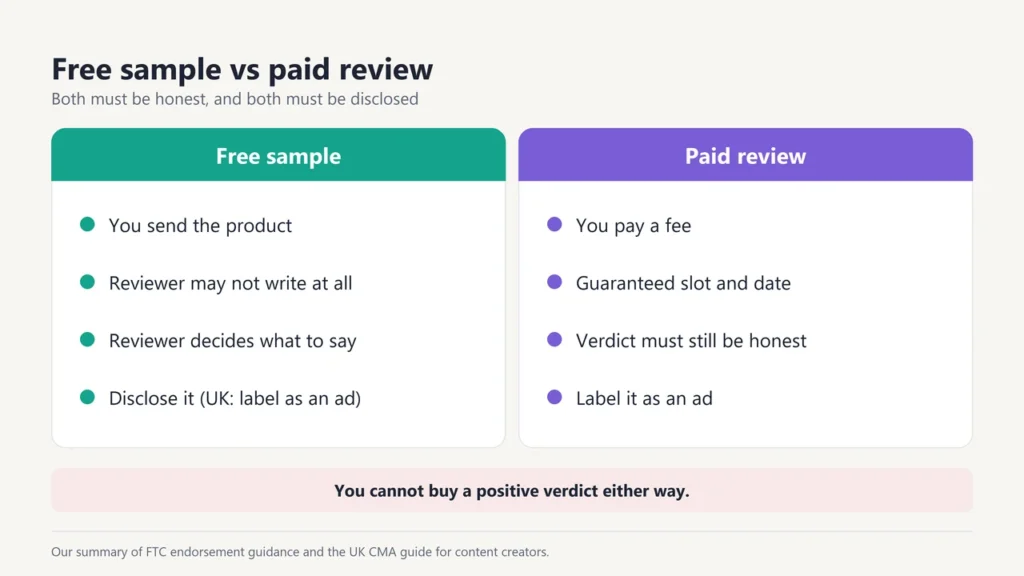
With a free sample, the reviewer chooses whether to write anything and what to say. With a paid review, you pay for a guaranteed article or video, often with an agreed date and format. In both cases the review must reflect the reviewer’s honest opinion, and the free product or payment must be disclosed. The UK CMA goes further: it says a paid or gifted post must be labelled as an ad.
The rules: disclosure, honesty and links
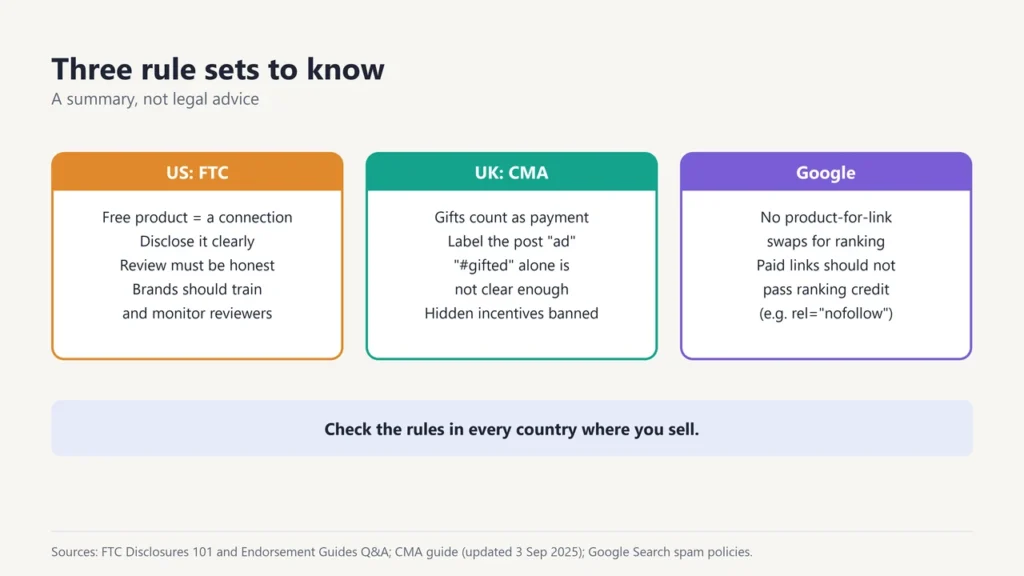
These rules come from the regulators’ own guidance. They are a summary, not legal advice, so check the rules in every country where you sell.
United States: the FTC
- Free products count. The FTC’s “Disclosures 101 for Social Media Influencers” says a material connection includes “giving you free or discounted products”. The reviewer has to disclose it clearly, where people will see it.
- Reviews must be honest. The FTC’s Endorsement Guides Q&A says an endorsement “must reflect the honest opinion of the endorser”.
- Brands have duties too. The same Q&A says brands should tell reviewers how to disclose, check what they post, and act on problems. The FTC says advertisers should have a “reasonable training, monitoring, and compliance program”.
- Review incentives have limits. The FTC’s Rule on the Use of Consumer Reviews and Testimonials took effect on 21 October 2024, and courts can impose civil penalties for knowing violations. For customer reviews, it bans incentives that require a particular sentiment, such as a refund only for five stars. Incentives with no sentiment condition are not banned by that rule, but hiding an incentive can still break the FTC Act.
United Kingdom: the CMA
The CMA’s guide for content creators says gifts of any products count as payment, even if the creator is not obliged to post. A post about a gifted or paid product must be labelled clearly, for example “ad” or “advert”. The CMA lists “#gifted”, “#collab” and “#spon” among labels that are not clear enough on their own. UK law also bans fake reviews and reviews that hide an incentive.
Google: don’t swap products for links
Google Search’s spam policies list “Sending someone a product in exchange for them writing about it and including a link” as a link scheme. A link to your shop in a review is fine if it doesn’t pass ranking credit. Google says paid links should be qualified, for example with rel=”nofollow”. So ask for a review, never for a ranking link.
Common mistakes that get pitches ignored
- Sending the same email to hundreds of people with “Dear blogger”.
- Pitching a reviewer who never covers your type of product.
- Asking for a positive review, a score or a link.
- Shipping a product that is not on sale yet, with no date.
- Asking for the sample back without saying so at the start.
- Chasing again and again after a reviewer has gone quiet.
Want your product in front of Justwebworld readers?
Justwebworld is a digital magazine publishing since December 2012, with 8,000+ articles across 20 topics and a public editorial policy. We offer product reviews, sponsored articles, banner placements and newsletter sponsorship. Pricing is on request, and the team usually replies within 24-48 hours. Accepted drafts are edited to our house standards, and we never promise backlinks, rankings or traffic. See Advertise with Justwebworld for the details, or email [email protected]. Expert writers can see Write for Us; free guest posting is closed.
Related reading: how to advertise on blogs, expert reviews vs customer reviews and blogger outreach tools.
Frequently asked questions
How do I get bloggers to review my product?
Pick bloggers who already review similar products for readers like your buyers. Send a short personal email that offers a free sample with no obligation, and ask them to disclose clearly that you sent it (in the UK, as an ad).
Do I have to pay for a product review?
No. Many reviewers accept free samples and decide for themselves whether to write. Some sites also sell paid reviews; those are adverts, must be labelled, and still can’t promise a good verdict.
Does a free product have to be disclosed?
Yes, in the US and UK. The FTC counts free products as a material connection, and the CMA counts gifts as payment. The disclosure should be clear and easy to see.
Can I ask a reviewer for a positive review?
You shouldn’t. FTC guidance says a review must reflect the reviewer’s honest opinion, so you can’t buy or demand a good verdict. For customer reviews, the FTC’s 2024 rule bans incentives that depend on the review being positive.
Can I ask for a link in return for a free product?
Not for ranking. Google lists sending a product in exchange for a write-up with a link as a link scheme. Links in reviews should not pass ranking credit, for example by using rel=”nofollow”.
What should a product review request email include?
The reviewer’s name, why you chose them, a one-line product description with price, a no-obligation offer of a sample, whether it is a gift or a loan, and your contact details.

Justwebworld has published guides since 2012. How we write and update articles Report an error
