

Sponsored content is content that a brand pays a publisher or creator to make or share. It can be an article, a product review, a video, a social post or a newsletter section. It usually looks like the other content around it, which is why the law in many countries says readers must be able to tell it is paid. In the US, the Federal Trade Commission (FTC) sums up its approach in one word: transparency.
This guide is for brands, marketers, PR teams and new publishers. It explains what counts as sponsored content, how it differs from native ads and advertorials, how to label it so readers are not misled, what Google says about links in paid articles, and how to plan a sponsored piece that people actually read.
What does sponsored content mean?
Sponsored content means someone was paid, or got something of value, to create or share the content. Three things make it “sponsored”:
- A sponsor pays. Usually a brand pays money. Free products and other perks can count too.
- A publisher or creator makes or hosts it. This can be a magazine, a blog, a podcast, a YouTube channel or an influencer.
- It fits in with normal content. It uses the same layout, style or format as the unpaid content next to it.
That last point is the reason disclosure matters. A banner ad looks like an ad. A sponsored article can look exactly like a staff article, so a clear label does the job that the design does for a banner.
Common types of sponsored content
| Type | What it looks like | Example |
|---|---|---|
| Sponsored article | A full article on a website, paid for by a brand | A guide to kitchen storage paid for by a cabinet maker |
| Sponsored review | A review where the brand paid or gave the product | A blogger reviews a phone the maker sent for free |
| Sponsored social post | A creator’s post, reel or story made for a brand | An influencer shows a snack in a paid video |
| Sponsored video or podcast segment | A paid mention or section inside a show | A host reads a sponsor message mid-episode |
| Newsletter sponsorship | A paid slot or full issue in an email newsletter | “This issue is sponsored by…” plus a short pitch |
| Underwritten content | The brand funds the piece but does not shape what it says | A travel list “presented by” a shoe brand |
Sponsored content vs native advertising vs advertorial
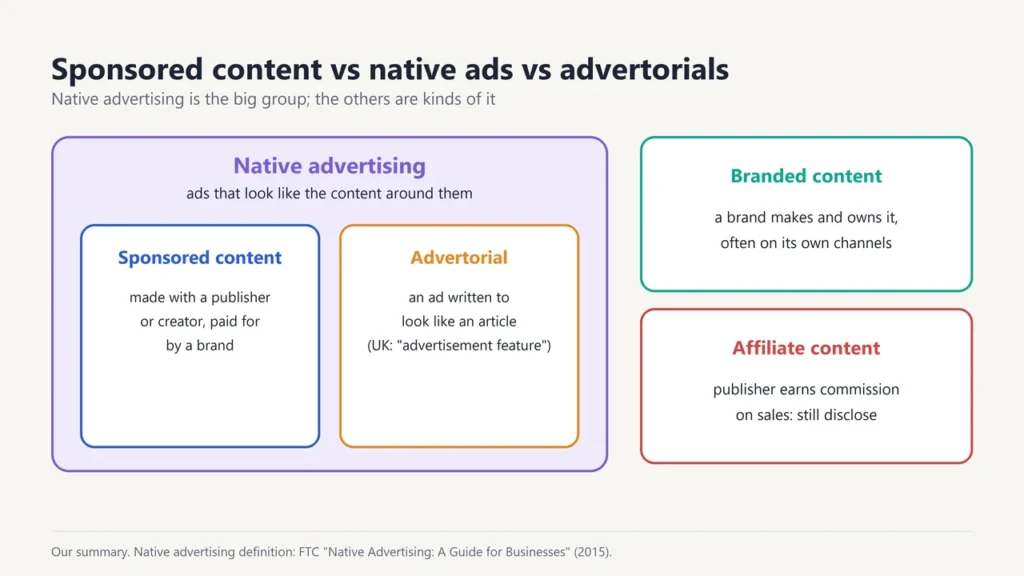
These terms overlap, and people often use them to mean the same thing. The short version: native advertising is the big group, and sponsored content and advertorials are kinds of it.
- Native advertising: the FTC describes it as content that “bears a similarity to” the news, articles, reviews and other material around it. It can appear on news and magazine sites, in social media feeds, in content recommendation widgets, in email, in videos and in games.
- Sponsored content: the everyday name for native ads made with or by a publisher or creator.
- Advertorial: an ad written in the style of an article. The word is older and is used in UK advertising rules.
- Branded content: content a brand makes and owns, such as a brand’s own blog or video series. It is not always placed on someone else’s site.
- Affiliate content: the publisher earns a commission when a reader buys through a link. Nobody pays up front, but the FTC’s Endorsement Guides Q&A still says to disclose the affiliate relationship.
Do you have to disclose sponsored content?
Yes, in most cases. In both the US and the UK, the core rule is the same: an ad must not pretend to be something else.
United States: FTC
The FTC’s “Native Advertising: A Guide for Businesses” (December 2015) says it is deceptive to mislead people about the commercial nature of content. An ad must not suggest it is independent or comes from someone other than the advertiser. The guide gives two useful examples:
- A shoe brand pays a fitness magazine for a travel list, “presented by” the brand, that does not promote any shoes. The FTC says the sponsorship is advertising, but the article itself is not an ad, so it does not need an ad label.
- A cabinet company pays an online lifestyle magazine for “10 Must-Haves for a Great Kitchen”, and most photos show its own cabinets. That article is an ad, and it needs a clear and prominent label.
So the test is not only “did money change hands?” but also “does the content promote the sponsor’s products?” If it does, label it as an ad. The FTC also says it has taken action against ad agencies and affiliate networks that helped make deceptive ads, not only brands.
United Kingdom: CAP Code
The UK Code of Non-broadcast Advertising (CAP Code), which the Advertising Standards Authority enforces, says in rule 2.1 that marketing “must be obviously identifiable as such”. Rule 2.3 adds that marketing must make its commercial intent clear if that is not obvious from the context. Rule 2.4 says marketers and publishers must make clear that advertorials are marketing, for example by heading them “advertisement feature”.
Other countries
Rules differ in wording, and some platforms add their own rules for paid partnerships. Check the advertising regulator in each country where your audience lives. The safe habit everywhere is the same: say clearly that the content is paid, and say it before people read or watch it.
How to label sponsored content clearly
A label only works if people notice it and understand it. The FTC guide lists what a good disclosure looks like:
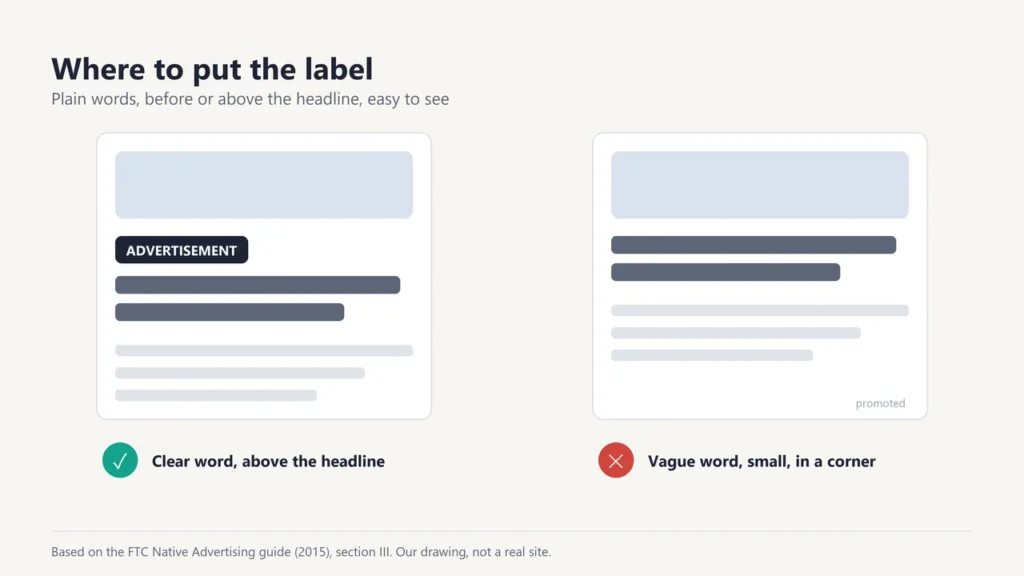
- Plain words. The FTC says terms like “Ad”, “Advertisement”, “Paid Advertisement” or “Sponsored Advertising Content” are likely to be understood. It calls “Promoted” or “Promoted Stories” at best ambiguous.
- In the right place. Put the label in front of or above the headline, where people look first. Labels to the right or below are easy to miss.
- Easy to see. Use a readable font size and a colour that stands out from the background, on phones as well as desktops.
- On every page people can land on. Readers may arrive from search or social media, so label the article page itself, not only the home page teaser.
- Kept when shared. The label should stay when the piece shows up elsewhere. The FTC suggests putting it at the start of the page title that appears in search results, and at the start of share links.
- Not just a logo. A brand logo on its own is not enough. “Sponsored by [brand]” can make people think the brand only paid and had no say, so use it only when that is true.
For videos, show the label on screen long enough to read. For audio, say it loud enough and slowly enough for listeners to follow.
Sponsored posts by influencers and reviewers
The same idea applies to creators. The FTC’s Q&A “FTC’s Endorsement Guides: What People Are Asking” says the rules apply when a brand pays you or gives you something of value to mention its product, including free products or other perks given with the expectation that you will talk about them.
- Disclose on each post. The FTC says followers may not read more than one post, so each sponsored post needs its own disclosure, such as “#ad”.
- Use clear words. The FTC says tags like “#comped” or “#hosted” are not clear enough.
- Don’t rely only on a platform’s paid-partnership label. Asked if creators can rely on that tool, the FTC answers “Not necessarily”: the tool alone may not be a clear disclosure.
- Disclose affiliate links where people see them. For a video, the FTC says to disclose in the video and in the description near the links.
Sponsored content and SEO: what Google says
Google’s spam policies (last updated 28 August 2026) list “advertorials or native advertising where payment is received for articles that include links that pass ranking credit” as link spam. In plain words: if you pay for an article, its links to your site must not pass ranking credit. Google says buying links for advertising is “a normal part of the economy of the web” and is fine when the links are qualified, for example with rel=”nofollow”.
The same policy page says advertorial or native advertising pages are not “site reputation abuse” when their purpose is to share content directly with readers, not to manipulate search rankings. So sponsored content is allowed. Sponsored content bought mainly for links is the problem. Treat a sponsored article as a way to reach readers, and judge it by the readers it reaches.
If you want to know more about how links are worded, see our guide to anchor text. For when an unpaid guest article makes more sense, read is guest posting worth it.
How to plan sponsored content that people read
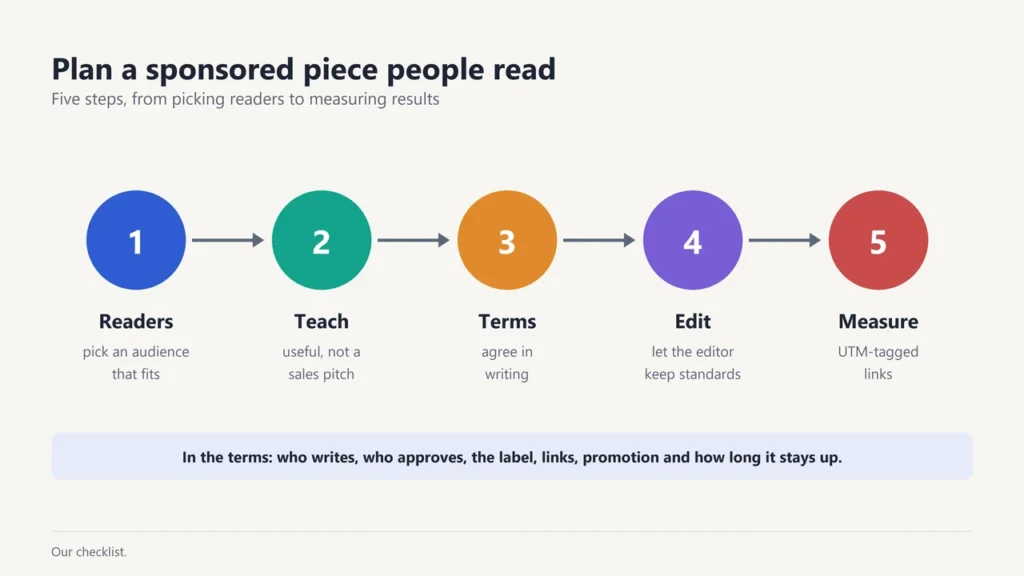
Paid content still has to earn attention. These steps help it do that:
- Pick the right readers first. Choose a publication or creator whose audience could become your customers. Our guide on how to advertise on blogs covers how to check a site.
- Teach, don’t shout. A useful guide, story or how-to gets read. A long sales pitch dressed as an article usually doesn’t.
- Agree the terms in writing. Who writes it, who approves it, how it is labelled, how links are handled, where it is promoted and how long it stays up.
- Let the editor edit. Good publishers keep their own standards. That is part of what you pay for.
- Measure it. Tag your links with UTM parameters so your analytics show visits, sign-ups and sales from the piece.
If you want an honest opinion on a product rather than a paid piece, a review request is a different route. See how to get your product reviewed.
How much does sponsored content cost?
There is no standard price. Rates depend on the publisher, the format, who writes the piece, how long it stays live and any extra promotion such as a newsletter slot. Many publishers do not publish their rates and quote on request. When you compare quotes, ask what is included: writing, edits, images, promotion, how long it stays up and how it will be labelled.
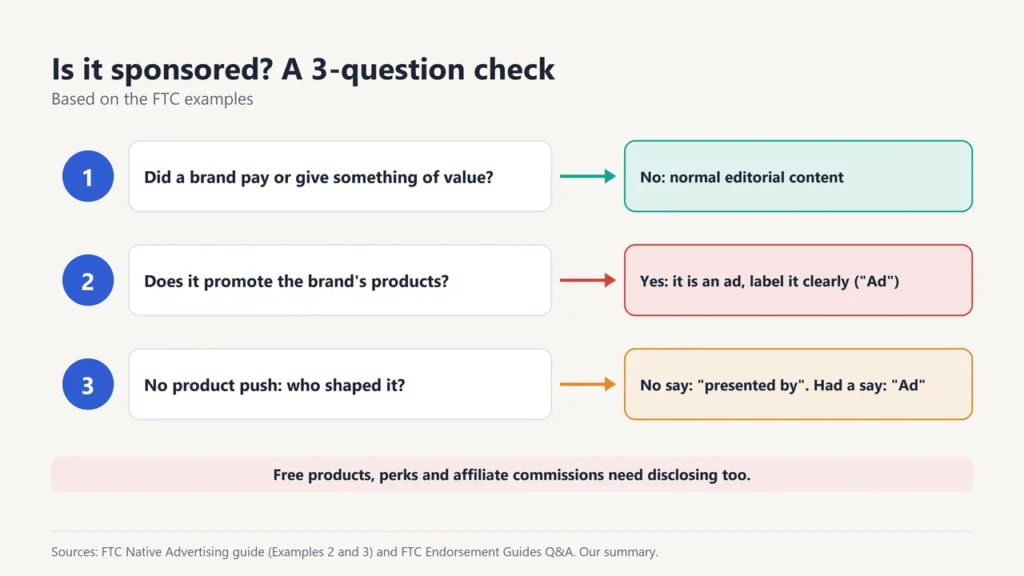
Is it sponsored? A quick check
Use these three questions, based on the FTC’s examples, before you publish:
- Did a brand pay, or give something of value? If no, it is normal editorial content.
- Does the content promote the brand’s products or services? If yes, it is an ad and needs a clear ad label.
- If it does not promote anything, who shaped the content? If the sponsor only paid and had no say, naming it with “presented by” fits. If the sponsor shaped what it says, use a clear label such as “Advertisement” or “Sponsored Advertising Content”. The FTC says readers may take “presented by” or “sponsored by” to mean the brand funded the piece but did not create or influence it.
Want to reach Justwebworld readers?
Justwebworld is a digital magazine that has published since December 2012, with 8,000+ articles across 20 topics and a public editorial policy. We offer sponsored articles, product reviews, banner placements and newsletter sponsorship. Pricing is on request, and the team usually replies within 24-48 hours. We never promise backlinks, rankings or traffic. See Advertise with Justwebworld for the details. Expert writers can see Write for Us; free guest posting is closed.
Frequently asked questions
Is sponsored content an ad?
Usually, yes. If a brand paid for it and it promotes the brand’s products, it is an ad and should be labelled as one. The FTC says content that a brand only funds, and that does not promote its products, does not need an ad label.
Is sponsored content the same as native advertising?
Mostly. Native advertising is the wider group: any ad that looks like the content around it. Sponsored content is the common name for native ads made with a publisher or creator.
What is the difference between sponsored content and an advertorial?
An advertorial is an ad written to look like an article. It is one kind of sponsored content. UK rules say advertorials must be clearly marked, for example with the heading “advertisement feature”.
What words should I use to label sponsored content?
Use plain words such as “Ad”, “Advertisement” or “Paid advertisement”, placed before or above the headline. The FTC warns that “Promoted” is at best ambiguous, and that a logo on its own is not enough.
Do sponsored posts help SEO?
Not through links. Google’s spam policies say paid links must not pass ranking credit, for example by using rel=”nofollow”. A sponsored post can still bring visitors, brand searches and new customers.
Is a free product the same as being paid?
For disclosure, yes. The FTC’s Endorsement Guides apply when you get free products or other perks with the expectation that you will promote them, and the FTC’s Q&A says affiliate commissions should be disclosed too.
Does Justwebworld publish sponsored content?
Yes. Brands can ask about sponsored articles, product reviews, banners and newsletter sponsorship on the Advertise page. Pricing is on request, and we never promise backlinks, rankings or traffic.

Justwebworld has published guides since 2012. How we write and update articles Report an error
