

Tor and a VPN both hide your IP address from the websites you visit, but they work very differently. A VPN sends your traffic through one server run by a company you trust. Tor sends it through three volunteer-run relays, so no single relay knows both who you are and where you are going. A VPN is faster and protects all your apps; Tor offers stronger anonymity but is slower and protects only apps set up to use it.
For everyday privacy, streaming and public Wi-Fi, a VPN is usually the practical choice. Tor suits situations where anonymity matters more than speed. This guide compares the two side by side and explains when to use each.
Key takeaways
- A VPN uses one provider’s server; Tor uses three relays run by volunteers.
- With a VPN you trust the provider; with Tor, no single relay sees the whole route.
- A VPN covers all your apps; Tor protects only apps configured to use it, usually Tor Browser.
- Tor is slower, because traffic bounces through relays around the world.
- The Tor Project does not generally recommend combining them unless you are an advanced user.
How a VPN works
A VPN app creates an encrypted tunnel from your device to a server run by the VPN provider. Websites see the VPN server’s IP address instead of yours, and your internet provider sees only that you are connected to the VPN. The catch is that the VPN provider can, in principle, see both your real address and where your traffic goes, so you have to trust it. Our guide to the pros and cons of using a VPN covers what that means in practice.
How Tor works
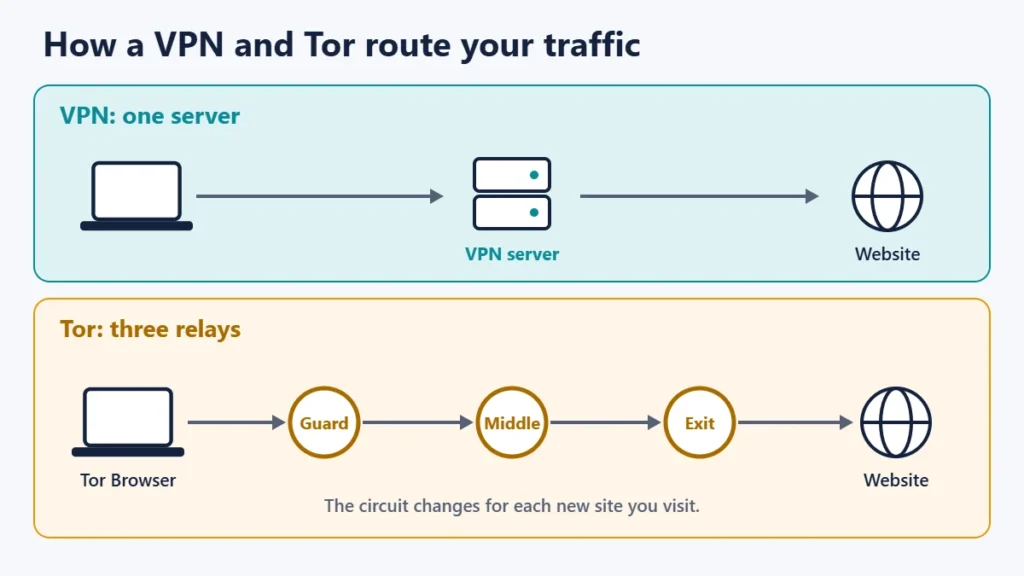
Tor, short for The Onion Router, sends your traffic through a circuit of three relays. The Tor Project’s relay guide shows the path as Tor user, guard relay, middle relay, exit relay, then the destination. It explains that services you connect to see the IP address of the exit relay instead of your real IP address. The first hop, the guard relay, is chosen as a stable and trusted relay, and the rest of the circuit changes with every new website you visit.
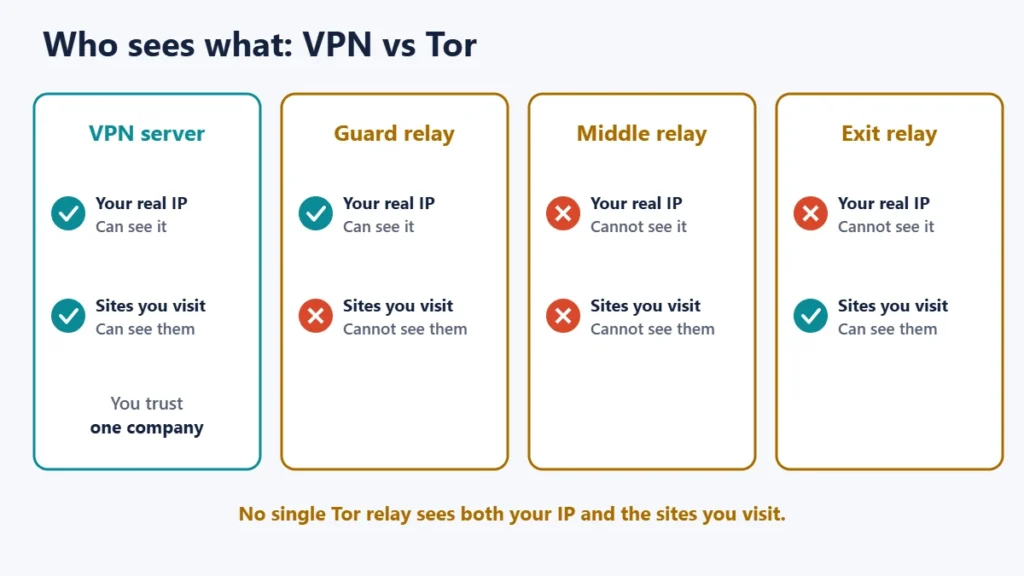
Because the guard knows where the traffic came from but not where it ends up, and the exit knows the destination but not the origin, no single relay can link you to the sites you visit.
Tor vs VPN at a glance
| VPN | Tor | |
|---|---|---|
| Route | One provider server | Three volunteer relays |
| Who you trust | The VPN company | No single relay |
| What it protects | All traffic from the device | Apps set up to use Tor, usually Tor Browser |
| Speed | Usually close to normal on a nearby server | Slower |
| Cost | Usually paid | Free |
| Choose your country | Yes | Not reliably |
| Good for streaming and downloads | Yes | No |
Speed
The Tor Project is open about speed. Its support page says Tor Browser can sometimes be slower than other browsers because, by design, your traffic is bouncing through volunteers’ servers in various parts of the world, so some bottlenecks and network latency will always be present. It also notes Tor is much faster than it used to be. A VPN adds one hop rather than three, so on a nearby server the slowdown is usually smaller.
What each protects
A VPN app usually covers every app on your device. Tor does not. The Tor Project warns that Tor does not protect all of your computer’s internet traffic when you run it, only applications that are properly configured to send their traffic through Tor. For most people, that means Tor Browser.
Encryption to the final website is another difference. The Tor Project explains that Tor encrypts your traffic to and within the Tor network, but encryption to the destination website depends on that website. Tor Browser includes an HTTPS-Only Mode to help. The same applies to a VPN: once traffic leaves the VPN server, HTTPS is what protects it.
When to use a VPN
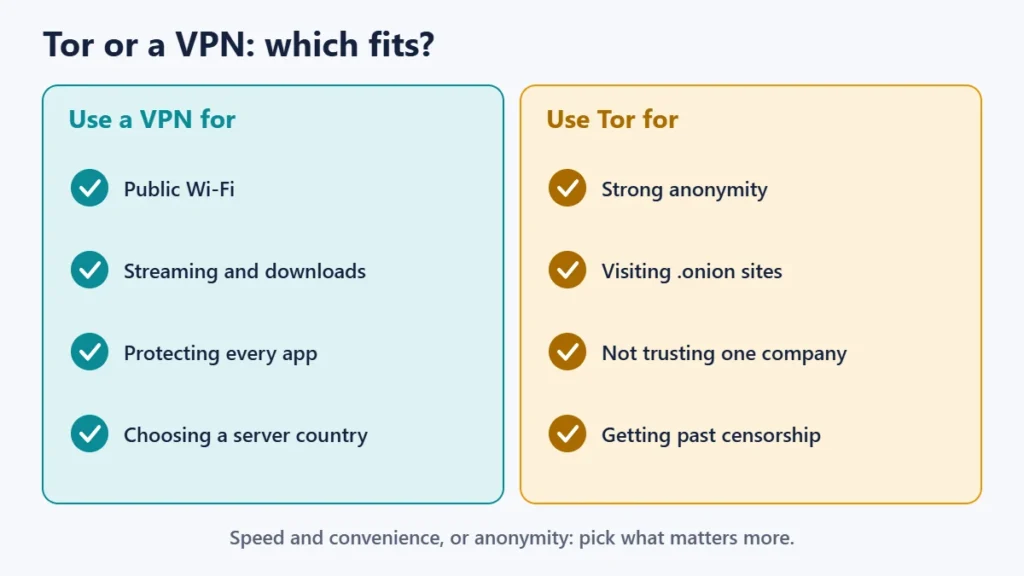
- Public Wi-Fi. A VPN protects all your apps at once. See our guide to using free Wi-Fi securely.
- Streaming, gaming and downloads, where speed matters.
- Choosing a location, for example to reach your home country’s services while travelling.
- Protecting the whole device, not just a browser.
When to use Tor
- When anonymity matters most, and you do not want to rely on one company.
- Visiting .onion sites, which are only reachable through Tor.
- Getting around censorship. The Tor Project describes bridges as alternative entry points that help bypass censorship when direct connections are blocked.
Do not use Tor for file sharing. The Tor Project warns that torrent applications have been observed to ignore proxy settings and connect directly, says it is not safe to use BitTorrent and Tor together, and notes it slows down the network for everyone else.
Can you use Tor and a VPN together?
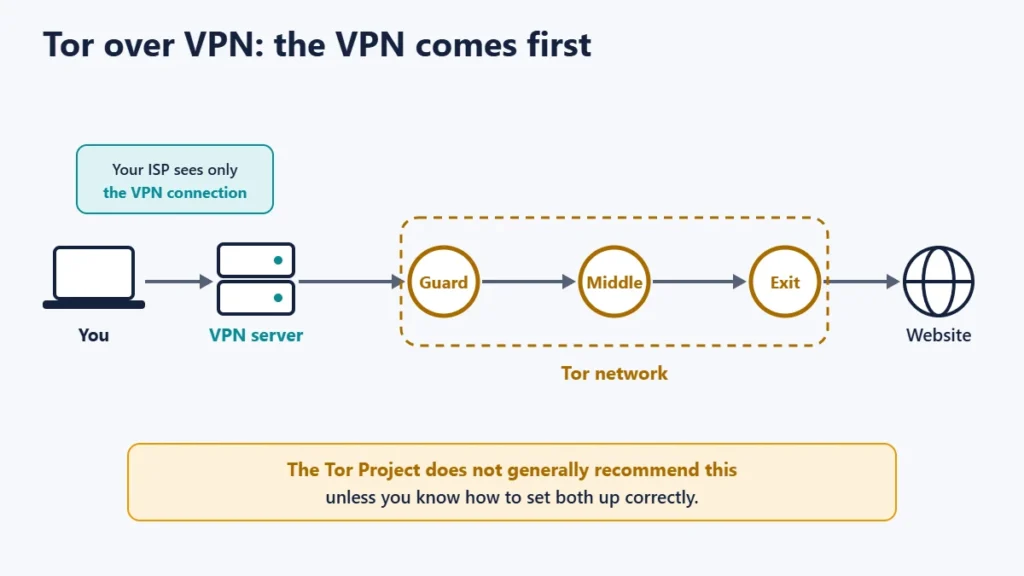
You can, but be cautious. The Tor Project says it generally does not recommend using a VPN with Tor unless you are an advanced user who knows how to configure both without compromising your privacy, because in practice it can reduce anonymity or break Tor’s protections if set up wrongly.
Some VPNs offer a built-in option. Proton VPN’s Tor over VPN feature lets you reach the Tor network, including .onion sites, in your regular browser without installing extra software, and Proton describes it as a feature on its paid plans. Proton also notes that using the Tor network is very slow compared with a regular VPN server.
Common mistakes
- Thinking Tor protects every app. It only covers apps set up to use it.
- Torrenting over Tor. The Tor Project says it is not safe.
- Logging in to personal accounts over Tor and expecting to stay anonymous.
- Ignoring HTTPS. Neither Tor nor a VPN encrypts the last leg to a site without it.
- Combining Tor and a VPN without understanding the set-up.
Frequently asked questions
Is Tor better than a VPN?
For anonymity, Tor is designed so that no single relay sees your whole route. For speed and protecting all your apps, a VPN is usually better.
Is Tor free?
Yes. Tor Browser is free to download and use.
Does a VPN make you anonymous?
Not fully. It hides your IP address from websites, but the VPN provider could see your activity, so trust matters.
Why is Tor so slow?
Your traffic passes through three relays run by volunteers around the world, which adds delay.
Can I watch streaming services over Tor?
It is impractical because of the speed, and you cannot reliably choose a country. A VPN suits streaming better.
Do I need a VPN to use Tor?
No. Tor Browser works on its own, and the Tor Project does not generally recommend adding a VPN unless you know how to set it up correctly.
The short version
A VPN routes all your traffic through one trusted provider’s server, which is fast and convenient for everyday privacy, public Wi-Fi and streaming. Tor routes browser traffic through three volunteer relays, which is slower but means no single relay knows both who you are and where you go. Use a VPN for daily use, Tor when anonymity matters most, and avoid combining them unless you know what you are doing. To check your VPN is doing its job, see how to check if your VPN is working.

Justwebworld has published guides since 2012. How we write and update articles Report an error
