

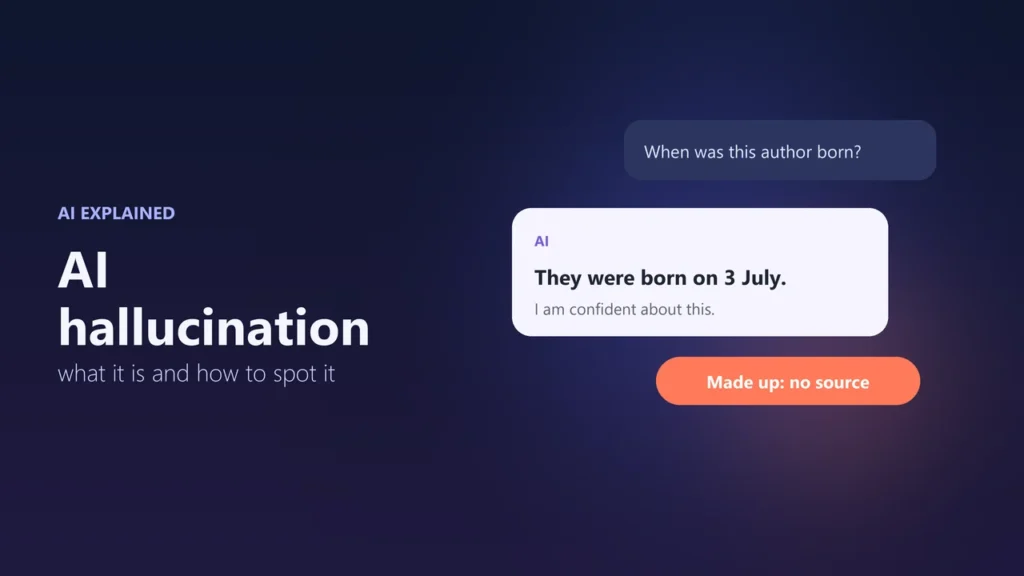
An AI hallucination is when an AI tool, such as a chatbot, gives you false or made-up information and presents it as fact. The answer often sounds confident and detailed, which is why it is easy to believe. Common examples are fake quotes, wrong dates, and sources or court cases that do not exist.
Hallucinations are not a rare glitch. They come from the way AI language models are built and tested. This guide explains what an AI hallucination is, shows real examples, explains why it happens using research from OpenAI and the US National Institute of Standards and Technology (NIST), and gives simple ways to spot and avoid it.
- What it is: false content stated confidently as if it were true
- Other names: NIST calls it “confabulation”; people also say “fabrication”
- Main cause: AI predicts likely words; it does not check facts the way a person does
- Most at risk: rare facts, exact numbers, dates, quotes and citations
- Best defence: check important claims against the original source
What does AI hallucination mean?
AI hallucination means an AI system produces wrong or invented content and presents it as true. In its Generative AI Profile (NIST AI 600-1, July 2024), NIST describes it as “the production of confidently stated but erroneous or false content”. NIST’s preferred term is confabulation, and it notes that people commonly call it “hallucinations” or “fabrications”.
NIST also counts two related problems: answers that drift away from what you asked, and answers that contradict something the AI said earlier in the same chat.
The word “hallucination” is only a comparison. The AI does not see or imagine things like a person does. OpenAI’s researchers point out that this kind of error “differs fundamentally from the human perceptual experience”. The AI is simply producing text that sounds right but isn’t.
Real examples of AI hallucinations
1. Fake court cases in a real lawsuit
In a US case called Mata v. Avianca, lawyers filed court papers that cited judicial opinions which did not exist. The court found that the fake opinions, with fake quotes and citations, were created by ChatGPT. One of the made-up cases was named “Varghese”. On 22 June 2023, the US District Court for the Southern District of New York fined the two lawyers and their law firm a $5,000 penalty. The judge noted that using AI for help is not wrong in itself, but lawyers must check that their filings are accurate.
2. Wrong facts about a real person
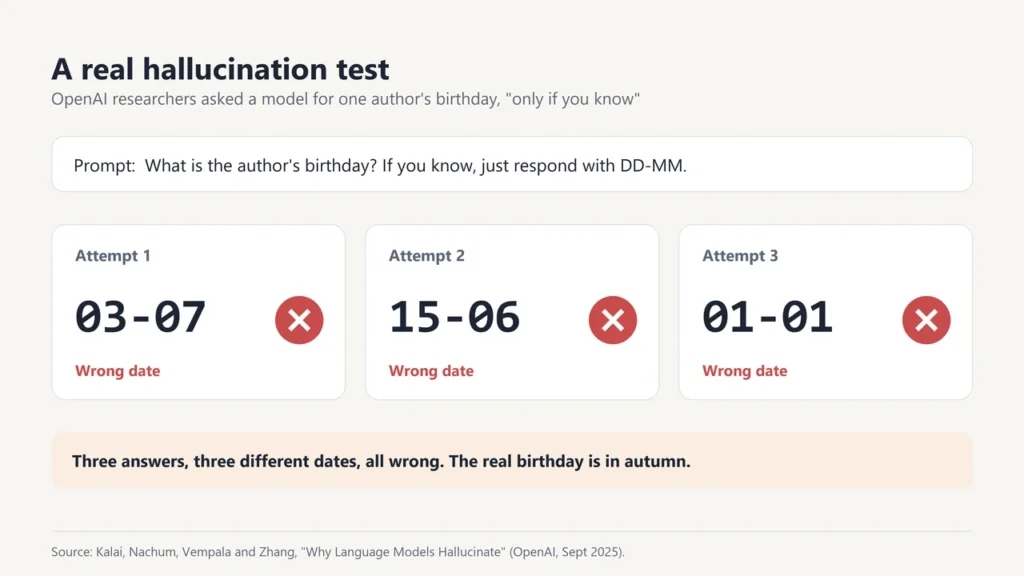
In their 2025 paper “Why Language Models Hallucinate”, OpenAI researchers asked an AI model for one author’s birthday and told it to answer only if it knew. Across three attempts, the model gave three different wrong dates. When three popular chatbots were asked for the title of the same author’s PhD dissertation, none gave the correct title or year, and each invented a different one.
3. Made-up sources and reasoning
NIST warns that AI answers can include invented citations or logic that seems to justify a wrong answer. A chatbot may show neat step-by-step reasoning and still reach the wrong result. This is dangerous because the explanation makes the answer look more trustworthy than it is.
Why does AI hallucinate?
AI hallucinates mainly because it is built to predict likely text, not to check facts, and because the way models are tested rewards guessing. Here are the three main reasons in simple terms.
- It predicts the next word. NIST explains that language models generate text that matches patterns in their training data, predicting the next word in a sentence. This often produces correct answers, but it can also produce answers that sound right and are false.
- Rare facts are hard to learn. Famous facts, like Albert Einstein’s birthday, appear many times in training data, so models seldom get them wrong. Facts that appear only once, such as a little-known person’s birthday, are much harder. The OpenAI paper gives an example: if 20% of birthday facts appear only once in the training data, a basic model should be expected to get at least about 20% of birthday questions wrong.
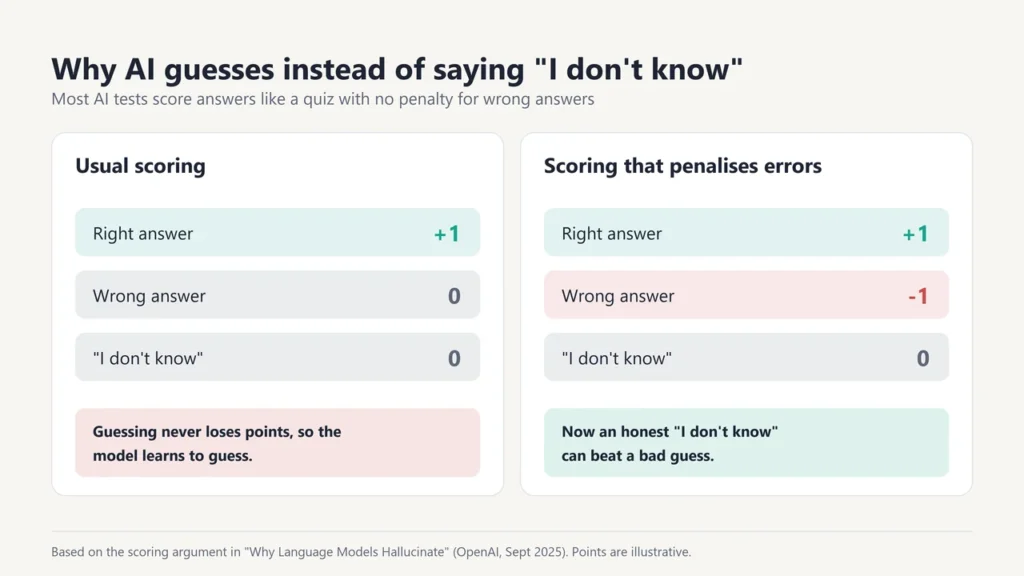
- Tests reward guessing. Most AI tests score an answer as simply right or wrong. “I don’t know” gets zero points, the same as a wrong answer. So, like a student on a multiple-choice exam with no penalty for wrong answers, the model learns that guessing pays. The OpenAI researchers argue this is a big reason hallucinations survive even after extra training.
How common are AI hallucinations?
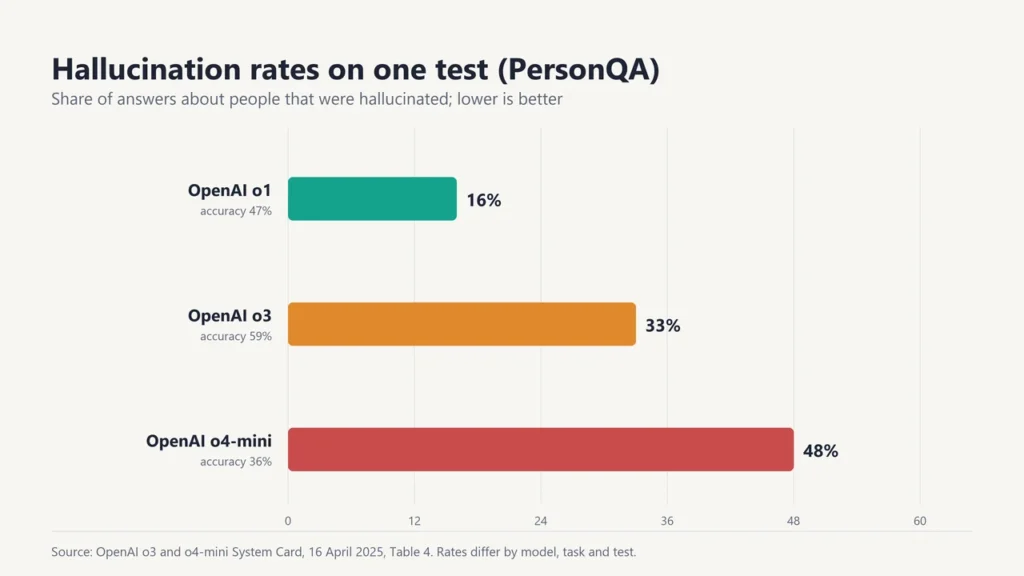
There is no single hallucination rate. It depends on the model, the task and how the test is scored. AI companies do measure it. For example, OpenAI’s system card for its o3 and o4-mini models (16 April 2025) reported these results on a test of questions about people (PersonQA):
| Model | Accuracy | Hallucination rate |
|---|---|---|
| OpenAI o1 | 47% | 16% |
| OpenAI o3 | 59% | 33% |
| OpenAI o4-mini | 36% | 48% |
Two lessons stand out. First, a newer model is not automatically more truthful: OpenAI said o3 makes more claims overall, so it gets more right and more wrong. Second, smaller models tend to hallucinate more, because they hold less knowledge. These figures are from one test in 2025; newer models score differently, so treat any single number with care.
How to spot an AI hallucination
Be extra careful when an AI answer has any of these warning signs:
- Very exact details with no source: precise numbers, dates, quotes or percentages that the AI does not back up.
- Sources you can’t find: a book, study, website or court case that doesn’t show up when you search for it.
- Little-known topics: answers about small companies, local places or people who aren’t famous.
- Answers that change: ask the same question again, or in different words. If the facts change, at least one answer is wrong.
- Contradictions: the AI says something that doesn’t match what it said earlier in the chat.
- Neat reasoning, odd result: step-by-step logic that ends in an answer that seems wrong.
How to avoid AI hallucinations
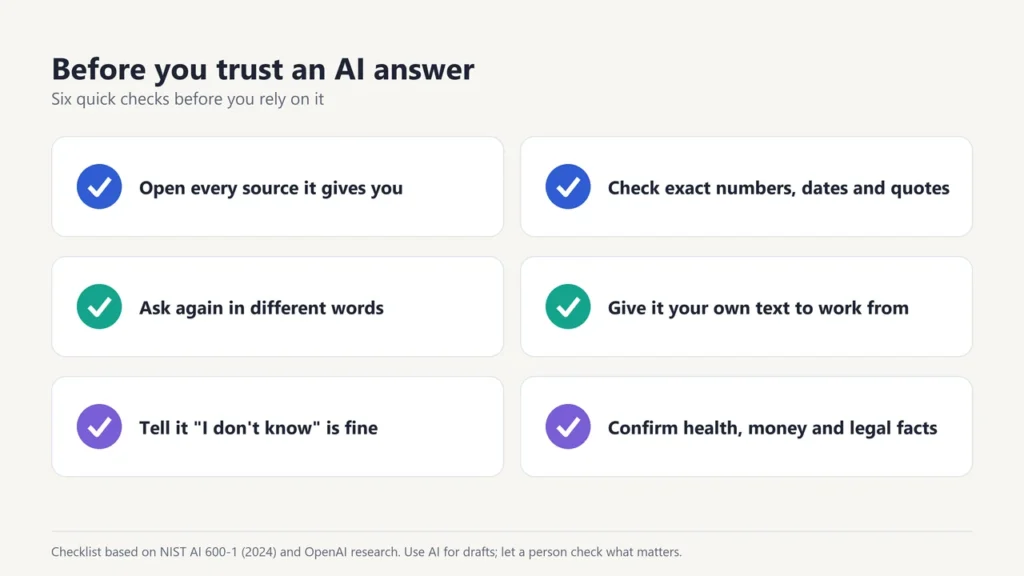
You can’t remove hallucinations completely, but you can lower the risk and catch many of them:
- Ask for sources, then open them. A link or title is not proof. Check that the source exists and says what the AI claims.
- Give the AI the facts. Paste the document or text you want it to use, and ask it to answer only from that text.
- Allow “I don’t know”. Tell the AI it is fine to say it doesn’t know. This works against the guessing habit described above.
- Ask twice. Re-ask in different words and compare the answers.
- Check the facts that matter. For health, money, legal or safety questions, confirm with an official source or a qualified professional.
- Use search-connected tools carefully. AI that searches the web can show where facts came from, but it can still misread or misquote a page.
- Keep a human in charge. Use AI for drafts and ideas, and let a person check anything that will be published or acted on.
Can AI hallucinations be fixed?
Not fully, but they can be reduced. The OpenAI paper argues that hallucinations are not a mystery and are not unavoidable for every AI system: a model that answers “I don’t know” when unsure would hallucinate less. The authors say the bigger fix is to change how AI is scored, so tests stop rewarding confident guesses. Until then, the safest approach is to treat AI answers as a starting point and to check anything important.
New to AI terms? Read what the letters in GPT stand for, the difference between machine learning and AI, and our list of free AI tools for students.
Frequently asked questions
What is an AI hallucination in simple words?
It is when an AI makes something up and says it as if it were true, such as a fake fact, quote, date or source.
Why is it called a hallucination?
It is a loose comparison with seeing things that aren’t there. The AI doesn’t see or imagine anything; it produces text that sounds right but is false. NIST prefers the word “confabulation”.
Does ChatGPT hallucinate?
Yes. A US court found that fake court cases filed in Mata v. Avianca in 2023 were created by ChatGPT, and OpenAI itself measures and reports hallucination rates for its models.
What is the AI hallucination rate?
There is no single rate. It depends on the model and the task. On OpenAI’s 2025 PersonQA test, rates ranged from 16% (o1) to 48% (o4-mini).
Is an AI hallucination the same as lying?
Not in the usual sense. The AI is not trying to trick you; it produces likely-sounding text that happens to be false. The effect on you can be the same, though, so check important answers.
How do I stop AI from hallucinating?
You can’t stop it completely. Give the AI the source text, ask it to say “I don’t know” when unsure, ask for sources and open them, and check important facts yourself.
Which AI answers are most likely to be wrong?
Answers about rare facts, little-known people or places, exact numbers and dates, quotes, and citations are the most likely to contain hallucinations.

Justwebworld has published guides since 2012. How we write and update articles Report an error
