

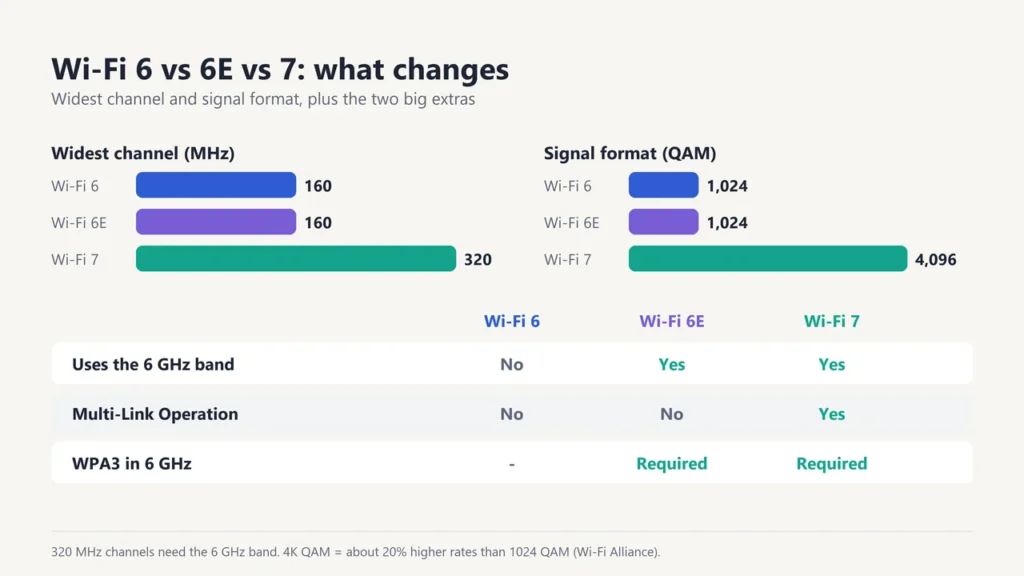
Wi-Fi 7 is the newer generation. Compared with Wi-Fi 6, it adds channels twice as wide (320 MHz, in the 6 GHz band), a denser signal format (4K QAM, about 20% faster than Wi-Fi 6’s 1024 QAM), and Multi-Link Operation, which lets a device use more than one band at the same time. Wi-Fi 6E sits in between. It is Wi-Fi 6 with access to the extra 6 GHz band.
For most homes, the real-world difference depends on three things: your internet plan, whether your phone or laptop also supports Wi-Fi 7, and whether your country allows Wi-Fi in the 6 GHz band. This guide explains each generation using information from the Wi-Fi Alliance (the group that certifies Wi-Fi products), the IEEE (which writes the technical standards), and national radio regulators.
- Wi-Fi 6: certified since September 2019. Uses 2.4 GHz and 5 GHz, with channels up to 160 MHz
- Wi-Fi 6E: certified since January 2021. Wi-Fi 6 features, extended into the 6 GHz band
- Wi-Fi 7: certified since January 2024. Uses 2.4, 5 and 6 GHz, with 320 MHz channels, Multi-Link Operation and 4K QAM
- WPA3 security is mandatory whenever Wi-Fi uses the 6 GHz band
- To get Wi-Fi 7 benefits, both the router and the device must support Wi-Fi 7
Wi-Fi 6 vs Wi-Fi 6E vs Wi-Fi 7 at a glance
| Feature | Wi-Fi 6 | Wi-Fi 6E | Wi-Fi 7 |
|---|---|---|---|
| IEEE standard | 802.11ax | 802.11ax in 6 GHz | 802.11be |
| Certification began | 16 Sept 2019 | 7 Jan 2021 | 8 Jan 2024 |
| Bands | 2.4 GHz, 5 GHz | 2.4 GHz, 5 GHz, 6 GHz | 2.4 GHz, 5 GHz, 6 GHz |
| Widest channel | 160 MHz | 160 MHz | 320 MHz (6 GHz only) |
| Signal format (QAM) | 1024 QAM | 1024 QAM | 4K QAM (4096) |
| Multi-Link Operation | No | No | Yes |
| Security | WPA3 required for certification | WPA3 required in 6 GHz | WPA3 required in 6 GHz |
You may notice there are no speed numbers in this table. The Wi-Fi Alliance does not publish a single top speed for Wi-Fi 6 or Wi-Fi 7. It describes Wi-Fi 7 as enabling “multigigabit” device speeds. The IEEE says its 802.11be standard was designed to support a maximum throughput of at least 30 Gbit/s. That is a lab design target for the whole standard, not a speed any home device will reach.
What is Wi-Fi 6?
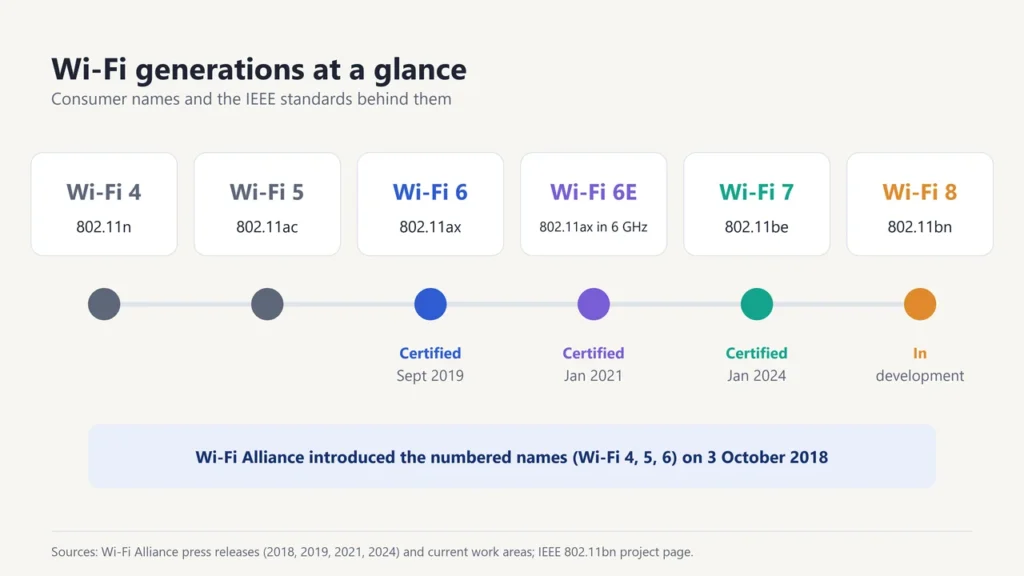
Wi-Fi 6 is the consumer name for the IEEE 802.11ax standard. The Wi-Fi Alliance created the simple numbered names on 3 October 2018, so Wi-Fi 4 means 802.11n, Wi-Fi 5 means 802.11ac and Wi-Fi 6 means 802.11ax. Wi-Fi 6 certification started on 16 September 2019.
Wi-Fi 6 is mainly about handling many devices at once, not just raw speed. The Wi-Fi Alliance says it delivers “nearly four times the capacity of Wi-Fi 5”. Its main features are:
- OFDMA: splits a channel so the router can serve several devices in one go, which lowers delays
- MU-MIMO: lets the router send data to more devices at the same time
- 160 MHz channels: wider lanes for more data
- 1024 QAM: packs more data into the same signal
- Target Wake Time: lets devices sleep between check-ins, which saves battery
- WPA3: Wi-Fi 6 certification requires the latest Wi-Fi security
What is Wi-Fi 6E?
Wi-Fi 6E is Wi-Fi 6 that can also use the 6 GHz band. It is not a new generation. The Wi-Fi Alliance added it as an option inside the Wi-Fi 6 certification programme in January 2021.
The 6 GHz band matters because it is newer and less crowded than 2.4 GHz and 5 GHz, where older Wi-Fi devices still work. Where the full band is open, the Wi-Fi Alliance says it adds “14 additional 80 MHz channels or seven additional 160 MHz wide channels”. Use of WPA3 security is mandatory in 6 GHz.
What is Wi-Fi 7?
Wi-Fi 7 is based on IEEE 802.11be, known as “Extremely High Throughput”. The Wi-Fi Alliance launched Wi-Fi CERTIFIED 7 on 8 January 2024. The IEEE board approved 802.11be later, on 26 September 2024, and published it on 22 July 2025.
According to the Wi-Fi Alliance, the main new features are:
- 320 MHz channels: double the widest Wi-Fi 6 channel. The Wi-Fi Alliance says they give “twice the throughput of Wi-Fi 6”. They only work in the 6 GHz band, in countries that make it available to Wi-Fi.
- Multi-Link Operation (MLO): lets devices send and receive data over more than one link at the same time. This aims at higher throughput, lower delay and better reliability.
- 4K QAM: squeezes more data into each signal, giving about 20% higher transmission rates than 1024 QAM.
- Multiple RUs to a single device: the router can join separate slices of a channel for one device, so less of the channel is wasted.
- 512 Compressed Block Ack: cuts some of the back-and-forth checking, which improves efficiency.
In January 2026, the Wi-Fi Alliance also extended Wi-Fi 7 certification to small smart-home devices that only use 20 MHz channels. So “Wi-Fi 7” on a box does not always mean every advanced feature is there. Check the product’s specs for 320 MHz and MLO support.
Is Wi-Fi 7 faster than Wi-Fi 6?
Yes, it can be, but only when the conditions are right. The biggest gains come from 320 MHz channels and MLO. Both need a Wi-Fi 7 router and a Wi-Fi 7 device, and 320 MHz also needs the 6 GHz band to be open where you live.
Your internet plan also limits what you’ll notice online. If your broadband plan is 300 Mbps, a faster Wi-Fi link won’t make websites load faster than 300 Mbps. Faster Wi-Fi helps most with transfers inside your home, such as backups to a network drive, and in homes with many busy devices. If calls or games are the problem, the cause may be delay rather than speed, as our guide to ping vs jitter vs latency explains. Not sure how your plan’s speed compares with download speeds? See our guide to Mbps vs MB/s.
Is the 6 GHz band available in my country?
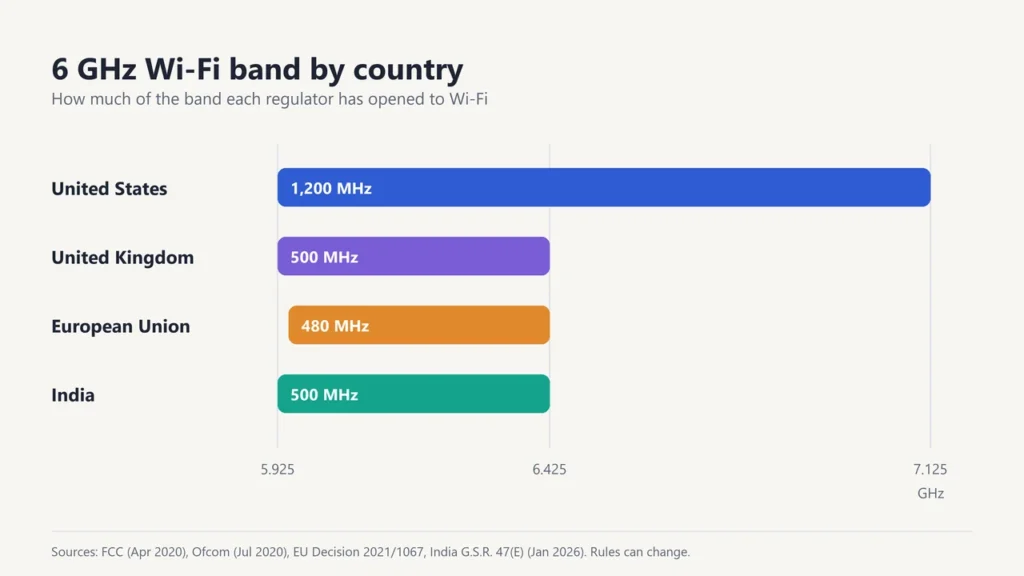
It depends on your country. Wi-Fi 6E and Wi-Fi 7’s 320 MHz channels need the 6 GHz band, and each country’s radio regulator decides how much of it Wi-Fi may use. Some countries opened the full band, some only the lower part.
| Country or region | 6 GHz range for Wi-Fi | Decided by |
|---|---|---|
| United States | 5.925-7.125 GHz (1,200 MHz) | FCC, 23 April 2020 |
| United Kingdom | 5.925-6.425 GHz (500 MHz) | Ofcom, 24 July 2020 |
| European Union | 5.945-6.425 GHz (480 MHz) | EU Decision 2021/1067, by 1 Dec 2021 |
| India | 5.925-6.425 GHz (500 MHz), low-power indoor and very-low-power outdoor use | Ministry of Communications, G.S.R. 47(E), January 2026 |
Rules keep changing. In July 2026, Ofcom said it plans to add the next 160 MHz (6.425-6.585 GHz) for Wi-Fi in the UK, but it was still consulting on the draft regulations at the time of writing. If your country hasn’t opened 6 GHz, a Wi-Fi 6E or Wi-Fi 7 router will still work on 2.4 GHz and 5 GHz, but without 320 MHz channels.
Will a Wi-Fi 7 router work with older devices?
Yes. The Wi-Fi Alliance’s certification seal covers backward compatibility, so a Wi-Fi 7 router still connects to Wi-Fi 6, Wi-Fi 5 and older devices. Each device just connects at the best level it supports. An older laptop won’t get Wi-Fi 7 features from a new router.
Should you upgrade from Wi-Fi 6 to Wi-Fi 7?
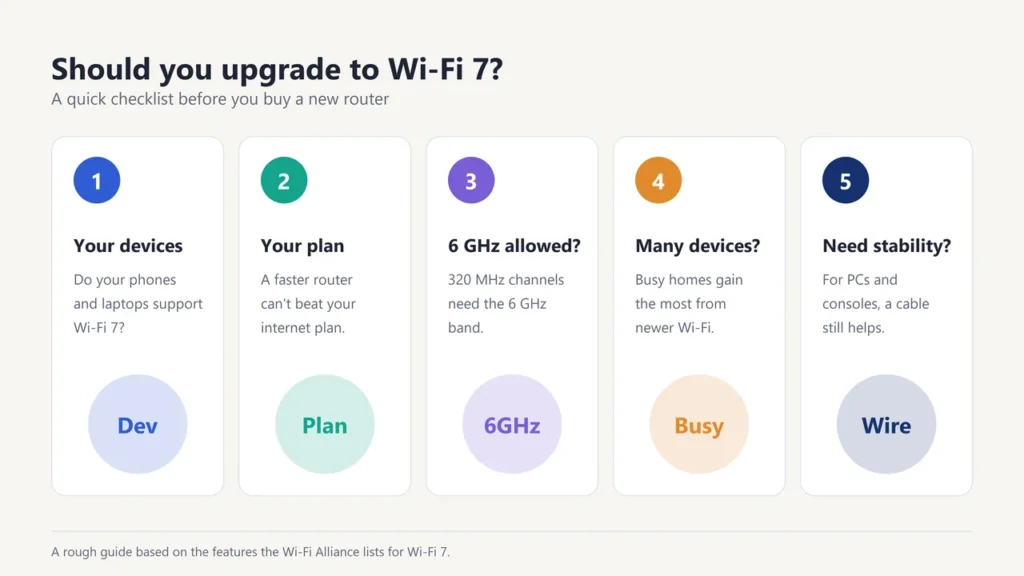
As a rough guide, upgrading to Wi-Fi 7 makes sense if most of these are true:
- Your newest phones, laptops or consoles support Wi-Fi 7
- Your internet plan is faster than about 1 Gbps, or you move big files inside your home
- Your country allows Wi-Fi in the 6 GHz band
- You have many busy devices, or your current router is old and struggling
Staying on Wi-Fi 6 makes sense if your devices are mostly Wi-Fi 6 or older, your plan is a few hundred Mbps, and your current network works well. If your problem is weak signal in far rooms, moving the router or adding a mesh system may help more than a new Wi-Fi generation. And for the most stable link to a desktop PC or games console, a cable still helps. See Wi-Fi vs Ethernet.
What comes after Wi-Fi 7?
Wi-Fi 8 is being developed now. The Wi-Fi Alliance lists Wi-Fi 8 (IEEE 802.11bn) as current work, focused on “ultra-high reliability”. The IEEE project, started in September 2023, aims for 25% more throughput and 25% lower delay in the slowest moments. There is no official launch date yet, so don’t wait for it if you need a new router today.
Whatever you choose, keep your network secure. Read how to know if your Wi-Fi is secure, and if you’re shopping, compare models in our best Wi-Fi routers list.
For wired connections, our guide to USB-C vs Thunderbolt compares port speeds from 480 Mbps to 120 Gbps.
Frequently asked questions
What is the main difference between Wi-Fi 6 and Wi-Fi 7?
Wi-Fi 7 adds 320 MHz channels in the 6 GHz band, Multi-Link Operation (using several bands at once) and 4K QAM. Wi-Fi 6 tops out at 160 MHz channels and 1024 QAM, and uses one link at a time.
Is Wi-Fi 6E better than Wi-Fi 6?
It has the same features, plus access to the 6 GHz band, which is less crowded. That helps only if your devices support 6E and your country allows 6 GHz Wi-Fi.
Do I need a Wi-Fi 7 phone to use a Wi-Fi 7 router?
No, older phones still connect. But to get Wi-Fi 7 features such as MLO and 320 MHz channels, the phone must support Wi-Fi 7 too.
What is the maximum speed of Wi-Fi 7?
The Wi-Fi Alliance does not give one figure. It describes “multigigabit” speeds. The IEEE 802.11be standard was designed for a maximum throughput of at least 30 Gbit/s in lab terms. Real speeds at home are far lower and depend on your devices, distance and internet plan.
Is Wi-Fi 7 802.11be?
Yes. Wi-Fi 7 is the consumer name for products based on IEEE 802.11be (“Extremely High Throughput”). Wi-Fi 6 is 802.11ax, and Wi-Fi 5 is 802.11ac.
Does Wi-Fi 7 work without the 6 GHz band?
Yes. Wi-Fi 7 works across 2.4 GHz, 5 GHz and 6 GHz. The Wi-Fi Alliance says Wi-Fi 7 improves performance across the 2.4 GHz, 5 GHz and 6 GHz bands. Without 6 GHz, you lose the 320 MHz channels.

Justwebworld has published guides since 2012. How we write and update articles Report an error
