

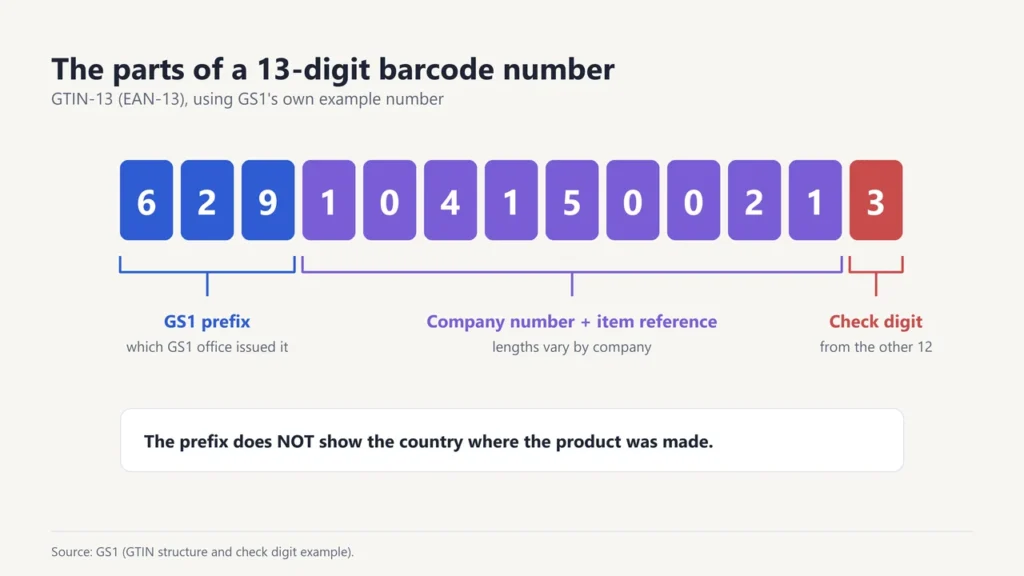
The numbers under a barcode are the product’s GTIN (Global Trade Item Number), a unique ID for that exact item. On a typical 13-digit barcode, the first digits are a GS1 prefix, the middle digits identify the company and the product, and the last digit is a check digit. The prefix does not tell you which country the product was made in.
That last point surprises many shoppers. GS1, the global organisation that manages barcode numbers, states plainly that the prefix “does not show the country of origin”. This guide explains what each part of a barcode number means, what the first digits really tell you, how to check that a barcode is valid, and what the numbers on fruit stickers mean.
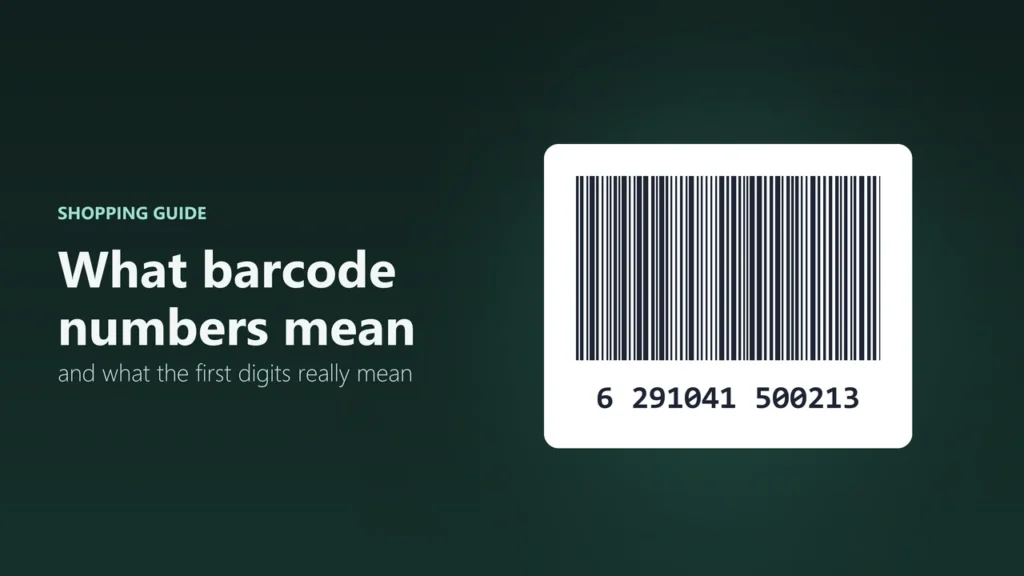
- GTIN: the product’s unique number, shown under the barcode
- First 3 digits: the GS1 office that issued the number, not the country of manufacture
- Middle digits: the company and the specific product
- Last digit: a check digit that catches scanning errors
- Fruit stickers: 4-digit PLU codes; a 5-digit code starting with 9 means organic
The parts of a barcode number
Most retail products outside North America carry a 13-digit number, called EAN-13 or GTIN-13. In the US and Canada, many products use a 12-digit UPC. Both are part of the same GS1 system.
| Part | What it means |
|---|---|
| GS1 prefix (usually the first 3 digits) | Which GS1 member organisation issued the number |
| Company number | The brand owner that registered with GS1 |
| Item reference | The specific product, size or flavour |
| Check digit (last digit) | A number calculated from the others, to catch errors |
Does a barcode show the country of origin?
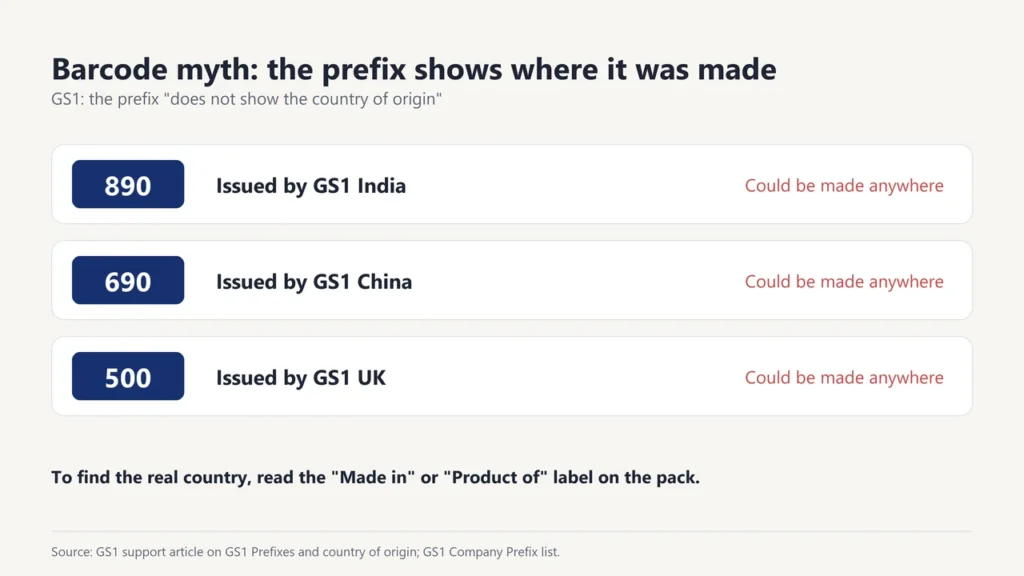
No. This is one of the most common barcode myths. According to GS1, the prefix is simply the code of the GS1 member organisation that allocated the number. The product “may have been produced anywhere in the world”. A company registered with GS1 in one country can make its products somewhere else entirely.
So a barcode starting with 890 (GS1 India) or 690 (GS1 China) tells you where the number was registered, not where the item was made. To find the real country of origin, read the “Made in” or “Product of” label on the pack.
Barcode prefix list: common examples
| Prefix | Issued by |
|---|---|
| 001 to 019, 030 to 039, 060 to 139 | GS1 US |
| 300 to 379 | GS1 France |
| 400 to 440 | GS1 Germany |
| 450 to 459, 490 to 499 | GS1 Japan |
| 500 to 509 | GS1 UK |
| 690 to 699 | GS1 China |
| 754 to 755 | GS1 Canada |
| 800 to 839 | GS1 Italy |
| 840 to 849 | GS1 Spain |
| 890 | GS1 India |
| 930 to 939 | GS1 Australia |
Special prefixes you might see
- 978 or 979: books. GS1 calls this range “Bookland”; these barcodes carry the book’s ISBN.
- 977: serial publications such as magazines (ISSN).
- 200 to 299: restricted circulation numbers, used inside a store or region, for example on items a shop weighs and prices itself.
- 980: refund receipts. 981 to 983 and 99: coupons.
How to check if a barcode is valid
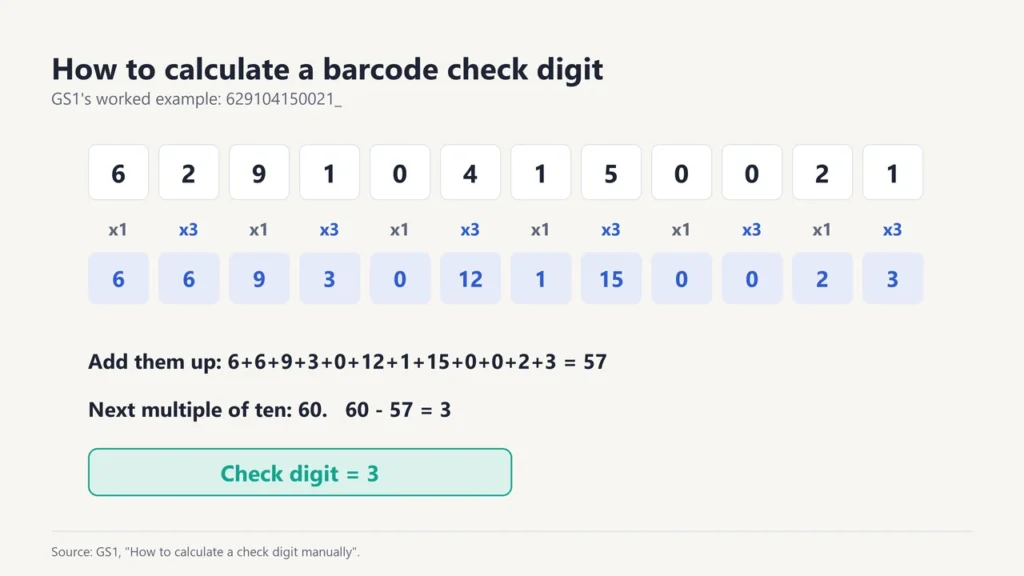
The last digit is calculated from all the others, so you can check a barcode by hand. GS1 gives this method and example for a 13-digit number, 629104150021_:
- Multiply the digits alternately by 1 and 3, starting with 1 on the first digit: 6×1, 2×3, 9×1, 1×3, and so on.
- Add up the results. In GS1’s example, the total is 57.
- Subtract the total from the next multiple of ten. 60 − 57 = 3, so the check digit is 3, and the full number is 6291041500213.
If your answer doesn’t match the last digit printed on the pack, the number has been mistyped or the barcode isn’t genuine. A valid check digit doesn’t prove the product is authentic, though. It only shows the number is correctly formed.
What the numbers on fruit stickers mean
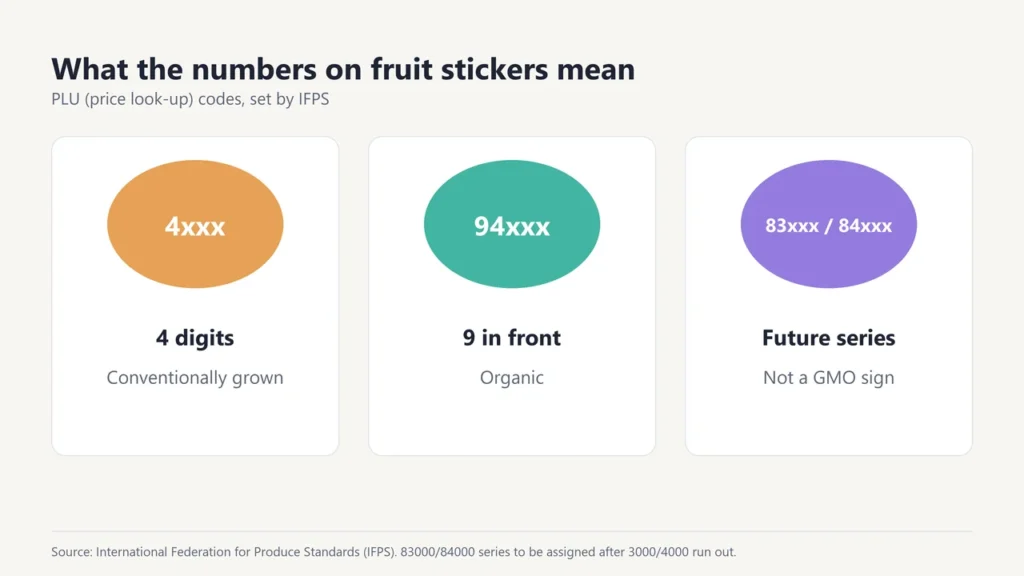
Stickers on loose fruit and vegetables carry PLU (price look-up) codes, managed by the International Federation for Produce Standards (IFPS). According to IFPS:
- 4 digits (in the 3000 and 4000 series): conventionally grown produce.
- A 9 in front, making 5 digits: organic. So if a conventional item is 4xxx, its organic version is 94xxx.
- 83000 and 84000 series: IFPS says these will be assigned once the 3000 and 4000 series run out. A code starting with 8 is not a sign of genetic modification.
Running a shop or small business? See our guides to barcode solutions for small businesses and how barcode scanners make life easier. Curious about other labels? Read what thread count means on bed sheets.
Frequently asked questions
What do the numbers on a barcode mean?
They form the product’s GTIN: a GS1 prefix, a company number, an item reference and a check digit at the end.
Does 890 on a barcode mean made in India?
No. 890 means the number was issued by GS1 India. GS1 says the prefix does not show the country of origin, so check the “Made in” label instead.
Can a barcode tell me where a product was made?
No. A barcode identifies the product and the company that registered it, not the place of manufacture.
What is the difference between UPC and EAN?
UPC is a 12-digit format common in the US and Canada; EAN is the 13-digit format used in most other countries. Both are GS1 GTINs.
What does a 5-digit sticker starting with 9 mean on fruit?
It means the produce is organic. IFPS adds a 9 in front of the 4-digit code for conventionally grown produce.
Why do books have barcodes starting with 978?
GS1 reserves 978 and 979 for books, a range it calls “Bookland”. The barcode contains the book’s ISBN.

Justwebworld has published guides since 2012. How we write and update articles Report an error
