

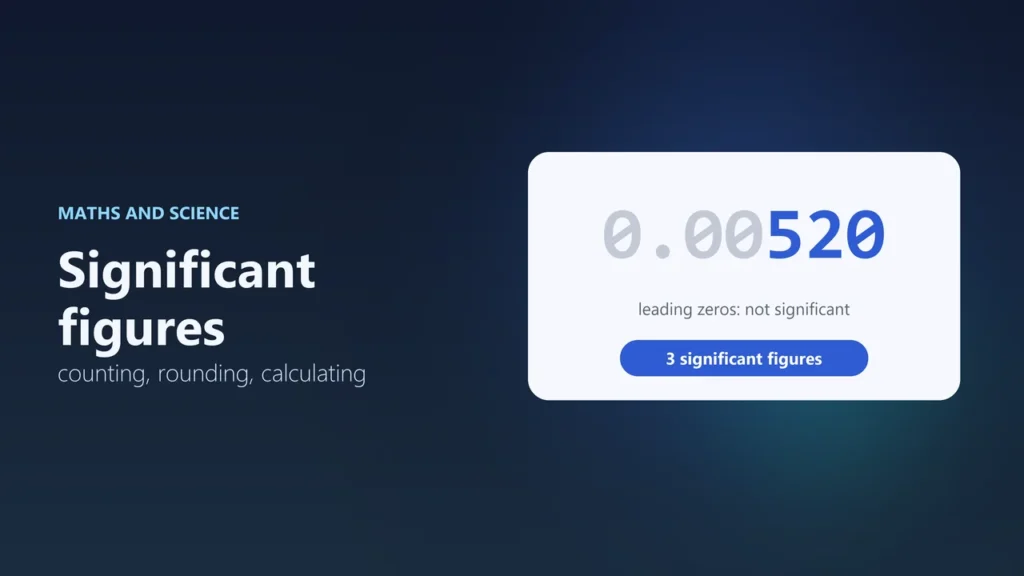
Significant figures (often called “sig figs”) are the digits in a number that carry real meaning about how precisely it was measured. The rules are simple: all non-zero digits count, zeros between them count, leading zeros never count, and trailing zeros count only when there is a decimal point. So 0.00520 has 3 significant figures (5, 2 and the last 0), and 1,002 has 4.
When you calculate, the answer cannot be more precise than your data. In multiplication and division, keep as many significant figures as the least precise number. In addition and subtraction, keep as many decimal places as the number with the fewest. This guide explains each rule with worked examples, shows two different ways to round a 5, and covers how to round to significant figures in a spreadsheet.
- Non-zero digits are always significant: 4.56 has 3.
- Zeros between non-zero digits are significant: 1,002 has 4.
- Leading zeros are never significant: 0.0052 has 2.
- Trailing zeros after a decimal point are significant: 4.700 has 4.
- Trailing zeros in a whole number with no decimal point are not counted by the usual rule: 1,200 has 2. Write 1.200 × 10³ if you mean 4.
What are significant figures?
Significant figures are the digits you are sure of, plus the first digit that is uncertain. They tell the reader how precise a measurement is.
Here is the idea in a real case. India’s Class 11 physics textbook (NCERT, “Units and Measurement”) gives this example: a pendulum swings once every 1.62 seconds. The 1 and the 6 are certain. The 2 is the first uncertain digit. So the value has 3 significant figures.
The US National Institute of Standards and Technology (NIST) puts it even more simply in its Guide for the Use of the SI (Special Publication 811): a digit is significant if it is needed to express the value. Writing more digits than you really measured is not “more accurate”. It is misleading, because it claims a precision you do not have.
How to count significant figures: the 5 rules
Read the number from left to right. Start counting at the first non-zero digit. Then apply these rules to any zeros you meet.
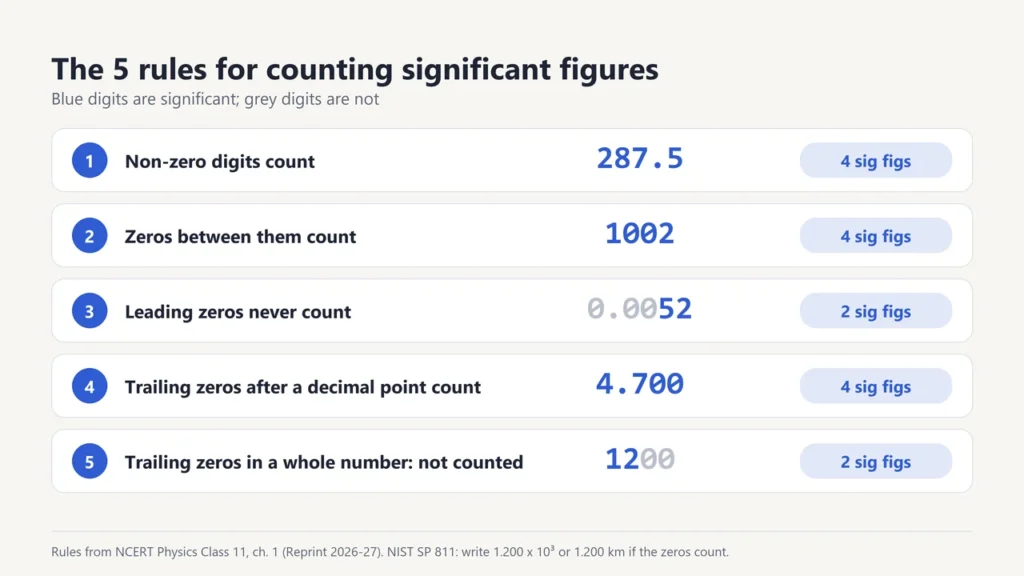
Rule 1: Non-zero digits always count
Every digit from 1 to 9 is significant. 287.5 has 4 significant figures. 7.94 has 3.
Rule 2: Zeros between non-zero digits count
These are sometimes called “captive” or “sandwiched” zeros. They always count, wherever the decimal point is. 2.308 has 4 significant figures, and so does 1,002.
Rule 3: Leading zeros never count
Zeros before the first non-zero digit only show where the decimal point is. In 0.002308, the three zeros at the front are not significant, so the number has 4 significant figures (2, 3, 0, 8). The zero you write in front of the decimal point in a number like 0.1250 is never significant either.
A good test: change the unit. NCERT’s textbook shows that 2.308 cm is the same as 0.02308 m or 23.08 mm. All three have 4 significant figures. Changing the unit moves the decimal point, but it cannot change how precisely you measured.
Rule 4: Trailing zeros after a decimal point count
If a number has a decimal point, zeros at the end are significant. 3.500 has 4 significant figures, and so does 0.06900. The person who wrote 4.700 m chose to write those zeros. If they were not measured, the value would simply be 4.7 m.
Rule 5: Trailing zeros in a whole number are not counted
In a whole number with no decimal point, zeros at the end are not counted by the usual school rule. So 123 m written as 12300 cm still has 3 significant figures.
But this is the one rule that can mislead. NIST’s guide points out that in “1200 m” you cannot tell whether the two zeros were measured or are only there to show the size of the number. The fix is to write the number another way:
- Use scientific notation: 1.200 × 10³ m has 4 significant figures, and 1.2 × 10³ m has 2.
- Use a bigger unit: NIST’s example is 1.200 km, where the two zeros are clearly significant.
Our guide to scientific notation explains how to write any number in this form, and the guide to metric prefixes lists the units, like kilo and milli, that do the same job.
Practice: how many significant figures?
| Number | Significant figures | Why |
|---|---|---|
| 4.56 | 3 | All non-zero digits |
| 1,002 | 4 | Zeros between non-zero digits count |
| 0.0052 | 2 | Leading zeros do not count |
| 0.00520 | 3 | Trailing zero after the decimal point counts |
| 4.700 | 4 | Trailing zeros after the decimal point count |
| 1,200 | 2 (usual rule) | Trailing zeros with no decimal point are not counted |
| 1.200 × 10³ | 4 | Every digit written before the “× 10” counts |
| 100 | 1 (usual rule) | Write 1.00 × 10² if you mean 3 |
Exact numbers have unlimited significant figures
Significant figures only apply to measured or rounded values. Counted and defined numbers are exact. They never limit the precision of your answer.
- Counted numbers: 12 eggs, 30 students.
- Numbers in a formula: the 2 in “circumference = 2πr” is exact. NCERT notes it can be written as 2.0, 2.00 or 2.0000 as needed.
- Defined conversions: 1 inch is exactly 2.54 cm, and 1 foot is exactly 0.3048 m.
Constants like π are known to many digits. Use enough of them (3.142 or 3.14159) that they do not become the least precise number in your calculation.
Significant figures in calculations
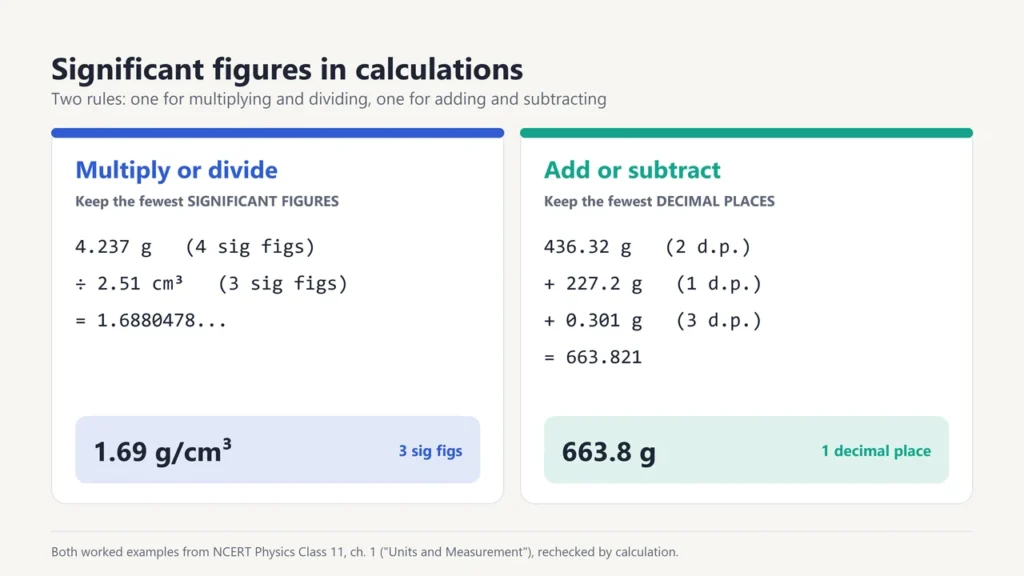
There are two rules, and the most common mistake is mixing them up. Multiplication and division use significant figures. Addition and subtraction use decimal places.
Multiplying and dividing
Keep as many significant figures as the number with the fewest significant figures.
NCERT’s example: an object has a mass of 4.237 g (4 significant figures) and a volume of 2.51 cm³ (3 significant figures). A calculator gives the density as 1.6880478… g/cm³. The volume has only 3 significant figures, so the answer is 1.69 g/cm³.
Adding and subtracting
Keep as many decimal places as the number with the fewest decimal places.
NCERT’s example: 436.32 g + 227.2 g + 0.301 g = 663.821 g. The least precise value, 227.2 g, has only 1 decimal place. So the answer is 663.8 g. If you wrongly used the significant-figure rule here, you would write 664 g and throw away real information.
Subtraction can lose significant figures fast. 0.307 m − 0.304 m = 0.003 m. Both inputs have 3 significant figures, but the answer has only 1.
Multi-step calculations
Do not round after every step. Small rounding errors add up. NCERT advises keeping one extra digit in the middle steps. NIST’s good practice guide for laboratories (GLP 9, 2019) goes further: do not round intermediate values at all, and round only the final result. If you use a calculator or spreadsheet, keep the full value in memory and round once at the end.
Unit conversions
When you convert units, round the answer so it keeps about the same precision as the original. NIST’s guide gives this example: 36 ft × 0.3048 m/ft = 10.9728 m, which it rounds to 11.0 m.
Why 11.0 and not 11? The value “36” could be anything from 35.5 to 36.5, an uncertainty of about ±1.4%. “11” would suggest about ±4.5%, losing information. “11.0” suggests about ±0.45%, which keeps it. Our long ton vs short ton guide uses exact conversion factors in the same way.
How to round to significant figures
To round to a set number of significant figures, count that many digits from the first non-zero digit. Then look at the next digit to decide whether to round up.
- Find the first non-zero digit. That is significant figure number 1.
- Count along to the last digit you want to keep.
- Look at the next digit. If it is less than 5, leave the last digit alone. If it is more than 5, add 1 to it.
- Replace the dropped digits with zeros if they are before the decimal point. Simply remove them if they are after it.
| Number | 1 sig fig | 2 sig figs | 3 sig figs |
|---|---|---|---|
| 45,678 | 50,000 | 46,000 | 45,700 |
| 3.14159 | 3 | 3.1 | 3.14 |
| 0.004567 | 0.005 | 0.0046 | 0.00457 |
Note the problem in the first row. “50,000” and “46,000” end in zeros that are not significant, so a reader cannot see how you rounded. If it matters, write 5 × 10⁴ or 4.6 × 10⁴ instead.
What if the next digit is exactly 5?
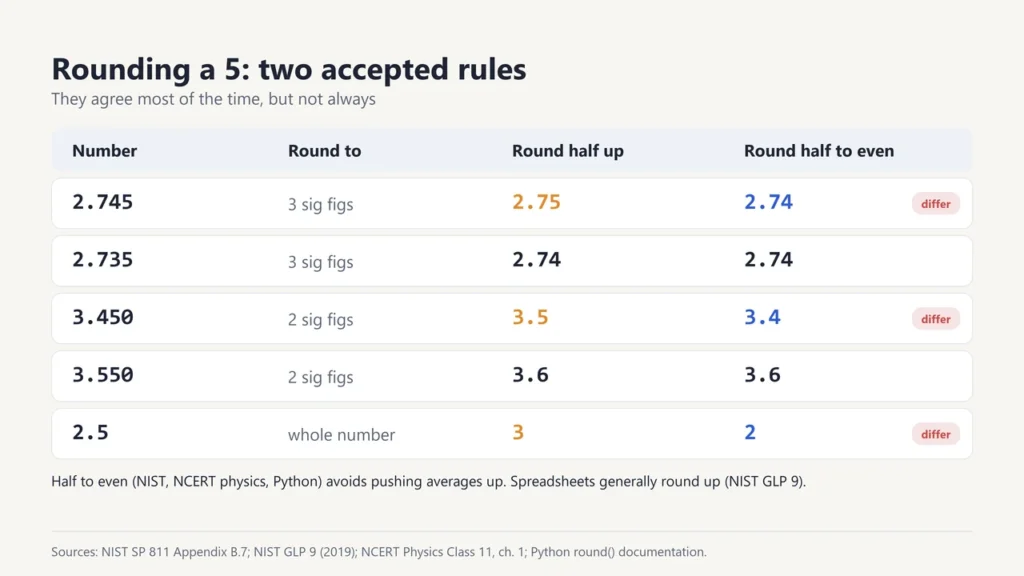
There are two accepted rules, and they give different answers. Use the one your teacher, exam board or lab asks for.
- Round half up: a 5 always rounds up. 2.745 to 3 significant figures becomes 2.75. This is the rule most people learn first. NIST’s GLP 9 says standard spreadsheet rounding “will generally round up”.
- Round half to even: if the digit you keep is even, leave it; if it is odd, round up. 2.745 becomes 2.74, but 2.735 also becomes 2.74. Both NIST SP 811 and NCERT’s physics textbook give this rule, and NIST’s GLP 9 calls it the even/odd method.
Why would anyone round a 5 down? NIST’s GLP 9 explains the reason. Of the nine possible dropped digits from 1 to 9, rounding up happens for five of them (5 to 9) but rounding down for only four (1 to 4). Over thousands of values, always rounding a 5 up pushes averages slightly too high. Rounding to even balances it out.
One more detail from NIST: the rule only applies when the dropped part is exactly 5. If any digit after the 5 is greater than zero, as in 2.7451, always round up (to 2.75).
Significant figures vs decimal places
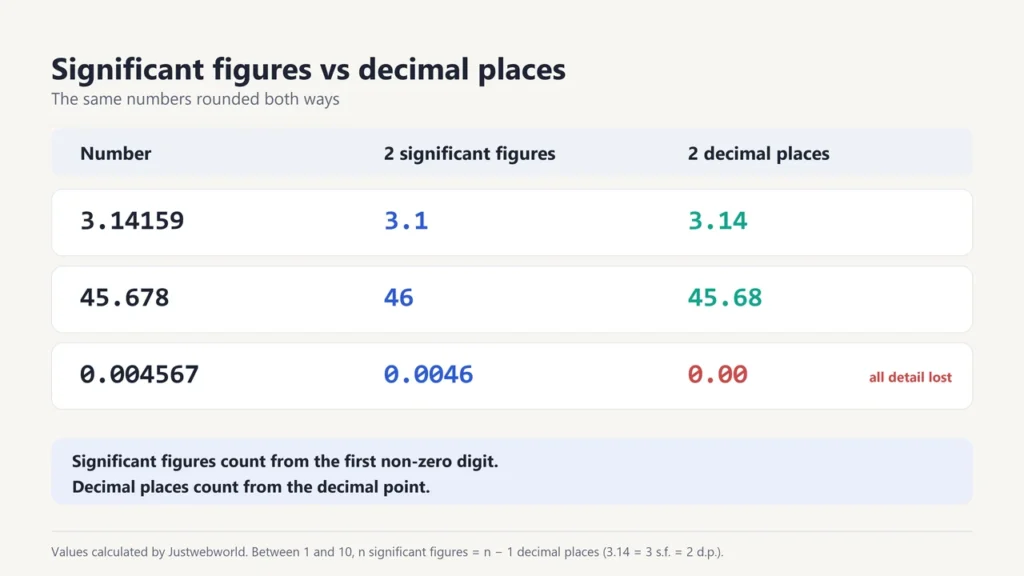
Significant figures count from the first non-zero digit. Decimal places count from the decimal point. For numbers between 1 and 10 they line up neatly: 3 significant figures is the same as 2 decimal places (3.14). For other numbers they can be very different.
| Number | Rounded to 2 significant figures | Rounded to 2 decimal places |
|---|---|---|
| 3.14159 | 3.1 | 3.14 |
| 45.678 | 46 | 45.68 |
| 0.004567 | 0.0046 | 0.00 |
The last row shows why scientists prefer significant figures for very small values. Rounding 0.004567 to 2 decimal places leaves 0.00, which tells you nothing.
How to round to significant figures in Excel, Google Sheets and Python
Spreadsheets have no built-in “significant figures” button, but their ROUND function can do it. Microsoft’s documentation explains that ROUND rounds to decimal places when the second number is positive, and to the left of the decimal point (tens, hundreds, thousands) when it is negative. Combine that with a base-10 logarithm, which finds the size of the number:
=ROUND(A1, 3-1-INT(LOG10(ABS(A1))))This rounds the value in cell A1 to 3 significant figures. Change the 3 to any number you need. We checked it by hand: for 45,678 and 2 significant figures, LOG10 gives 4.66, INT makes it 4, and the formula becomes ROUND(45678, −3) = 46,000. For 0.004567 it becomes ROUND(0.004567, 4) = 0.0046. The formula gives an error if the cell is 0, because the logarithm of 0 does not exist.
Python’s built-in round() function uses the other rule for a 5. Python’s documentation says that when two values are equally close, it rounds to the even one, so round(2.5) gives 2 and round(3.5) gives 4. The documentation also warns that round(2.675, 2) gives 2.67, not 2.68. This is not a bug. Computers store most decimals as very close binary fractions, and 2.675 is stored as a value just below 2.675.
Common significant figure mistakes
- Copying every digit from the calculator. 1.6880478 g/cm³ looks precise but claims far more than you measured.
- Counting leading zeros. 0.0045 has 2 significant figures, not 5.
- Dropping zeros you measured. If a scale shows 2.50 g, write 2.50 g, not 2.5 g.
- Using the multiplication rule for addition. Addition and subtraction go by decimal places.
- Rounding in every step. Round once, at the end.
- Letting exact numbers limit the answer. The 2 in 2πr, or 12 in “a dozen”, has no limit on precision.
Frequently asked questions
Is zero a significant figure?
Sometimes. Zeros between non-zero digits are significant (1,002), and zeros at the end of a number with a decimal point are significant (4.700). Leading zeros (0.005) are never significant. Trailing zeros in a whole number (1,200) are not counted by the usual rule.
How many significant figures does 100 have?
By the usual rule, 1, because trailing zeros in a whole number are not counted. NIST notes that you really cannot tell from the number alone. Write 1.00 × 10² to show 3 significant figures, or 1.0 × 10² to show 2.
How many significant figures does 0.0050 have?
2. The leading zeros do not count, the 5 counts, and the final zero counts because the number has a decimal point.
How do you round to 3 significant figures?
Count 3 digits from the first non-zero digit, then look at the fourth. If it is 5 or more, round the third digit up (but check which rule you use for exactly 5). So 3.14159 becomes 3.14, and 45,678 becomes 45,700.
What is the rule for significant figures in addition?
For addition and subtraction, keep as many decimal places as the number with the fewest decimal places. For example, 436.32 + 227.2 + 0.301 = 663.8, because 227.2 has only 1 decimal place.
Do exact numbers affect significant figures?
No. Counted numbers (like 12 eggs) and defined numbers (like 1 inch = 2.54 cm) are exact. They have unlimited significant figures and never limit the answer.
Why do some people round 2.5 down to 2?
They use “round half to even”, which NIST and many science courses use to avoid bias. A 5 rounds to whichever neighbour is even, so 2.5 becomes 2 and 3.5 becomes 4. Python’s round() function works this way too.

Justwebworld has published guides since 2012. How we write and update articles Report an error
