

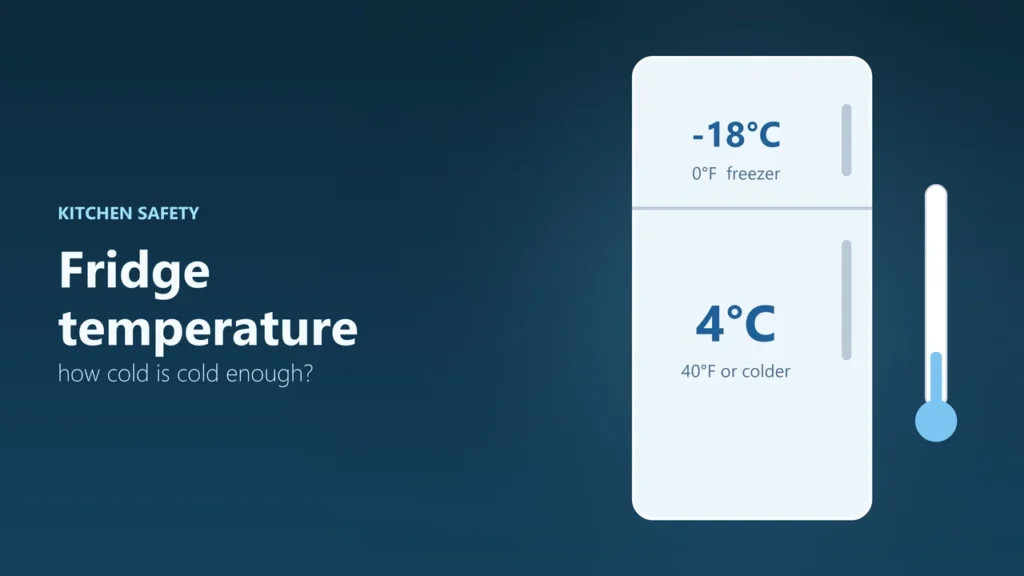
Your fridge should be at 4°C (40°F) or colder, and your freezer at -18°C (0°F). That is the advice from the US FDA and USDA and from Health Canada. The UK Food Standards Agency says to keep a fridge between 0 and 5°C, and Australia and New Zealand say 5°C or colder. A thermometer reading of about 3.5 to 4°C (38 to 39°F) meets all of these at once.
Cold slows down the bacteria that cause food poisoning, but only if your fridge is really as cold as you think. The numbers on the dial (1 to 5, or 1 to 7) are not degrees, so the only way to know is to measure. This guide shows the safe temperatures, how to check yours, what the dial numbers mean, and where to put food so it stays cold.
Safe fridge and freezer temperatures by country
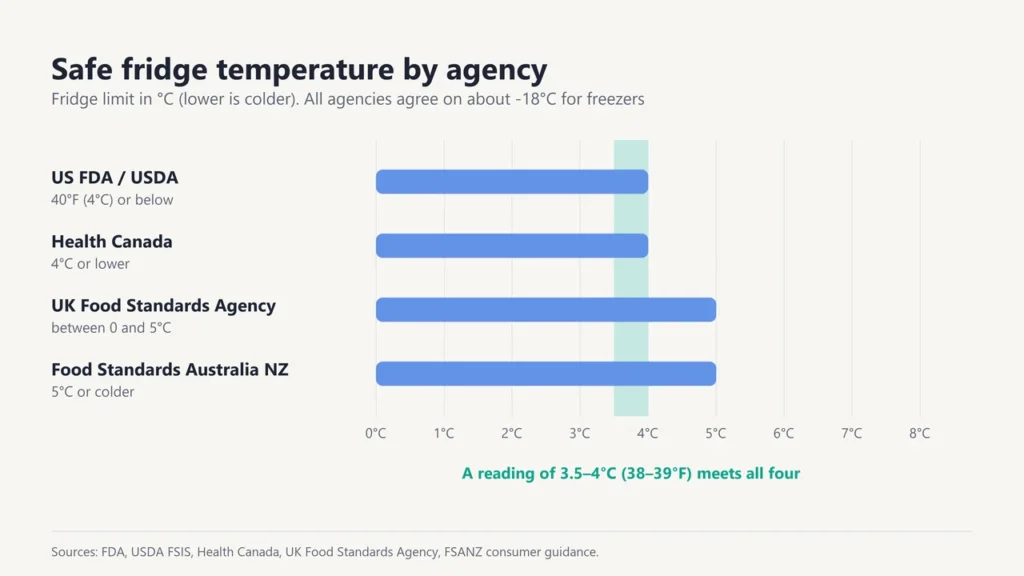
Food safety agencies agree closely. The small differences come from rounding and from how each one sets its limit.
| Agency | Fridge | Freezer |
|---|---|---|
| US FDA and USDA | 40°F (4°C) or below | 0°F (-18°C) |
| Health Canada | 4°C (40°F) or lower | -18°C (0°F) or lower |
| UK Food Standards Agency | Between 0 and 5°C | Around -18°C |
| Food Standards Australia New Zealand | 5°C or colder | Keep food frozen (no figure given on its consumer page) |
Why -18°C for the freezer? The UK Food Standards Agency calls the freezer a “pause button”. At -18°C most bacteria cannot grow, but they are not killed. They can start growing again as food thaws. The FDA says food kept at 0°F (-18°C) stays safe, but its quality drops the longer it is stored.
What is the temperature danger zone?
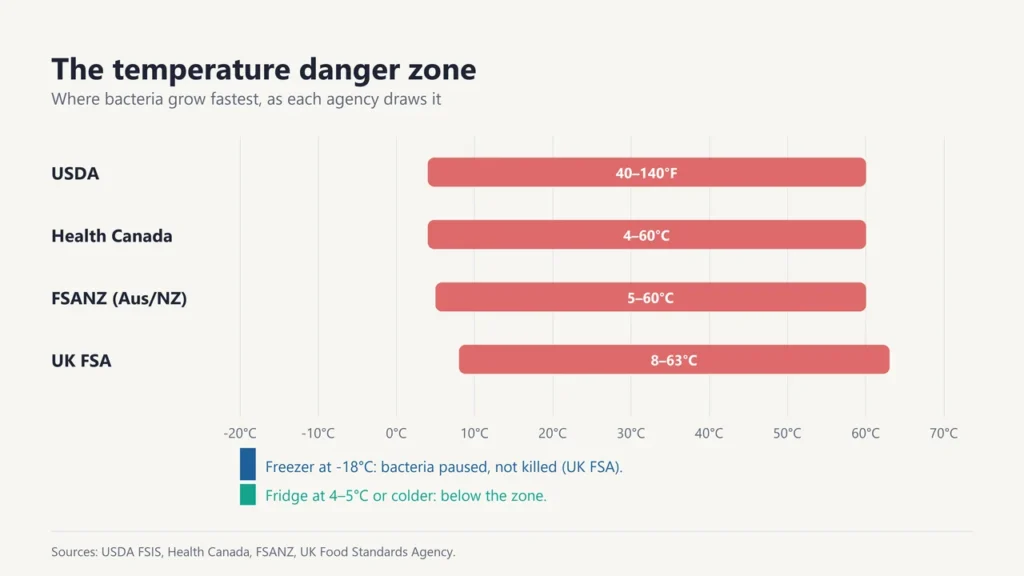
The danger zone is the range where bacteria grow fastest. Each agency draws it a little differently:
- USDA: 40°F to 140°F (4°C to 60°C). Its appliance thermometer guide says harmful bacteria “multiply rapidly” in this range and grow very slowly below 40°F.
- Health Canada: 4°C to 60°C (40°F to 140°F).
- Food Standards Australia New Zealand: 5°C to 60°C.
- UK Food Standards Agency: 8°C to 63°C.
The message is the same everywhere: keep cold food cold. A fridge that drifts up to 7 or 8°C is no longer doing its job, even if the food still feels cold to touch.
How to check your fridge temperature
Use an appliance thermometer. The FDA says this is the best way to know your fridge and freezer temperatures, and that few fridge controls show the real temperature. The USDA says appliance thermometers are made to be accurate at cold temperatures.
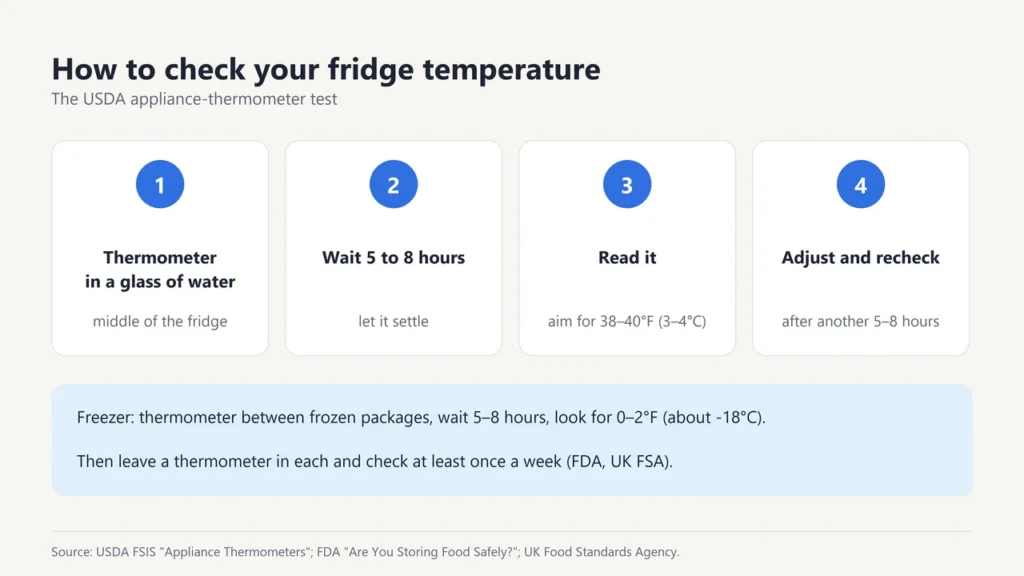
The USDA gives this simple test:
- Fridge: put the thermometer in a glass of water in the middle of the fridge.
- Wait 5 to 8 hours.
- Read it. If it is not 38 to 40°F (about 3 to 4°C), adjust the fridge control.
- Check again after another 5 to 8 hours. Fridges take time to settle after a change.
- Freezer: put the thermometer between frozen food packages, wait 5 to 8 hours, and look for 0 to 2°F (about -18 to -17°C).
After that, you can leave a thermometer in each one. The FDA suggests putting it at the front, where it is easy to read, and checking at least once a week. The UK Food Standards Agency also says to check once a week.
What do the numbers on a fridge dial mean?
The numbers on a dial (such as 1 to 5, 1 to 7 or 1 to 9) are power settings, not degrees. The UK Food Standards Agency describes the dial as a way to change the fridge’s power setting. A “4” does not mean 4°C.
Which way is colder depends on the make and model, so check your manual. Then use a thermometer to find the setting that gives you 0 to 5°C (or 40°F or below). If your fridge has a digital display, still check it with a thermometer now and then.
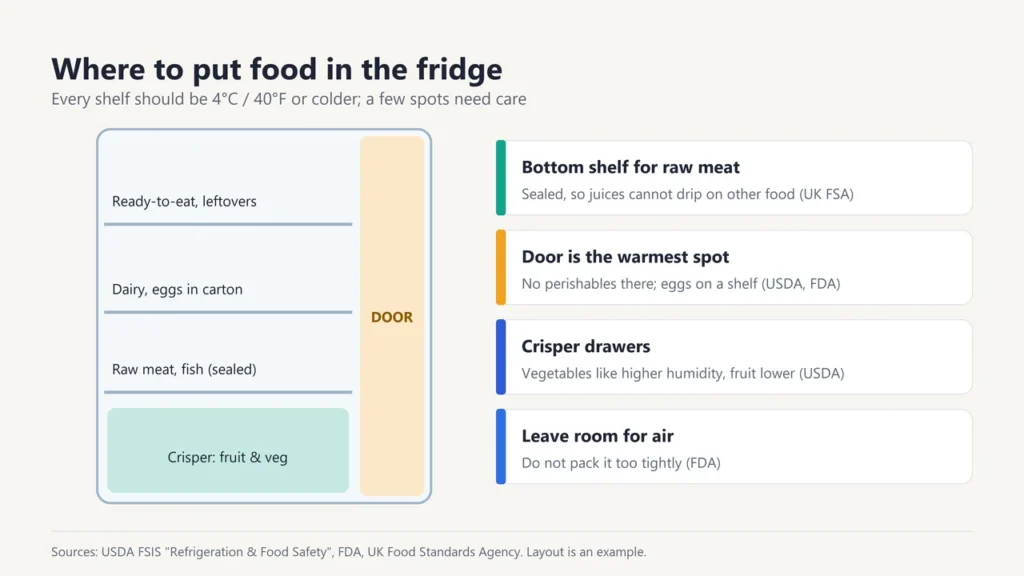
Where to put food in the fridge
The USDA says the whole fridge should be at 40°F or below, so any shelf is safe for any food when the fridge is cold enough. Still, a few places need care:
- Bottom shelf: raw meat, poultry and fish, in sealed containers or their packaging. The UK Food Standards Agency says this stops raw juices dripping onto other food.
- Door: the warmest and least steady spot. The USDA says not to store perishable food in the door, because its temperature changes more. The FDA says to keep eggs in their carton on a shelf, not in the door.
- Crisper drawers: fruit and vegetables. The USDA notes that vegetables like higher humidity and fruit likes lower humidity.
- Leave space: the FDA says not to pack the fridge or freezer so tightly that air cannot move around.
Can you put hot food in the fridge?
Agencies give slightly different advice here. The USDA says hot food can go straight into the fridge, or be cooled quickly in an ice or cold water bath first. The UK Food Standards Agency says not to put hot food in, but to let it cool and put it in the fridge within one to two hours.
Both agree on the important part: cool food quickly and get it cold within about two hours. Splitting a big pot of soup or stew into small, shallow containers is the easiest way to do that. For how long cooked food then stays safe, read how long leftovers last in the fridge.
What to do in a power cut
- Keep the doors shut. The FDA says an unopened fridge keeps food cold for about 4 hours. A full freezer holds its temperature for about 48 hours if the door stays closed.
- Check the thermometer when the power returns. The USDA says food is safe if the fridge is still at 40°F (4°C) and the freezer at 0°F (-18°C) or below.
- Throw out risky food. The USDA says food held above 40°F for more than 2 hours should not be eaten. If you are not sure, throw it out.
Simple habits that keep your fridge cold
- Close the door quickly. The UK Food Standards Agency says an open door makes the fridge work harder to cool down again.
- Clear out food that is past its best once a week. The USDA suggests a weekly check, and a rough limit of 4 days for cooked leftovers.
- Wipe up spills straight away with hot, soapy water, then rinse.
- Store fresh produce the right way so it lasts longer. See our guides to storing fresh herbs, garlic and ginger.
Frequently asked questions
What temperature should a fridge be in Celsius?
4°C or colder in the US and Canada, between 0 and 5°C in the UK, and 5°C or colder in Australia and New Zealand. A reading of about 3.5 to 4°C meets all of them.
What temperature should a fridge be in Fahrenheit?
40°F or below. When testing with a thermometer, the USDA says to aim for 38 to 40°F.
What temperature should a freezer be?
-18°C (0°F) or colder. That is the figure from the FDA, USDA, Health Canada and the UK Food Standards Agency.
What number should my fridge be on, 1 to 5 or 1 to 7?
There is no single right number. The dial sets the power, not the temperature, and the colder direction varies by model. Check your manual, then use a thermometer to find the setting that gives 0 to 5°C (40°F or below).
Is 7°C too warm for a fridge?
Yes. 7°C is above every agency’s limit (4°C in the US and Canada, 5°C in the UK, Australia and New Zealand). Turn the fridge colder and check again after a few hours.
Should I change my fridge setting in summer?
Only if your thermometer says so. A hot kitchen and more door opening can make a fridge run warmer, so check it more often in hot weather and adjust if it goes above your target.
Where is the coldest part of the fridge?
It varies by fridge design, so measure if you need to know. What the agencies agree on is that the door is the warmest, least steady spot, so keep milk, eggs and other perishables on the shelves instead.

Justwebworld has published guides since 2012. How we write and update articles Report an error
