

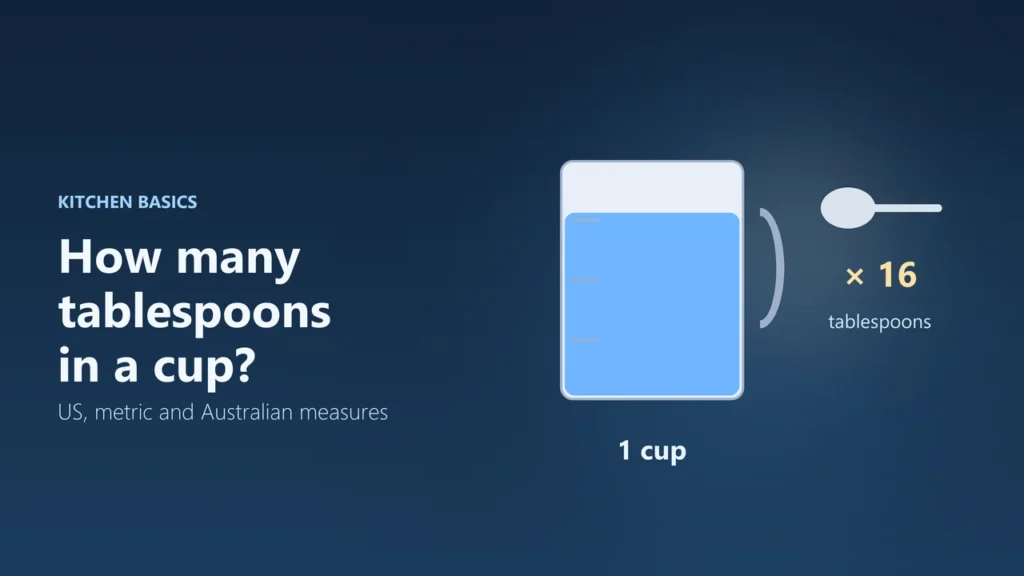
There are 16 tablespoons in 1 cup. That is the US cup used in most American recipes. The same cup also holds 48 teaspoons or 8 fluid ounces. So half a cup is 8 tablespoons, and a quarter cup is 4 tablespoons.
The catch is that a “cup” is not the same size everywhere. A US cup is about 237 mL, US food labels round it to 240 mL, and the metric cup used in many other countries is 250 mL. This guide shows every common conversion, explains why the sizes differ, and gives the weight of a cup of butter, flour and sugar. The numbers come from the US National Institute of Standards and Technology (NIST), US and Canadian food labelling rules, and the US Department of Agriculture.
Cup to tablespoon conversion chart
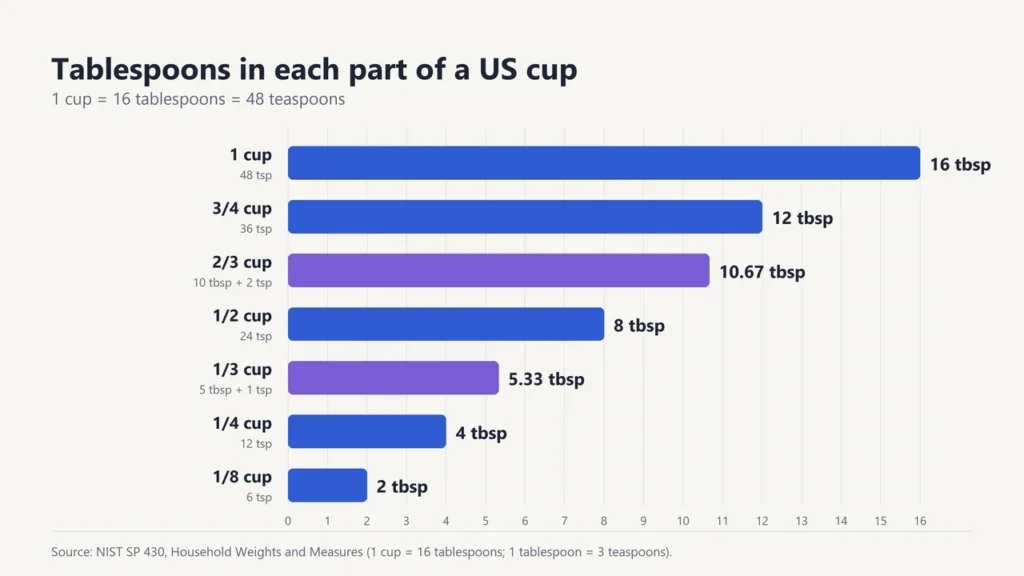
Use this chart for US recipes. One tablespoon is 3 teaspoons, so any leftover part of a tablespoon is shown in teaspoons.
| Cups | Tablespoons | Teaspoons | Fluid ounces | Millilitres (US cup) |
|---|---|---|---|---|
| 1 cup | 16 tbsp | 48 tsp | 8 fl oz | 236.6 mL |
| 3/4 cup | 12 tbsp | 36 tsp | 6 fl oz | 177.4 mL |
| 2/3 cup | 10 tbsp + 2 tsp | 32 tsp | 5 1/3 fl oz | 157.7 mL |
| 1/2 cup | 8 tbsp | 24 tsp | 4 fl oz | 118.3 mL |
| 1/3 cup | 5 tbsp + 1 tsp | 16 tsp | 2 2/3 fl oz | 78.9 mL |
| 1/4 cup | 4 tbsp | 12 tsp | 2 fl oz | 59.1 mL |
| 1/8 cup | 2 tbsp | 6 tsp | 1 fl oz | 29.6 mL |
| 1/16 cup | 1 tbsp | 3 tsp | 1/2 fl oz | 14.8 mL |
Two rows trip people up. A third of a cup is not a whole number of tablespoons: it is 5 tablespoons plus 1 teaspoon. Two-thirds of a cup is 10 tablespoons plus 2 teaspoons. If you need 3/4 cup and only have spoons, our guide to measuring 3/4 cup has more ideas.
How big is a cup? US, label and metric cups
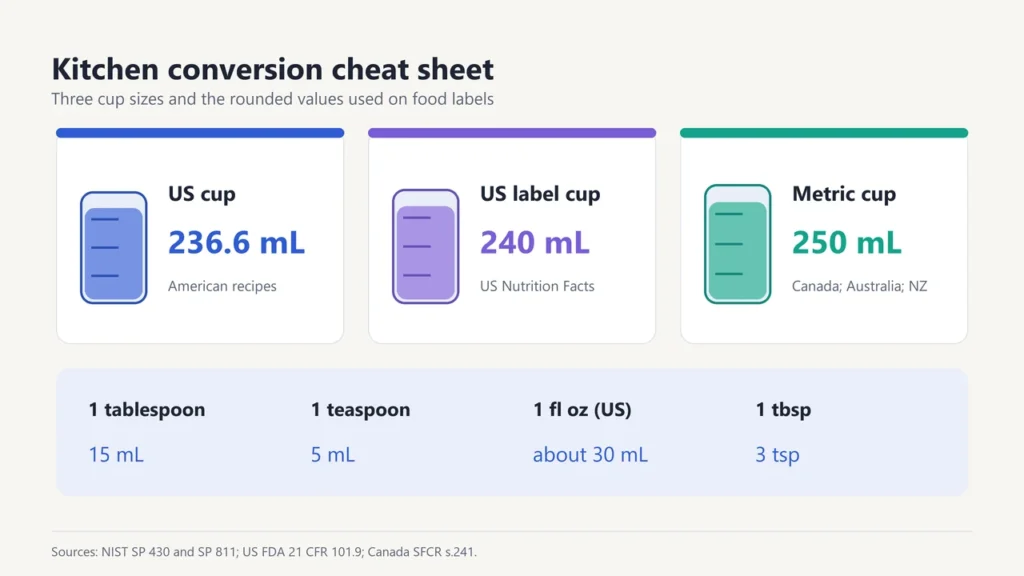
There are three cup sizes you are likely to meet. They are close, but not the same:
| Cup | Size | Where it is used |
|---|---|---|
| US customary cup | 236.6 mL (8 US fl oz) | American recipes and measuring cups |
| US food-label cup | 240 mL | Nutrition Facts serving sizes in the US |
| Metric cup | 250 mL | Canadian food labels; common in recipes from Canada, Australia and New Zealand |
The US customary cup is one-sixteenth of a US gallon. NIST gives its exact size as 236.588 mL. Most people round it to 237 mL.
The US label cup is a rounder number set by the US Food and Drug Administration (FDA). Its rule for nutrition labels says a cup means 240 mL, a tablespoon 15 mL and a teaspoon 5 mL. That is why a food label and a measuring cup can disagree by a few millilitres.
The metric cup is 250 mL. Canada’s food rules say that when a label gives servings in cups or tablespoons, one cup equals 250 mL and one tablespoon equals 15 mL. NIST notes that a recipe made with a metric cup gives only about 5 percent more food than one made with a US cup.
How many tablespoons are in a metric cup?
A 250 mL metric cup holds 16 2/3 tablespoons of 15 mL each. In practice, that is 16 tablespoons plus 2 teaspoons. The difference from the US answer of 16 is small, so most recipes still work if you swap one cup for the other, as long as you use the same cup for the whole recipe.
Australian recipes are the main exception. They often use a 20 mL tablespoon, which is 4 teaspoons, not 3. With that spoon, a 250 mL cup holds 12 1/2 tablespoons. If a recipe comes from Australia and uses a lot of tablespoons, check which spoon it means.
How big is a tablespoon and a teaspoon?
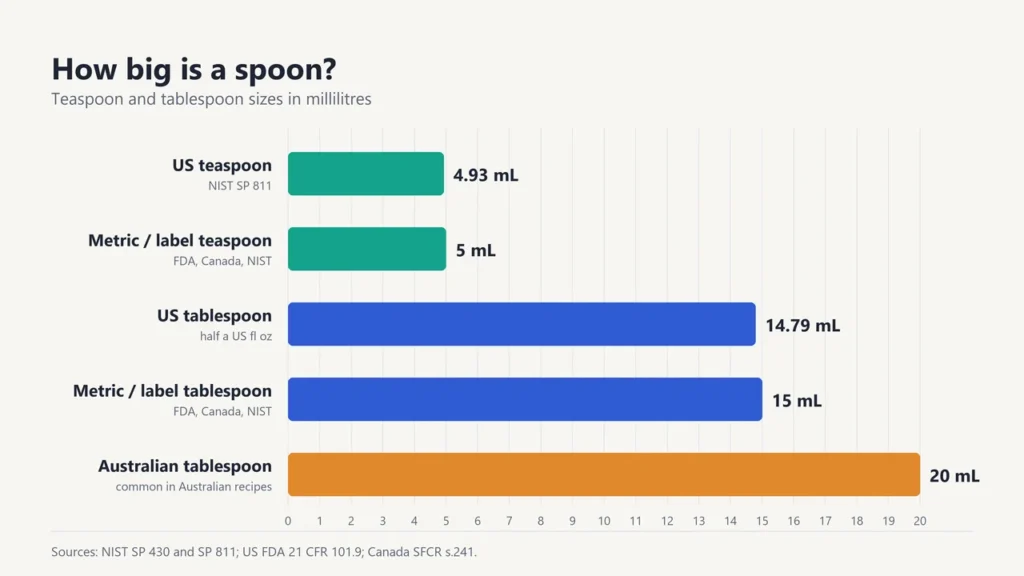
- US tablespoon: 14.79 mL, which is half a US fluid ounce (NIST SP 811).
- Metric and label tablespoon: 15 mL. This is the size used on US and Canadian food labels and in the NIST kitchen tables.
- Australian tablespoon: often 20 mL in Australian recipes.
- Teaspoon: 4.93 mL (US) or 5 mL (metric and labels). One tablespoon is 3 teaspoons in the US and metric systems.
The “milli” in millilitre means one-thousandth, so 15 mL is 15 thousandths of a litre. Our guide to metric prefixes explains how milli, centi and kilo work.
Old British recipes and the imperial fluid ounce
Older British recipes may give liquids in imperial fluid ounces or pints. An imperial fluid ounce is 28.41 mL, a little smaller than a US fluid ounce of 29.57 mL (both figures from NIST SP 811). So “8 fluid ounces” in an old British recipe is about 227 mL, not 237 mL. Many UK recipes today give grams and millilitres instead, which avoids the problem. The long ton vs short ton guide shows the same US-versus-imperial split for weight.
How many tablespoons in a cup of butter, flour or sugar?
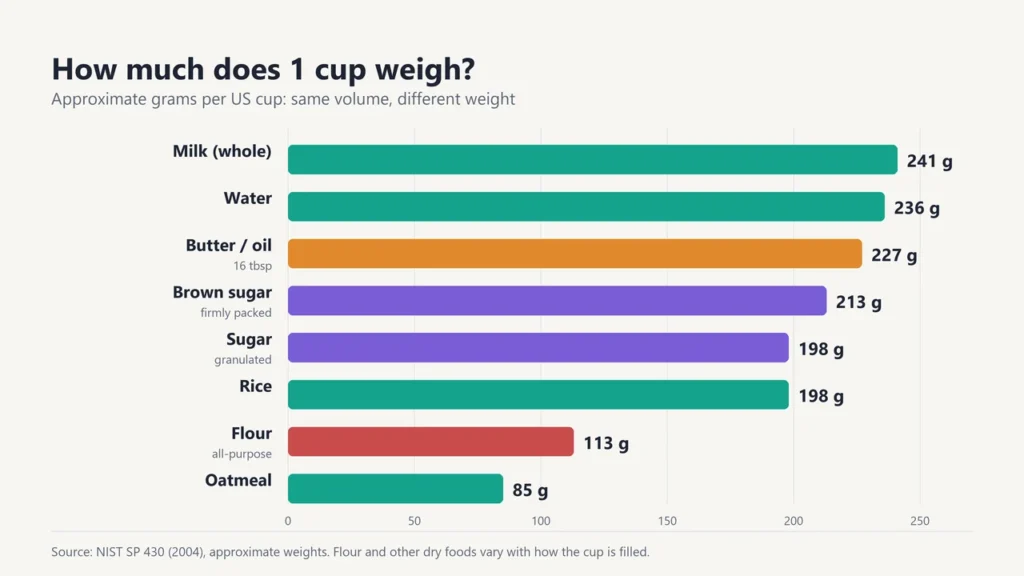
A cup is a measure of space, so it always holds 16 tablespoons, whatever you put in it. What changes is the weight. A cup of butter is much heavier than a cup of flour.
| Ingredient (1 US cup) | Grams | Ounces |
|---|---|---|
| Butter, margarine or cooking oil | 227 g | 8 oz |
| Water | 236 g | 8 1/3 oz |
| Milk (whole) | 241 g | 8 1/2 oz |
| Sugar, granulated | 198 g | 7 oz |
| Sugar, brown, firmly packed | 213 g | 7 1/2 oz |
| Rice | 198 g | 7 oz |
| Flour, all-purpose wheat | 113 g | 4 oz |
| Oatmeal | 85 g | 3 oz |
Butter: 1 cup is 16 tablespoons and weighs about 227 g. The USDA’s FoodData Central lists 1 tablespoon of butter at 14.2 g and one stick at 113 g, so a stick is half a cup, or 8 tablespoons.
Flour: treat any cup weight for flour as a rough guide. Flour packs down, so a scooped cup can weigh much more than a spooned and levelled one. Other references give higher figures than NIST’s 113 g for the same reason. For baking, weighing is safer.
Liquid cups vs dry cups
A liquid measuring cup (usually clear, with a spout and lines) and a set of dry measuring cups (filled to the top) hold the same amount. But NIST says using the wrong type is a common way to get the measure wrong. Follow these tips from NIST’s kitchen guide:
- Use a dry cup for dry foods like sugar and flour, and level off the top with a straight edge.
- Use a liquid cup for water, milk and oil. Put it on a flat surface and read the line at eye level.
- For the best results, weigh ingredients on a kitchen scale instead of using cups.
- Use the same set of measures for the whole recipe, so every ingredient stays in the right ratio.
How to convert a US recipe to metric
NIST suggests the safest way: measure the ingredient once with a US cup or spoon, then weigh it in grams and write the weight down. Next time, just weigh it. For liquids, these quick rules work well at home:
- 1 cup = about 240 mL
- 1 tablespoon = 15 mL
- 1 teaspoon = 5 mL
- 1 fluid ounce = about 30 mL
These are the same rounded values NIST uses in its kitchen conversion table and the FDA uses on food labels.
Frequently asked questions
How many tablespoons are in half a cup?
There are 8 tablespoons in half a US cup. A quarter cup is 4 tablespoons, and three-quarters of a cup is 12 tablespoons.
How many tablespoons are in 1/3 cup?
One-third of a cup is 5 tablespoons plus 1 teaspoon. That is because a cup holds 48 teaspoons, and a third of 48 is 16 teaspoons.
How many teaspoons are in a cup?
There are 48 teaspoons in a cup: 16 tablespoons times 3 teaspoons each.
How many tablespoons are in a cup of butter?
A cup of butter is 16 tablespoons and weighs about 227 g (8 oz). In the US, that is two sticks of butter.
How many mL is 1 cup?
A US cup is 236.6 mL. US food labels use 240 mL, and a metric cup is 250 mL. For most home cooking, the difference does not matter.
Is a tablespoon 15 mL?
Yes, for metric recipes and food labels. A US tablespoon is slightly smaller at 14.79 mL. Many Australian recipes use a larger 20 mL tablespoon.
How many tablespoons are in a cup in the UK?
Many UK recipes now use grams and millilitres. If a recipe uses cups, check whether it means a US cup (16 tablespoons) or a 250 mL metric cup (about 16 2/3 tablespoons of 15 mL). Either way, the answer is close to 16.

Justwebworld has published guides since 2012. How we write and update articles Report an error
