

In Operation, players take turns using tweezers to lift funny ailments out of Cavity Sam without touching the metal sides. Touch the edge and the buzzer goes off and Sam’s nose lights up. Each ailment you remove earns you its card, and each card is worth money. When all the ailments are out, the player with the most money wins.
This guide follows Hasbro’s official rules for the classic Operation game (B2176): setup, how a turn works, what happens when you get buzzed and how to win.
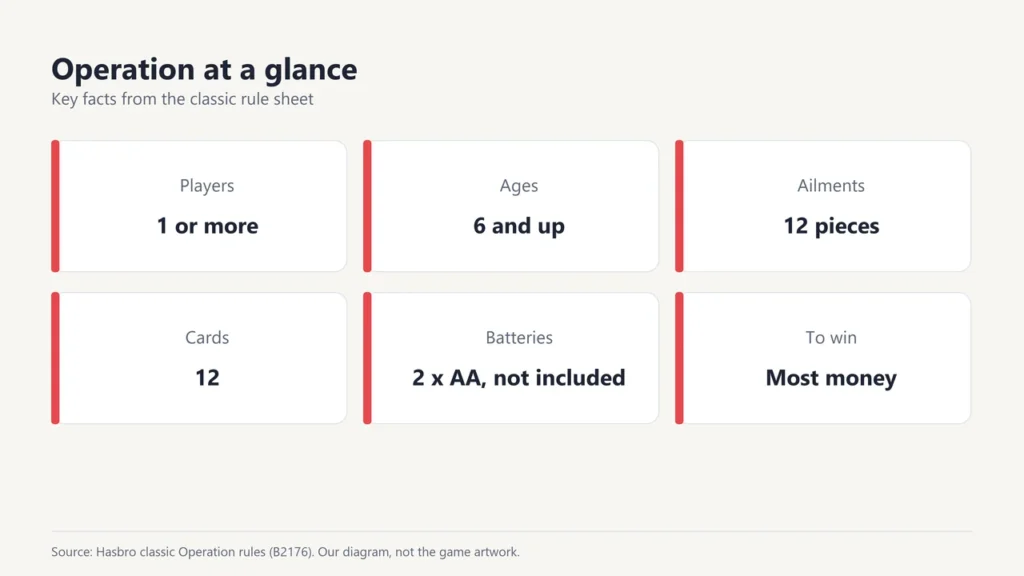
- Players: 1 or more, ages 6 and up
- In the box: gameboard and tweezers, 12 plastic ailments (including a rubber band), 12 cards and a plastic storage bag
- Batteries: 2 x 1.5 V AA (LR6), not included
- Who goes first: the youngest player; play then moves to the left
- To win: collect the most money
How to set up Operation
The first time you play, an adult should take the ailment pieces off their plastic frame and punch out the 12 cards. Then, before every game:
- Put each ailment in its matching space on the board.
- Stretch the rubber band between the two pegs in Cavity Sam’s right leg.
- Put the tweezers where everyone can reach them.
- Shuffle the ailment cards and stack them money-side up.
How to play Operation
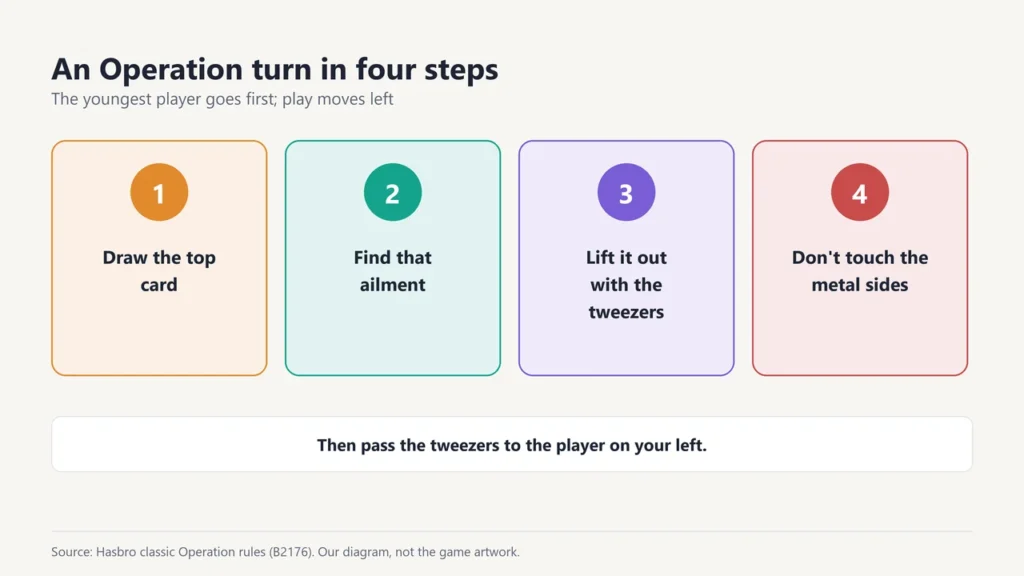
- Take the top card from the deck and flip it over. It shows the ailment you must remove.
- Use the tweezers to lift that ailment out of Cavity Sam.
- Don’t touch the metal sides of the opening.
- Pass the tweezers to the player on your left.
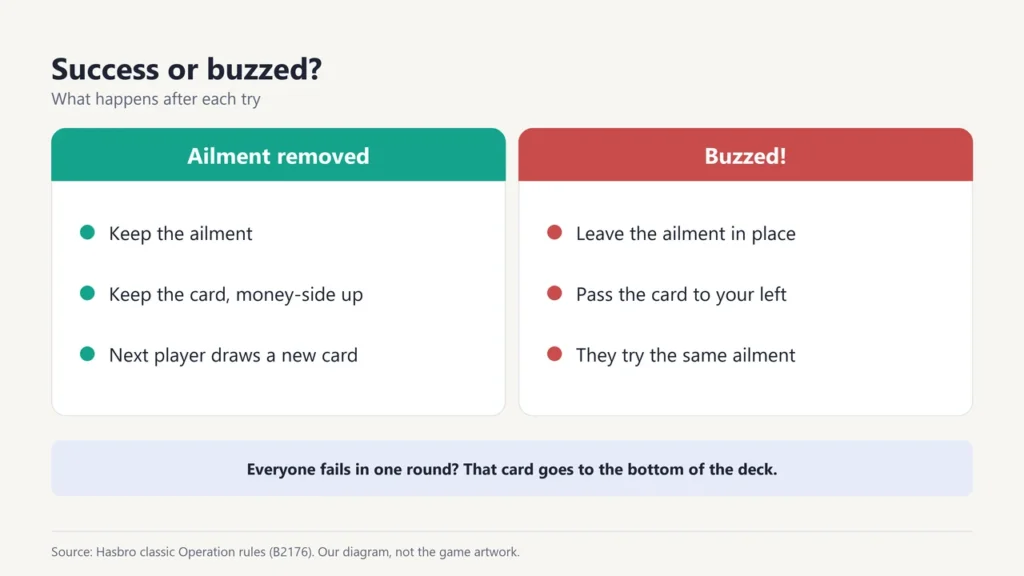
What happens if you remove the ailment?
It is a successful operation. You keep the ailment and the card. Put the card in front of you money-side up. The amount on the card is the money you earned. Then the next player draws a new card.
What happens if you get buzzed?
If the tweezers touch the metal sides, the buzzer sounds and Cavity Sam’s nose lights up. Leave the ailment where it is and pass the card to the player on your left. Now it is their turn, and they try to remove the same ailment. If they get buzzed too, the card moves on to the next player, and so on.
If every player fails on the same ailment in one round, the last player to try puts that card on the bottom of the deck. The next player then draws a new card.
How to win Operation
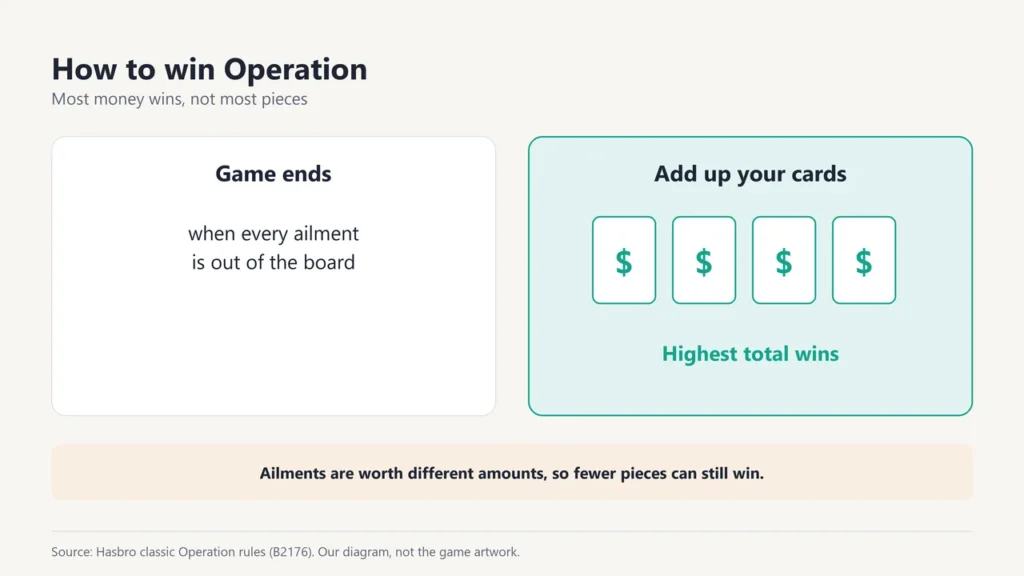
The game ends when all the ailments are out of Cavity Sam. Everyone adds up the money on their cards, and the player with the most money wins.
Ailments are worth different amounts, so the player who removed the most pieces may not be the winner. A few hard pieces can beat lots of easy ones.
Solo play
You can play Operation alone. Follow the same rules and count how many tries it takes you to collect all of the ailments. Try to beat your best score next time.
Simple Operation tips
- Rest your elbow on the table. A steady arm means a steady hand.
- Grip the piece, not the edge. Lift straight up from the middle of the opening.
- Go slowly. There is no time limit in the rules.
- Check the batteries. If the buzzer stops working, the game needs 2 fresh AA batteries.
Themed editions of Operation can have different rules, so check the sheet in your box. More family game rules: Mouse Trap rules, Jenga rules, Guess Who? rules and Connect 4 rules.
Want a faster game for younger players? Our Hungry Hungry Hippos rules explain the Beginner’s and Advanced games.
Frequently asked questions
How do you win the game Operation?
Collect the most money. When all the ailments are removed, everyone adds up the money on their cards, and the highest total wins.
What happens when you get buzzed in Operation?
Leave the ailment in Cavity Sam and pass the card to the player on your left. They try to remove the same ailment.
How many people can play Operation?
Hasbro’s box says 1 or more players, and the rules include a solo game.
What batteries does Operation take?
The classic game takes 2 x 1.5 V AA (LR6) batteries, which are not included.
How many pieces are in Operation?
12 plastic ailments (one is a rubber band) and 12 matching cards, plus the board and tweezers.
Who goes first in Operation?
The youngest player. Play then moves to the left.

Justwebworld has published guides since 2012. How we write and update articles Report an error
