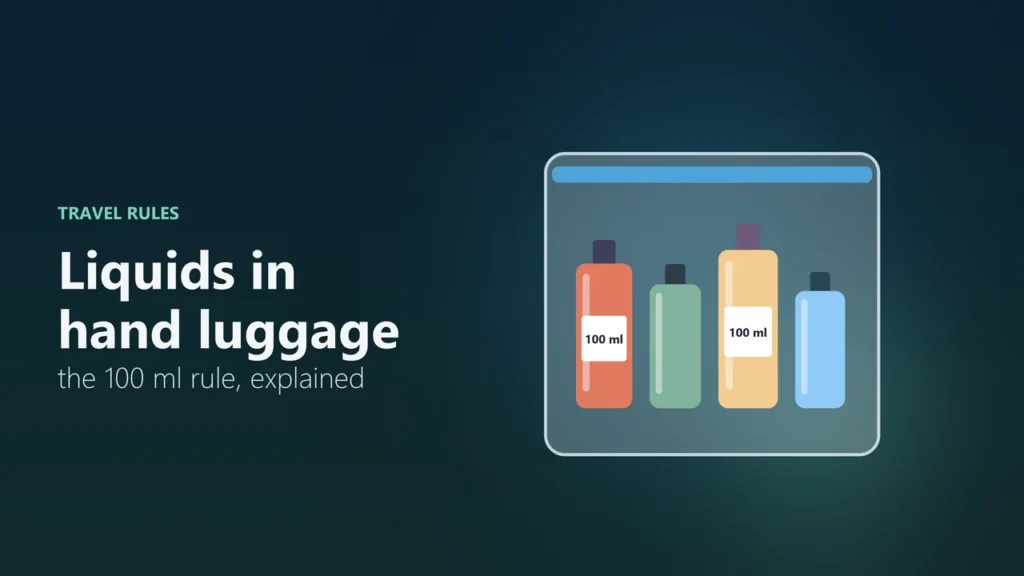
At most airports, every liquid in your cabin bag must be in a container of 100 ml (3.4 oz) or less. All of those containers must fit in one small, clear, resealable bag. Anything bigger goes in your checked luggage. Medicines and baby food are the main exceptions.
The catch is that the rule is no longer the same everywhere. Some UK and European airports with newer scanners now allow containers of up to 2 litres. Most airports in the US and India still use the 100 ml limit. This guide explains what counts as a liquid, the rules in the US, UK, EU and India, and how to avoid losing your shampoo at a connecting airport.
- Container limit: 100 ml (3.4 oz) at most airports
- The bag: one clear, resealable bag per person (about 1 litre, or a US quart)
- Exceptions: medicines and baby food
- Bigger bottles: pack them in checked luggage
- Always check: your departure, transfer and return airports
What is the 100 ml liquids rule?
The rule limits how much liquid you can carry through airport security in your hand luggage. It has two parts:
- Each container holds 100 ml or less. The US Transportation Security Administration (TSA) gives this as 3.4 ounces (100 millilitres) per item.
- All the containers go in one small clear bag. The TSA allows one quart-sized bag. GOV.UK describes a single transparent, resealable bag that holds no more than a litre and measures about 20 cm × 20 cm, one per traveller.
The limit is about the size of the container, not how much is left in it. GOV.UK says a partly filled container is still subject to the limit, so a 200 ml bottle that is half empty will not get through.
What counts as a liquid?
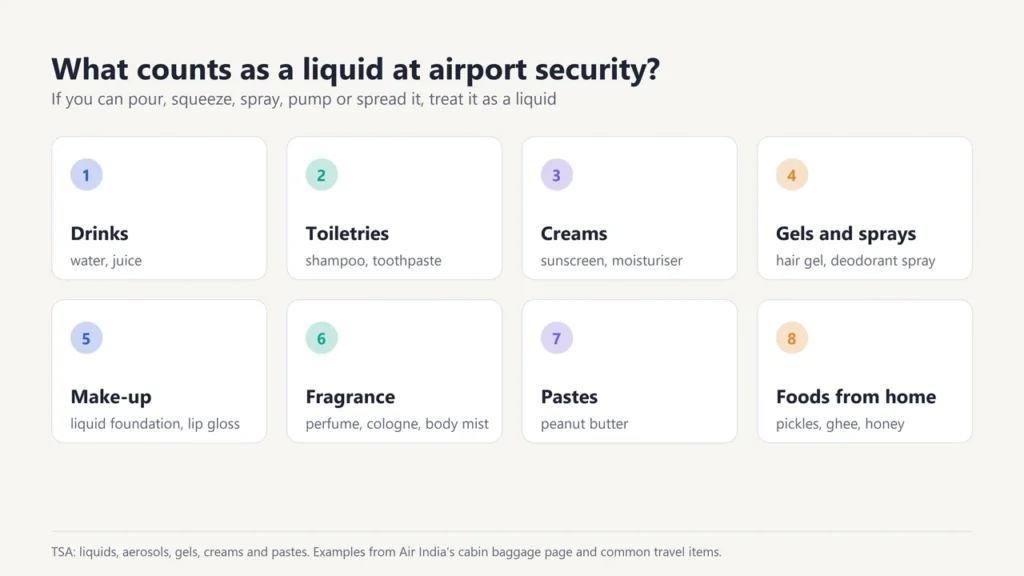
More than you might think. The TSA’s rule covers liquids, aerosols, gels, creams and pastes. Air India’s cabin baggage page gives these examples:
- Drinks
- Toiletries such as shampoo, toothpaste, sunscreen and moisturiser
- Hair gel and hair spray
- Liquid make-up and anything of a similar texture
A simple test: if you can pour it, squeeze it, spray it, pump it or spread it, treat it as a liquid. That includes everyday travel items like lip gloss, deodorant sprays, perfume, honey, ghee and pickles in oil.
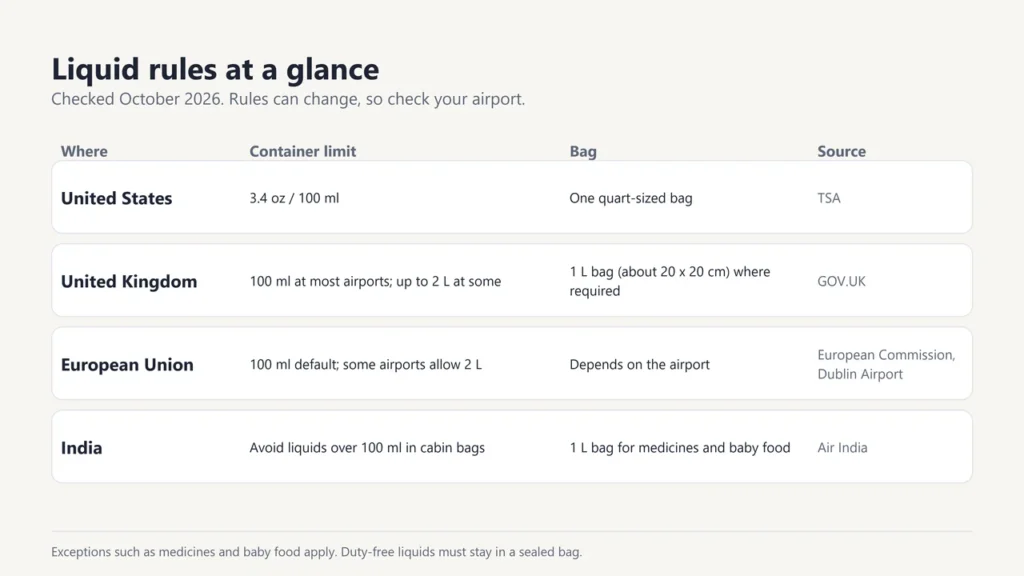
Liquid rules in the US, UK, EU and India
| Where | Container limit | Bag | Main exceptions |
|---|---|---|---|
| United States (TSA) | 3.4 oz / 100 ml | One quart-sized bag | Medications; infant and child nourishment |
| United Kingdom | 100 ml at most airports; up to 2 litres at some | One clear 1-litre bag (about 20 × 20 cm) where required | Essential medicines, special dietary food, baby food and milk (up to 2 litres at all UK airports) |
| European Union | 100 ml is the default; some airports allow up to 2 litres | Depends on the airport | Check the airport |
| India (Air India guidance) | Avoid liquids over 100 ml in cabin bags | Clear, resealable 1-litre bag for medicines and baby food | Prescription medicines and inhalers; baby food |
United States
The TSA allows travel-sized containers of 3.4 oz (100 ml) or less, in one quart-sized bag in your carry-on. Medications and food for babies and children are exempt. Bigger containers must go in checked bags.
United Kingdom
GOV.UK says the rules depend on the airport. Most UK airports still use the 100 ml limit, but some may allow containers of up to 2 litres. Where the 100 ml rule applies, containers go in one clear, resealable bag of up to 1 litre. Essential medicines, special dietary food and baby food or milk are allowed up to 2 litres at all UK airports. Frozen liquids are not allowed in hand luggage.
European Union
The 100 ml limit is still the starting point across the EU, but some airports have newer screening equipment that lets them relax it. The European Commission briefly brought back the 100 ml limit at those airports from 1 September 2024 to fix a technical issue. Since then, some airports have lifted it again. Dublin Airport, for example, now says the 100 ml limit no longer applies there. It allows containers of up to 2 litres, and liquids no longer need to go in clear bags.
India
Air India’s cabin baggage page, which follows Indian government security rules, tells passengers to avoid carrying liquids, aerosols or gels over 100 ml in cabin baggage. Prescription medicines, inhalers and baby food are exceptions, but they should be carried in a clear, transparent, resealable one-litre plastic bag and screened at security. If you fly with another airline, check its own baggage page too.
The return-trip trap
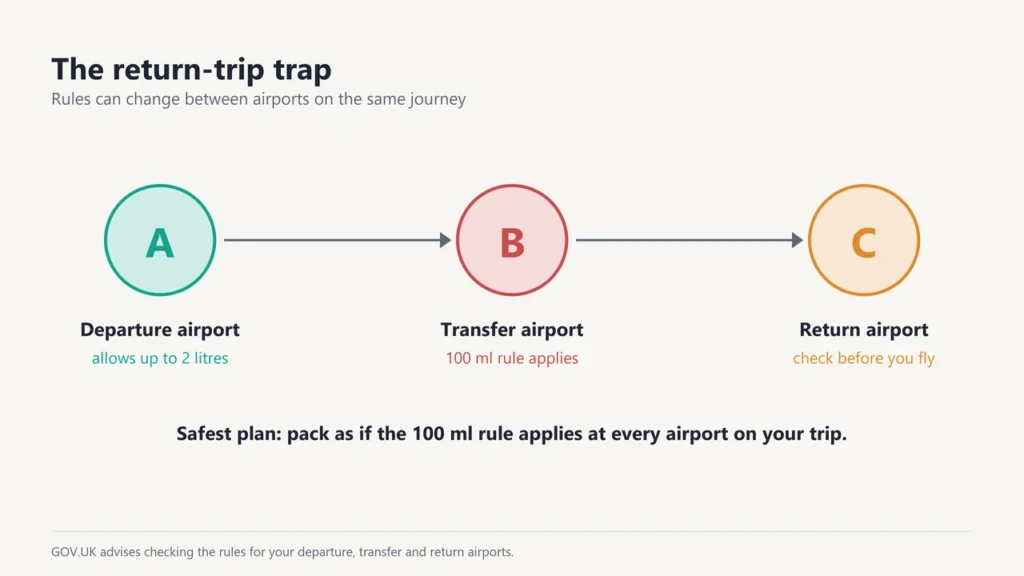
This is where many travellers get caught. You might leave from an airport that allows 2-litre bottles. Then you go through security again at a connecting airport, or on the way home, where the 100 ml rule still applies. Your big bottle would be taken away there.
GOV.UK’s advice is to check the rules for your departure airport, any transfer airport and your return airport. It also warns that rules for transit flights outside the UK may be different. The simplest way to stay safe is to pack as if the 100 ml rule applies everywhere on your trip.
Medicines and baby food
The US, UK and Indian rules all make room for liquids you genuinely need. The TSA exempts medications and infant and child nourishment. In the UK, essential medicines, special dietary food and baby food or milk are allowed up to 2 litres at every airport. In India, Air India says prescription medicines, inhalers and baby food may be carried, packed in a clear one-litre bag. Keep these items easy to reach, because security staff may need to check them separately.
Duty-free liquids
Liquids you buy after security, such as perfume or alcohol from a duty-free shop, are allowed on board. GOV.UK says they must stay sealed in the shop’s security bag with the receipt visible. Don’t open the bag until you reach your final destination. The TSA also refers to secure, tamper-evident duty-free bags. If you open the bag before a connecting flight, you may lose the item at the next security check.
How to pack liquids for a flight
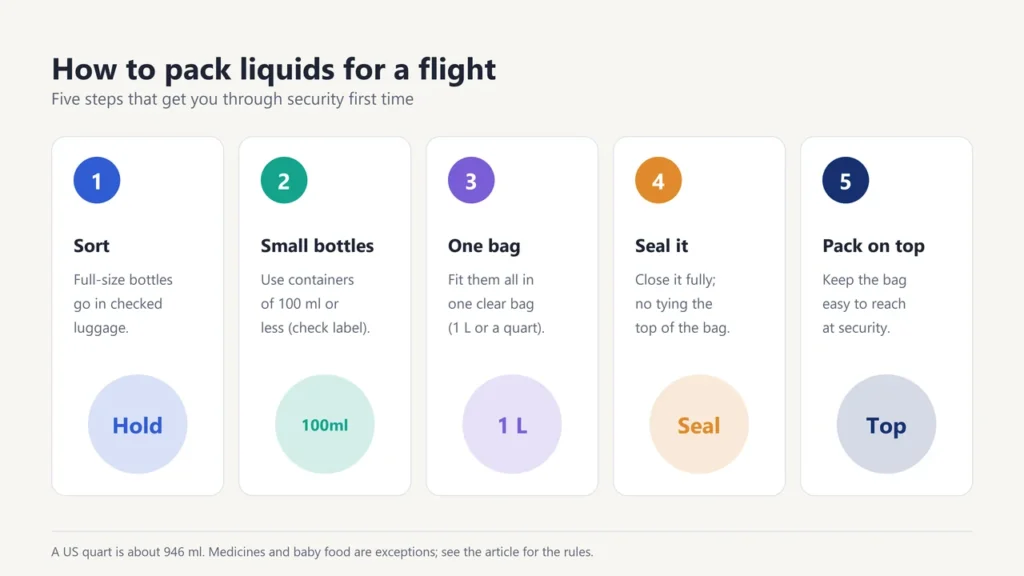
- Decide what really needs to be in your cabin bag. Put full-size bottles in checked luggage.
- Use travel bottles of 100 ml or less. Check the size printed on the bottle, not how full it is.
- Fit them all into one clear, resealable bag. A 1-litre bag or a US quart bag (a quart is about 946 ml) both work.
- Seal the bag fully. GOV.UK says it must close without being tied at the top.
- Pack the bag where you can reach it. At airports that still need it, you will take it out at security.
Common mistakes
- Carrying a big bottle that is nearly empty. The container size counts, not the contents.
- Forgetting pastes and creams. Toothpaste, face cream and peanut butter all count.
- Assuming 2 litres is allowed everywhere. Most airports still use the 100 ml rule.
- Opening duty-free bags before a connection. Keep them sealed until your final stop.
- Packing food from home in jars. Pickles, ghee, honey and sauces count as liquids, so pack them in checked luggage.
Planning a bigger trip? These guides cover travel insurance for adventure travellers and what to do when your flight is delayed or cancelled. If you are flying across time zones, our guide to GMT vs UTC helps you read departure times.
Frequently asked questions
How many ml of liquid can I take on a plane?
At most airports, up to 100 ml per container, with all containers fitting in one clear bag of about 1 litre. Some UK and EU airports with new scanners allow containers of up to 2 litres, so check your airport.
How many 100 ml bottles can I carry?
As many as fit in your one clear bag with the bag still fully sealed. You are allowed only one bag.
Is toothpaste a liquid at airport security?
Yes. The TSA’s rule covers pastes and gels, and Air India lists toothpaste as an example. Carry a tube of 100 ml or less in your liquids bag.
Can I take perfume in my hand luggage?
Yes, if the bottle is 100 ml or less and fits in your liquids bag. Larger bottles must go in checked luggage, unless you bought them after security and they stay in a sealed duty-free bag.
Can I carry liquids in checked luggage?
Yes. The TSA says containers over 3.4 oz (100 ml) should be packed in checked bags. Some items, such as flammable products, have their own limits, so check your airline’s dangerous goods list.
Is the 100 ml rule the same on Indian domestic flights?
Air India’s cabin baggage guidance on liquids does not make a separate rule for domestic flights, so plan on the 100 ml limit for both. Check your airline’s page before you travel.