

GMT and UTC show the same clock time, so for everyday use you can treat them as equal. The real difference is what they are. UTC (Coordinated Universal Time) is the world’s time standard, kept by atomic clocks. GMT (Greenwich Mean Time) is a time zone. The UK uses it in winter, and some other countries use it all year. It started as time based on the Sun at Greenwich in London.
In practice, two things trip people up. London is not on GMT in summer, because the UK moves to British Summer Time (BST), which is one hour ahead. And in science and computing, UTC is the reference to use, because GMT is no longer defined precisely. This guide explains both, with a conversion table and the common mistakes to avoid.
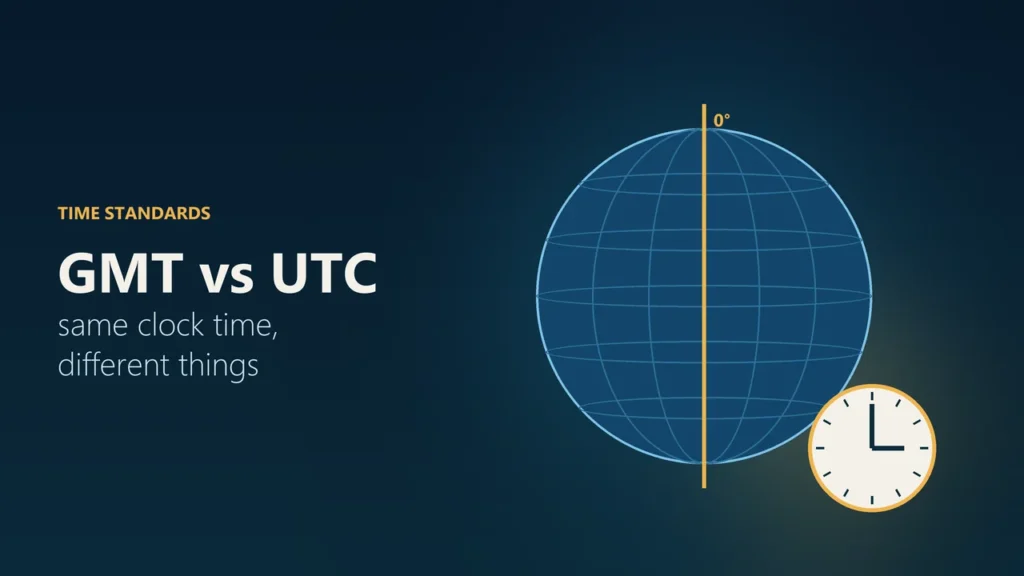
- Same time? Yes, GMT = UTC+0 on the clock.
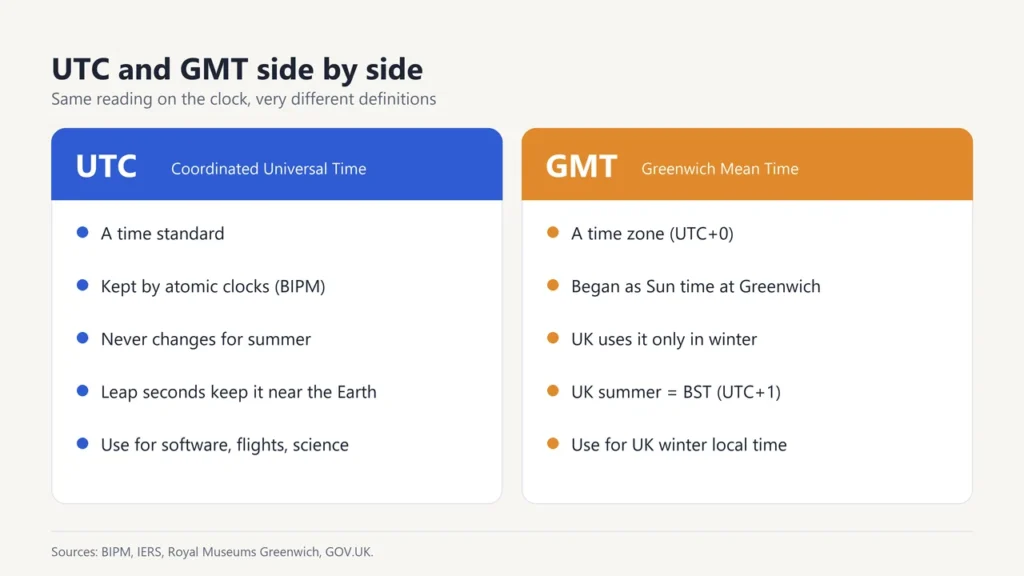
- UTC is a time standard. It never changes for summer.
- GMT is a time zone. The UK uses it only from late October to late March.
- India (IST) is UTC+5:30 all year.
- Use UTC for software, flights, servers and anything international.
What is UTC?
UTC, or Coordinated Universal Time, is the time scale the whole world sets its clocks by. Every time zone is written as an offset from it, such as UTC+5:30 for India or UTC−5 for New York in winter.
Many computer systems skip local time altogether and store a Unix timestamp, a count of seconds from midnight UTC on 1 January 1970.
UTC is worked out by the International Bureau of Weights and Measures (BIPM) in France, using atomic clocks in laboratories around the world. It ticks at the steady rate of International Atomic Time (TAI). Since 1 January 2017, UTC has been exactly 37 seconds behind TAI, according to the International Earth Rotation and Reference Systems Service (IERS). Those 37 seconds come from the leap seconds explained below, plus a 10-second gap set when the system began in 1972.
The short name “UTC” is meant to work in every language, so it matches neither the English (CUT) nor the French (TUC) word order.
What is GMT?
GMT, or Greenwich Mean Time, began as the average time each day when the Sun crosses the Prime Meridian at the Royal Observatory in Greenwich, London. That is how Royal Museums Greenwich, which runs the observatory today, defines it.
In 1884, the International Meridian Conference recommended Greenwich as the world’s Prime Meridian, or 0° longitude. That is why GMT became the base for world time zones for much of the 20th century. Royal Museums Greenwich notes that UTC has now replaced GMT as the world’s reference. GMT is still the legal time in Britain during winter.
GMT vs UTC: the differences at a glance
| UTC | GMT | |
|---|---|---|
| What it is | A time standard | A time zone (and the old world reference) |
| Based on | Atomic clocks | The Sun’s position at Greenwich |
| Who keeps it | BIPM, with the IERS for leap seconds | Used by the UK and some other countries as winter or all-year local time |
| Changes for summer? | Never | The UK switches from GMT to BST (UTC+1) in summer |
| Clock time | UTC+0 | Same as UTC+0 |
| Best for | Software, aviation, science, international meetings | Local time in the UK in winter |
Do GMT and UTC ever show different times?
Only by less than a second. Atomic time and the Earth’s spin don’t match perfectly, because the Earth’s rotation speeds up and slows down slightly. The international rule for UTC, set in Recommendation ITU-R TF.460-6 from the International Telecommunication Union, keeps UTC within 0.9 seconds of Earth-rotation time (called UT1). When the gap gets close to that limit, a leap second is added.
The bigger everyday difference is the one-hour gap in UK summer. From the last Sunday in March to the last Sunday in October, UK clocks run on BST, which is UTC+1, according to GOV.UK. So “London time” equals GMT only for about five months of the year.
For the full rules on when clocks change in the UK, Europe and the US, see daylight saving time explained.
Leap seconds, and what changes next
A leap second is an extra second added to UTC, usually as 23:59:60 on 30 June or 31 December, to keep atomic time in step with the Earth. Here are the key facts:
- 27 leap seconds have been added since 1972. All have been added seconds. A second has never been taken away.
- The last one was added at the end of 31 December 2016.
- No leap second at the end of 2026. The IERS confirmed this in Bulletin C 72, dated 6 July 2026.
- Leap seconds are being phased out. In 2022, the General Conference on Weights and Measures (CGPM) decided that the allowed gap between UTC and Earth-rotation time will be increased in, or before, 2035.
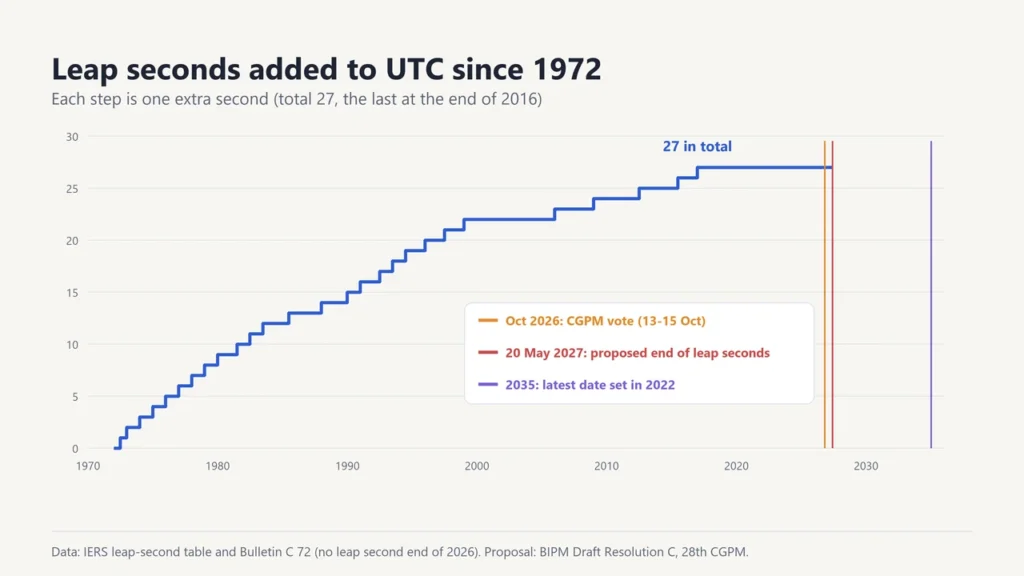
The vote has now happened. At its 28th meeting, held in Versailles, France, from 13 to 15 October 2026, the CGPM adopted Resolution 5, “On the technical actions needed to ensure the continuity of UTC”. It decides that continuous UTC, with no more leap seconds, begins on 20 May 2027. The allowed gap between UTC and Earth-rotation time (UT1) will grow to one hour (3,600 seconds). The resolution says this keeps UTC continuous for several centuries. This brings the 2035 plan forward, so the leap second added at the end of 2016 is set to stay the last one. Ordinary clocks will not change at all. The difference only matters to systems that depend on exact time, such as satellite navigation, telecom networks and energy grids.
GMT, BST, UTC and IST: common time zones compared
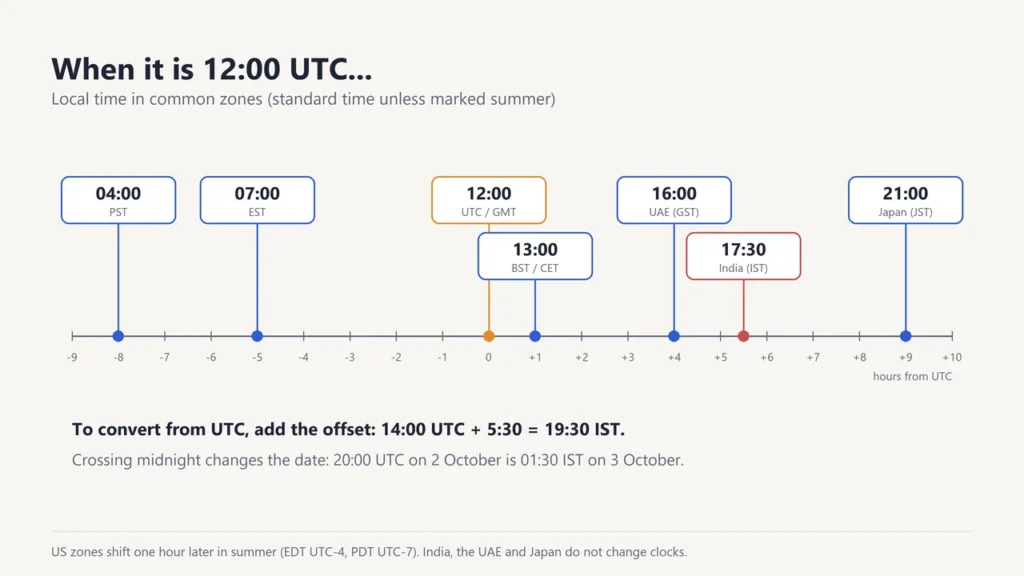
To convert from UTC, add or subtract the offset. For example, 14:00 UTC is 19:30 in India, because IST is UTC+5:30.
| Time zone | Offset from UTC | When 12:00 UTC is… |
|---|---|---|
| GMT (UK winter) | UTC+0 | 12:00 |
| BST (UK summer) | UTC+1 | 13:00 |
| CET / CEST (Central Europe) | UTC+1 / UTC+2 in summer | 13:00 / 14:00 |
| Gulf Standard Time (UAE) | UTC+4 | 16:00 |
| IST (India) | UTC+5:30 | 17:30 |
| Japan Standard Time | UTC+9 | 21:00 |
| US Eastern (EST / EDT) | UTC−5 / UTC−4 in summer | 07:00 / 08:00 |
| US Pacific (PST / PDT) | UTC−8 / UTC−7 in summer | 04:00 / 05:00 |
India uses a single time zone. IST is based on the 82.5° East line of longitude, and the official time is kept by CSIR-National Physical Laboratory in New Delhi.
What do “Z” and “Zulu time” mean?
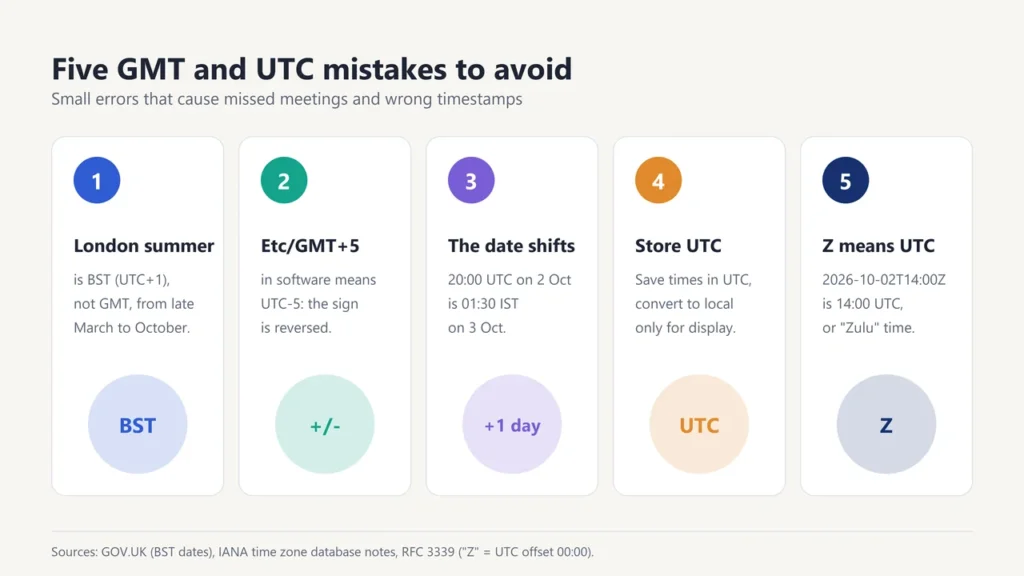
“Z” means UTC. You will see it at the end of timestamps such as 2026-10-02T14:00:00Z. The internet standard for dates and times, RFC 3339, defines “Z” as a UTC offset of 00:00. It is often spoken as “Zulu”, which is the word for Z in the phonetic alphabet used in aviation, so “Zulu time” is simply UTC.
For the full format, including dates, offsets and week numbers, see our guide to the ISO 8601 date format.
Common mistakes with GMT and UTC
- Saying “GMT” for London time in summer. From late March to late October, London is on BST (UTC+1), not GMT.
- Writing “GMT+1” when you mean a place. It is clearer to name the zone (for example “CET”) or to write the UTC offset.
- Misreading “Etc/GMT+5” in software. In the IANA time zone database, used by most computers, the sign is reversed. “Etc/GMT+5” means five hours behind UTC, the same as UTC−5. The database’s own notes say this follows the POSIX standard, even though many people expect the opposite.
- Forgetting the date can change. 20:00 UTC on 2 October is 01:30 IST on 3 October.
- Storing times in local time. Servers and databases should store UTC and convert to local time only when showing it to people.
Should you use GMT or UTC?
Use UTC for almost everything: international meetings, flight times, software, logs and science. It is precise and never changes with the seasons. Use GMT only when you mean the UK’s winter local time, or when a document or organisation specifically asks for it.
Working with people in other countries? Writing meeting times in UTC, with each person’s local time next to it, avoids most mix-ups. These guides on managing remote teams and building an effective remote team cover the rest of working across time zones.
Frequently asked questions
Is GMT the same as UTC?
On the clock, yes. Both show UTC+0. But UTC is the atomic-clock time standard, and GMT is a time zone that can differ from UTC by less than a second.
Does UTC change for daylight saving time?
No. UTC never changes. Countries move their local clocks, so their offset from UTC changes instead. The UK, for example, goes from UTC+0 (GMT) to UTC+1 (BST) in summer.
Is the UK on GMT all year?
No. The UK uses GMT from the last Sunday in October to the last Sunday in March, and BST (UTC+1) for the rest of the year.
What is UTC time in India?
India is 5 hours 30 minutes ahead of UTC. To convert UTC to IST, add 5:30. For example, 09:00 UTC is 14:30 IST.
Is Zulu time the same as UTC?
Yes. “Zulu” is the phonetic-alphabet word for the letter Z, and Z marks a UTC time.
Why is it UTC and not CUT?
Because the abbreviation was chosen to be the same in every language. English would give CUT and French would give TUC, so UTC was picked as a neutral form.
Are leap seconds ending?
They are being phased out. In 2022 the CGPM decided to widen the allowed gap in, or before, 2035, so that leap seconds are no longer needed. In October 2026 the CGPM brought this forward: its Resolution 5 says continuous UTC, with no more leap seconds, starts on 20 May 2027.

Justwebworld has published guides since 2012. How we write and update articles Report an error
