

In Sequence, you play a card from your hand and put one of your chips on a matching picture of that card on the board. Get five of your chips in a row (across, up and down, or on a slant) and you have a Sequence. With 2 players or 2 teams, the first side to make two Sequences wins. With 3 players or 3 teams, one Sequence wins.
This guide follows the official instruction sheet for the classic edition with 50 green, 50 blue and 35 red chips, the set Goliath sells today. It covers how many cards to deal, how a turn works, what the one-eyed and two-eyed Jacks do, dead cards, and the team rules.
| Players | 2 to 12 (2, 3, 4, 6, 8, 9, 10 or 12) |
| Ages | 7 and up |
| Playing time | 20-40 minutes |
| In the box | Folding board, 2 decks of Sequence cards (104 cards), 135 chips: 50 green, 50 blue, 35 red |
| Goal | 2 Sequences (2 players or teams) or 1 Sequence (3 players or teams) |
What is a Sequence?
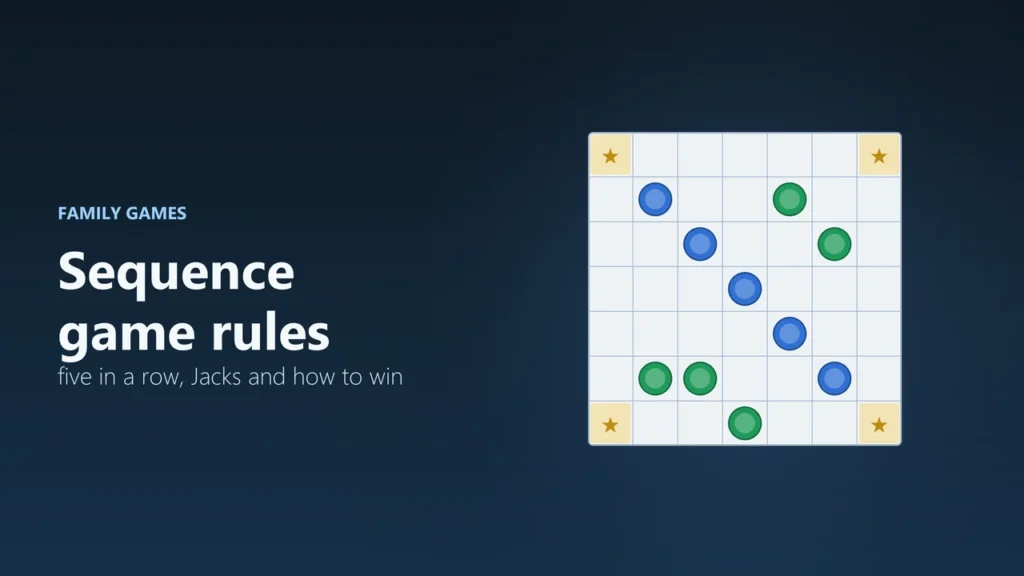
A Sequence is five chips of the same colour in a straight, connected line. The line can go across, up and down, or diagonally. It works a bit like Connect 4, but you need five and the cards decide where you can play.
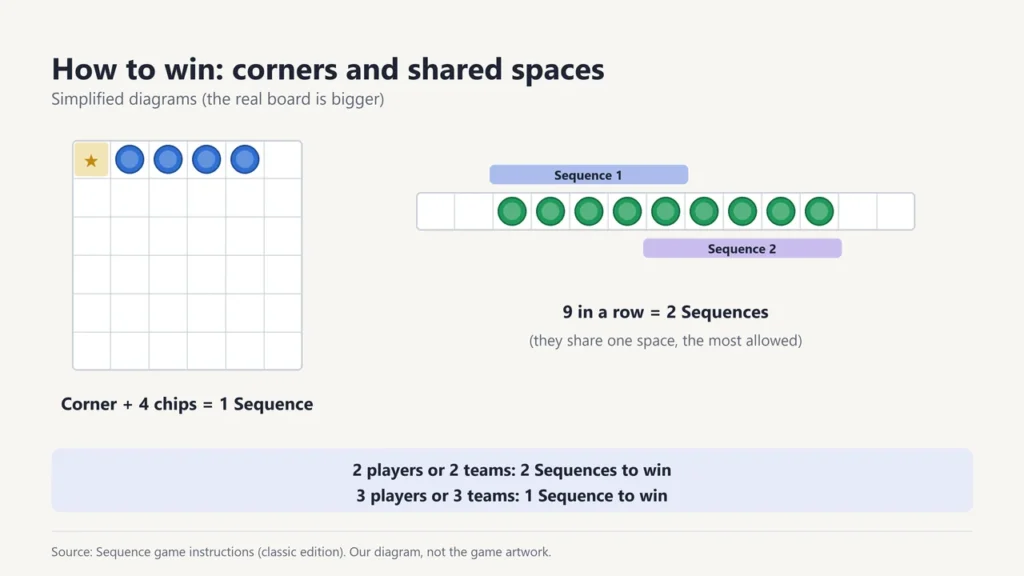
The four corners of the board have a printed chip. Every player counts a corner as their own colour, so a line that uses a corner needs only four of your chips. More than one player can use the same corner.
How many cards do you deal in Sequence?
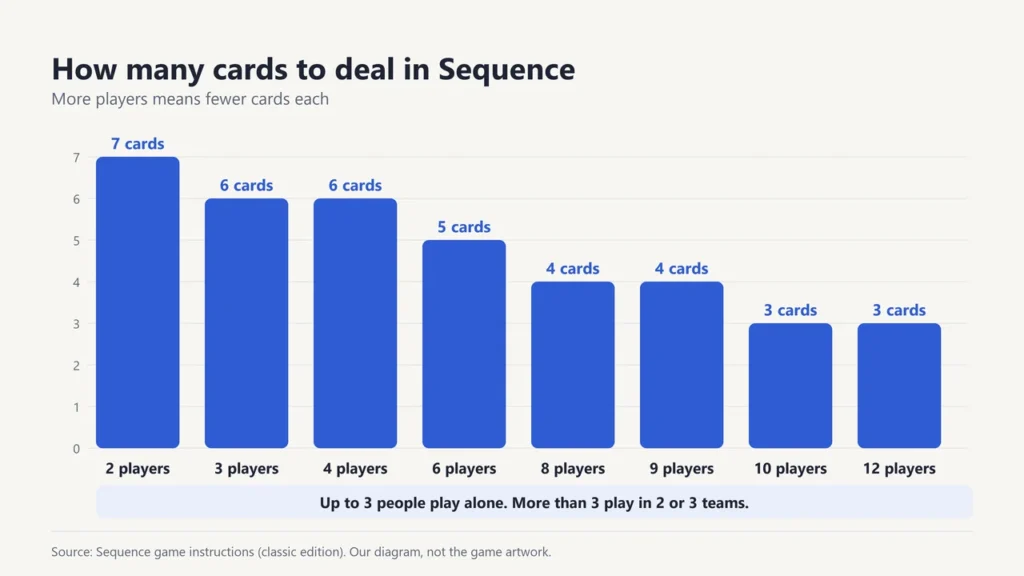
It depends on how many people play. The more players, the fewer cards each one gets.
| Players | Cards each | How you play |
|---|---|---|
| 2 | 7 | 1 v 1, two Sequences to win |
| 3 | 6 | Each for themselves, one Sequence to win |
| 4 | 6 | 2 teams of 2 |
| 6 | 5 | 2 teams of 3, or 3 teams of 2 |
| 8 | 4 | 2 teams of 4 |
| 9 | 4 | 3 teams of 3 |
| 10 | 3 | 2 teams of 5 |
| 12 | 3 | 2 teams of 6, or 3 teams of 4 |
How to set up Sequence
- Lay the board flat, with room for the draw deck and a discard pile in front of each player.
- Split into teams if needed. Teammates sit apart, so the seats go team A, team B, team A, team B (or A, B, C with three teams).
- Give each team one chip colour. With two sides, use blue and green only. Red is for a third player or team.
- Cut the cards. The lowest card deals, and Aces count high.
- The dealer shuffles and deals the number of cards in the table above. The rest form the draw deck.
How to play Sequence: a turn
The player on the dealer’s left goes first, and play moves clockwise. On your turn:
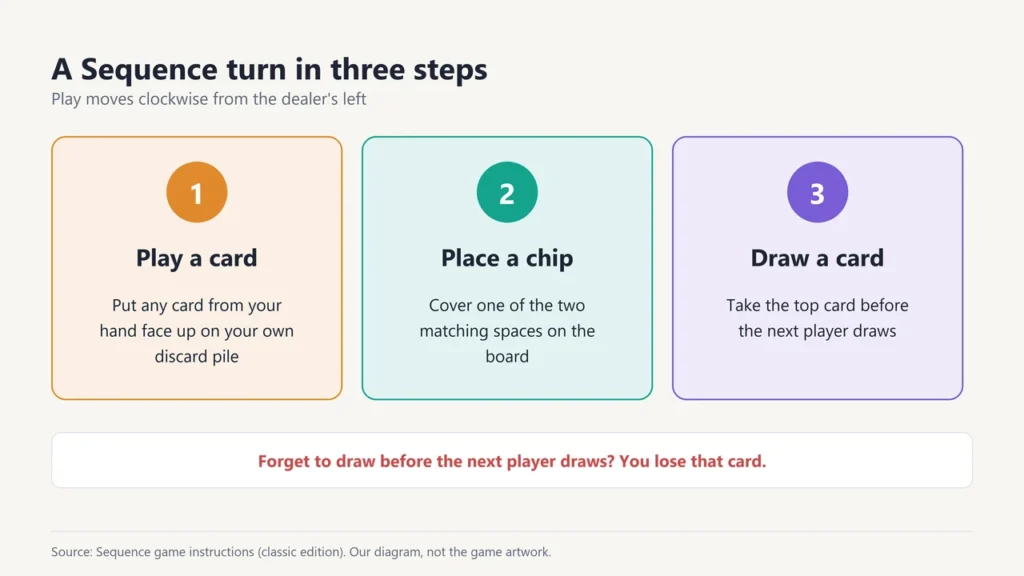
- Play a card. Pick any card from your hand and put it face up on your own discard pile.
- Place a chip. Put one of your chips on a picture of that card on the board. Every card except the Jacks is shown twice, so you can use either space if it is free.
- Draw a card. Take the top card from the draw deck.
Do not forget step 3. If you have not drawn before the next player places a chip and draws, you lose that card and play the rest of the game with one card fewer.
One-eyed vs two-eyed Jacks in Sequence
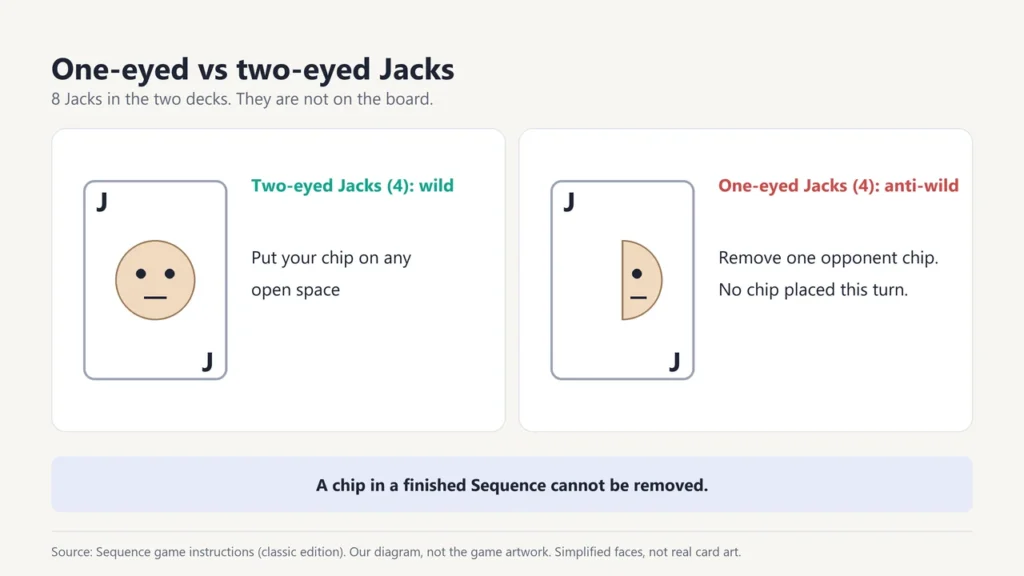
Jacks are not on the board. Instead they are special cards, and there are 8 of them in the two decks.
- Two-eyed Jacks (4) are wild. Discard one and put your chip on any open space.
- One-eyed Jacks (4) are anti-wild. Discard one and take one of your opponent’s chips off the board. You do not place a chip on this turn, and you cannot put your own chip on that space in the same turn.
You cannot remove a chip that is part of a finished Sequence. Once a Sequence is made, it cannot be broken. You can play a Jack on any turn you like.
The instructions only say a one-eyed Jack “completes your turn”. They do not say directly whether you then draw a card. Agree on this before you start; drawing keeps everyone’s hand the same size. To tell the Jacks apart, look at the picture: a Jack drawn side-on, showing one eye, is a one-eyed Jack. Jokers are not used in Sequence.
What is a dead card in Sequence?
A dead card is a card whose two spaces on the board are both covered. On your turn, put it on your discard pile, say you are turning in a dead card, and draw a new one. You can do this once per turn. Then take your normal turn.
How do you win Sequence?
The first player or team to make the number of Sequences they need wins:
- 2 players or 2 teams: two Sequences. Your second Sequence may use one space from your first, so a straight line of nine chips counts as two.
- 3 players or 3 teams: one Sequence.
If the draw deck runs out, shuffle all the discard piles together to make a new deck and keep playing.
The no table talk rule
Teammates may not coach each other. If a player warns a teammate about a move they should not make, every member of that team must throw away one card of their choice onto their discard pile.
Common Sequence rule mistakes
- Placing a chip after a one-eyed Jack. You remove a chip instead of placing one.
- Using two shared spaces. Your second Sequence can borrow only one space from your first.
- Dealing the wrong number of cards. Check the table. Two players get 7 each, not 6.
House rules are common, so agree on them before you start. Rule sheets can also differ by edition. One sheet we read, for an edition with 48 chips of each colour, lists the no table talk rule as an “alternative rule” and adds an “advanced” rule that lets a one-eyed Jack remove a chip even from a finished Sequence. If your box has its own sheet, follow that.
Want more? See board games like Sequence, or learn the rules of UNO and Boggle.
Frequently asked questions
How many cards does each player get in Sequence?
7 for 2 players, 6 for 3 or 4, 5 for 6, 4 for 8 or 9, and 3 for 10 or 12.
How many Sequences do you need to win?
Two with 2 players or 2 teams. One with 3 players or 3 teams.
What does a one-eyed Jack do in Sequence?
It removes one opponent chip from the board, as long as that chip is not part of a finished Sequence. You do not place a chip on that turn.
What does a two-eyed Jack do in Sequence?
It is wild. You can put your chip on any open space on the board.
Can 5 or 7 people play Sequence?
Not under the official rules. The number of players must divide evenly by 2 or 3: 2, 3, 4, 6, 8, 9, 10 or 12.
Do the corners count in Sequence?
Yes. Each corner counts as a chip of every player’s colour, so a line through a corner needs only four of your own chips.
Can two Sequences share a chip?
Yes, but only one. In a two-Sequence game, your second line may use one space from your first.

Justwebworld has published guides since 2012. How we write and update articles Report an error
