

Kelvin and Celsius use the same size step, so a change of 1 kelvin is exactly a change of 1 degree Celsius. The only difference is where zero sits. Kelvin starts at absolute zero, the coldest possible temperature, while Celsius puts 0 at the freezing point of water. To convert, add 273.15: K = °C + 273.15. Fahrenheit is different again: its steps are smaller (1 °C = 1.8 °F) and water freezes at 32 °F.
Below you’ll find the three scales side by side, the exact formulas, worked examples, why kelvin has no degree sign, and the one mistake almost everyone makes when converting temperature differences.
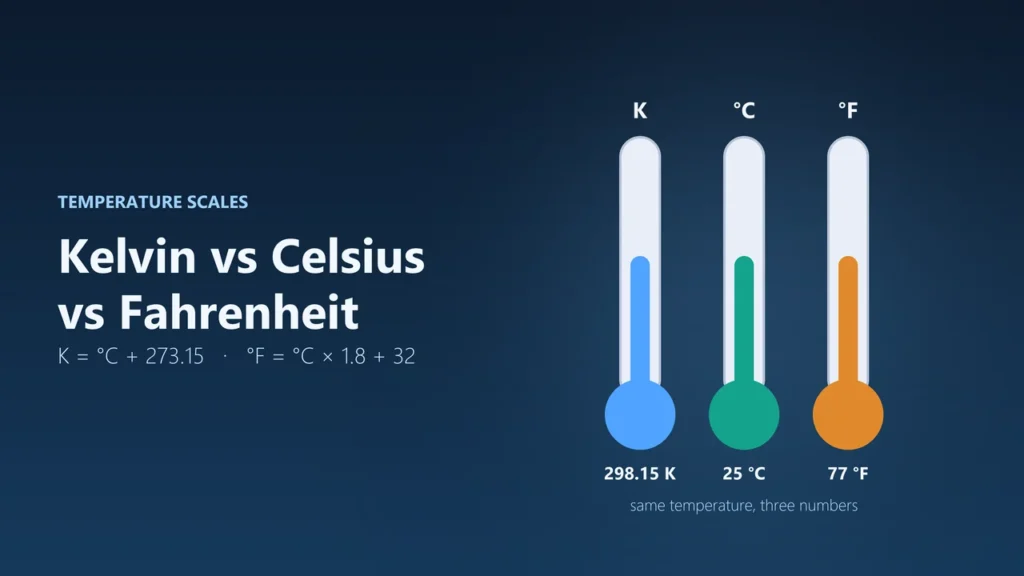
Kelvin vs Celsius vs Fahrenheit at a glance
| Point | Kelvin (K) | Celsius (°C) | Fahrenheit (°F) |
|---|---|---|---|
| Absolute zero | 0 K | −273.15 °C | −459.67 °F |
| Water freezes | 273.15 K | 0 °C | 32 °F |
| Room temperature (about) | 294 K | 21 °C | 70 °F |
| Water boils at sea level (about) | 373.15 K | 100 °C | 212 °F |
| Size of one step | 1 K | 1 °C (same as 1 K) | 1 °F (5/9 of 1 K) |
| Can it go below zero? | No | Yes | Yes |
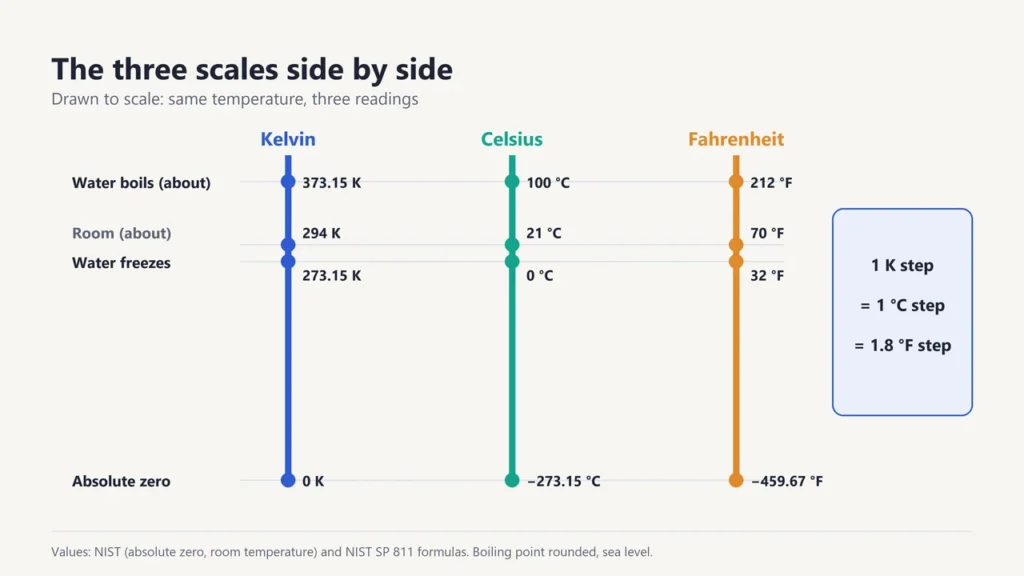
What is the Kelvin scale?
The kelvin (symbol K) is the SI base unit of temperature. Its zero point, 0 K, is absolute zero: the point where a substance has the least possible heat energy. Nothing can be colder, so kelvin temperatures are never negative.
Since 20 May 2019, the kelvin has been defined by fixing the value of the Boltzmann constant at exactly 1.380 649 × 10−23 joules per kelvin (BIPM). Before that, from 1954, it was defined as 1/273.16 of the temperature of the triple point of water, the point where ice, liquid water and water vapour exist together (NIST). The new definition does not change everyday values; it ties the unit to a constant of nature instead of a sample of water.
The scale is named after William Thomson, Lord Kelvin, the 19th-century physicist who worked on the idea of an absolute temperature scale.
What is the Celsius scale?
Celsius is the everyday temperature scale in most of the world. Today it is defined from the kelvin: Celsius temperature equals kelvin temperature minus 273.15, and one degree Celsius is “equal in magnitude” to one kelvin (NIST Special Publication 811). Water freezes at 0 °C and boils at about 100 °C at sea level.
What is the Fahrenheit scale?
Fahrenheit is still the everyday scale in the United States. On it, water freezes at 32 °F and boils at about 212 °F, so there are 180 Fahrenheit degrees between the two points instead of 100. That is why one Celsius degree equals 1.8 Fahrenheit degrees. Like Celsius, Fahrenheit can go below zero: absolute zero is −459.67 °F (NIST).
Why is kelvin not written in degrees?
Because the rules changed in 1967. The 13th General Conference on Weights and Measures (CGPM), in its Resolution 3, decided that the unit is called “kelvin” with the symbol “K”, replacing the older “degree Kelvin” and “°K”. So you write 300 K and say “300 kelvins”, not “300 degrees Kelvin”. Celsius and Fahrenheit keep the degree sign: 25 °C, 77 °F.
Conversion formulas
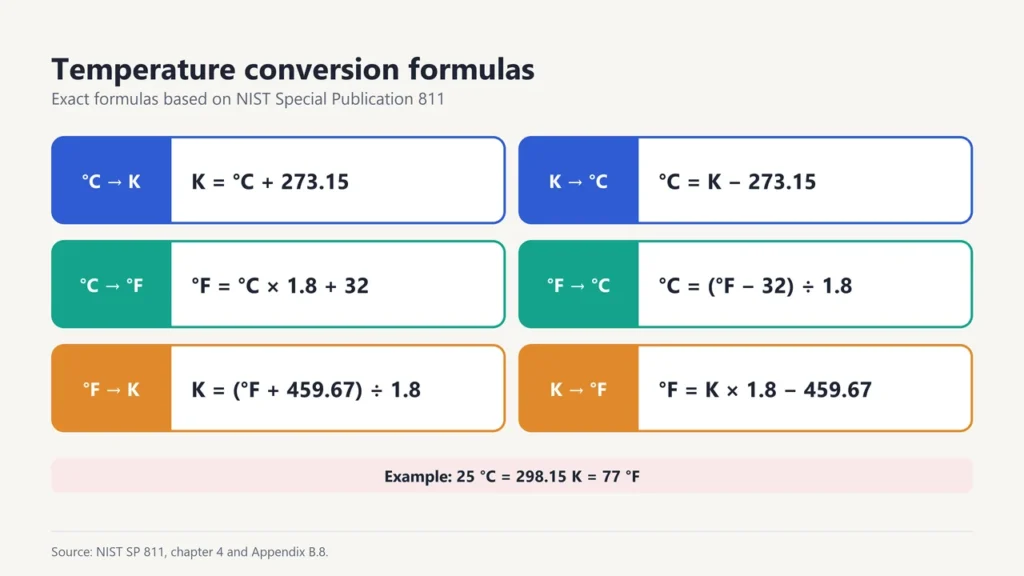
These exact formulas come from, or are rearranged from, NIST Special Publication 811. Multiplying by 1.8 is the same as multiplying by 9/5.
| From | To | Formula |
|---|---|---|
| Celsius | Kelvin | K = °C + 273.15 |
| Kelvin | Celsius | °C = K − 273.15 |
| Celsius | Fahrenheit | °F = °C × 1.8 + 32 |
| Fahrenheit | Celsius | °C = (°F − 32) ÷ 1.8 |
| Fahrenheit | Kelvin | K = (°F + 459.67) ÷ 1.8 |
| Kelvin | Fahrenheit | °F = K × 1.8 − 459.67 |
Worked examples
- 25 °C to kelvin: 25 + 273.15 = 298.15 K.
- 300 K to Celsius: 300 − 273.15 = 26.85 °C.
- 37 °C to Fahrenheit: 37 × 1.8 + 32 = 98.6 °F.
- 68 °F to kelvin: (68 + 459.67) ÷ 1.8 = 293.15 K (that is 20 °C).
- 300 K to Fahrenheit: 300 × 1.8 − 459.67 = 80.33 °F.
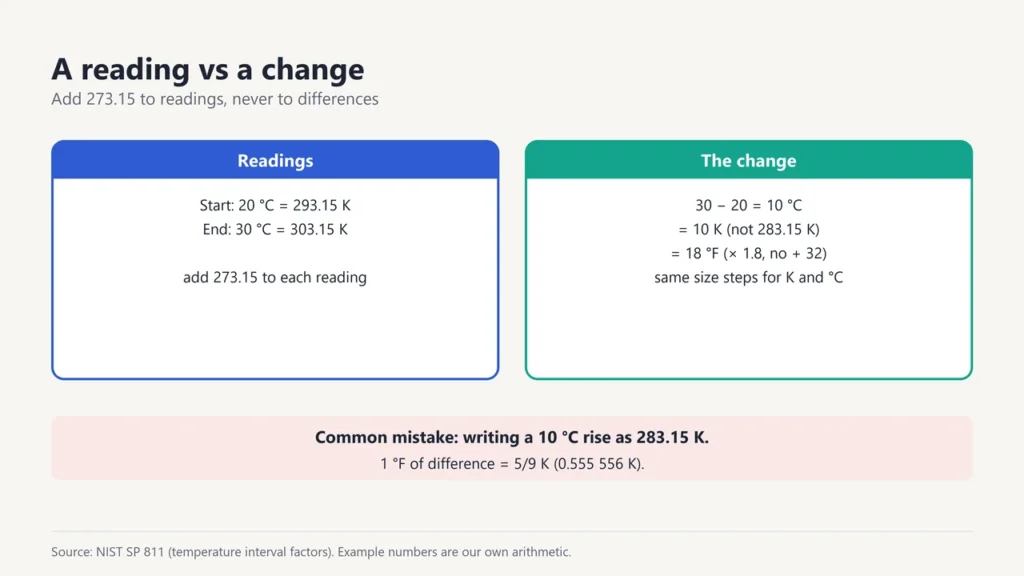
The common mistake: converting a temperature change
A reading and a difference are not converted the same way. If water warms from 20 °C to 30 °C, it rose by 10 °C. That rise is also 10 K, not 283.15 K, because the step size is the same. You only add 273.15 to a reading, never to a difference.
For Fahrenheit, a difference only uses the 1.8 factor, without the 32: a rise of 10 °C is a rise of 18 °F. NIST lists one Fahrenheit degree of difference as 0.555 556 kelvin (5/9).
When to use kelvin, Celsius or Fahrenheit
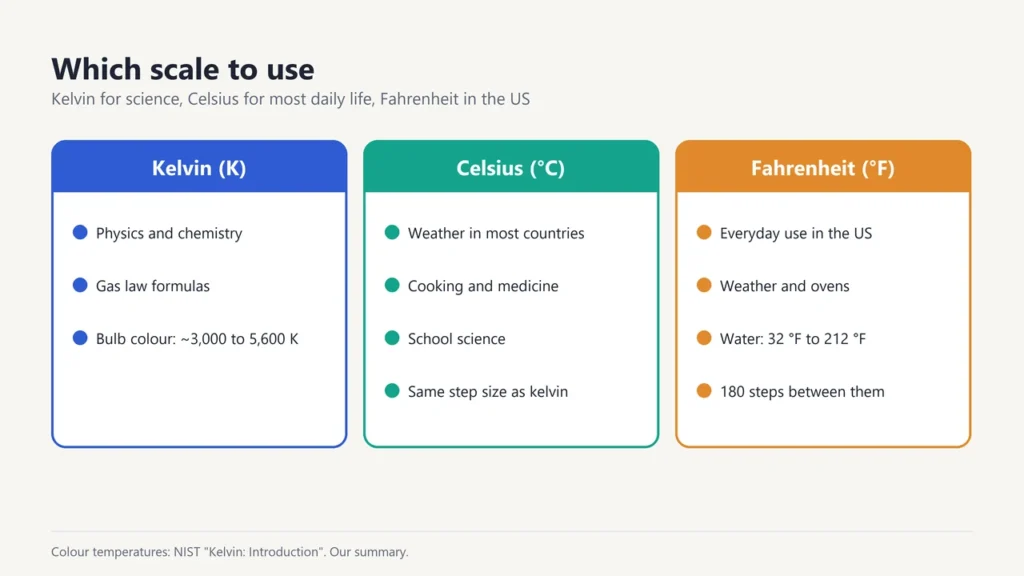
- Kelvin: science and engineering. Formulas such as the gas laws need a scale that starts at absolute zero, so they use kelvin. NIST notes you most often meet kelvin in daily life as the colour temperature of a light bulb: an old incandescent bulb is about 3,000 K, and “daylight” bulbs are about 5,000 to 5,600 K. Try our colour temperature calculator to see what those numbers look like.
- Celsius: weather, cooking and medicine in most countries, and in school science alongside kelvin. Our fridge temperature guide gives food-safety settings in both °C and °F.
- Fahrenheit: everyday use in the United States, such as weather reports and oven settings.
There is also a fourth scale used in some US engineering work: Rankine (°R). Like kelvin, it starts at absolute zero, but it uses Fahrenheit-sized steps. NIST gives the conversion as K = °R ÷ 1.8.
For more on how units and prefixes work, see our guides to metric prefixes and scientific notation, or compare other unit pairs such as acre vs hectare and nautical mile vs mile.
Frequently asked questions
Is kelvin the same as Celsius?
The step size is the same, but the starting point is not. A kelvin reading is always 273.15 higher than the Celsius reading for the same temperature.
Is 0 °C equal to 273 K or 273.15 K?
Exactly 273.15 K. Many school problems round it to 273 K, which is fine for rough answers but not for exact ones.
Can kelvin be negative?
No. 0 K is absolute zero, the lowest temperature possible, so kelvin temperatures are always zero or above. Celsius and Fahrenheit can go below zero.
Is 1 kelvin hotter than 1 degree Celsius?
As a reading, 1 K is much colder: it is −272.15 °C, just above absolute zero, while 1 °C is just above the freezing point of water. As a step size, they are the same: a change of 1 K equals a change of 1 °C.
Why do scientists use kelvin?
Because kelvin starts at absolute zero, a doubled kelvin value means double the thermodynamic temperature. That makes it the right scale for physics and chemistry formulas, and it is the SI base unit.
At what temperature are Celsius and Fahrenheit the same?
At −40. −40 °C is exactly −40 °F, which is 233.15 K.
Is centigrade the same as Celsius?
For everyday use, yes. “Centigrade” is an old name for the same 0-to-100 scale. “Celsius” is the official name used with the SI.

Justwebworld has published guides since 2012. How we write and update articles Report an error
