

Note (October 2026): This list has been updated because several chatbots changed: Babylon Health collapsed in 2023, GYANT was acquired by Fabric in 2024, and the Woebot consumer app was retired on June 30, 2025.
Healthcare chatbots are AI tools that answer health questions, check symptoms, book appointments and route patients to care. Well-known examples include Infermedica, Buoy Health, Sensely, HealthTap and Kommunicate. As of October 2026, several early names have changed: Babylon Health collapsed in 2023, Woebot retired its consumer app in 2025 and GYANT was acquired by Fabric in 2024.
Key Takeaways
- Healthcare chatbots handle symptom checking, triage, appointment booking, medication reminders and FAQs, but they do not replace a clinician’s diagnosis.
- Of the 14 chatbots on this list, Babylon Health no longer operates in its original form, the Woebot consumer app was retired on June 30, 2025, GYANT is now part of Fabric and Sensely is part of Mediktor.
- Some tools here are consumer symptom checkers (Buoy Health, Healthily), while others are platforms that providers use to build their own bots (Kommunicate, BotPenguin).
- In the US, a chatbot that handles protected health information for a provider or health plan falls under HIPAA privacy rules.
The penetration of chatbots in healthcare is burgeoning with time. Healthcare is one of the topmost industries extracting the AI-backed perks of bots. One market research forecast published in the early 2020s projected that the global healthcare chatbots market would reach USD 543.65 million by 2026, at a CAGR of 19.5%.
Today, bots encompass different dimensions of healthcare, from physical to mental, from pharmaceutical to mood tracker – more like a friend who’s always there. Chatbots can also boost patient engagement and take routine questions off clinicians’ and front-desk staff’s workload.
Are you planning to create a healthcare chatbot? We suggest you read a bit about the platforms that can help you develop the best solution.
What are healthcare chatbots?
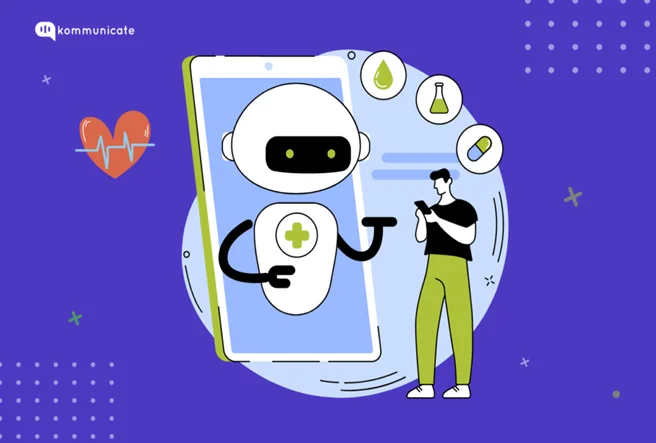
Healthcare chatbots, or medical chatbots, are AI-powered conversational tools that answer patient questions, collect symptoms and route people to the right clinician or service, often before a doctor is involved. From health assessment to constant support, several use cases of healthcare chatbots make them a go-to option for healthcare institutions. Their automation and their ability to handle a queue of patients at once help bridge the gap between users and healthcare providers.
Benefits of chatbots in healthcare
It is no surprise that the emergence of remote medical support has driven more and more customers to tap into the bot and seek advice. Because it is available right on the screen, a chatbot is often preferred for quick, routine questions.
Here are the benefits of chatbots in the healthcare industry:
- 24/7 Availability: Medical emergencies do not wait, and they can be worrisome at times. Outside office hours, a patient can ask a chatbot routine questions at any time; in a medical emergency, people should call their local emergency number rather than rely on a chatbot.
- Easy access to medical assistance: Chatbots give a hand in providing helpful information effectively. Customers can turn to the chatbot and seek instant support when they face any trouble.
- Decoding Symptoms: This one is a great advantage of a healthcare bot. With a large medical knowledge base, a symptom-checker chatbot can suggest possible causes and an urgency level based on the symptoms a patient describes, but it does not replace a diagnosis by a clinician. It saves time and effort for the patient.
List of 14 best healthcare chatbots
Kommunicate
Kommunicate is a customer-service automation platform worth considering if you want to build a feature-packed healthcare chatbot. This easy-to-use AI-enabled platform helps unlock patient engagement and enhance interactions in your institution. Its listed healthcare features include personalized patient interaction, appointment scheduling and support for physical and mental health queries. As of October 2026, Kommunicate describes its product as generative AI chatbots, voice AI agents and AI email ticketing that work across channels such as WhatsApp, Facebook Messenger, Instagram and Telegram, and that hand complex issues to human agents.
BotPenguin
BotPenguin is a no-code chatbot builder that healthcare providers can use to create bots that interact with patients on mobile apps or websites; as of October 2026 it lists healthcare as an industry and offers a hospital appointment template. A bot built on it can respond to common queries and share general health information with users. The software also enables users to follow up with the doctor via texts and features a medical library with relevant information for patients to read.
Izzy
In the guise of a fluffy bird, Izzy is a healthcare bot extending its hand to women who need medical assistance through Facebook Messenger. It was designed to keep track of women’s menstrual health, sexual health, or any pain and to remind them of the medicines to take on time. Izzy’s current availability on Messenger could not be confirmed as of October 2026.
Sensely Inc.
Sensely is one of the best chatbots in healthcare that interacts with users through its avatar Molly. This virtual medical assistant assesses the patient’s symptoms, decodes the issue based on them, and provides medical advice. This healthcare bot uses a triage system to check a case’s urgency and determine if the patient should see a doctor. As of October 2026, Sensely’s website says the company is now part of Mediktor, a symptom-assessment company, and Molly remains one of its avatar personas.
Safedrugbot
Safedrugbot is a chatbot service that assists doctors and health professionals. It offers valuable data to them on the use of drugs. Apart from that, it was described as providing information about alternative medicines and the ingredients present in the medication (Safedrugbot’s current availability could not be confirmed as of October 2026) – simplifying users’ work.
HealthTap, Inc.
HealthTap is one of the best chatbots in healthcare to consider. This platform facilitates the option for patients to identify the problem they are struggling with. The user can submit their question to the bot simply by messaging. The doctors review these questions, analyze the issue, and offer medical guidance. HealthTap’s services have changed over time, so check its current offering before signing up.
Buoy Health, Inc.
Buoy Health is a healthcare bot that allows patients to check their symptoms online or browse through the massive database of Buoy Health. The chatbot asks patients about their medical condition in detail and provides them with the appropriate steps to take next. It helps them figure out the issue with their health. As of October 2026, Buoy Health still offers its online symptom checker.
Babylon Health
Babylon Health was one of the best-known healthcare chatbots, letting patients report and explain the signs of illness to its app. The app checked symptoms against a large database of diseases and then provided advice. Babylon Health no longer operates in its original form: its US business filed for bankruptcy in August 2023, and its UK business entered administration in September 2023, with its assets sold to eMed Healthcare UK for £500,000.
Infermedica SP
Infermedica is yet another option on the list available on smartphones and online. As of October 2026, Infermedica describes itself as a clinical AI triage, patient intake and follow-up provider that has operated in more than 30 countries since 2012 and covers more than 50 languages. This chatbot platform uses machine learning capabilities and helps patients identify their health condition based on the symptoms. It also arranges the diagnosis for them, when needed, and advises them on the next course of action.
Florence
Florence is a healthcare bot that launched on Skype, Messenger, and Kik. Microsoft retired Skype on May 5, 2025, and Florence’s current availability could not be confirmed as of October 2026. It has handy features like reminding patients to take medicines, tracking the user’s health (weight, mood, etc.), and more that allow the user to achieve a healthy lifestyle. The chatbot can also help the user find the nearest pharmacy, making it an option to consider.
GYANT
GYANT is a healthcare chatbot that assesses the patient’s condition based on the symptoms they explain and shares the data with the doctors, who then offer a diagnosis and prescription. The service was originally offered in real time on Alexa or Facebook Messenger. The bot was described as multilingual, with Spanish, German, and Portuguese among its languages. On January 31, 2024, the healthcare operations company Fabric announced it had acquired GYANT, whose conversational AI is now aimed at patient intake, navigation and scheduling for health organizations.
Woebot Labs, Inc.
Woebot was one of the best-known healthcare chatbots dedicated to mental health. It used Cognitive Behavioral Therapy (CBT) techniques to listen to and guide the user. It launched on Facebook Messenger. It was never a therapist, but it served as a support tool for users’ mental well-being. Woebot Health retired its consumer app on June 30, 2025; users could download their conversation history until that date, and the company had already been working with health systems such as Virtua Health and Akron Children’s.
Your. Md
Your.MD is a free chatbot platform that provides helpful health information and guides the patient to the best action. Your.MD is the company behind the Healthily app, which as of October 2026 describes itself as an AI-driven health navigation platform whose symptom assessment covers more than 1,300 symptoms. At its core, the solution checks symptoms using artificial intelligence, and it was originally offered on mobile devices, Facebook Messenger, Slack, and Telegram. It also helps users locate the nearest pharmacies, test labs, and health centers.
Baidu, Inc
Baidu, the Chinese search company, introduced Melody, an AI-enabled conversational bot, on October 11, 2016, as a feature of its Baidu Doctor app for patients who need instant medical support. It assists patients in determining if and when they need to see a doctor, helps them with medical consultation, and offers many other options that save the patient’s time and render an accessible service.
Conclusion
Healthcare chatbots have become a common part of the industry and are changing how patients find health centers and assistance, although several early consumer bots on this list have closed, been acquired or changed focus. If you are planning to create one for your healthcare business, consider the features and options listed in the section and ensure you find the one that caters to your business needs.
Healthcare Chatbot Status at a Glance
The table below summarizes what each chatbot on this list does and its status as of October 2026, based on each company’s own website or news coverage.
| Chatbot | Main use | Status as of October 2026 |
|---|---|---|
| Kommunicate | Platform for building support and patient-engagement bots | Active; offers generative AI chatbots and voice AI agents |
| BotPenguin | No-code chatbot builder | Active; lists healthcare as an industry |
| Izzy | Women’s health tracker on Messenger | Could not be confirmed |
| Sensely | Avatar-based virtual assistant and triage | Active; now part of Mediktor |
| Safedrugbot | Drug information for health professionals | Could not be confirmed |
| HealthTap | Questions answered by doctors | Active; services have changed over time |
| Buoy Health | Online symptom checker | Active |
| Babylon Health | Symptom checker and digital care | US business bankrupt (August 2023); UK business in administration (September 2023) |
| Infermedica | Clinical AI triage and patient intake | Active in more than 30 countries |
| Florence | Medication reminders and health tracking | Could not be confirmed; Skype retired May 5, 2025 |
| GYANT | Conversational care assistant | Acquired by Fabric (announced January 31, 2024) |
| Woebot | CBT-based mental health support | Consumer app retired June 30, 2025 |
| Your.MD (Healthily) | Symptom checker and health information | Active as Healthily |
| Baidu Melody | Medical assistant in the Baidu Doctor app (China) | Introduced October 11, 2016; current status not confirmed |
What Types of Healthcare Chatbots Are There?
Healthcare chatbots fall into a few broad types, and the right one depends on whether the user is a patient or a provider.
- Symptom checkers and triage bots: Buoy Health, Infermedica and Healthily ask structured questions about symptoms and suggest how urgently a person should seek care.
- Virtual assistants with avatars: Sensely’s Molly guides patients through check-ins and triage in a conversational, character-led format.
- Mental health support bots: Woebot used CBT techniques before its consumer app closed; this category raises the strongest safety questions. Read more in our guide to AI and mental wellness.
- Chatbot-building platforms: Kommunicate and BotPenguin let clinics and hospitals build their own bots for appointment booking, FAQs and patient messaging, similar to other AI virtual assistants for business.
- Professional reference bots: Safedrugbot was built to give clinicians drug information rather than to talk to patients.
What Are the Risks of Healthcare Chatbots?
Healthcare chatbots carry real limits that patients and providers should weigh before relying on them.
- Accuracy: A symptom checker suggests possibilities; it cannot examine a patient, and its suggestions can be wrong.
- Emergencies: A chatbot is not an emergency service. Chest pain, breathing difficulty or thoughts of self-harm need an emergency number or crisis line, not a bot.
- Privacy: In the United States, the Health Insurance Portability and Accountability Act (HIPAA), signed into law in 1996, protects identifiable health information held by health plans, healthcare clearinghouses and most providers, and extends to their business associates such as technology vendors. A general consumer app outside that relationship may not be covered. Providers choosing a vendor should also check its infrastructure, as covered in our guide to HIPAA-compliant web hosting.
- Service continuity: As Babylon Health and Woebot show, a chatbot can close or change focus, so check that you can export your data.
- Governance of generative AI: The World Health Organization has published guidance on the ethics and governance of large multi-modal models in health, which applies to newer generative AI chatbots.
How to Choose a Healthcare Chatbot
- Define the job: appointment booking and FAQs need a chatbot builder; symptom triage needs a clinically validated engine.
- Check regulatory status: Infermedica, for example, states that its triage is certified as a Class IIb medical device under the EU Medical Device Regulation, and Healthily describes its assessment as a Class IIa medical device.
- Confirm privacy terms: in the US, ask whether the vendor will sign a HIPAA business associate agreement.
- Check channels: make sure the bot runs where your patients already are, such as your website, WhatsApp or SMS.
- Plan the human handoff: the bot should pass complex or urgent cases to staff with the conversation history.
Chatbots work best alongside virtual visits; see how telehealth is changing healthcare and our tips for preparing for a telehealth appointment.
Frequently Asked Questions
What is the best chatbot in healthcare?
There is no single best healthcare chatbot. For symptom checking, Buoy Health, Infermedica and Healthily are established options as of October 2026; for providers building their own bot, platforms such as Kommunicate and BotPenguin fit better.
Can a healthcare chatbot diagnose me?
No. A healthcare chatbot can suggest possible causes and how urgently to seek care, but only a qualified clinician can make a diagnosis.
Is Woebot still available?
The Woebot consumer app was retired on June 30, 2025. Users could download their conversation history until that date.
What happened to Babylon Health?
Babylon Health’s US business filed for bankruptcy in August 2023, and its UK business entered administration in September 2023, after which its assets were sold to eMed Healthcare UK for £500,000.
Are healthcare chatbots HIPAA compliant?
Some are and some are not. In the US, a chatbot that handles protected health information on behalf of a provider or health plan must meet HIPAA requirements, usually through a business associate agreement; many general consumer apps are not covered.

Justwebworld has published guides since 2012. How we write and update articles Report an error
