

Good board games for kids with autism have clear rules, predictable turns and a definite ending. Simple classics such as Candy Land, Connect 4 and Chutes and Ladders suit younger children; cooperative games such as Race to the Treasure remove the pressure of losing; and Qwirkle, Battle Sheep and No Stress Chess add strategy as skills grow.
Key Takeaways
- Board games give autistic children a structured, predictable way to practise turn-taking, sharing and communication.
- Choose games with clear goals and end points, and match them to the child’s current play stage and interests.
- Cooperative games such as Race to the Treasure remove the stress of a single winner or loser.
- Visual supports, short sessions and stopping when the child is not enjoying it make game time more successful.
- Go Fish on this list is a card game, not a board game, but it builds the same turn-taking skills.
Play is often described as the “work” of childhood: games give children a low-pressure way to make friends, understand how groups behave and practise social skills such as sharing and taking turns.
Many autistic children enjoy board games because a good board game has clear rules, a predictable sequence of turns and a definite ending, which the Australian Government-supported Raising Children Network notes can make play more predictable and manageable for autistic children. Every autistic child is different, so treat the 13 games below as starting points and match them to your child’s age, interests and play skills.
Board Games for Kids – Great for Bonding & New Skills
Chinese Checkers
- A classic, brightly colored race game in which each player moves 10 pegs or marbles across a six-pointed star board; despite the name, it was invented in Germany in 1892 as “Stern-Halma”.
- It involves more decision-making than simple roll-and-move games, which keeps players engaged and focused on their own moves.
- Can be played by two, three, four or six people, so it suits a family or a small group.
- The rules are simple (step to a neighboring hole or jump over pieces), but players must watch their opponents’ moves as well as their own.
- There is no capturing, so no piece is ever “lost”, and each game teaches new jump chains players can reuse.
Battleship
- An incredible methodology game, Battleship urges players to focus on gaining from the mix-ups that they have made before while attempting to sink their adversary’s ships and utilizing that data to shape their new moves.
- Calling shots by grid coordinates (such as B-5) quietly practises letters, numbers and logical thinking.
- Placing the fleet in secret adds a planning step that many children enjoy.
- It is a two-player game, which keeps the social demand to one partner at a time.
- With practice, players develop their own strategy and learn to base each guess on the results of earlier shots.
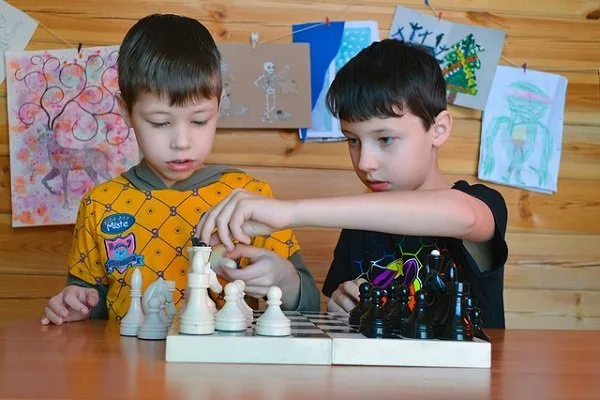
No Stress Chess
- A chess-teaching game from Winning Moves Games for two players aged 7 and up: players draw an illustrated card that tells them which piece to move, which limits the number of choices and lowers the pressure.
- New players quickly learn how each piece moves without feeling that they have no chance of winning.
- Each of the 56 action cards shows a piece and how it moves, which suits children who learn well from pictures.
- Play moves up in levels: at Level Two players hold a hand of three cards and at Level Three a hand of five, so choices grow gradually.
- One side of the board shows the starting setup and two common openings; once players are confident, the board is flipped to a normal chessboard and the cards are put away.
Animal on Animal
- Made by the German toy company HABA, the game is sold as Animal Upon Animal: players roll a die and take turns stacking wooden animals (29 in the standard set) onto a growing pile.
- The animals are solid, brightly painted wooden pieces that are pleasant to handle and look at.
- Balancing the pieces gives steady practice in fine motor control and hand steadiness.
- Players can talk about where the next animal should go, which creates natural chances to communicate.
- It rewards patience and careful planning; HABA lists it for 2 to 4 players aged 4 and up, with games of about 15 minutes.
- When the stack falls, the game simply continues with the next roll, so a mistake has only small consequences.
Candyland
- Candy Land, created by teacher Eleanor Abbott and published by Milton Bradley (now Hasbro) in 1949, is a very simple game: players draw a color card and move to the next space of that color, so no reading is needed.
- Because there are no decisions to make, players never have to worry about making the wrong choice.
- Some cards can send a player backwards on the path, so progress is not guaranteed.
- That makes it a gentle way to practise coping with setbacks and disappointment.
- It is designed for two to four players aged 3 and up, although a child can also simply enjoy drawing color cards and moving a piece alone.
Our Candy Land rules guide explains every step in simple words.
Scrabble
- Players draw random letter tiles (100 in a standard set) and build crossword-style words on a 15 x 15 board for two to four players.
- It can easily be played in teams, which lets a child cooperate with a partner and get help when needed.
- It supports language development, because players spell words and can talk about what the words mean.
- Adding up tile values and bonus squares gives regular practice in basic arithmetic.
- Players must wait patiently while others plan their words, which practises turn-taking.
Qwirkle
- Qwirkle, designed by Susan McKinley Ross and published by MindWare in 2006, is competitive but slower-paced than many games on this list; it won Germany’s Spiel des Jahres award in 2011.
- Scoring is part of the game, but it can be set aside while a child is still learning the matching rules and the social side of play.
- Its 108 wooden tiles combine six colors and six shapes, which appeals to children who like sorting and matching.
- It practises spatial thinking and pattern matching, since every line must share one color or one shape.
- Scoring involves simple counting, so number skills are practised without obvious math drills.
- The chunky tiles are easy to handle; Qwirkle is listed for two to four players aged 6 and up, with games of 30 to 45 minutes.
Blue Orange Battle Sheep
- Battle Sheep, designed by Francesco Rotta and published by Blue Orange Games, is an abstract strategy game that plays quickly and is easy to understand.
- It suits two to four players and is listed for ages 7 and up; the board is built from four hexagonal sections, so the layout changes every game.
- Each player starts with a stack of 16 sheep tokens, which are easy to hold and satisfying to split and move.
- The game introduces strategy and forward thinking without a high-pressure atmosphere.
- Splitting and sliding the stacks also gives fine motor practice.
- Players need to watch each other and wait for their turns, which encourages social play.
- The winner is the player whose sheep cover the most spaces when nobody can move, which suits children who enjoy planning their own strategies.
Ticket to Ride: First Journey
- Ticket to Ride: First Journey is the 2016 children’s version of Alan R. Moon’s train game, published by Days of Wonder; turns follow a predictable pattern but still leave room for a simple plan.
- Games take about 15 to 30 minutes and the game is listed for ages 6 and up.
- Simplified rules make it easier for players of all abilities to understand.
- It is designed for two to four players, and new players can play in a team with an adult while they learn.
- Its map uses shorter routes than the original game, and the first player to complete six tickets wins the Golden Ticket.
- Players learn to cope when another player claims a route they wanted.
Race to the Treasure
- Race to the Treasure from Peaceable Kingdom is a cooperative game, which makes it a good introduction for children who are not yet ready for competitive games.
- Players work together to build a path, collect three keys and reach the treasure before the Ogre, but still take turns, which helps teach patience.
- The illustrations and the Ogre theme are playful rather than frightening for most children; the game is listed for two to four players aged 5 and up, with games of about 20 minutes.
- The board and cards are made of sturdy card stock that stands up to regular play.
- Everyone wins or loses together, so there is no single loser at the end of the game.
Chutes and Ladders
- Chutes and Ladders is the version of the ancient Indian game Snakes and Ladders that Milton Bradley has published since 1943, and it is a simple way to practise waiting for a turn.
- Movement is quick, which helps keep players from getting bored.
- Little is at stake: sliding down a chute is part of the fun rather than a punishment.
- Because movement is decided by chance, there is no strategic move to get wrong.
- The game shows in a gentle way that results can go up or down, and practises handling both calmly.
Our Chutes and Ladders rules guide explains every step in simple words.
Connect 4
- Connect 4, sold by Milton Bradley since 1974, is a two-player game, so it is ideal for one-on-one play.
- Players drop discs into a 7-column, 6-row grid to make a line of four, which teaches simple strategy in a low-stress setting.
- Games are quick, so a new one can start straight away with almost no setup.
- The discs are easy to grip and drop, which is useful fine motor practice.
- The bright colors help hold the player’s attention.
- Other editions exist with different colors and piece designs, which can help if a child finds bright colors overstimulating.
Go Fish
- Go Fish is a card game rather than a board game, played with a standard 52-card deck or a children’s picture deck; large children’s cards are easier for small hands.
- It teaches players to wait while others ask for and hand over cards.
- Players collect “books” of four cards of the same rank, which practises sorting and matching.
- On each turn a player asks a named person for a rank; if that person has none, they say “Go fish” and the asker draws from the pile, which builds direct, simple communication.
- The rules are clear and the game unfolds the same way every time, which suits children who prefer predictability.
- Players benefit from remembering which ranks other players asked for, so they can ask for those cards later.
Board Games for Autistic Kids Compared
The table below summarizes the 13 games using the player counts, ages and play times published by their makers or listed in standard references, as of October 2026. Where no age was verified, the table says so; check the box of the edition you buy.
| Game | Type | Players | Listed age | Play time | Best for |
|---|---|---|---|---|---|
| Chinese Checkers | Race and strategy | 2, 3, 4 or 6 | Varies by edition | Varies | Planning moves, small groups |
| Battleship | Guessing and logic | 2 | Varies by edition | Varies | Coordinates, one-on-one play |
| No Stress Chess | Chess teaching game | 2 | 7+ | Varies | Learning chess step by step |
| Animal Upon Animal | Stacking and dexterity | 2 to 4 | 4+ | About 15 minutes | Fine motor skills, short sessions |
| Candy Land | Color matching, no reading | 2 to 4 | 3+ | Short | First board game, coping with setbacks |
| Scrabble | Word building | 2 to 4 | Varies by edition | Varies | Language and spelling |
| Qwirkle | Tile matching | 2 to 4 | 6+ | 30 to 45 minutes | Pattern matching, calm play |
| Battle Sheep | Abstract strategy | 2 to 4 | 7+ | About 15 minutes | Strategy without pressure |
| Ticket to Ride: First Journey | Route building | 2 to 4 | 6+ | 15 to 30 minutes | Simple planning, maps |
| Race to the Treasure | Cooperative | 2 to 4 | 5+ | About 20 minutes | Children not ready to compete |
| Chutes and Ladders | Luck-based race | 2 or more | Varies by edition | Short | Waiting for a turn |
| Connect 4 | Abstract strategy | 2 | Varies by edition | A few minutes | Quick one-on-one games |
| Go Fish | Card game | About 2 to 5 | Varies by deck | Short | Asking questions, matching |
How Do You Choose a Board Game for a Child with Autism?
The best board game for an autistic child is one with a clear goal and a clear end point that matches the child’s current play skills. The Raising Children Network, which is supported by the Australian Government, lists board games, jigsaws and matching games among the structured activities that work well because they tell children what to do and when.
- Start with the child’s interests. A child who loves trains may engage more with Ticket to Ride: First Journey; a child who loves animals may prefer Animal Upon Animal or Battle Sheep.
- Match the play stage. A child who is still learning to take turns may do better with Candy Land or Chutes and Ladders, where there are no decisions, before moving to strategy games such as Qwirkle or No Stress Chess.
- Use strengths. Children who respond well to pictures often do well with color and shape games such as Candy Land and Qwirkle.
- Consider sensory needs. Look at piece size, colors and noise; some games, such as Connect 4, come in several editions with different colors and pieces.
- Think about losing. If losing causes distress, a cooperative game such as Race to the Treasure, where everyone wins or loses together, is a gentler start.
How to Make Game Time Work: Step by Step
- Choose one game with a clear end point and set it up before inviting the child to play.
- Make a simple visual support: show each step of the game with objects, pictures or words, and tick off or remove each cue as you go so the child can see what comes next, as the Raising Children Network suggests.
- Keep the first sessions short and talk only as much as you need to.
- Watch whether the child is enjoying the game; if not, take a break and try something else later.
- Reduce your support gradually as the child learns the steps, then add new games or longer sessions.
Why Board Games Can Help Autistic Children
Autism spectrum disorder (ASD) is a developmental condition that affects communication, social interaction and behavior. According to the US Centers for Disease Control and Prevention (CDC), about 1 in 31 children aged 8 (3.2%) had been identified with ASD by the CDC’s Autism and Developmental Disabilities Monitoring (ADDM) Network for the 2022 surveillance year, the newest estimate the CDC lists as of October 2026, and ASD was more than three times as common among boys as among girls.
Structured play such as board games can help autistic children practise sharing, taking turns, seeing other people’s points of view and interacting with others, and it can also build fine motor and communication skills, according to the Raising Children Network. Board games are a play activity, not a therapy; for advice about a specific child, speak to the child’s doctor, therapist or teacher.
More Board Game Guides
For more ideas, see the board games guide by type, theme and group, these board games that help with math, board games with words for language practice, board games with spinners for younger players, and board games like Ticket to Ride for children ready for the next step.
Frequently Asked Questions
What is the best first board game for a young autistic child?
Candy Land is a common first board game because it needs no reading and no decisions: players draw a color card and move to the next space of that color. It is listed for two to four players aged 3 and up.
Are cooperative games better for kids with autism?
Cooperative games can be a good starting point for children who find losing upsetting, because all players win or lose together. Race to the Treasure from Peaceable Kingdom is one example, listed for two to four players aged 5 and up.
How can I teach an autistic child to take turns in a board game?
Turn-taking is easier to learn in games with a clear, repeating structure, such as rolling a die or drawing a card. Visual supports that show each step, short sessions and gradually reducing adult help can make turn-taking more predictable.
Which board games help with fine motor skills?
Animal Upon Animal (stacking wooden animals), Connect 4 (dropping discs into a grid) and Battle Sheep (splitting and sliding stacks of sheep tokens) all involve handling small pieces, which gives regular fine motor practice.
Can older autistic kids learn chess?
Yes. No Stress Chess from Winning Moves Games is designed to teach chess to players aged 7 and up by using illustrated cards that tell players which piece to move, before they flip the board and play regular chess.

Justwebworld has published guides since 2012. How we write and update articles Report an error
